


Games With AI: How Artificial Intelligence Is Transforming Modern Gaming

Artificial intelligence has become one of the driving forces of modern entertainment, and nowhere is that more visible than in games with AI. As a long‑time gamer, I’ve watched NPCs evolve from simple on‑rails bots into companions that respond, learn, and even converse.
Today, AI touches nearly every aspect of game development, from procedural world building to dynamic difficulty adjustment. This article breaks down what AI does in gaming, highlights the games pushing boundaries, and offers a look at where these innovations might lead.
Jump to:
Why Games With AI Are Changing the Industry
Games with AI are reshaping expectations because they make virtual worlds more adaptive, immersive, and personal. Traditional AI in gaming was limited to scripted routines, but modern titles often use neural networks, behavior trees, and machine learning to create believable characters and unpredictable scenarios.
For example, non‑player characters (NPCs) now act as companions, merchants, or quest‑givers, and their realism has improved dramatically thanks to AI techniques that allow them to react to players in real time. Large technology companies and indie studios alike are experimenting with generative systems that produce quests, dialogue, and even entire levels on the fly.
Many developers see AI as a tool that can augment creative work. It helps studios design complex systems without manually scripting every scenario. At the same time, there is spirited debate over whether generative models risk replacing human creativity. For gamers, the immediate benefit is richer interactions and worlds that feel less like pre‑programmed amusement parks and more like living environments.
Types of AI Used in Modern Video Games
The term “AI” covers a range of techniques. Different genres rely on distinct methods, but they all serve the same goal: to give the game enough intelligence to create an engaging experience.
Rule‑Based AI and Finite State Machines
Many classic titles use rule‑based systems that follow simple if‑then instructions. Finite state machines are a common structure; NPCs switch between states (patrolling, chasing, attacking) based on triggers. This method is predictable and lightweight, making it ideal for early shooters and platformers. It’s still used in mobile games or simpler indie projects where performance is critical.
Pathfinding Algorithms
A fundamental problem for any game agent is finding a route from point A to point B. Pathfinding algorithms like A* search help enemies navigate complex maps. In real‑time strategy games, pathfinding ensures that armies move efficiently, avoiding obstacles and adjusting when the player builds new structures. Even open‑world titles rely on these algorithms for vehicles, animals, and pedestrians.
Behavior Trees and Utility Systems
More sophisticated games use behavior trees or utility systems to prioritize actions. Behavior trees break decisions into nodes that an agent evaluates in order; if one fails, the agent moves to the next. Utility systems assign numerical scores to possible actions, then pick the highest‑scoring option. These techniques allow AI characters to make nuanced choices – ducking for cover when hurt, flanking the player, or searching for health pickups.
Machine Learning and Neural Networks
Machine learning changed the game by enabling AI agents to learn from data rather than just following scripts. Deep learning models analyze game states and select actions based on predicted outcomes. Reinforcement learning uses rewards and punishments to train agents; for example, bots can teach themselves to play complex strategy games or drive in racing simulations.
Machine learning also powers features like dynamic difficulty, which adjusts the challenge based on player performance. According to research on machine learning in gaming, this technology is used for non‑player character control, procedural content generation, and deep learning‑based content generation. It’s one reason certain games feel more responsive as you improve.
Small and Large Language Models (SMLs & LLMs)
Narrative games with AI often employ language models to generate dialogue and internal monologues. Small language models (SMLs) like SmartJoy in inZoi are streamlined and efficient, enabling life‑sim characters to plan their days, reflect on events, and adapt to new situations. Large language models (LLMs) can produce more diverse conversations but require more computational power. The choice between SML and LLM depends on whether a developer needs speed or sophistication. These models are also appearing in experimental projects that let players converse with NPCs using natural language.
AI‑Powered Game Mechanics and Procedural Generation
One of the most exciting aspects of games with AI is how they create worlds and mechanics that respond to players. NPCs are no longer static quest dispensers; they are integral to storytelling. They convey lore, react to your choices, and even change tactics during combat. When I played an open‑world RPG recently, I noticed that shopkeepers remember if I stole from them, and companions comment on my decisions. That level of interactivity makes the world feel alive.
Procedural generation is another area where AI shines. Instead of handcrafting every level, developers use algorithms to generate landscapes, dungeons, and side quests. Early examples relied on random number generation, but AI‑driven approaches can learn from existing content to produce more coherent environments. Machine learning assists in creating levels for platformers or roguelikes by analyzing what makes a map fun and then producing similar layouts.
AI also improves visual fidelity through techniques like AI upscaling and animation. Some engines use neural networks to predict motion, resulting in smoother animations. Pathfinding combined with physics helps creatures navigate uneven terrain naturally. These improvements may seem subtle, but they accumulate into a polished experience.
For researchers, games provide a testing ground for AI algorithms. Hao AI Lab recently tested LLMs in Super Mario levels and measured how far they progressed. Such experiments offer insight into how advanced agents handle dynamic environments.
Noteworthy Games With AI
Several titles exemplify how AI enhances storytelling and gameplay. Here are a few that stand out:
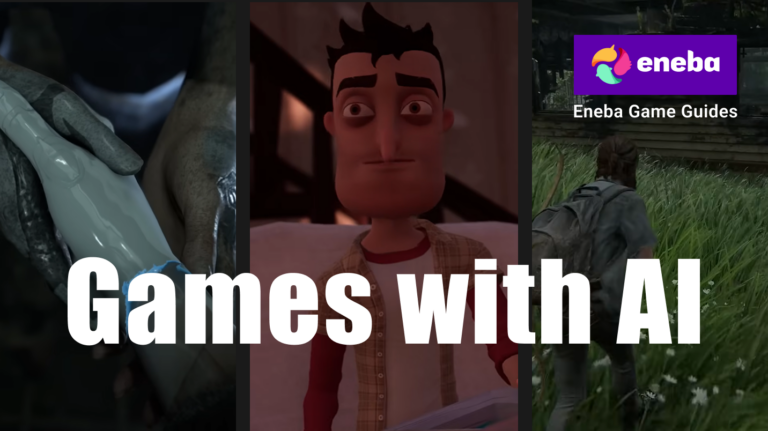
- Detroit: Become Human – Games like Detroit: Become Human generally imagine a future where androids strive for autonomy. The game uses branching storylines and a choice‑based system, making each decision ripple through the narrative. Characters track your choices, and subtle shifts in their behavior create a personal experience.

- Hello Neighbor – In this stealth horror game, the antagonist learns from your actions. If you repeatedly use a window to enter the house, the AI will board it up next time. The adaptive behavior keeps you guessing and heightens tension.

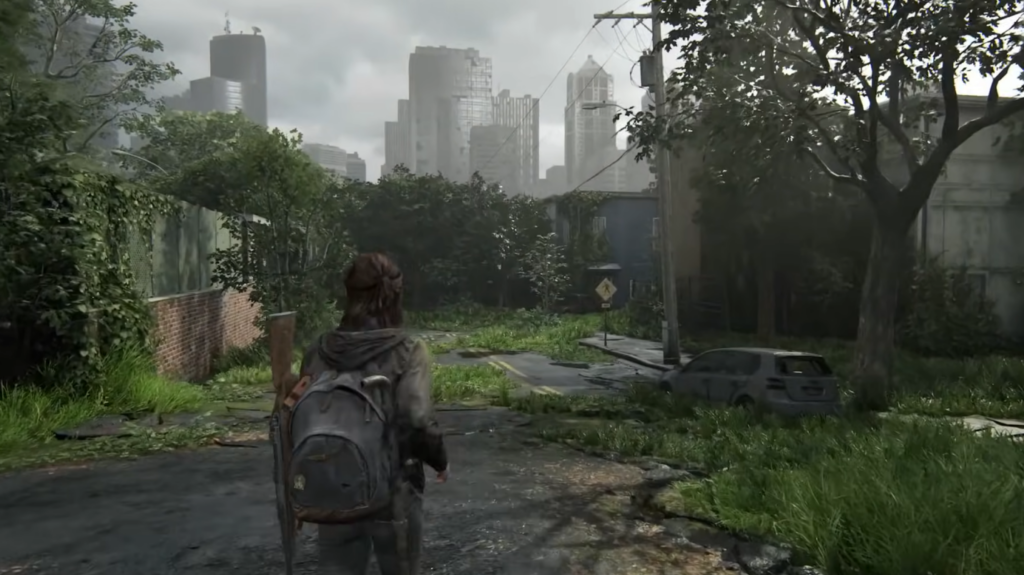
- The Last of Us Part II – Companion AI and enemy squads coordinate tactically, flanking players and calling out positions. Allies like Dina provide cover fire and call for help when surrounded. Such behaviors stem from behavior trees and utility systems.
- Civilization Series – Turn‑based strategy games rely heavily on AI. Opponents use a mix of rule‑based systems and heuristics to expand, negotiate, or wage war. With each new entry, developers tweak the AI to present a fair challenge without blatant cheating. Even so, the community often debates whether the computer “knows too much,” a reminder that balancing AI intelligence and fun is tricky.
- Procedural Roguelikes – Games like No Man’s Sky or Dead Cells use procedural generation to build vast universes or unique levels. AI algorithms ensure that environments make sense and provide the right balance of challenge and reward.
These examples show that games with AI are not limited to one genre. From story‑driven adventures to competitive strategy, AI enriches player experience across the board.
Benefits and Challenges of Integrating AI in Games
The benefits of AI in gaming are clear: it offers more realistic interactions, reduces development time, and helps developers test and balance their games. Key advantages include generating in‑game content, detecting and preventing cheating, automating testing, enhancing visuals, and analyzing player data. For players, that means varied quests, fairer matchmaking, and fewer bugs.
AI also helps address cheating in multiplayer games. By analyzing player behavior and looking for anomalies, machine learning models can spot cheaters faster than human moderators. Developers can then adjust their anti‑cheat tools to block new exploits.
However, there are challenges. Generative AI may produce content that lacks the human touch. Over‑reliance on AI might strip games of the quirks and handcrafted charm that make them memorable. There are also ethical concerns, including data privacy, algorithmic bias, and addiction. NPCs that adapt too well can frustrate players by becoming too unpredictable or difficult. Balancing realism and fun is an ongoing challenge.
Another issue is computational cost. Advanced AI models need significant processing power, which can strain resources, especially in open‑world games where multiple NPCs operate simultaneously. Developers must allocate resources carefully to avoid performance drops. Finally, the more dynamic and adaptive AI becomes, the harder it is to test thoroughly; emergent behaviors can lead to unexpected bugs.
The Future of Games With AI
Looking ahead, games with AI will likely grow even more immersive. Research labs are building agents that not only play games but design them. Procedural generation will evolve to produce quests and narratives tailored to each player, and language models will enable conversations with NPCs that feel natural.
We may also see generative AI produce art assets, soundscapes, and voice performances. NVIDIA’s ACE suite, for example, showcases tools for generating characters and animations. While such innovations reduce workloads, they also raise questions about originality and compensation for artists. Meanwhile, AI benchmarking projects like the Super Mario tests aim to measure and improve the capabilities of AI agents. These benchmarks will push developers to create smarter, more adaptable systems.
As AI becomes more ubiquitous, transparency will be essential. Players should know when they are interacting with an AI and how their data is being used. Ethical guidelines and industry standards will help ensure that AI enhances games without exploiting users. Ultimately, I believe the future of gaming lies in collaboration: AI will handle repetitive tasks and generate possibilities, while human designers infuse games with heart and meaning.
A New Horizon for AI in Gaming
Artificial intelligence has evolved from basic pathfinding to generative systems that can build worlds, characters, and stories. Games with AI offer richer interactions, more varied content, and endless replay value. At the same time, they challenge developers to balance creativity with efficiency and to navigate new ethical dilemmas. The journey is just beginning, and as a gamer, I’m excited to see how AI will shape the next generation of experiences.
If you’re curious about exploring an AI‑themed title yourself, grab our Detroit: Become Human Steam key. This cinematic adventure immerses you in a future where androids struggle for identity, and your choices shape the outcome. It’s a powerful example of how interactive storytelling and artificial intelligence can combine to create an unforgettable game world.
FAQs
What are AI games?
AI games are video games that use artificial intelligence techniques to control non‑player characters or generate content. These techniques allow the game to adapt to player actions, create dynamic environments, and offer more immersive experiences.
How is AI used in games?
AI is used in games to simulate intelligent behavior. It controls NPCs, generates levels or quests, balances difficulty, enhances graphics through upscaling, and helps detect cheating. AI also supports procedural generation and dynamic storytelling.
Which game has the best AI?
There isn’t a single “best” AI, but some titles are known for impressive implementations. Games like Hello Neighbor use adaptive AI that learns from your actions, while The Last of Us Part II features companions and enemies that coordinate in believable ways. Strategy games like Civilization also offer notable AI opponents.
Can AI create a video game?
Yes, AI can assist in creating video games by generating levels, quests, dialogue, and even coding assistance. Developers use procedural generation and machine learning to speed up design. However, human oversight remains essential to ensure quality and creativity.
What is the future of AI in gaming?
The future of AI in gaming promises more personalized and dynamic experiences. We’ll see smarter NPCs, natural language conversations, and generative worlds tailored to individual players. Ethical considerations and transparent use of data will play a key role as AI becomes more integrated into game design.