



How We Test: Eneba Hub’s Product Reviews
We know how overwhelming it can be to pick new gear or games when there are so many choices. That’s why our editorial team is committed to providing accurate, unbiased, and reliable product reviews.
We draw on decades of experience as journalists and gamers, and we use that knowledge to guide you towards making informed decisions about gaming gear and accessories that truly meet your needs. Even though we sometimes include affiliate links to support our work, our editorial content remains independent. Our goal is to give you honest insights that will help you make the best decision for your setup.
What Makes Our Testing Unique?
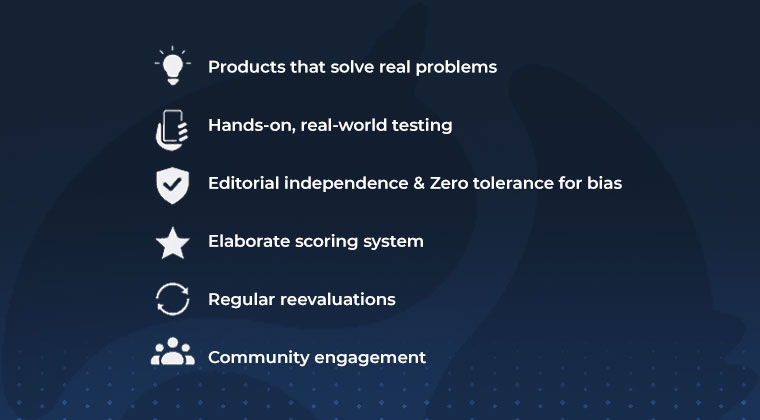
We make sure our process is thorough, fair, and completely transparent. Many lists simply recycle product specs, but we take a different approach. When selecting and testing products, we listen to the gaming community and talk with experienced players to understand real‑world performance. We study how hardware and accessories perform in actual gaming sessions, from fast‑paced shooters to sprawling RPGs.
Our team members have decades of combined experience, which allows us to spot genuine innovations and call out marketing fluff. We also read technical documentation, monitor driver updates, and, where necessary, speak with developers.
Our commitment is to give you unbiased opinions based on real testing, not corporate messaging. We summarized our method in a simple infographic that illustrates the principles behind our evaluations: independence, a diverse expert team, real‑world testing, and transparency. This focus on the needs of gamers sets our reviews apart.
Visuals: A simple infographic summarizing the key principles of your testing process (independence, expert team, real-world testing, etc.)
Meet the Eneba Hub Reviewers
Our reviews are created by people who live and breathe games and tech.
You can learn more about our wider team on our About Us page.
How We Select Products for Review
We choose products based on what matters most to our readers. If a game, PC component, or accessory is generating any buzz among gamers and tech enthusiasts, we take note. We look for items that solve real problems such as lag, long load times, and uncomfortable controls. Relevance, value, innovation, and user interest drive our selection.
We do not promise to cover every product, and no company can buy a review. Even when we link to retailers or earn a small commission, our recommendations remain independent.
We also pay attention to community feedback and emerging trends, so if our readers ask us to test a new headset or graphics card, we listen. Our aim is to focus on products that offer meaningful improvements or outstanding value, and to let you know when something does not live up to its promise.
How We Evaluate Products
Testing products means more than reading spec sheets. We set up each device and use it the way you would at home. For gaming PCs and laptops, we check how quickly they boot, how well they handle demanding games, and how stable they are during long sessions. We run benchmarks that measure processor speed, graphics performance, and storage throughput, and we observe whether those numbers translate into smoother gameplay.
We pay attention to heat, noise, and energy use, because performance should not come at the cost of comfort or a sky‑high electricity bill. For accessories like controllers, mics, and headsets, we check comfort over hours of play and how easy it is to set them up. We listen for microphone clarity, evaluate latency, and test cross‑platform compatibility. We also consider design and build quality, including materials, durability, and ergonomics.
When evaluating products, our writers often compare multiple models side by side across different platforms to spot subtle differences in performance and usability. We document our findings with photos and videos so you can see the products in action, and we keep detailed notes that inform our recommendations.
Visuals: Photos or videos of testers using the products in real-world conditions
How We Test PCs, Laptops, and Their Key Components
We run a series of performance tests to understand how each PC or laptop handles today’s games and apps. Processor tests measure single‑core and multi‑core performance, while graphics tests track frame rates and rendering smoothness. We also check storage by measuring boot times and file‑transfer speeds. Battery life is tested through everyday tasks and gaming sessions to see how long a laptop lasts.
When necessary, we try mild overclocking to see how much extra performance a system can safely deliver. Temperature and noise are monitored because cool, quiet machines improve the gaming experience.
To see examples of our work for this particular category, make sure to explore some of the following articles on our website:
- 11 Best CPUs for Gaming That Are Worth Every Penny
- 11 Best GPUs for Gaming in 2025: Power, Performance, and Value
- 5 Best HP Gaming Laptops That Totally Rule in 2025
- 11 Best Gaming Laptops in 2025: Most Powerful Options
- 9 Best Lenovo Laptops in 2025: Excellent Value Options
Each review explains our tests and shows how the hardware performs in real games.
How We Test Peripherals
Comfort and usability are key when we evaluate controllers, keyboards, mice, and headsets. Our testers use each peripheral in real games for many hours and note how it feels during fast action, strategy, and casual play. We test button responsiveness, stick tension, and trigger travel on controllers. For keyboards and mice, we measure input latency and check whether software allows easy customization.
When reviewing headsets, we try models across PC, console, and mobile devices and rate them on sound quality, microphone clarity, durability, and fit. In our headset guides, our writers explain that they have tried multiple models across platforms and selected them based on sound performance, comfort, microphone clarity, and durability.
We also consider practical details such as battery life, charging time, wireless range, and ease of setup. If a peripheral claims to provide advanced features like noise cancellation or haptic feedback, we verify how well those features work in practice.
To see our method in action, check out our roundups:
- 8 Best Turtle Beach Headsets Explained: What Makes Them Great in 2025?
- 8 Best Razer Headsets: Your Ultimate Guide for 2025
- 7 Best Budget Gaming Headsets Worth Buying in 2025
Evaluation Criteria: What We Look For
Our scoring rubric focuses on four core pillars: performance, usability, design and build quality, and value for money.
Performance looks at how well a product does its main job. For hardware, we measure frame rates, load times, and stability in demanding games. For accessories, we look at responsiveness, audio fidelity, and battery life. We use synthetic benchmarks alongside real‑world testing and consult experienced gamers for context.
Usability examines how easy it is to set up and operate the product. We pay attention to software, driver installation, and how seamlessly the item integrates into existing setups. Clear instructions, intuitive controls, and reliable connectivity all count towards a higher score.
Design & Build Quality covers comfort, materials, and durability. We consider whether a laptop stays cool and quiet, whether a controller feels good in the hands of different sizes, or whether a headset’s ear cushions remain comfortable after long sessions.
Value for Money assesses the relationship between price and performance. We compare products with similar features to judge whether a higher price is justified or a cheaper option offers better overall value.
Our reviews often include comparison tables and graphs that illustrate differences in performance, which help you see how each product stacks up.
Visuals: Performance comparison graphs, star ratings, or scores for each evaluation criterion.
Example for Lenovo Legion Pro 7i Gen 9
| Attributes | Rating | Notes |
|---|---|---|
| Design | 9/10 | The matte black chassis (Eclipse Black) is premium and sturdy, with minimal flex and a clean port layout, though quite heavy (~2.8 kg / 6.17 lb), so sleek but not ultra-portable. |
| Display | 10/10 | Brilliant 16″ QHD+ (2560×1600), 240 Hz IPS panel with ~108 % DCI-P3, ~456–473 nits brightness, HDR support. Immersive and color-rich. |
| Performance | 10/10 | Exceptional gaming and productivity power with Core i9-14900HX + RTX 4080/4090, hitting top benchmark scores and smooth gameplay, even with ray tracing and DLSS. Thermal performance is strong. |
| Camera | 6/10 | 1080p webcam is serviceable, color-accurate, but not standout. Adequate for video calls only. |
| Battery | 5/10 | A 99.99 Wh battery promises 5–6 hours, but real-world tests show only ~4h 29m of web usage; gaming drains it in under an hour. Some users report even shorter times. |
| Value | 9/10 | Priced high (~$3k+), but delivers exceptional performance-to-price for top-end gaming. It’s also often discounted, which improves value. |
Turtle Beach Stealth 700 Gen 3 Example
| Attributes | Rating | Notes |
| Design | 9/10 | Premium over-ear build with a steel-reinforced headband, lay-flat design, and glasses-friendly memory foam cushions. Slightly heavier than some rivals at 408 g, but still well-balanced for long sessions. |
| Display | 10/10 | 60 mm Eclipse Dual Drivers deliver deep bass, crisp highs, and excellent positional accuracy. DTS Headphone X spatial audio and Superhuman Hearing mode enhance immersion and competitive awareness. |
| Performance | 9/10 | Plush memory foam ear cushions remain cool during long use; lightweight feel despite robust construction. Very comfortable even with glasses. |
| Camera | 8/10 | Flip-to-mute mic with AI noise reduction offers clear, natural voice pickup. Great for gaming and casual streaming, though not on par with dedicated studio mics. |
| Battery | 9/10 | Up to 80 hours of use with quick-charge support. While non-swappable, battery life far exceeds most competitors and lasts days without recharging. |
| Value | 9/10 | At ~$200, it’s competitively priced for premium sound, build, and features. Multi-platform compatibility (PC, console, mobile) adds long-term value. |
The Scoring System: How We Rate Products
We use a straightforward rating scale that runs from one to ten stars. Each star level corresponds to a clear set of benchmarks, which makes it easy to see how a product performs at a glance.
A low score means the product has significant shortcomings in performance, usability, design, or value. A high score signals that it excels across most criteria and is a strong recommendation for gamers.
Our Rating System
Our ten‑point scale is designed to capture nuance without confusing readers. We pair each score with a short explanation to make our reasoning transparent.
| Score Range | Description |
| 1-3 | Serious problems such as poor performance, unstable software, or fragile construction. |
| 4-5 | Average product that works but does not stand out. |
| 6-7 | Performs well in some areas but has minor drawbacks. |
| 8 | Very good product, worth considering for most gamers. |
| 9-10 | Outstanding product with top-tier performance, excellent usability, thoughtful design, and great value for money. |
How We Assign Scores
When assigning scores, we start with our testing results and our evaluation criteria. For example, a headset that delivers crisp audio, a comfortable fit, and long battery life but has a complicated setup might score seven or eight.
A budget GPU that offers strong frame rates and energy efficiency relative to its price could earn an eight or nine. A premium laptop that combines blazing performance, efficient cooling, long battery life, and a fair price might receive a nine or ten.
Products that fail in key areas, such as a controller with high input lag or a laptop that overheats, will receive lower scores.
Visuals: A visual scale showing the rating system (1 to 10 stars, with descriptions for each).
Transparency in Testing
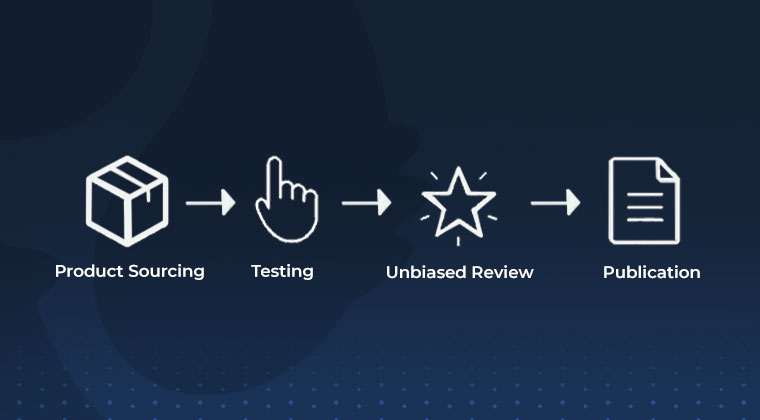
We believe in providing you with honest, unbiased reviews, and we make sure that our methods are clear every step of the way. Our commitment to transparency means you’ll always know how we source products, how we test them, and how we ensure that our opinions remain independent. We take extra care to disclose any potential conflicts of interest to maintain your trust in our reviews.
Zero Bias Tolerance Policy
We are committed to absolute impartiality. Our editorial team operates separately from advertising and sales teams, and our opinions cannot be bought. As our About Us page outlines, the editorial news team takes pride in being independent. When we include affiliate links, they help support our platform but do not influence our recommendations.
If we ever receive products from manufacturers, we disclose that information. Our writers are free to point out flaws or recommend alternatives, and no external party reviews our articles before publication. When potential conflicts of interest arise, we acknowledge them to maintain trust with our readers.
Visuals: A flowchart or diagram showing how the testing process ensures transparency (product sourcing → testing → unbiased review → publication).
How We Handle Affiliate Links
Affiliate links allow us to earn a small commission when you buy through our recommendations, at no extra cost to you. These commissions support our work and enable us to continue testing products. However, we only include links to products or services we genuinely find relevant and valuable. The affiliate disclosure page explains that our editorial content remains unbiased and is not influenced by affiliate partnerships.
Our recommendations are based on research, expert opinions, and user experience, regardless of any commission. You can trust that our reviews reflect honest assessments.
How We Handle Product Updates and Revisions
Technology moves fast, and we want our reviews to stay current. When a product receives a significant firmware or driver update, or when a new model replaces an old one, we revisit our review. We retest where needed, update performance charts, and adjust scores if improvements or regressions change our conclusions.
For instance, if a graphics card receives a driver update that boosts performance or fixes stability issues, we will rerun our benchmarks to provide accurate data. When a new version of a laptop or headset is released, we compare it with the previous model and update our recommendations. Our goal is to ensure that every review you read reflects the product’s current state and provides relevant advice.
We Value Your Feedback
Community input is vital to our process. Our Contact us page encourages readers to share ideas, feedback on articles, and suggestions for products to cover. We read comments and messages to understand which products interest you and what problems you face. If you tell us that a certain keyboard has a common issue, we will investigate.
Your insights help us refine our tests, highlight new products, and stay aware of trends. We also invite you to reach out through social media or our feedback form if you have questions or need clarification.
As the contact page states, Eneba is “your trusted source on all things gaming”; we take that promise seriously by listening to our community and improving our work based on what you share.
Why You Can Trust Us
Trust is earned through consistent, honest, and thorough work. Our team’s independence and experience are at the heart of our credibility. We cover the gaming industry with the goal of providing insightful features and thought‑provoking pieces, and we apply the same rigor to our product reviews.
Each review is based on hands‑on testing, real‑world use, and careful analysis. We tackle the problems gamers face, such as lag, long load times, and uncomfortable gear, and we work to find solutions that make your experience better. We speak with experienced players and test multiple models to ensure that our recommendations reflect what actually works.
Affiliate links support our site, but they never shape our conclusions. We update our reviews as products evolve, and we welcome feedback from our readers. That openness and commitment to accuracy are why you can trust our reviews. We strive to be your go‑to resource for gaming gear and tech advice, and we take that responsibility seriously.