

Best Credit Cards for Beginners in 2026



The Discover it Secured Cash Back Credit Card tops our list of the best credit cards for beginners, with a refundable deposit as low as $49, no credit score required to apply, and cash back while you build credit. Among secured options, it’s our best secured credit card and a strong credit card for no credit history, while Capital One Quicksilver Secured, Chase Freedom Rise, Petal 2, and Capital One Platinum cover simpler rewards or no-deposit alternatives.
Whether you’re choosing a first credit card, looking for the best starter credit card or best credit card to build credit, the five picks below make the trade-offs easier.
We checked issuer terms on August 24, 2026. Rates, offers, and eligibility can change, so confirm the live details before applying.
Jump to:
What Is a Credit Card?
Before choosing among the best credit cards for beginners, it helps to understand what a credit card actually does. Think of it as a reusable line of credit: you spend up to your approved limit, then repay what you owe. Pay the balance in full by the due date and you can generally avoid purchase interest; carry a balance, and interest may apply.
Unlike a debit card, a credit card also reports your account activity to the credit bureaus, helping you build a credit history over time.
For anyone getting a first credit card, the big choice is often secured vs unsecured credit card. Secured cards require a refundable deposit, while unsecured cards rely on factors such as credit history, income, or alternative underwriting. That’s why some unsecured cards may still be available as a credit card for no credit history.
Best Credit Cards for Beginners: The Top 5 Compared
Here is how the best credit cards for beginners compare at a glance. Each row shows the annual fee, the standout intro perk, and who the card suits best, so you can shortlist fast and jump to the full review below.
| Rank | Card | Best For | Annual Fee | Intro Perk |
|---|---|---|---|---|
| 1 | Discover it Secured Cash Back | Lowest deposit plus rewards | $0 | First-year Cashback Match |
| 2 | Capital One Quicksilver Secured | Flat 1.5% cash back | $0 | None |
| 3 | Chase Freedom Rise | Students and new-to-credit | $0 | 3% dining for 6 months + $25 autopay credit |
| 4 | Petal 2 Cash Back, No Fees | No deposit and soft-pull pre-approval | $0 | None |
| 5 | Capital One Platinum | Easiest no-frills approval | $0 | None |
None of these five pays a traditional cash sign-up bonus, which is normal for beginner and secured cards. Where there is a real intro perk instead, like Discover‘s first-year Cashback Match or Chase‘s $25 autopay statement credit, it is listed above in place of a bonus.
The Best Credit Cards for Beginners, Reviewed
Below is the full breakdown of each card, with the verified fee, APR, deposit, credit requirement, and who it fits. Two are secured cards that take a refundable deposit, and three are unsecured starter cards that do not. Start with our top pick, Discover it Secured Cash Back.
1. Discover it® Secured Cash Back Credit Card: Best Overall
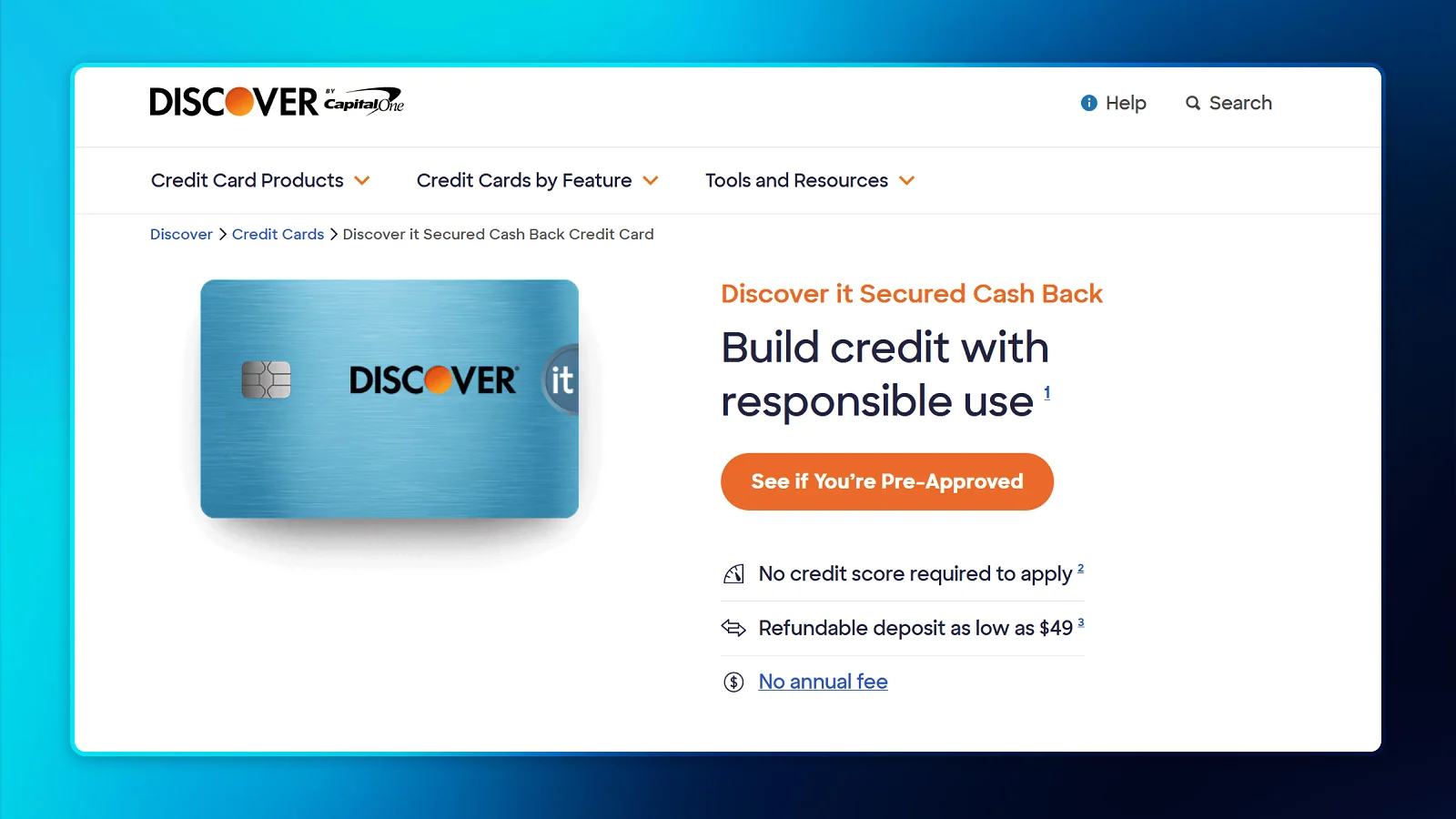
The Discover it Secured Cash Back Credit Card is the best credit card for beginners overall because it has the lowest required deposit of the two secured cards here, as low as $49, requires no credit score to apply, and still pays real cash back while you build credit.
| Account detail | Information |
|---|---|
| Annual fee | $0 |
| APR | 28.24% variable |
| Deposit | Refundable, from $49 (or $99/$200 by profile) |
| Credit needed | None required to apply |
| Rewards | 5% rotating categories plus 1% on everything |
| Best for | Lowest deposit plus real rewards |
Discover sets the lowest bar to entry here. Your refundable deposit can be as low as $49, rather than the usual $200, depending on your profile, and it unlocks a credit line starting at $200. No credit score is required to apply, though Discover notes it may use one if available.
You earn 5% cash back in rotating quarterly categories after activation, up to the quarterly cap, plus 1% on everything else, and Discover‘s first-year Cashback Match doubles all the cash back you earn in year one, with no cap on the match amount, which out-earns every flat-rate card here. Because it needs no credit score at all, it also works well as a credit card for no credit history.
Discover is now a Capital One brand, and the product page reflects that. With responsible use, Discover returns the deposit and moves eligible cardholders to the unsecured Discover it Cash Back Credit Card. Once you’re ready for an unsecured rewards card, compare the best credit cards for cashback for stronger long-term cash-back options.
As of August 24, 2026, Discover lists a $0 annual fee and 28.24% variable APR; confirm the live terms before applying.

See how Discover it Secured Cash Back compares with Capital One Quicksilver Secured in the head-to-head section below.
2. Capital One Quicksilver Secured Cash Rewards: Best Flat Cash Back
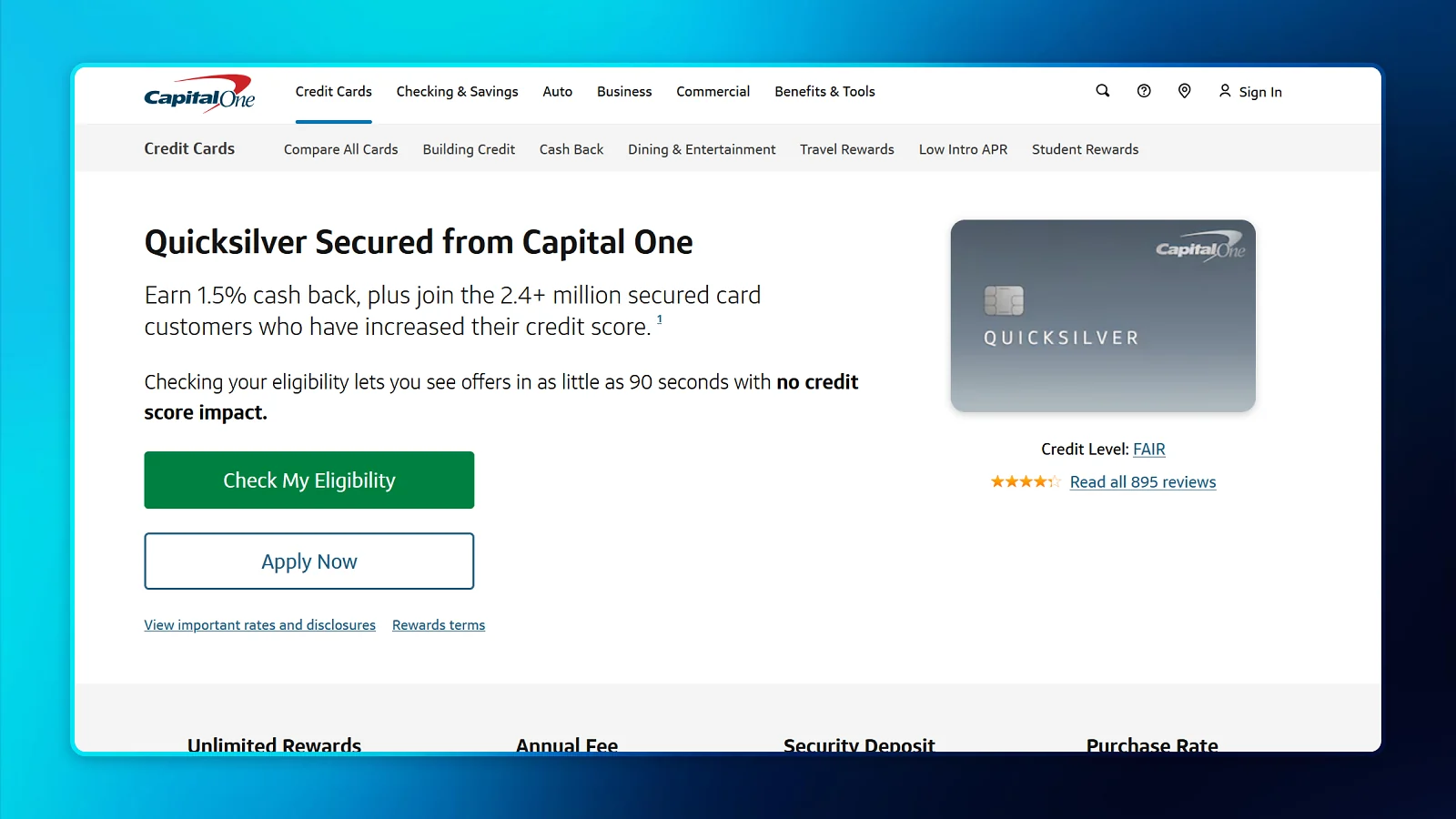
Capital One Quicksilver Secured is the best pick for a simple flat cash-back rate with nothing to track, paying an unlimited 1.5% on every purchase while you build credit.
| Account detail | Information |
|---|---|
| Annual fee | $0 |
| APR | 28.99% variable |
| Deposit | $200 minimum, refundable |
| Credit needed | Fair |
| Rewards | 1.5% flat on everything |
| On-site rating | 4.3/5 (895 reviews) |
Where Discover uses rotating categories, Quicksilver Secured keeps it simple: an unlimited 1.5% cash back on every purchase, no activation, no calendar to track. The refundable deposit is $200, which sets your credit line, and there is no annual fee. Capital One lists the target credit level as Fair, and with responsible use it reviews your account to return the deposit and move you to an unsecured card.
Quicksilver Secured comes with a relatively high 28.99% variable APR, which makes paying the balance in full especially important if you want the 1.5% cash back to remain worthwhile.
User feedback on Capital One’s product page is positive overall: the card holds a 4.3 out of 5 rating across 895 reviews, and 85% of reviewers say they would recommend it. That score is specific to Quicksilver Secured and should be viewed separately from broader reviews of Capital One as a company.

See how Quicksilver Secured compares with Discover it Secured Cash Back in the head-to-head section below.
3. Chase Freedom Rise® Credit Card: Best for Students and New-to-Credit

Chase Freedom Rise is the best fully unsecured starter card for students and people new to credit, and it has the lowest APR floor in this set.
| Account detail | Information |
|---|---|
| Annual fee | $0 |
| APR | 18.24% to 27.74% variable |
| Deposit | None (unsecured) |
| Credit needed | New to credit or student |
| Rewards | 1.5% flat on 1.5% cash back; 3% total on dining for the first 6 months, up to $6,000 in dining spendeverything |
| Best for | Students, new-to-credit applicants |
Freedom Rise is Chase‘s on-ramp for first-time cardholders, marketed for people new to credit and students. There is no security deposit or annual fee, and its APR is 18.24% to 27.74% variable. You earn 1.5% cash back on purchases, plus a limited-time 3% total cash back on dining, including takeout and eligible delivery, on up to $6,000 spent in the first six months. You can also earn a $25 statement credit by enrolling in autopay within the first three months and staying enrolled for at least 90 days.
Chase notes that keeping at least $250 in a linked Chase checking or savings account improves your approval odds. Cardholders who make all payments on time and use Freedom Rise within 12 months can be automatically upgraded to Chase Freedom Unlimited, Chase‘s rewards card, which is a clear built-in path off a beginner card.
Chase does not post a card-level rating, and its company-wide Trustpilot score is 1.3 out of 5 across 2,726 reviews, which reflects the bank broadly, not this card.
If you’re currently studying, compare it with our best credit cards for students to see whether a dedicated student card offers stronger rewards.

4. Petal® 2 “Cash Back, No Fees” Visa®: Best No-Deposit Pre-Approval Option
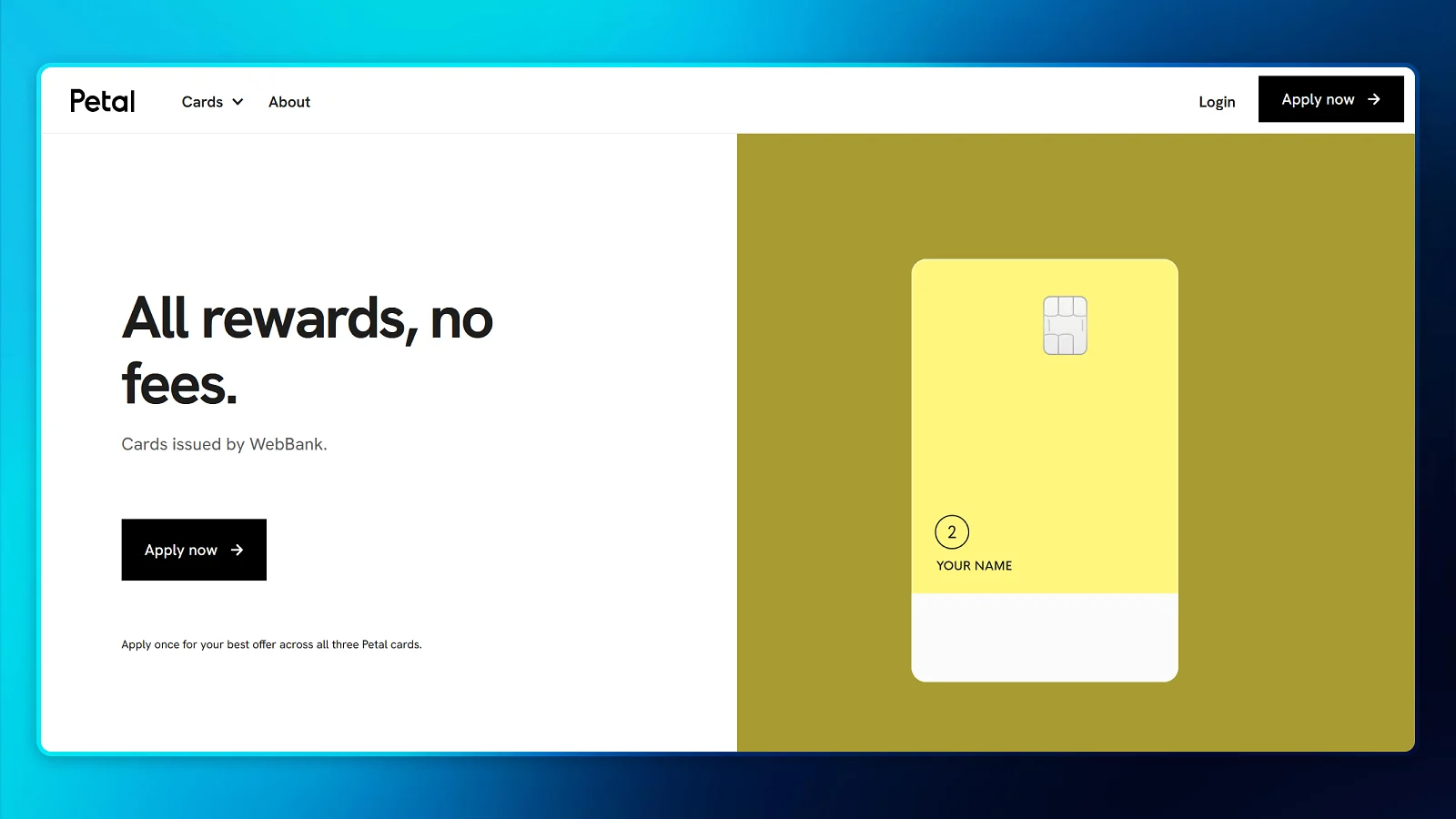
Petal 2 is an unsecured card with no security deposit and a pre-approval process that does not affect your credit score; if you move forward with a full application, Petal performs a hard inquiry.
| Account detail | Information |
|---|---|
| Annual fee | $0 |
| APR | 28.24% to 30.24% variable (as of Jan 5, 2026) |
| Deposit | None (unsecured) |
| Credit needed | Soft-pull pre-approval; hard inquiry on full application |
| Rewards | 1% to 1.5%, up to 10% at select merchants |
| Best for | No deposit and soft-pull pre-approval |
Petal 2 lets you check for pre-approval with a soft pull and no security deposit. If you are pre-approved and submit a full application, Petal performs a hard inquiry, and approval still depends on creditworthiness and other eligibility criteria. Eligible applicants may also be asked to link a bank account so Petal can evaluate cash-flow data. The card charges no annual fee and earns 1% to 1.5% cash back on eligible everyday purchases, with additional offers available at select merchants.
Two notes. Petal‘s own page dates its 28.24% to 30.24% variable APR range as accurate as of January 5, 2026, and it was still the figure shown when we checked directly on August 24, 2026. And you may see older reviews mentioning an $8 monthly fee introduced after Petal‘s acquisition by Empower; the current product page shows no fees for new applicants, so do not treat that old complaint as a live cost without checking. Petal shows curated testimonials rather than an aggregate star rating.

5. Capital One Platinum Credit Card: Best No-Frills Approval
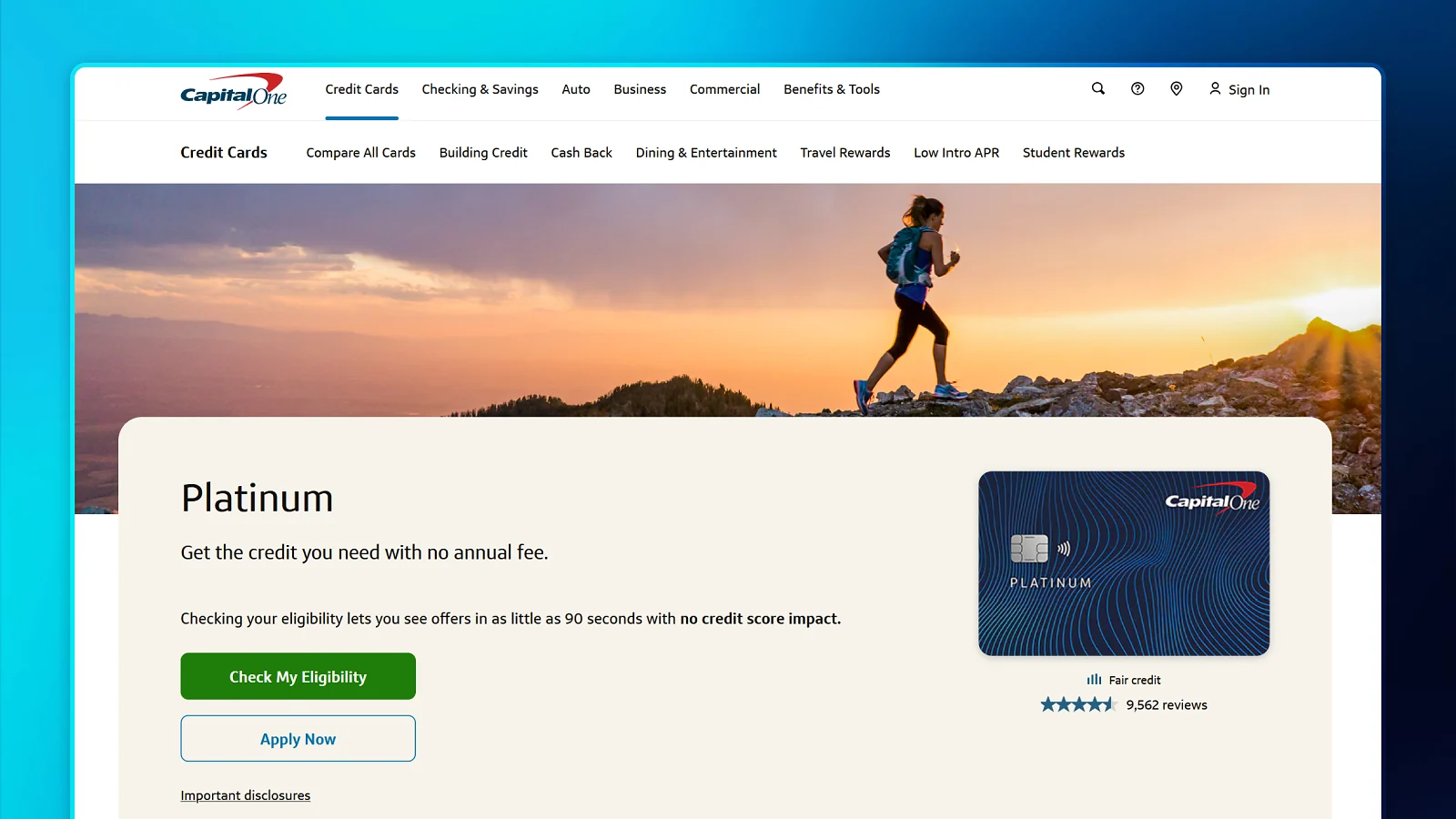
Capital One Platinum is the best pick for the simplest possible unsecured card for fair or limited credit, with no deposit and the highest on-site rating in this set.
| Account detail | Information |
|---|---|
| Annual fee | $0 |
| APR | 28.99% variable |
| Deposit | None (unsecured) |
| Credit needed | Fair |
| Rewards | None |
| On-site rating | 4.5/5 (9,562 reviews) |
Platinum is the plainest card here, and that is the point. There is no deposit, no annual fee, and no rewards program to manage, just a straightforward unsecured card aimed at the Fair credit tier that reports to the bureaus and reviews your account for a credit-line increase with responsible use. Its 28.99% variable APR matches Quicksilver Secured‘s.
On trust, it stands out: a 4.5 out of 5 rating from 9,562 reviews on Capital One‘s own product page, with 91% of reviewers recommending it, the highest on-site score among the cards in this comparison. J.D. Power’s 2025 U.S. Credit Card Satisfaction Study also ranked Capital One Platinum first for customer satisfaction among bank cards without rewards or an annual fee, for the second year running.
Keep in mind that the 4.5 rating is Capital One‘s own product-page widget, not an independent third-party score, and is separate from the company-wide 1.3 out of 5 on Trustpilot.
Discover it Secured Cash Back vs. Capital One Quicksilver Secured
The two secured cards here make the most useful head-to-head for a beginner deciding how to put down a deposit. Discover it Secured Cash Back beats Capital One Quicksilver Secured for most beginners on deposit size and reward value, mainly on its $49 minimum deposit versus $200, and a first-year Cashback Match that can double whatever a new cardholder earns.
Quicksilver Secured still wins on simplicity, a flat 1.5% cash back with no rotating categories to track and a clearly stated 4.3 out of 5 on-site rating, so it is the better pick if you would rather not activate quarterly bonus categories.
| Feature | Discover it Secured Cash Back | Capital One Quicksilver Secured |
|---|---|---|
| Minimum deposit | $49 | $200 |
| Annual fee | $0 | $0 |
| Rewards | 5% rotating plus 1% | 1.5% flat |
| Year-one perk | Cashback Match | None |
| Credit needed | None to apply | Fair |
| On-site rating | Not shown | 4.3/5 (895 reviews) |
Pick Quicksilver Secured if you want a flat rate with nothing to activate, and Discover it Secured Cash Back if you want the lowest deposit and the most rewards.
Editor’s Pick
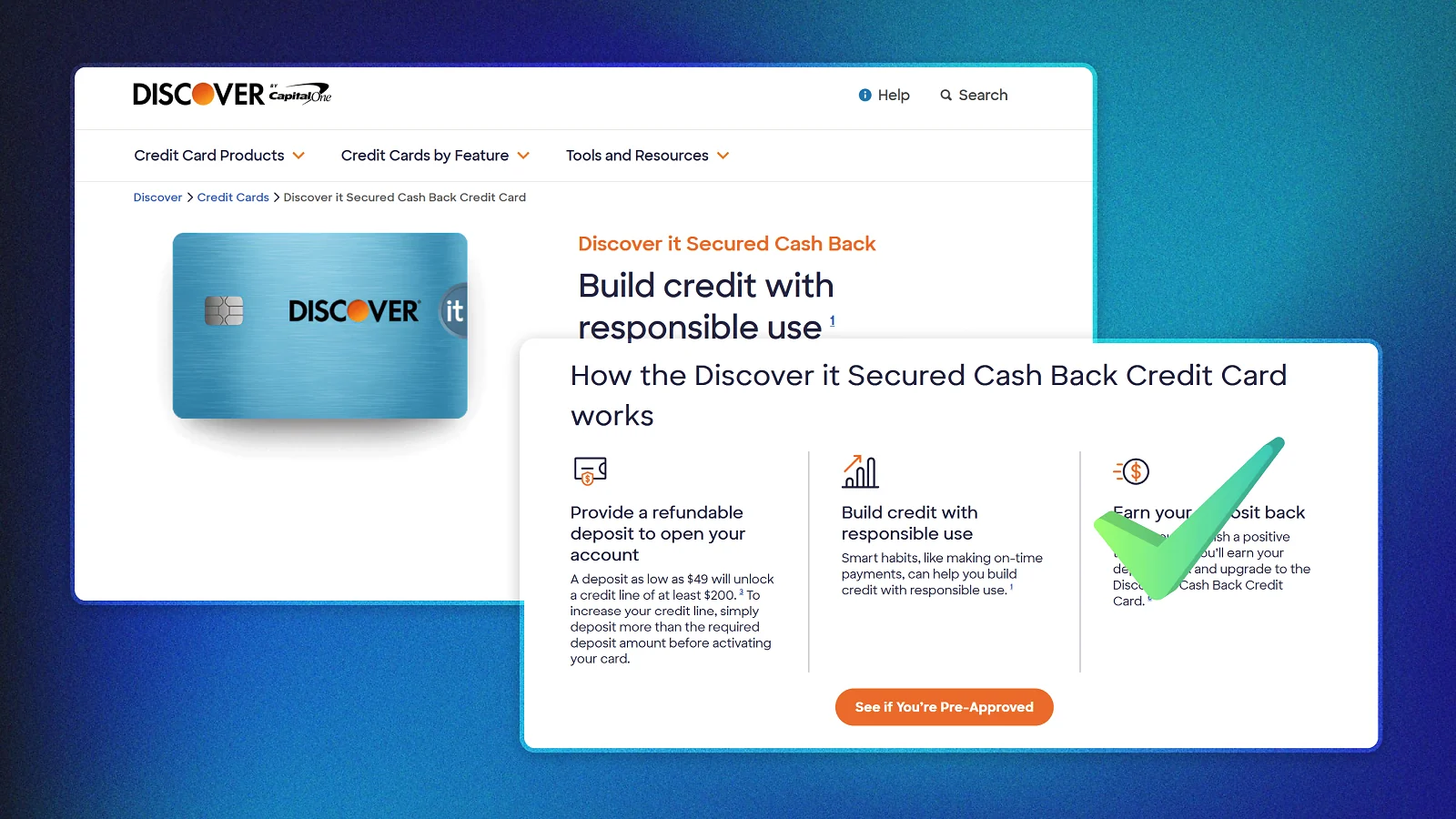
Editor’s Pick: Discover it® Secured Cash Back Credit Card. Chosen for the lowest required deposit among the secured cards in this set, as low as $49 versus $200 for Quicksilver Secured, no credit score required to apply, and an unlimited first-year Cashback Match.
Skip it if you want to avoid rotating bonus categories or a deposit altogether, where Capital One Quicksilver Secured or Petal 2 are the better fit.
How Much Can Carrying a Balance Cost You?
Here is the number that matters most for a beginner. Carrying just a $200 balance on a starter card at roughly 28% variable APR, the rough midpoint of the five confirmed rates here, costs about $56 in interest over a year, which more than wipes out a year of flat-rate cash back for a modest spender. The table scales that across three balances.
| Balance carried for a year | Approx. interest at ~28% APR |
|---|---|
| $200 | ~$56 |
| $500 | ~$140 |
| $1,000 | ~$280 |
Paying the statement balance in full every month avoids that interest entirely, while still reporting the same on-time payment history to the credit bureaus, which is what actually moves a beginner’s credit score. These are simple illustrations at a flat 28% APR; each issuer’s real APR varies from 18.24% to 30.24%, so use your card’s rate as shown on the issuer’s page.
How to Apply for Your First Credit Card
Applying for a beginner credit card like Discover it Secured Cash Back takes about 5 to 10 minutes online, and secured cards usually do not require an existing credit score.
- Complete the online application with your basic ID and SSN or ITIN.
- For a secured card, submit the refundable deposit (as low as $49 for Discover it Secured, $200 for Quicksilver Secured) to set your credit line; unsecured picks like Chase Freedom Rise, Petal 2, and Capital One Platinum skip this step.
- Get a decision, often instant, sometimes a few business days for a manual review.
- Activate the card, make a first purchase, and set up autopay from day one to avoid a missed payment.
Choosing the Best Credit Card for You
The single biggest factor in finding the best credit card to build credit is whether you can put down a deposit at all, and after that, how much you want to earn while doing it. If the secured vs unsecured credit card question is still open for you, start with the deposit, since that decides which of the five picks below even applies to you.
- If you have no credit history and want the lowest deposit: Discover it Secured Cash Back, a $49 minimum with no credit score required.
- If you would rather put down no deposit and want to check eligibility without affecting your score: Petal 2, which uses a soft pull for pre-approval; a full application triggers a hard inquiry.
- If you are a student or completely new to credit: Chase Freedom Rise, marketed for exactly that.
- If you want the simplest flat cash-back rate while building credit: Capital One Quicksilver Secured, at 1.5% with a $200 deposit.
- If you just want the easiest approval with nothing to manage: Capital One Platinum, unsecured, aimed at Fair credit.
Eligibility varies by issuer. Discover it Secured requires applicants to be at least 18 and have a Social Security number, U.S. address, and U.S. bank account. Chase Freedom Rise asks for identifying information including an SSN and/or ITIN and a mailing address, while Capital One says Quicksilver Secured and Platinum may be available to applicants using an ITIN. Petal applies its own U.S. address, identity, and creditworthiness requirements. Check each issuer’s live application requirements before applying.
How We Rate Credit Cards
We score every credit card on four things, and fee-to-rewards value carries the most weight, since finding the best credit card to build credit means weighing what a deposit or fee costs against what it earns back. The ranking is not arbitrary: we pull each fee, APR, and deposit directly from the issuer’s official page, then weight the cards on the criteria below.
- Fee-to-rewards value (40%): what a low or zero deposit and fee buy back in real rewards and credit-building power.
- Fees and transparency (25%): APR range, deposit terms, and how clearly they are disclosed.
- Eligibility (20%): how accessible the card is to a thin or no-credit file.
- Support and reviews (15%): issuer support and independent ratings like Trustpilot.
We re-verify every fee, APR, and deposit quarterly, and sooner when an issuer’s page changes.
Final Verdict
For most first-time applicants, the Discover it Secured Cash Back Credit Card is the best credit card for beginners right now. It asks for the lowest required deposit among the secured options here, as low as $49, requires no credit score to apply, and its first-year Cashback Match out-earns every flat-rate card on this list while you build credit.
Capital One Quicksilver Secured is the runner-up for a simple flat rate, Chase Freedom Rise suits students and the new-to-credit, Petal 2 skips both a deposit and a credit check, and Capital One Platinum is the easiest no-frills approval. Check the live fee and APR on the issuer’s page before you apply, then set up autopay from day one.
FAQs
Among the best credit cards for beginners, Discover it Secured Cash Back ranks first, with a refundable deposit as low as $49, no credit score required to apply, and cash-back rewards. Capital One Quicksilver Secured is the flat-rate runner-up.
For most beginners, Discover it Secured Cash Back is the best secured credit card, with a deposit as low as $49 and unlimited first-year Cashback Match. Capital One Quicksilver Secured is a strong alternative if you prefer flat 1.5% cash back.
If a deposit is not an option, Petal 2 is a strong best starter credit card choice because you can check pre-approval without affecting your credit score. A full application does trigger a hard inquiry. Chase Freedom Rise is another unsecured option aimed specifically at students and people new to credit.
It varies. Discover it Secured Cash Back and Petal 2 do not require an existing credit score for your first credit card, Capital One‘s Quicksilver Secured and Platinum target the Fair credit tier, and Chase Freedom Rise is marketed directly at readers with no credit history.
A secured card requires a refundable security deposit, while an unsecured card does not. This secured vs unsecured credit card choice mainly comes down to eligibility, deposit requirements, and the card’s terms and rewards.
Yes. Discover it Secured Cash Back requires no credit score to apply, Petal 2 offers soft-pull pre-approval, and Chase Freedom Rise is designed for people new to credit. For the best credit card to build credit, Discover it Secured Cash Back is our top pick for its low deposit and cash-back rewards.