


Best Banks for Youth Savings Accounts in 2026



Disclaimer
This guide is for general information only and is not financial advice. All APYs, fees, and eligibility terms were verified on each provider’s official page on July 29, 2026 and are variable, so they can change at any time. Two of the highest rates are capped to a starter balance (Spectrum and BECU), and Spectrum specifically requires eStatement enrollment within 60 days of opening to keep its boosted rate, so confirm the live terms directly with each provider before opening. Bank deposits are FDIC-insured and credit-union deposits are NCUA-insured up to $250,000 per depositor, per institution.
Alliant Credit Union Teen Checking tops our list of the best banks for youth savings accounts, with a bundled High-Rate Savings account paying 3.01% APY and no monthly fee. Unlike Spectrum at 7.00% on the first $1,000 and BECU at 5.12% on the first $500, Alliant has no upper balance cap on its rate once the $100 balance requirement is met. Capital One Kids Savings is another simple option at 2.50%.
For families comparing the best banks for youth savings accounts, that range gives you both uncapped and starter-balance options, while a teen bank account bundle can add everyday spending features.
Whether you need a teen bank account, youth bank account, or the best bank account for teenager savings, we compare the rates, limits, and membership rules that matter most. Rates were verified on official provider pages on July 29, 2026 and can change, so check the current APY before opening.
Jump to:
What Is a Youth Savings Account?
A youth savings account is an interest-bearing deposit account for a teenager, opened jointly with, or held in custody by, a parent or legal guardian until the teen reaches an age where the account converts or they can manage it alone.
It earns real, bank-set interest that is FDIC or NCUA insured. That is what sets it apart from fintech apps like Greenlight, Copper, or Step. Greenlight and Step use reward-based savings features rather than traditional bank-set interest, while Copper discontinued its deposit accounts and debit cards in 2024. For parents comparing the best bank account for teenager savings goals, this is usually the core product to look for, especially if the goal is a savings account for teenager use rather than spending.
Some parents simply search for a savings account for teenager use without knowing the exact product category. If that is you, a youth savings account is the specific type to compare, since it earns real, insured interest rather than a parent-funded or rewards-style rate.
A custodial account under a UTMA or UGMA setup is another route once balances grow. That makes a youth bank account with a real APY easier to compare across the best banks for youth savings accounts.
Best Banks for Youth Savings Accounts: The Top 4 Compared
Here is how the top four banks for youth savings accounts compare at a glance, whether you are shopping for a youth bank account or a bundled teen checking account. Each row shows the headline APY, the opening minimum, and who the account suits best, so a parent or teen can shortlist fast and jump to the full review below.
A teen bank account can combine spending and saving, while a savings account for teenager use keeps the focus on earning interest.
| Rank | Provider | Best For | APY | Min. Deposit / Membership Cost |
|---|---|---|---|---|
| 1 | Alliant Credit Union Teen Checking | Highest uncapped rate (bundled savings) | 3.01% | $5 to keep open; $100 average to earn APY |
| 2 | Spectrum CU MySavings Youth | Highest rate on a starter balance | 7.00% (first $1,000) | $25 membership share |
| 3 | BECU Early Saver | Easy nationwide membership | 5.12% (first $500) | $0 in person; $10 online |
| 4 | Capital One Kids Savings Account | No membership, no age cutoff | 2.50% | $0 |
None of these four pays a cash sign-up bonus on the savings product. The headline rate is the real differentiator, and two of the top rates apply only to a small starter balance, which the reviews explain in full. This makes it easier to see which of the best banks for youth savings accounts offers the right youth bank account for your starting balance.
The Best Banks for Youth Savings Accounts, Reviewed
Below is the full breakdown of each pick, with the verified rate, the fees, the eligibility rules, and who each account fits.
Two of the highest rates are capped to a starter balance, which is why the winner is not simply the biggest number. That distinction matters when the best bank account for teenager savings is bundled with a teen bank account rather than offered as a standalone product.
Start with our top pick, Alliant Credit Union.
1. Alliant Credit Union Teen Checking: Best Overall
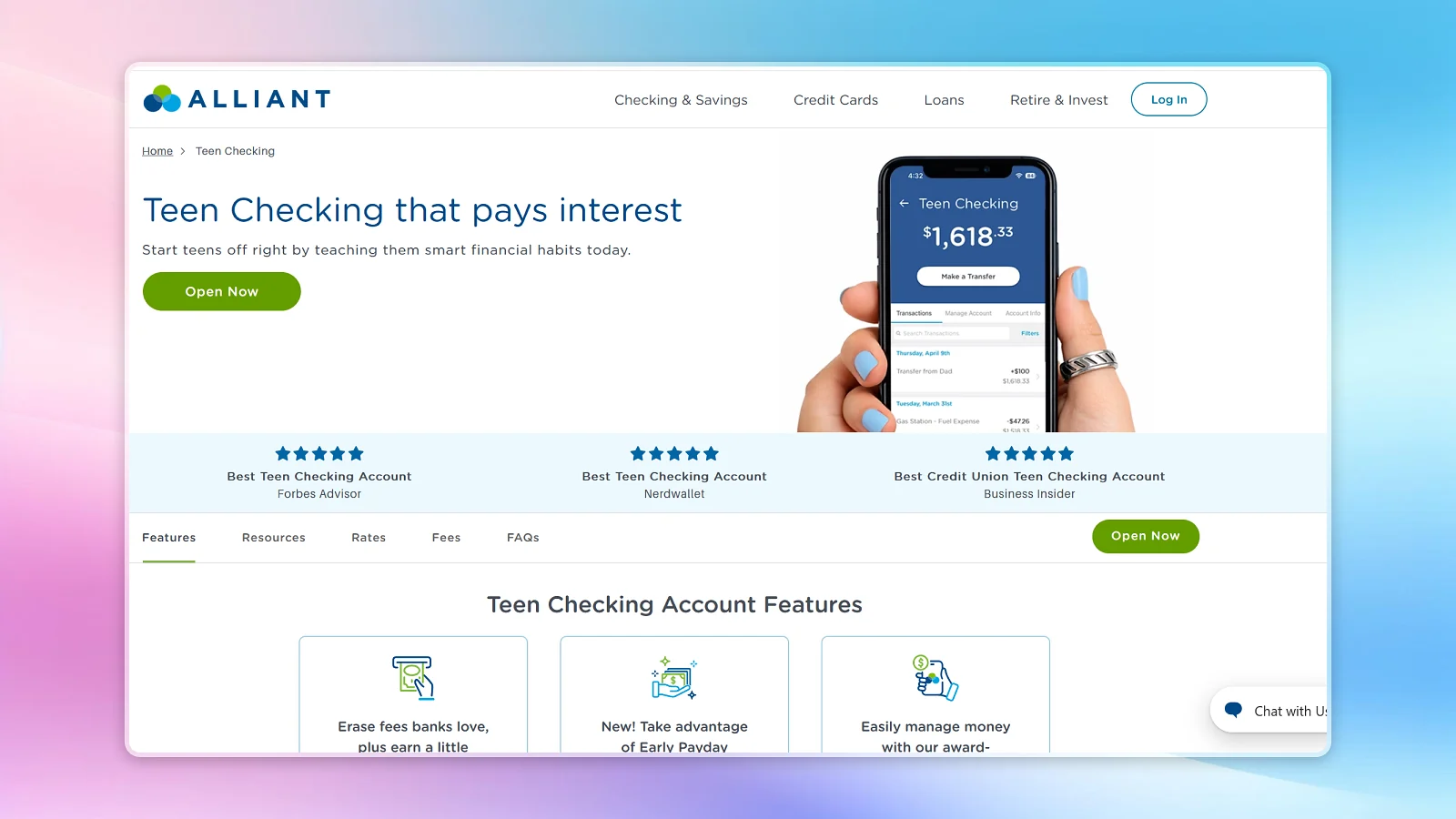
Alliant Credit Union Teen Checking is the best bank for a youth savings account overall, because its bundled High-Rate Savings account pays 3.01% APY with no balance cap, the highest real ongoing rate here once a teen saves past a starter sum. That balance makes it one of the best banks for youth savings accounts for families expecting a savings account for teenager use to grow beyond $1,000.
| Account detail | Information |
|---|---|
| Savings APY | 3.01% (2.97% dividend) on the bundled High-Rate Savings |
| Checking APY | 0.25% (needs eStatements plus one monthly electronic deposit) |
| Monthly fee | $0 |
| Balance to earn dividend | $100 average daily balance |
| Eligibility | Ages 13 to 17, adult co-owner must be an Alliant member |
| Insurance | NCUA (not FDIC) |
The reason Alliant tops the list of the best banks for youth savings accounts is durability. Its bundled High-Rate Savings account pays 3.01% APY once you maintain an average daily savings balance of at least $100, with no upper balance cap on that APY.
Unlike the capped starter rates below, the return does not drop once a teen saves past a few hundred or a few thousand dollars. The paired teen bank account also makes Alliant a strong contender for families looking for the best bank account for teenager saving and spending in one place.
The teen checking account itself pays a small 0.25% APY, and only if you opt into eStatements and make at least one electronic deposit each month, so treat the 3.01% savings rate as the real draw. There are no monthly fees, and deposits are NCUA insured up to $250,000. For families comparing the best banks for youth savings accounts, that setup keeps the youth bank account simple without sacrificing a competitive savings rate.
The account is built for ages 13 to 17 and converts to a standard adult Alliant checking account when the teen turns 18. The age-based conversion is worth noting if you want a savings account for teenager use that can sit alongside a teen bank account until adulthood. A parent or guardian has to be a joint owner and an Alliant member, usually satisfied with a small one-time partner-organization contribution at sign-up.
As a trust signal, Alliant’s company-wide Trustpilot score is 2.6 out of 5 from 163 reviews, an institution-level figure rather than a teen-account rating.

Compare Alliant vs. Spectrum Credit Union in the head-to-head section below to see how two of the best banks for youth savings accounts stack up.
2. Spectrum Credit Union MySavings Youth Account: Highest Rate on a Starter Balance
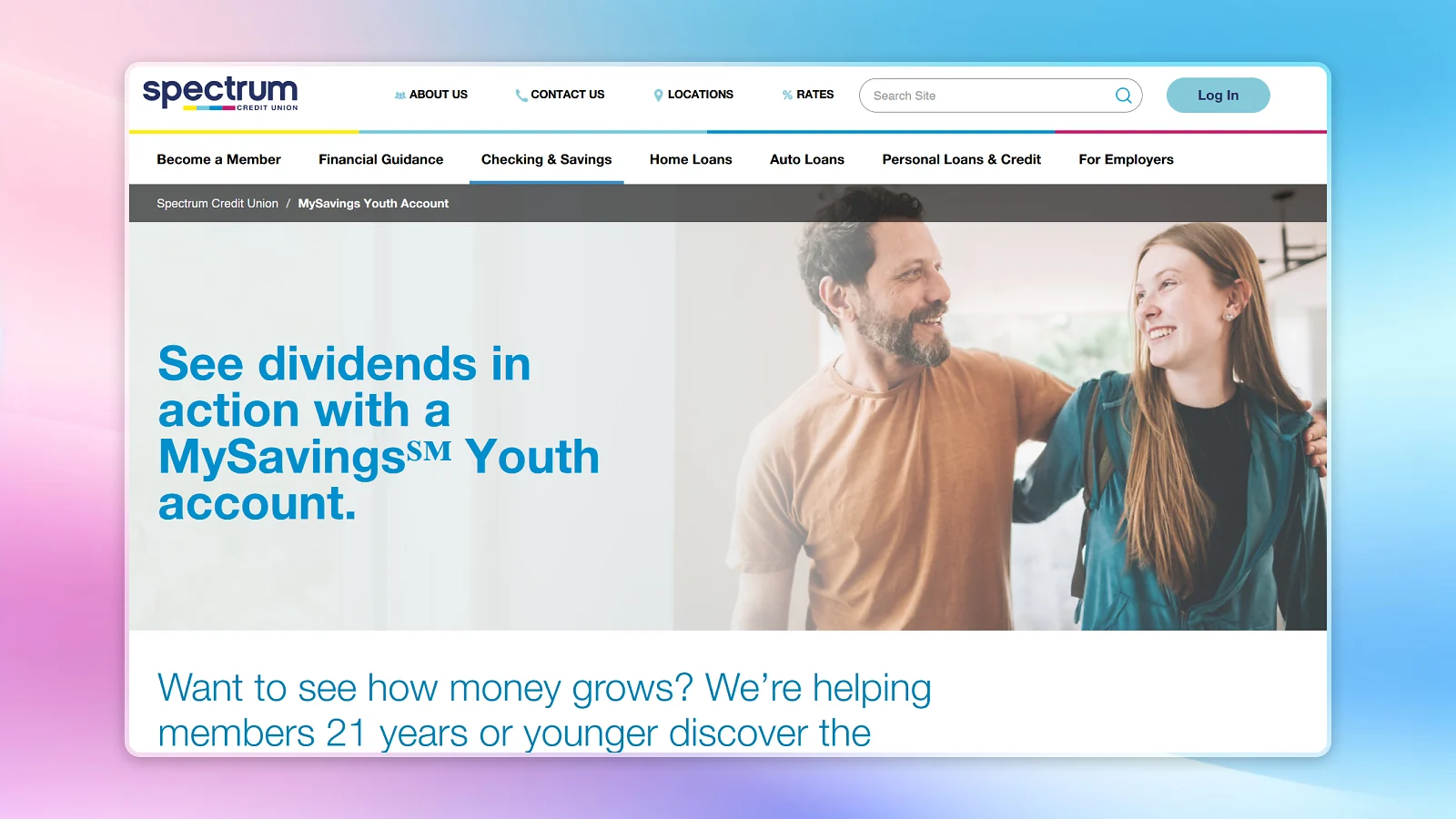
Spectrum Credit Union MySavings Youth Account has the single highest headline rate here, a 7.00% APY, but it applies only to a teen’s first $1,000, which makes it best for a brand-new saver with a small balance.
| Account detail | Information |
|---|---|
| APY | 7.00% (6.77% dividend) on the first $1,000 |
| Above $1,000 | 0.75% Primary Share Savings rate |
| Condition | Enroll in eStatements within 60 days of opening |
| Monthly fee | $0 |
| Eligibility | Membership required (employer, family, or donation) |
| Insurance | NCUA |
The 7.00% APY is genuinely the biggest number in this comparison, and it is confirmed live, but it only covers the first $1,000 in the account. Anything above that earns Spectrum’s standard Primary Share Savings rate of 0.75%, so this account rewards a small, growing starter balance rather than a large one. There is no monthly fee. Among the best banks for youth savings accounts, Spectrum is strongest when the savings account for teenager use will stay near or below $1,000.
Two conditions matter. You have to enroll in eStatements within 60 days of opening, or the account converts to a standard, much lower-rate Spectrum savings account, which is the easiest way to lose the advertised rate by accident.
Membership is also required, through a qualifying employer or family member, or a small donation to one of Spectrum’s partner nonprofits. Those extra steps make this less hands-off than a teen bank account or youth bank account with no membership or eStatement requirement. Deposits are NCUA insured up to $250,000.

For a closer look at two of the best banks for youth savings accounts, compare Spectrum Credit Union vs. Alliant below.
3. BECU Early Saver: Best for Easy Nationwide Membership
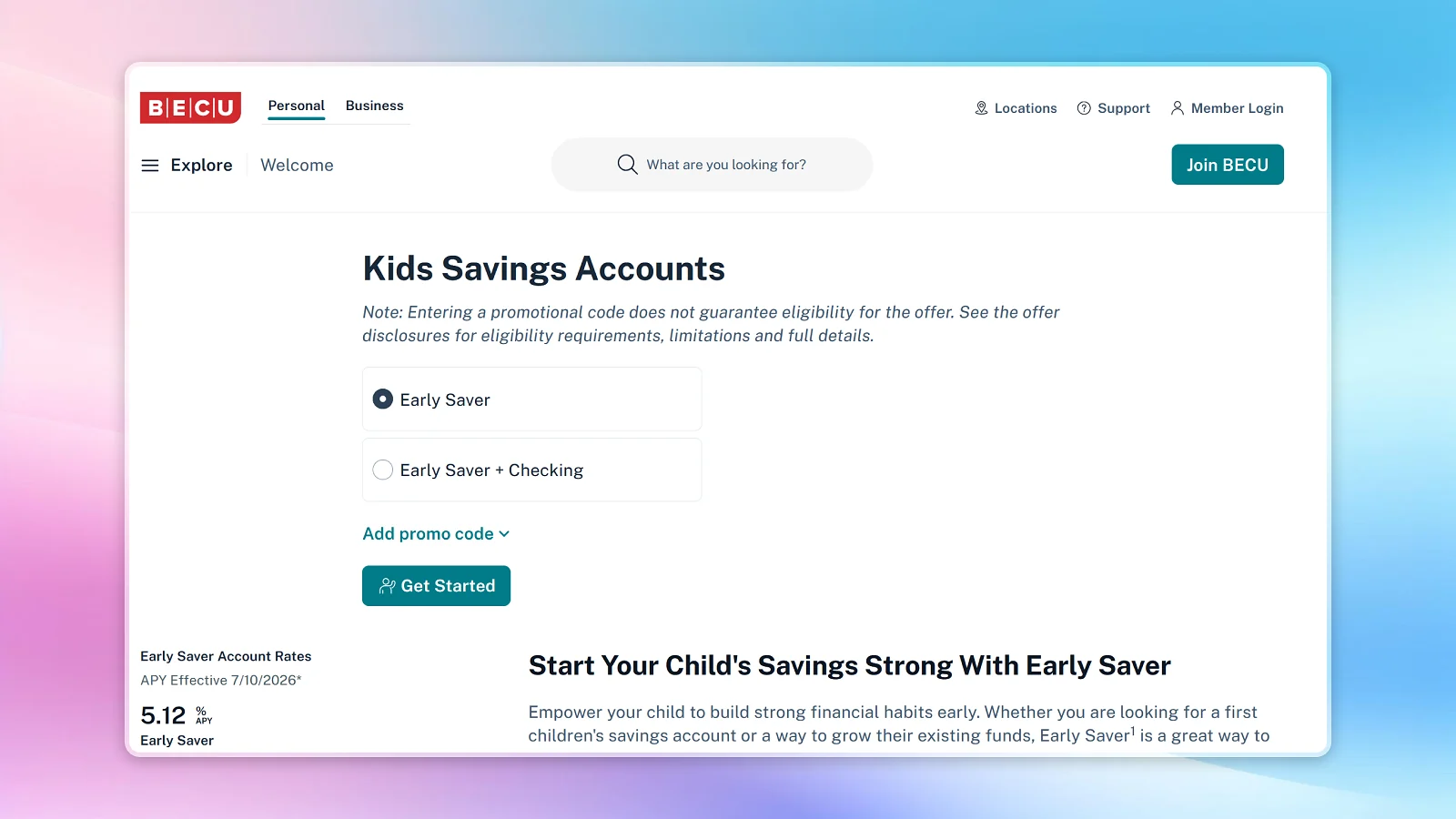
BECU Early Saver is the best pick for a strong starter rate with an easy nationwide path to membership, paying 5.12% APY on the first $500. For families searching for the best bank account for teenager savings, BECU stands out as one of the best banks for youth savings accounts with an easy nationwide membership path.
| Account detail | Information |
|---|---|
| APY | 5.12% on the first $500, 0.20% above $500 |
| Monthly fee | $0 |
| Minimum balance | None |
| Eligibility | Parent or guardian joint owner, members up to age 18 |
| Membership | Nationwide via a $1 BECU Foundation donation |
| Insurance | NCUA |
BECU’s Early Saver pays 5.12% APY on the first $500, with 0.20% above that, so like Spectrum it rewards a small starter balance. There is no monthly fee and no minimum balance. It opens with a parent or legal guardian as joint holder, is available to members up to age 18, and comes bundled with a teen checking account that gives the teen their own online and mobile login from 13. It can work well as a savings account for teenager goals while the bundled teen bank account covers everyday spending.
A common myth about BECU is that you must live in the Pacific Northwest or work for Boeing to join. You do not. Anyone nationwide can qualify with a one-time donation of as little as $1 to the BECU Foundation or another partner nonprofit.
Weigh the customer sentiment, though: BECU’s Trustpilot score is 1.5 out of 5 from 168 reviews, lower than the others here, driven mostly by customer-service and fraud-response complaints. Deposits are NCUA insured up to $250,000. BECU does not list eStatement enrollment as a condition for the Early Saver APY.

4. Capital One Kids Savings Account: Best for No Membership and Long-Term Continuity
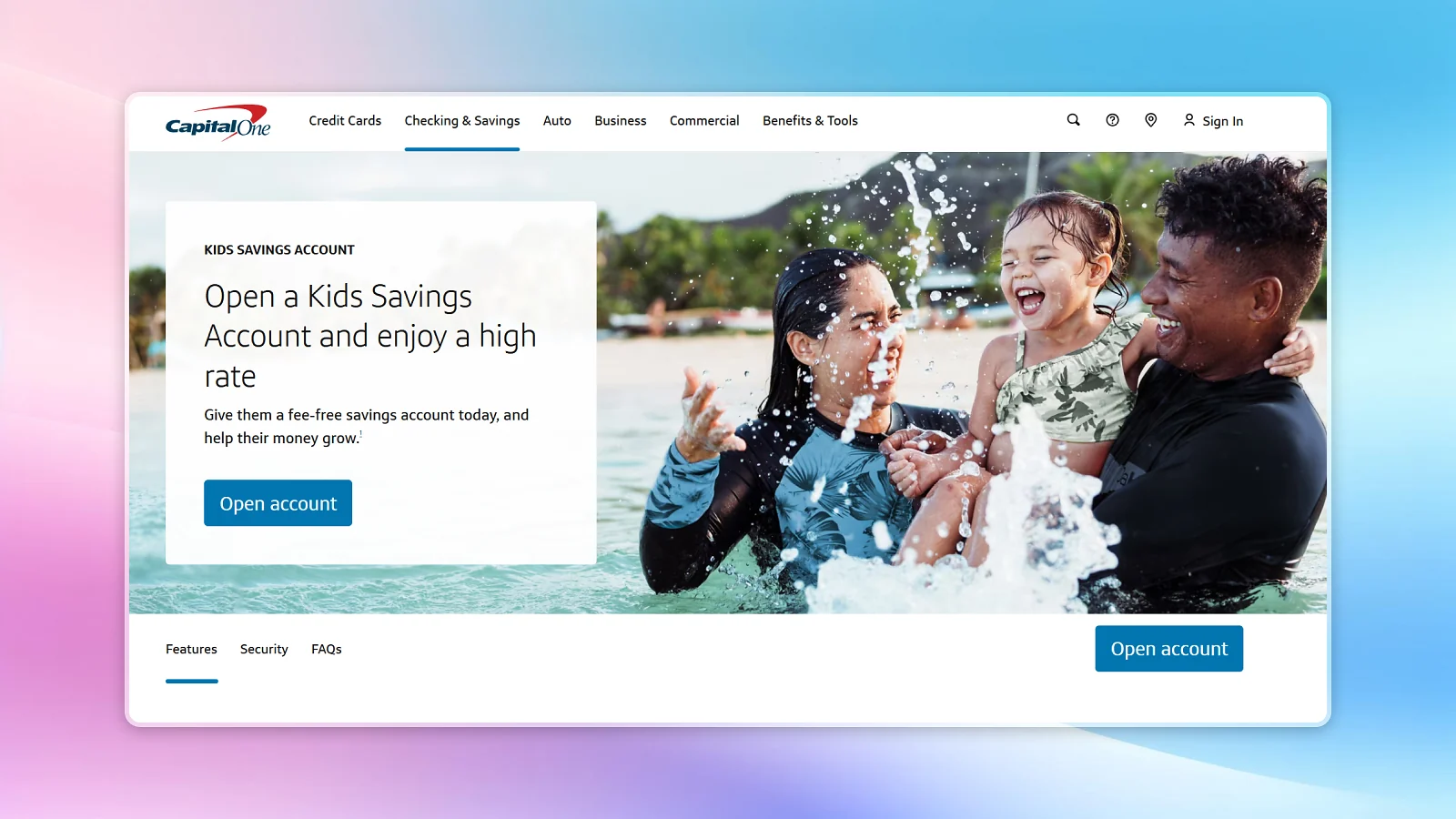
Capital One Kids Savings Account is the best pick for families who want zero membership requirements and an account that never needs to change, paying 2.50% APY on any balance. That simplicity makes the youth bank account especially appealing if your priority is the best bank account for teenager needs without credit-union membership.
| Account detail | Information |
|---|---|
| APY | 2.50% (effective July 29, 2026) |
| MONEY Teen Checking APY | 0.10% (optional pairing) |
| Monthly fee | $0 |
| Minimum | $0 |
| Eligibility | No age cutoff, parent or guardian owner |
| Insurance | FDIC (Capital One, N.A.) |
Capital One pays 2.50% APY with no monthly fee or minimum balance. There is no minimum age to open the account, but it must initially be co-owned by one child under 18 and one adult; if the child is under 12, the adult must be a parent or legal guardian. The account stays open with its existing features after the child turns 18.
You can optionally pair it with the Capital One MONEY Teen Checking account, which pays 0.10% APY and gives the teen a debit card. Among the best banks for youth savings accounts, Capital One is one of the easiest choices if you want a savings account for teenager use with no minimum balance.
Ratings cover different parts of the Capital One experience rather than the Kids Savings Account itself. Capital One’s app scores 4.8 out of 5 on the App Store and 4.5 out of 5 on Google Play, which is an app rating, while Trustpilot shows a much lower 1.3 out of 5 from 4,052 reviews for Capital One’s US banking business overall. Deposits are FDIC insured through Capital One, N.A.

Alliant Credit Union Teen Checking vs. Spectrum Credit Union MySavings Youth Account
Alliant Credit Union and Spectrum Credit Union have the two highest rates here, but they win in different ways depending on the total balance. The choice also depends on whether you want a teen bank account bundle or a standalone youth bank account focused mainly on savings.
Spectrum’s MySavings Youth Account keeps paying 7.00% on the first $1,000 no matter how large the total balance grows, because that is how a tiered rate works. Only the amount above $1,000 drops to Spectrum’s standard 0.75% Primary Share Savings rate. That means Spectrum keeps out-earning Alliant’s flat 3.01% in dollar terms well past the $1,000 mark, not the instant the balance crosses it.
The blended return only falls below Alliant’s 3.01% once the total balance climbs to roughly $2,750, the point where the larger low-rate portion of the balance finally drags the average down. Below that, Spectrum’s tiered structure still earns more in dollars overall. Above it, Alliant’s uncapped 3.01% wins.
| Total Balance | Spectrum Blended Rate | Spectrum Interest | Alliant Flat Rate | Alliant Interest |
|---|---|---|---|---|
| $1,000 | 7.00% | $70 | 3.01% | $30 |
| $1,500 | 4.92% | $74 | 3.01% | $45 |
| $2,000 | 3.88% | $78 | 3.01% | $60 |
| $2,750 | 3.02% | $83 | 3.01% | $83 |
| $3,000 | 2.83% | $85 | 3.01% | $90 |
| Feature | Alliant Teen Checking | Spectrum MySavings Youth |
|---|---|---|
| Headline APY | 3.01% (bundled savings) | 7.00% |
| Rate cap | None | First $1,000 only |
| Rate above cap | Not applicable | 0.75% Primary Share Savings |
| Condition | $100 balance to earn | eStatements within 60 days |
| Monthly fee | $0 | $0 |
| Membership | Adult co-owner must join | Employer, family, or donation |
| Insurance | NCUA | NCUA |
Pick Spectrum for a smaller balance you expect to grow gradually, and Alliant once your teen’s total balance is likely to climb past about $2,750. For parents choosing the best bank account for teenager savings, this crossover point is one reason the best banks for youth savings accounts can change depending on balance.
Editor’s Pick
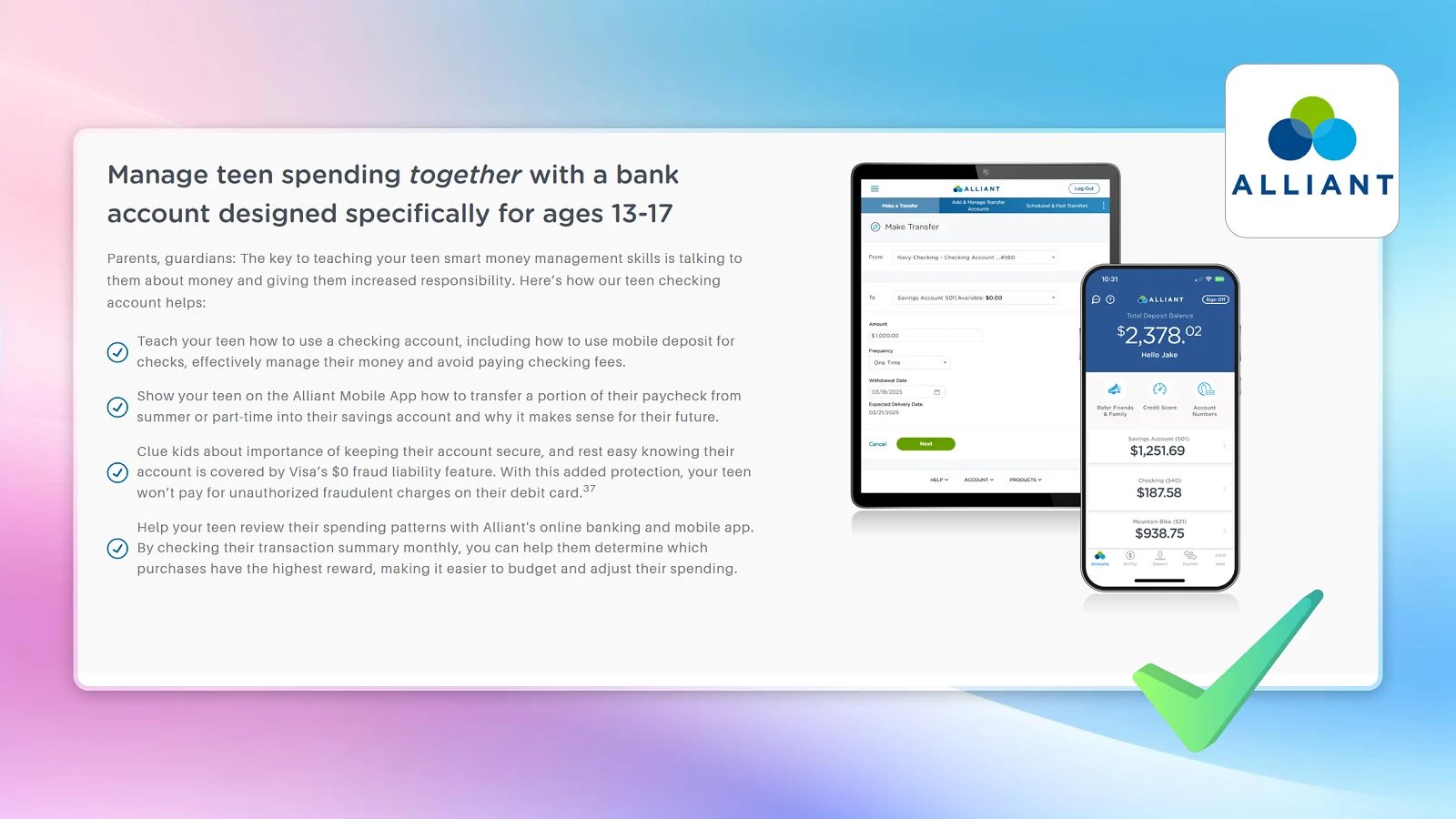
After weighing all four of the best banks for youth savings accounts head-to-head, one pick stands out.
Editor’s Pick: Alliant Credit Union Teen Checking. Chosen for the highest fully verified, uncapped ongoing rate in this comparison, 3.01% APY on its bundled High-Rate Savings account, plus a real teen checking account and NCUA insurance up to $250,000. It is particularly strong for families who want a savings account for teenager use bundled with a teen bank account under the same credit union.
Skip it if you would rather not join a credit union or cannot keep $100 in the bundled savings to earn the dividend. In that case, the best bank account for teenager needs without any membership hoops is the Capital One Kids Savings Account instead.
How Much Can a Teen Earn With a Savings Account?
Here is what the winner’s rate looks like in real numbers. $500 in Alliant’s bundled High-Rate Savings account at 3.01% APY earns about $15 in a year, once the $100 average balance needed to earn the dividend is met. Put in $2,000 and that grows to roughly $60, assuming the rate holds for the full 12 months.
The table scales the example across three balances. These examples can also help you judge whether a youth bank account delivers enough interest to qualify as the best bank account for teenager savings at your expected balance.
| Balance | Approx. earned in 1 year at 3.01% APY |
|---|---|
| $500 | ~$15 |
| $1,000 | ~$30 |
| $2,000 | ~$60 |
These are simple illustrations at a flat 3.01% APY, verified in July 2026, assuming no additional deposits or withdrawals. Because APY already reflects compounding, actual one-year earnings should land close to these figures if the rate holds for the full year. Rates are variable, so confirm the live APY before relying on these numbers. A capped starter rate like Spectrum’s 7.00% would earn more on the first $1,000 but far less on anything above it.
How To Open a Youth Savings Account
Opening a youth bank account like this takes about 10 to 15 minutes online, and it always requires a parent or legal guardian to apply as a joint owner or custodian. The application process is similar across the best banks for youth savings accounts, although the documents needed for a savings account for teenager use can vary by provider.
- Gather the teen’s full legal name, date of birth, and SSN or ITIN, plus your own ID and SSN or ITIN as joint owner.
- Complete the online application, naming the teen as the account holder and the adult as joint owner.
- Fund the account by bank transfer, mobile check deposit, or an opening deposit (several of these issuers require as little as $0).
- Set up separate parent and teen logins so both can track the balance, and opt into eStatements where offered to unlock the full advertised rate.
Ready to open the account that fits your teen? Start with Alliant Credit Union Teen Checking, our top pick, or compare all four options in the summary table above.
Choosing the Best Youth Savings Account for Your Teen
The single biggest factor in choosing a teen bank account is the APY a teen actually earns, weighed against any balance cap or membership step attached to it. That trade-off is often what separates the best bank account for teenager savings from the rest of the best banks for youth savings accounts.
- If you want the highest uncapped ongoing rate and do not mind joining a credit union: Alliant Credit Union Teen Checking, at 3.01% APY on the bundled savings once you keep $100 in it.
- If your teen is just starting with a small balance and you want the biggest number compounding fastest: Spectrum Credit Union MySavings Youth Account, at 7.00% on the first $1,000.
- If you want an easy nationwide credit-union membership path and a strong starter rate: BECU Early Saver.
- If you would rather skip any membership requirement and want an account that never needs to change as your teen grows up: Capital One Kids Savings Account.
Eligibility differs by provider. Alliant and BECU require a qualifying parent or guardian joint owner for their youth products, while Capital One requires an adult co-owner and Spectrum’s MySavings Youth account is available to primary members age 21 or younger. Alliant, Spectrum, and BECU also require credit-union membership, so check each institution’s membership rules before applying.
How We Rate Youth Savings Accounts
We built this ranking of the best banks for youth savings accounts around four criteria, and rate value carries the most weight.
The ranking is not arbitrary: we pull each figure from the provider’s official page, then weight the accounts on the criteria below. The same framework helps compare a savings account for teenager use across the best banks for youth savings accounts without overvaluing a flashy headline APY.
- Rate value (40%): the APY a teen actually earns, after any balance cap.
- Fees and transparency (25%): monthly fees and how clearly the terms and conditions are disclosed.
- Eligibility and custodial requirements (20%): how easy the account is to open and who has to co-sign or join.
- Support and reviews (15%): support options and independent ratings like Trustpilot.
We re-verify these rates quarterly, and immediately when a boosted introductory rate’s conditions, like eStatement enrollment or a balance cap, cannot be reconfirmed.
Final Verdict on the Best Banks for Youth Savings Accounts
For most families, the Alliant Credit Union Teen Checking bundle is the standout among the best banks for youth savings accounts right now. Its High-Rate Savings account pays 3.01% APY on any balance, so it keeps paying as a teen’s savings grow, unlike the capped starter rates from Spectrum and BECU. Those two are excellent for a small first balance, at 7.00% on the first $1,000 and 5.12% on the first $500, while Capital One is the easiest to open with no membership and no age cutoff.
Balance, eligibility, and account requirements will determine which option fits best. Always confirm the current APY and any eStatement rules before choosing among the best banks for youth savings accounts.
FAQs
Alliant Credit Union Teen Checking tops our best banks for youth savings accounts, with a bundled High-Rate Savings account paying 3.01% APY. Spectrum Credit Union MySavings Youth is the runner-up at 7.00% on the first $1,000.
At 3.01% APY, $500 earns about $15 over a year and $2,000 earns roughly $60, once the $100 balance needed to earn the dividend is met. The rate is variable, so the figures are illustrative.
Yes. Bank deposits are FDIC-insured up to $250,000 per depositor, and credit-union deposits carry the same $250,000 NCUA coverage. On this list Alliant, Spectrum Credit Union, and BECU are NCUA-insured, while Capital One is an FDIC-insured bank.
No. None of these four requires a credit check or income. A parent or guardian must be a joint owner or custodian, and the teen typically needs only their SSN or ITIN and date of birth.
No. Greenlight and Step offer reward-based savings features rather than traditional bank-set interest, while Copper discontinued its banking products in 2024. For FDIC- or NCUA-insured interest, consider one of the youth savings accounts above.
Not always. A teen bank account can mean checking, a youth savings account, or both. For the best bank account for teenager savings, look for a savings account for teenager use that pays interest, like Alliant Credit Union’s checking-and-savings setup.