


How To Become a Game Writer: Tools and Steps for 2026

Eneba Hub contains affiliate links, which means we may earn a small commission if you make a purchase through them—at no extra cost to you. Learn more


Recent update
Start with Udemy for structured game-writing lessons, then apply them to a playable dialogue sample in Twine.

Learning how to become a game writer starts with developing interactive storytelling skills, practicing branching dialogue, and building a portfolio that demonstrates your writing ability. Create a playable scene using tools like Twine, revise it based on feedback, and use your finished samples to apply for entry-level studio or freelance opportunities. A degree can help, but specific education requirements vary by employer.
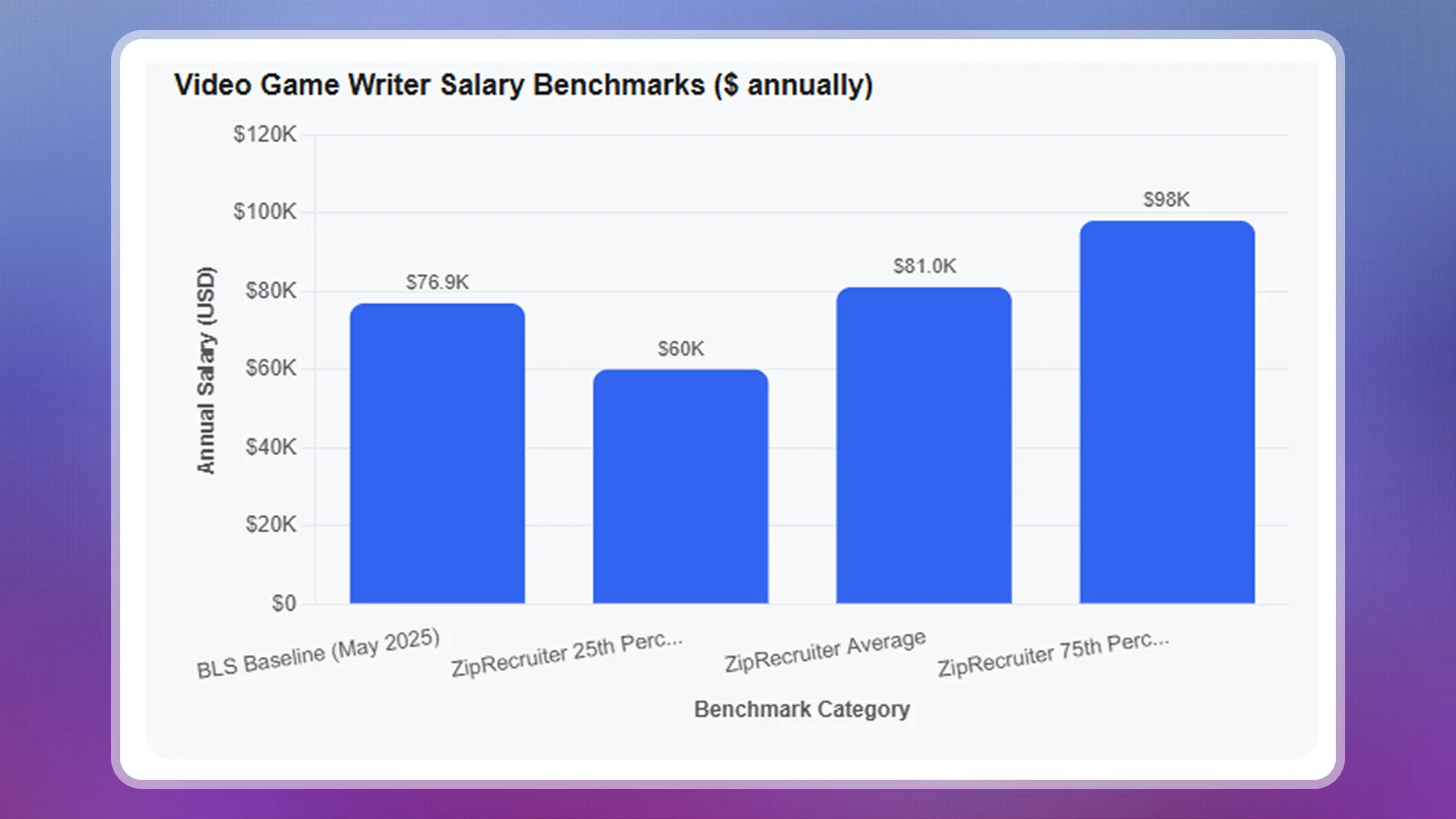
The pay might catch your eye, too. The U.S. Bureau of Labor Statistics reports median annual earnings of $76,910 for writers and authors, though that’s a broad benchmark, not a game writer salary. To see whether you’d enjoy the work, try writing a scene where a player refuses a quest and the story still holds together.
This guide covers the skills, tools, portfolio steps, salary context, and courses to get started.
Jump to:
What Is a Game Writer?
A game writer creates dialogue, lore, and story within playable constraints. They work with studio teams or take freelance and contract assignments.
Becoming a game writer involves writing for actions a player can interrupt, repeat, or approach out of order. This guide focuses on narrative content, rather than technical documentation or game marketing.
What Does a Game Writer Do?
A game writer creates the stories that give players a reason to care about the world they’re exploring. Their work covers character dialogue and interactive storytelling, but they also need to make sure every scene fits the gameplay. Here’s what their day-to-day responsibilities usually look like:
- Dialogue and barks: Write conversations and brief reactive lines, called barks, for combat, exploration, or other repeatable situations. Characters need recognizable voices without distracting players from the action.
- Story structure and pacing: Arrange reveals around missions and player progress. Account for a player who skips optional content or discovers information in an unexpected order.
- Worldbuilding and continuity: Maintain consistent factions, histories, and character motivations. Record decisions so another contributor can write within the same world.
- Cross-team collaboration: Revise scenes with designers, artists, and voice actors. A changed level or unavailable animation may require a different way to communicate the same story beat.
- Story pitches: Present the premise, characters, dialogue, and world in a pitch deck, a short presentation that explains the proposed story and its production needs.
A big part of the job involves revisions. A scene might sound great on paper but need major changes once it’s tested in-game. Game writers have to balance their creative ideas with what developers can realistically build, especially on larger projects.
Roles in Game Writing
The main tracks are narrative design, dialogue or script writing, and freelance game writing. Freelance describes a working arrangement, so it can overlap with either specialization.
If you’re exploring how to become a game writer, compare these roles by the assignments they involve:
|
Role |
What you’d do |
Writing focus |
First portfolio piece |
|---|---|---|---|
|
Narrative designer |
Connect story and player choice to game systems |
Structure and consequences |
Branching quest outline |
|
Dialogue or script writer |
Write conversations, barks, and cinematic scripts |
Character voice |
Playable dialogue scene |
|
Freelance game writer |
Complete contracted lore, scripts, or narrative revisions |
Project-specific briefs |
Lore sample or pitch document |
A contained dialogue assignment is a practical starting target for entry level game writer jobs. Junior game writer jobs may also include implementation, so read beyond the title.
To become a game writer who communicates effectively with designers, learn how a game design document organizes a project:
Pros and Cons of Becoming a Game Writer
Becoming a game writer suits people who enjoy creative work within shared constraints. Enjoying games alone is a weaker reason to pursue the role than enjoying revision and collaboration.
Consider these trade-offs before paying for training:
| Pros | Cons |
|---|---|
| ✅ Creative contribution – shape characters and player choices. ✅ Portable skills – practice scripts, pitches, and revision. ✅ Flexible project types – explore studio and freelance assignments. ✅ Visible practice work – demonstrate your approach through playable scenes. | ❌ Limited broad growth – the overall writing occupation has a flat outlook. ❌ Constrained authorship – production changes can remove or reshape your work. |
Entry level game writer jobs still require careful targeting. Treat junior game writer jobs as opportunities to contribute to someone else’s project, rather than invitations to pitch an entire game.
Game Writer Qualifications
Video game writer education requirements depend on the employer and assignment. Relevant writing samples and collaborative skills give employers evidence beyond a credential alone.
No single game-writing credential covers every role. Your background affects what to focus on when learning how to become a game writer: writers need systems knowledge, while developers may need more practice with voice and revision.
Use these categories to assess your preparation:
- Education: English, communications, journalism, or game-design study can support the work. US employers set their own video game writer education requirements, so distinguish a mandatory degree from a preferred qualification in each listing.
- Alternative paths: Self-directed projects and short courses can organize your learning. Career changers should adapt existing writing skills to interactive work instead of submitting unrelated samples unchanged.
- Portfolio or experience: Include a playable conversation, a clearly annotated script, or a story pitch. Explain the intended player experience and identify your contribution to collaborative projects.
- Course certificates: Label completion certificates accurately. They show that you completed training, not that you passed an industry-wide licensing or certification exam.
- Soft skills: Practice taking feedback, explaining a revision, and recording decisions. Writers in junior game writer jobs must work with contributors whose priorities include level design, animation, and performance.
- Production awareness: Show that you can write to constraints. A scene that needs unavailable characters or expensive new assets may be unsuitable even if the dialogue is strong.
These categories make video game writer education requirements easier to evaluate without treating a degree as a substitute for practice. Entry level game writer jobs may request different sample formats, so follow each submission brief.
Junior game writer jobs also reward clarity about authorship. If you use a team project, name the scenes you wrote and describe changes made after feedback.
The strongest practical preparation is a finished, playable portfolio piece that demonstrates your decisions. Anyone learning how to become a game writer without a degree should make that evidence easy to access and understand.

Tools Every Game Writer Should Learn
Start with a branching narrative tool and a script-writing workflow. Twine supports interactive conversations, while Celtx supports script-focused work.
The tools serve different portfolio needs:
|
Tool |
Best for |
Practice assignment |
Price |
|---|---|---|---|
 Twine |
Branching narrative and player choices |
Conversation with alternate outcomes |
Free |
 Celtx |
Scripts and organized dialogue |
Linear mission or cinematic script |
Paid |
If you’re figuring out how to become a game writer, start with Twine to create an interactive sample. Add Celtx when your work needs a script format.
Video game writer jobs may use other internal tools. Transferable skills, including clear conditions and consistent dialogue labels, are more useful than treating one application as universal.
Video Game Writer Salary and Career Progression
Game writing can be a rewarding career for those interested in interactive storytelling, with opportunities to work on projects of different sizes. The average video game writer salary in the US is approximately $81,000 per year, although earnings vary depending on experience and the type of employment.
Here’s a breakdown of the reported annual salary range:
- Lower percentile: $60,000 at the 25th percentile.
- Average: $81,001 across the reported category.
- Upper percentile: $98,000 at the 75th percentile.
These are not experience-level bands. They cannot establish a starting video game writer salary or prove what a senior writer earns.
Progression can involve broader responsibility for quests, narrative systems, or other writers. Becoming a game writer does not require moving into narrative design, and leadership brings more review work.
Compare video game writer jobs by contract terms and responsibilities as well as pay. A video game writer salary benchmark is context for evaluating an offer, not a promised outcome.
How To Become a Game Writer: A Step-by-Step Guide
Build fundamentals, tool proficiency, and finished samples, then use them in targeted applications. Your route to becoming a game writer should advance through completed work rather than an assumed hiring deadline.
Step 1: Learn Game-Writing Fundamentals
Study story structure and character motivation, then examine how player control changes them. Rewrite a practice scene for entry level game writer jobs so the player can refuse the request or arrive without key information.
As you learn how to become a game writer, practice preserving meaning across those alternatives. Annotate the conditions for each line. This creates clearer evidence for entry level game writer jobs than a scene that only works in a fixed reading order.
Step 2: Learn the Core Writing Tools
Practice branching dialogue in Twine and script organization in Celtx. Keep the initial exercise small enough to test every path yourself.
Learning how to become a game writer requires attention to those details, though not every role involves advanced programming. For junior game writer jobs that request implementation, explain how you built and tested the sample.
Step 3: Build a Portfolio Piece
Finish a playable conversation, a set of contextual barks, or a compact pitch deck. Accompany each sample for junior game writer jobs with a brief description of its purpose and constraints.
Choose work that matches your target assignments. Entry level game writer jobs involving quest dialogue need different evidence from cinematic scripting roles. To become a game writer with a convincing portfolio, show revision decisions alongside the finished result rather than uploading every draft.
Step 4: Take a Structured Course
Choose a course that addresses a specific weakness in your sample. Use Udemy as a structured lesson platform, then apply each relevant concept to the project you already started.
The Recommended Courses section below separates design documentation from narrative-focused study. Learning how to become a game writer through a course still requires independent practice. A completion certificate cannot replace a clear scene or establish that you meet video game writer education requirements.
Step 5: Apply for Entry-Level and Junior Roles
Target entry level game writer jobs whose requested work resembles your portfolio. Tailor the sample selection and describe your contribution plainly.
Search junior game writer jobs alongside assistant and contract writing opportunities, but inspect the duties carefully. Video game writer jobs can use similar titles for different work. Review video game writer education requirements before applying, and submit the requested format rather than an unsolicited full-game concept.
Step 6: Keep Building Credits and Collaborating
Contribute to game jams or small modding projects where you can complete a defined writing assignment. Agree on scope and credit before starting, then keep a record of revisions and feedback.
Showing that you can finish work with others matters as you explore how to become a game writer. Use each collaboration to improve the portfolio you already have. A completed team contribution gives you something concrete to discuss when an interviewer asks about production constraints.

A structured learning platform can support the course stage without replacing hands-on work:
Recommended Courses
Choose training that improves your next deliverable. A broad industry overview and a dialogue-writing course serve different needs when you’re learning how to become a game writer.
These options cover documentation, narrative practice, and industry context:
|
Course |
Provider |
What it covers |
|---|---|---|
|
Write a Professional Game Design Document (GDD) |
 |
Organizing a game design document |
|
Game Writing: Storytelling through Video Game Design |
|
Storytelling within game design |
|
Narrative Design Master Class: Write Stories for Video Games |
|
Narrative design for games |
|
All About Gaming Industry Careers and Game Design Fundamentals |
|
Industry roles and design fundamentals |
|
Become a Game Writer |
 |
Dialogue, narrative design, and story pitching |
Course completion certificates are not vendor certifications or substitutes for video game writer education requirements in a particular listing. To become a game writer, turn the lessons into work another person can read or play.
For a focused storytelling introduction, consider this course:
Alternate Careers in Game Writing
Consider adjacent writing careers if production-dependent storytelling does not suit you. Video game writer jobs are not the only way to use writing skills around games.
These alternatives change the core assignment:
- Editor: Review scripts and lore for clarity and consistency. The trade-off is less original drafting and more responsibility for other people’s work.
- Technical writer: Explain tools or game systems. Accuracy and usability take priority over character and plot.
- Games journalist: Report on games and the industry. The work requires independent reporting rather than contributing to a studio’s fiction.
Becoming a game writer develops revision and audience-awareness skills that can support these paths. Assess their qualifications independently rather than assuming video game writer education requirements apply across them.
Final Verdict on How To Become a Game Writer
This path is worth considering if you enjoy interactive storytelling and collaborative revision. Start with a contained playable scene, then buy training only when it addresses a clear weakness.
It is a poor fit for someone seeking unrestricted authorship or a predictable hiring timetable. A video game writer’s salary average cannot compensate for disliking production constraints. Editing or technical writing may suit you better if your strongest interest is clarity rather than player choice.
If you’re figuring out how to become a game writer, finish work that demonstrates both writing ability and production awareness. Let that evidence guide your applications for entry level game writer jobs and your further study.
For deeper narrative-design study, consider this course:
FAQs
Start with a short branching scene in Twine, then revise it after someone plays it. Use the finished sample to demonstrate relevant skills when applying for entry level game writer jobs.
Pay depends on the assignment and employment terms. A video game writer salary comparison should distinguish annual employment from contract work and account for responsibilities, benefits, and location.
There is no fixed timetable. Becoming a game writer depends on your existing writing skills, practice, portfolio quality, and access to suitable opportunities. Completing a course does not establish job readiness.
No, there is no single degree required across all game-writing roles. Video game writer education requirements differ by employer, and some listings make a degree mandatory or preferred.
Interactive writing samples, revision skills, and collaboration help demonstrate preparation. Short courses can support practice, but a completion certificate is different from an industry certification.
Yes, for writers who enjoy player choice and collaborative production. It is less suitable if you need predictable hiring or complete creative control. Assess the daily work alongside video game writer salary figures.
Dialogue, character voice, worldbuilding, revision, and collaboration are useful foundations for junior game writer jobs. A playable sample shows how you apply them as you learn how to become a game writer.