



How to Level Up in DnD: 2026 Guide to Character Advancement


Look, I’ve been running DnD campaigns for over six years now, and I can tell you that leveling up is hands down one of the most satisfying moments at any table. There’s something special about watching your scrappy level 1 wizard finally hit level 3 and pick their subclass after barely surviving goblin ambushes for three sessions straight.
This guide breaks down how to level up in DnD using both main systems, what actually changes when you gain a level, and how DMs can manage progression without slowing down the game. I’ll share the exact process I use at my table and the mistakes I’ve seen trip up new players.
Jump to:
How to Level Up in DnD: Understanding the Two Main Systems
The first thing you need to know is that DnD offers two completely different approaches to leveling. The experience point system tracks numbers after every encounter, while milestone leveling ties advancement directly to story beats.
XP works great when you want transparent progression that players can track themselves. They know exactly how close they are to the next level, which creates anticipation. Milestone leveling gives you total control over pacing and eliminates math entirely.
Here’s the real difference in practice. With XP, your players might level up mid-dungeon after defeating a tough encounter. With milestones, you decide they level up after completing the dungeon, regardless of how many fights happened inside.
The XP system requires more bookkeeping but rewards consistent play. Players accumulate points from combat, solving puzzles, and completing objectives. When they hit specific thresholds, they level up. A character needs 300 XP to reach level 2, 900 total XP for level 3, and 2,700 total XP for level 4.
Milestone leveling strips away all numbers. You simply announce that the party levels up after major story moments. Defeated the dragon terrorizing the village? Level up. Discovered the secret behind the mysterious murders? Level up. This method keeps the entire party at the same level and focuses attention on narrative rather than numbers.
Most groups I know use milestone leveling because it’s cleaner and prevents the awkward situation where one player misses a session and falls behind in XP. But XP systems appeal to players who enjoy tracking their progress like they would in video games.
Step-by-Step: How to Level Up a Character in DnD

When you actually level up, you need to follow a specific sequence to avoid missing important updates. I’ve seen players forget crucial steps and end up with incorrect stats for multiple sessions.
Here’s the exact process I walk my players through:
- Confirm you’ve reached the required XP threshold or that your DM has announced a milestone level-up
- Check your class table in the Player’s Handbook to see what you gain at this level
- Roll your hit die and add your Constitution modifier to determine new hit points
- Select any new spells or class features you receive
- Update your proficiency bonus if it increases at this level
- Choose ability score improvements or feats if this level grants them
- Recalculate your attack bonuses, spell save DC, and other derived stats
- Update your character sheet with all new information
- Take a moment to understand your new abilities before the next session
- Inform your DM that your character sheet is updated and ready
The hit point calculation trips up new players constantly. You roll the die listed for your class, add your Constitution modifier, and add that total to your current maximum. A level 4 fighter with +2 Constitution who rolls a 7 on their d10 would add 9 hit points to their maximum.
If your Constitution modifier increases during this level-up because you boosted your Constitution score, you gain 1 additional hit point for every level you already have. A level 5 character increasing their Constitution modifier from +2 to +3 would immediately gain 5 hit points on top of their normal roll.
Digital tools like DnD Beyond automate most of these calculations, which helps prevent errors. But understanding the manual process means you can spot mistakes when they happen.
DnD Level Up Chart: XP Requirements for Levels 1-10
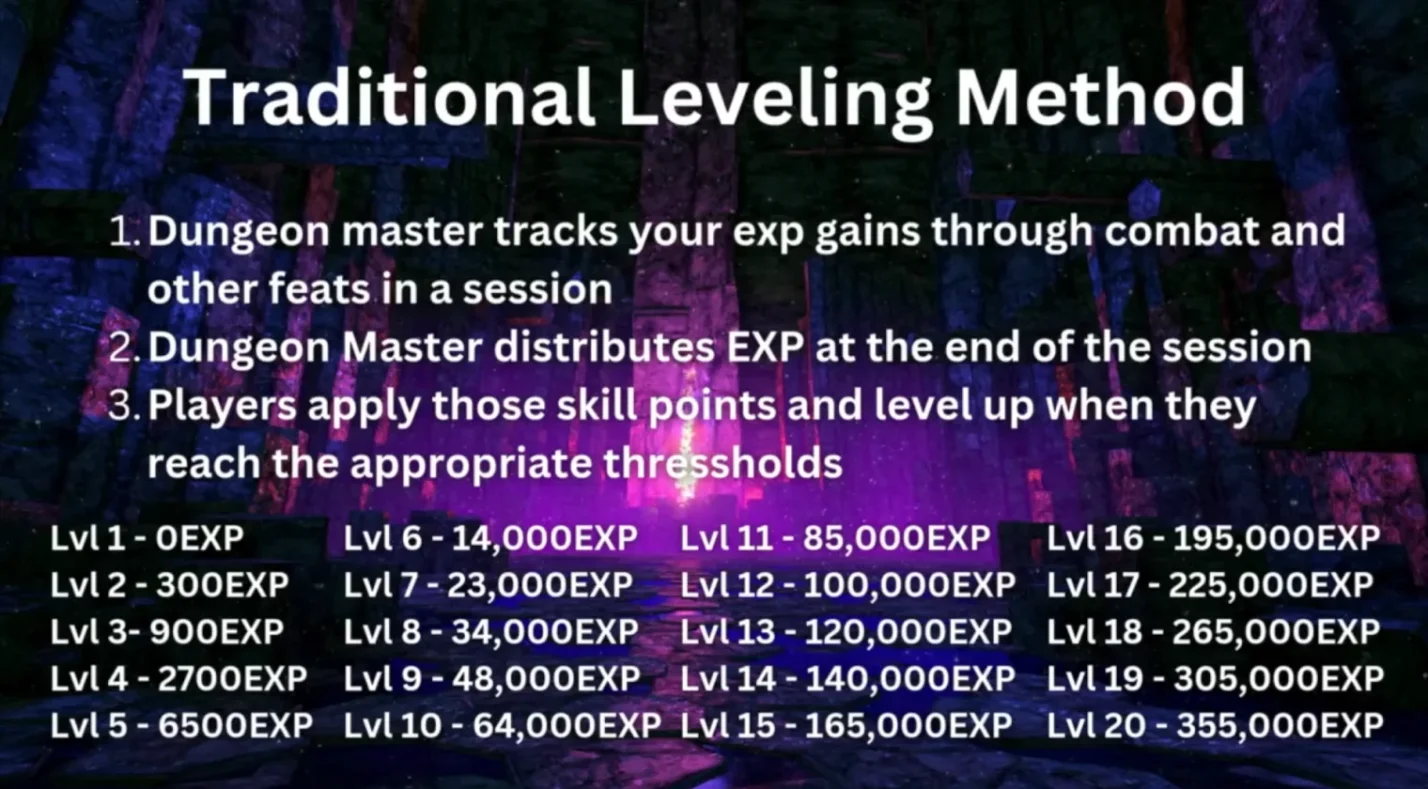
The XP thresholds increase dramatically as you advance. Early levels come fast, but higher levels require significantly more experience.
| Level | Total XP Required | XP to Next Level | Proficiency Bonus |
| 1 | 0 | 300 | +2 |
| 2 | 300 | 600 | +2 |
| 3 | 900 | 1,800 | +2 |
| 4 | 2,700 | 3,800 | +2 |
| 5 | 6,500 | 7,500 | +3 |
| 6 | 14,000 | 9,000 | +3 |
| 7 | 23,000 | 11,000 | +3 |
| 8 | 34,000 | 14,000 | +3 |
| 9 | 48,000 | 16,000 | +4 |
| 10 | 64,000 | 21,000 | +4 |
Notice how the proficiency bonus jumps at level 5 and again at level 9. These increases affect every attack roll, skill check, and saving throw that uses proficiency. Missing this update means your character is weaker than they should be.
XP comes primarily from combat encounters based on creature Challenge Ratings. A CR 1 creature awards 200 XP, while a CR 5 creature awards 1,800 XP. The total gets divided among all party members equally.
Smart DMs also award XP for non-combat achievements. Negotiating peace between warring factions, solving complex puzzles, or discovering crucial information can all justify XP rewards. This encourages creative problem-solving instead of just fighting everything.
What Changes When You Level Up in DnD
Every level brings specific mechanical improvements that make your character more capable. Understanding what changes helps you use your new power effectively.
Hit points always increase. You’re tougher and can survive more damage. This matters more than players realize because it’s the difference between getting one-shot by a critical hit or surviving to fight back.
Class features arrive at most levels. Fighters gain Extra Attack at level 5, letting them swing their weapon twice per action instead of once. Rogues get Uncanny Dodge at level 5, which lets them halve damage from an attack they see coming. These features fundamentally change how you play your character.
Spellcasters gain new spell slots and access to higher-level spells at specific breakpoints. A wizard reaching level 5 unlocks 3rd-level spells like Fireball and Counterspell, which are significantly more powerful than anything they had before. This represents a major power spike.
The proficiency bonus increases at levels 5, 9, 13, and 17. This affects your attack rolls, skill checks, saving throws, and spell save DC. A +1 increase might not sound like much, but it translates to roughly 5% better success rate on everything you do.
Ability Score Improvements arrive at levels 4, 8, 12, 16, and 19 for most classes. You can increase two different ability scores by 1 each, or increase one ability score by 2. Alternatively, you can take a feat instead, which grants special abilities or proficiencies.
I’ve watched players struggle with ASI decisions. Increasing your primary stat is usually the safe choice. A wizard should boost Intelligence, a fighter should boost Strength or Dexterity. But feats like Great Weapon Master or Sharpshooter can dramatically increase damage output if you build around them.
Some players interested in deep character customization mechanics might enjoy exploring games with character creation to see how different systems handle progression and stat allocation.
Leveling Speed and Campaign Pacing
How fast you level determines the entire feel of your campaign. I’ve run fast campaigns where players gained a level every session and slow campaigns where they spent five sessions at the same level.
Fast pacing means leveling every 1-2 sessions. This works great for short campaigns or when you want to experience high-level play quickly. Players constantly gain new abilities and the power level escalates rapidly. The downside is that players barely have time to master their current abilities before gaining new ones.
Standard pacing advances the party every 2-4 sessions. This matches most published adventures and gives players time to understand their abilities while maintaining steady progress. I find this sweet spot works for most groups.
Slow pacing means 5-10 sessions per level. This creates a grittier, more challenging campaign where resources matter and every fight feels dangerous. Players really learn their characters inside and out. But it requires patient players who won’t get frustrated by slower advancement.
Here’s a practical pacing guide based on campaign style:
| Campaign Style | Sessions Per Level | Level 1-10 Duration | Best Method |
| Fast-Paced | 1-2 sessions | 10-20 sessions | Milestone |
| Standard | 2-3 sessions | 20-30 sessions | Either |
| Slow-Burn | 3-5 sessions | 30-50 sessions | XP with bonuses |
| Epic | 4-6 sessions | 40-60 sessions | Milestone |
The key is communicating expectations upfront. Tell your players roughly how often they’ll level up so they know what to expect. Nothing kills enthusiasm faster than thinking you’ll level up soon and then spending eight sessions at the same level.
Understanding different progression systems across gaming platforms, similar to how leveling works on Steam, can give you ideas for structuring rewards and maintaining player engagement in your campaigns.
Tips for Dungeon Masters Managing Party Leveling

Running the leveling system smoothly requires clear communication and consistent execution. I’ve made plenty of mistakes here and learned what actually works.
- Set expectations at Session Zero. Tell your players whether you’re using XP or milestones, how often they’ll likely level up, and any house rules you’re using. This prevents confusion later.
- If you use XP, announce totals at the end of every session. Tell players exactly how much XP they earned and what their new total is. This transparency builds trust and lets them track their own progress.
- Keep the entire party at the same level. Individual XP tracking creates problems when some players miss sessions or when one character dominates combat. Equal XP distribution keeps everyone engaged and prevents power imbalances.
- Balance encounters for the party’s current level. A level 3 party shouldn’t fight the same enemies as a level 8 party. Use Challenge Rating as a guideline but adjust based on your party’s actual capabilities. Some groups punch above their weight class, others need easier encounters.
- Celebrate level-ups as significant moments. Pause the game, let players update their sheets, and maybe even end the session right after a level-up so players can prepare for next time. This makes advancement feel momentous rather than just administrative.
- Award XP for non-combat achievements if you want to encourage creative problem-solving. The party that sneaks past the guards and steals the artifact should get the same XP as the party that fights their way through. Otherwise you’re incentivizing combat as the only solution.
Having proper gaming setup with organized materials can make the leveling process smoother and help players track their progression more effectively. Quality gifts for gamers like dice sets and character sheet organizers streamline table management.
Consider using milestone leveling if bookkeeping feels like a chore. There’s no shame in simplifying the system to focus on storytelling. Most of my campaigns now use milestones because it eliminates math and keeps everyone together.
Multiclassing and Advanced Leveling Concepts

Multiclassing lets you combine features from different classes to create unique character builds. A fighter who takes levels in wizard becomes a spellsword. A rogue who takes levels in cleric becomes a trickster priest.
The mechanics get complicated fast. When you multiclass, you gain the features of your new class at 1st level in that class, not at your total character level. A level 5 fighter who takes their 6th level in wizard becomes a level 5 fighter and level 1 wizard. They get 1st-level wizard features, not 6th-level wizard features.
Spellcasting progression is the most confusing part. Multiclass spellcasters use a special table to calculate total spell slots based on their combined levels in spellcasting classes. A level 3 wizard and level 2 cleric has the spell slots of a 5th-level spellcaster, but can only prepare spells up to 2nd level from each class.
I’ve seen powerful multiclass combinations dominate tables. Paladin and sorcerer is notorious for massive damage through smite-spell combos. Rogue and fighter combines sneak attack with extra attacks for consistent damage. Warlock and any other caster patches up warlock’s limited spell slots.
But multiclassing also delays your main class progression. That fighter who takes wizard levels won’t get their second Extra Attack at level 11 like a pure fighter would. You’re trading focused power for versatility.
Players exploring multiclass builds might find value in studying detailed character progression guides like our Shadowheart build analysis, which demonstrates how combining class features creates synergies.
Most new players should stick to single-class characters until they understand the base game. Multiclassing is an advanced option that requires system knowledge to execute well.
Advanced Considerations: Level Caps and Campaign Tiers
DnD officially caps at level 20, though some campaigns end much earlier. Many DMs run campaigns that conclude at level 10 or 15 because high-level play gets mechanically complex and narratively challenging.
The game divides into four tiers of play. Tier 1 covers levels 1-4 and focuses on local threats like bandits and monsters. Tier 2 spans levels 5-10 and introduces regional threats like dragons and powerful villains. Tier 3 runs from levels 11-16 with world-shaking threats. Tier 4 includes levels 17-20 where characters face gods and reshape reality.
Each tier feels completely different. Tier 1 characters struggle against a pack of wolves. Tier 4 characters fight demon lords and ancient dragons. The scope of challenges and available solutions changes dramatically.
Most campaigns never reach level 20. The sweet spot for many groups is levels 5-12, where characters are powerful enough to be heroic but not so powerful that normal challenges become trivial.
Understanding how progression systems work across different game types, including games with skill trees, can help DMs design more engaging advancement paths that keep players invested throughout long campaigns.
Bringing DnD Leveling to Life at Your Table

Mastering how to level up in DnD comes down to choosing the right system for your group and executing it consistently. XP tracking works when you want transparent progression and mathematical rewards. Milestone leveling works when you want narrative control and simplified bookkeeping.
The actual level-up process requires careful attention to detail. Update hit points, add new features, recalculate proficiency bonuses, and verify all derived stats. Missing steps creates problems that compound over multiple sessions.
Campaign pacing matters more than most DMs realize. Fast progression creates excitement but prevents mastery. Slow progression builds challenge but risks frustration. Standard pacing of 2-4 sessions per level works for most groups.
Communication prevents most leveling problems. Tell your players what system you’re using, how often they’ll level up, and what you expect from them. Celebrate level-ups as meaningful achievements rather than just administrative updates.
Players wanting to experience DnD’s leveling mechanics in digital form should check out Baldur’s Gate 3, which faithfully implements DnD 5e rules including the complete character advancement system with all class features, spell progression, and ability score improvements that define the tabletop experience.
I’ve spent years testing different approaches at my table and watching other DMs run their games. The groups that handle leveling well share one trait: they keep it simple and consistent. Pick a system, communicate clearly, and stick with it.
For players wanting to experience DnD’s leveling mechanics in a digital format, exploring the best DnD video games provides excellent examples of how tabletop progression translates to interactive gameplay.
FAQs
How often should players level up in DnD 5e?
Players should level up in DnD 5e approximately every 2-3 sessions for standard pacing, though this varies based on campaign style and DM preference. Fast-paced campaigns might level every 1-2 sessions while slow-burn campaigns extend to 4-6 sessions per level, with the key being consistent communication about expectations.
What’s the difference between XP leveling and milestone leveling?
The difference between XP leveling and milestone leveling is that XP tracks numerical points earned from encounters and challenges while milestone grants levels at specific story moments chosen by the DM. XP provides transparent progression tracking but requires bookkeeping, while milestone offers narrative flexibility and keeps the party at equal levels without mathematical tracking.
Can players level up at different rates in the same campaign?
No, players cannot effectively level up at different rates in the same campaign because level disparities create balance issues and spotlight problems that frustrate lower-level characters. Most groups award equal XP to all party members or use milestone leveling to advance everyone simultaneously, with intentional level gaps only working in specific scenarios like introducing new characters mid-campaign.
How do DMs decide when it’s time for players to level up?
DMs decide when it’s time for players to level up by either tracking XP until characters reach required thresholds or choosing significant story moments for milestone advancement. Milestone DMs consider factors like completing major story arcs, achieving campaign objectives, reaching appropriate power levels for upcoming content, and maintaining engagement through regular advancement every few sessions.
Are there faster alternatives to traditional leveling methods?
Yes, there are faster alternatives to traditional leveling methods including session-based leveling that advances characters every single session, starting campaigns at higher levels to skip early progression, accelerated XP awards that double or triple standard experience, and time-skip leveling that advances characters multiple levels during narrative jumps. These methods work best for short campaigns, experienced players wanting high-level play, or groups exploring specific mechanics rather than traditional long-form progression.