



Hytale vs Minecraft


Hytale and Minecraft are often slapped together because both are sandbox-style games built around exploration, creativity, and multiplayer. Minecraft prioritizes player creativity, while Hytale leans toward guided progression and story elements.
Although it’s a fact that Minecraft has remained the king of the hill for the sandbox genre for years, Hytale has recently donned the title of “Minecraft killer” in the gaming space by taking everything Minecraft is known for and making it better. Essentially, you’re getting a more structured vision that blends sandbox freedom with RPG-style systems.
In this comparison, I’ll be setting clear expectations for both games without assuming one experience is better than the other. You’ll learn where each title pulls ahead of the other and which game appeals to you best.
Jump to:
Hytale vs Minecraft: Quick Comparison
| Details | Hytale | Minecraft |
|---|---|---|
| Our Score | Enebameter 8.8/10
☆
★
☆
★
☆
★
☆
★
☆
★
☆
★
☆
★
☆
★
☆
★
☆
★
| Enebameter 9.6/10
☆
★
☆
★
☆
★
☆
★
☆
★
☆
★
☆
★
☆
★
☆
★
☆
★
|
| Type of game | RPG sandbox | Pure sandbox |
| Genre | Adventure game, Action game, Fighting game, Nonlinear gameplay | Survival game, Action-adventure game, Nonlinear gameplay |
| Platforms | Linux, Microsoft PC, and Mac operating systems | PC, macOS, Linux, Xbox, PlayStation, Nintendo Switch, Android, iOS, Chromebook, and Fire TV |
| Year of release | 2026 | 2011 |
| Creator/s | Hypixel Studios | Mojang Studios |
| Unique features | Quest progression, RPG combat | Endless replayability, massive modding |
| Best for | Co-op, structured gameplay | Creativity and freedom |
| What I liked | Progression and combat | Unmatched player control |
| Purchase | Get gift cards on Eneba | Get Minecraft on Eneba |
Hytale vs Minecraft: RPG Sandbox vs Pure Sandbox
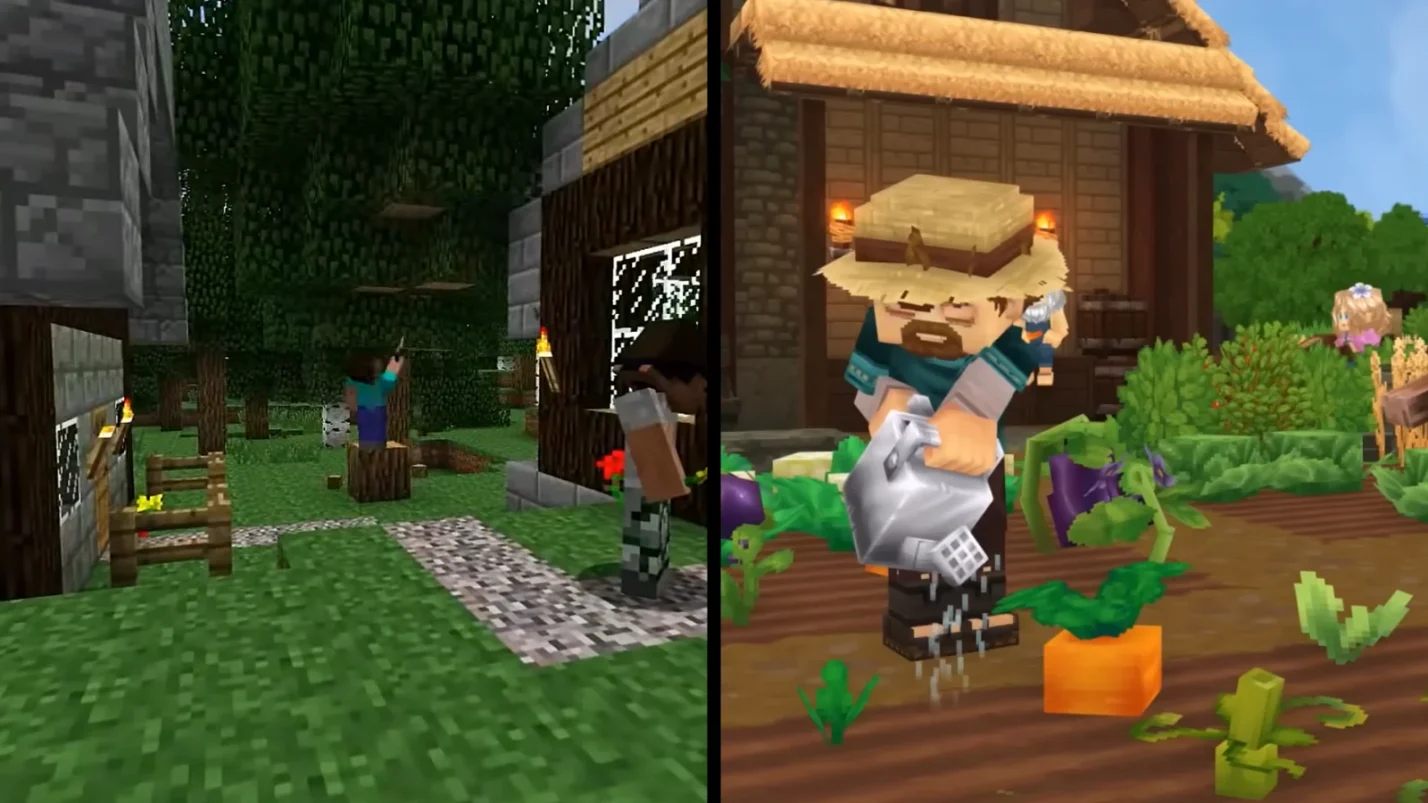
The world of Hytale is an RPG-first sandbox built around quests, distinct regions, enemy factions, and character-centric systems. Players are nudged through content with clear objectives, narration, and combat encounters that reward advancement.
Minecraft, by contrast, represents a pure sandbox philosophy. There are no required quests, storylines, or progression paths. Players decide what matters, choosing from survival, building, automation, exploration, or redstone engineering. This freedom is what allows Minecraft to support wildly different playstyles using the same core mechanics.
It’s also because of this fundamental difference that shapes everything else. Hytale emphasizes curated experiences and multiplayer content. Whereas Minecraft emphasizes creativity and long-term replayability driven by the community.
Honestly, neither approach is inherently better, so I can’t possibly announce a winner in the Minecraft vs Hytale comparison, but they do appeal to different players. Those who enjoy guided progression would gravitate toward Hytale, while players who value doing their own thing right from the start often prefer Minecraft.
Hytale vs Minecraft: Development Status & Feature Completeness
Minecraft has been out for a while now, since May 2009, specifically. It’s fully released and widely available across multiple platforms, including PC, consoles, and mobile. The game has 17 whopping years of updates backing it up and boasts a legendary modding community. I particularly appreciate the game’s high stability and features like redstone (for mechanical creations), biomes, and multiplayer, all well-established and widely supported.
Hytale, on the other hand, only recently launched in January of 2026 and is in its early access phase with ongoing updates. Development for this game began all the way back in 2015 by none other than, surprise surprise, members of a Minecraft server team! Although the original Hytale mod is still available, it proved so ambitious that it became a standalone game.
Having said that, players have access to Hytale’s core experience, but features and quality-of-life systems are still being refined through patches. Its development team is pretty committed to providing a slew of frequent and beefy updates that add content and improve stability. Eager to try this game out? Choose best Hytale server hosting and start the journey today!
With all the above considered, you should expect Minecraft to offer a more stable, complete foundation today. Hytale’s development seems quite promising, but I’d give it a few years before putting the completion tag on it.
Hytale vs Minecraft: Combat Systems
A Hytale vs Minecraft comparison cannot be considered complete without shedding light on the combat systems for both games. Each game approaches fighting with a very different design goal.
In Hytale, weapons are designed with intentional movesets rather than single-click attacks. For example, lighter sword attacks feel fast and responsive for crowd control, while heavier attacks hit slower but deal more damage or stagger enemies. Combat often involves positioning, dodging, and choosing the right attack for the situation. Let’s break it down:
Hytale combat typically includes:
- Distinct light and heavy attacks
- Abilities specific to weapons and animations
- Enemies that encourage tactical responses
In Minecraft, combat is far more straightforward. A sword, axe, or bow performs one primary action, with effectiveness mostly tied to weapon tier and enchantments. Swords swing at a fixed speed, axes trade speed for damage, and bows focus on timing shots.
Minecraft combat emphasizes:
- Simple weapon roles like swords, axes, and bows
- Gear progression over mechanical skill
- Accessibility across all playstyles
Overall, Hytale prioritizes engagement, while Minecraft favors simplicity that supports its broader sandbox freedom. Even though both have different angles for approaching combat, I would comfortably consider either title as one of the top multiplayer survival games available today.
Hytale vs Minecraft: Crafting
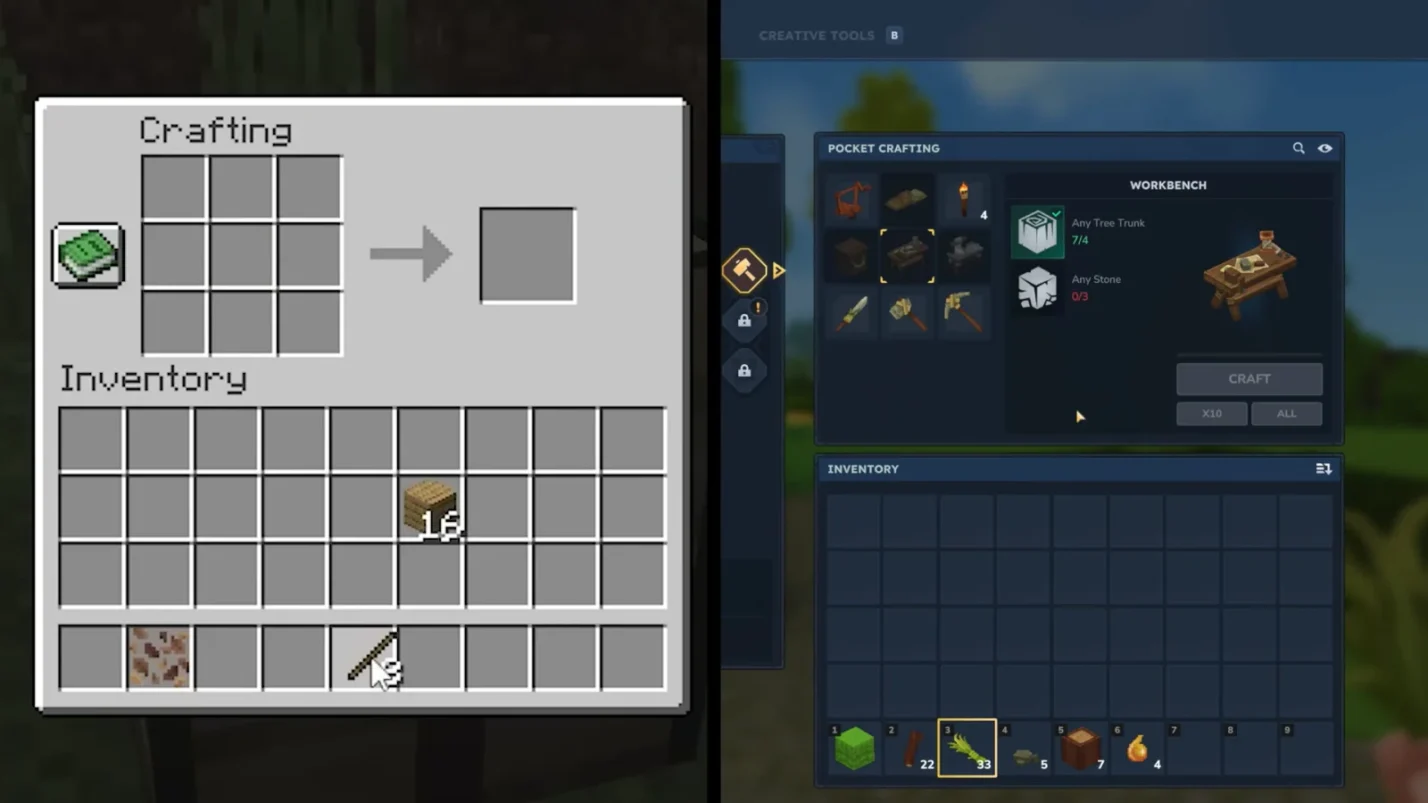
Crafting arguably highlights one of the biggest philosophical differences between Hytale and Minecraft. In Minecraft, crafting is recipe-based and largely unrestricted, which is also why this gameplay mechanic often appears in discussions around best games like Minecraft, especially for players who are hungry for unbridled creativity. This freedom supports experimentation and replayability, but it also means progression is mostly self-directed rather than guided by the game itself.
Hytale uses a more structured crafting progression, similar to Valheim-style systems. Players get new recipes to unlock as they explore, defeat enemies, and advance through regions. This creates a better sense of pacing, where crafting supports the overall progression loop instead of existing as a standalone system.
These two distinct approaches impact replayability in different ways. Minecraft encourages endless replays through creativity and mods. Hytale focuses on replay value through progression paths, builds, and cooperative progression, giving each playthrough a more deliberate flow. Neither system really pulls ahead of the other, but each shapes how players experience growth.
Hytale vs Minecraft: Modes
Both Hytale and Minecraft support single-player, co-op, multiplayer, and creative modes, but how players engage with those modes feels very different. The differences in Hytale vs Minecraft come down to flexibility versus curated experiences.
In Minecraft, modes are highly flexible. Single-player and multiplayer worlds follow the same core rules, with players free to set their own goals. Creative mode removes survival limits entirely, turning the game into a pure experimentation sandbox. With so much freedom, Minecraft is often listed among the best sandbox games for long-term creativity and player freedom.
Hytale takes a more guided approach. Single-player and co-op are designed around progression, objectives, and RPG systems that encourage players to move through content together. Multiplayer in this game shines by offering clearer roles, rather than relying solely on player-made rules.
To sum it up, Minecraft modes adapt to how players want to play, while Hytale modes are built to provide a more focused, cooperative experience.
Hytale vs Minecraft: World Generation & Exploration
Exploration in Hytale and Minecraft feels worlds apart due to how both games are built. Minecraft relies heavily on procedural randomness, creating endless worlds where biomes blend organically, and surprises come from unpredictability.
Hytale uses a more zone-based approach. While worlds are still large and explorable, regions are crafted with specific themes, enemies, and progression goals in mind. Although it’s set to get more randomized worlds, at the moment its exploration is more structured, similar to what players expect from many of the best RPG games.
Hytale vs Minecraft: Engine & Technology
Since one version of Minecraft is built on Java, it’s an engine that has proven stable over time, its performance is well understood, and years of optimization make it reliable across many systems.
It also has a Bedrock version built in C++, which is largely the same but better for cross-platform play.
Hytale runs on a C#-based engine, which was chosen to support modern tooling, smoother performance, and deeper built-in mod support. This allows developers and creators to work with more advanced systems out of the box, especially for animations, combat logic, and multiplayer tools. The engine also supports a more unified experience between single-player and online play, which benefits co-op design.
From a player perspective:
- Minecraft feels established and predictable
- Hytale feels built with future scalability in mind.
That long-term potential is part of why it’s often discussed alongside the best co-op games for structured group play.
Hytale vs Minecraft Similarities
Even though they have different design goals, Hytale and Minecraft share a common sandbox foundation, which is why they’re so often compared. At their core, both games give players tools to shape the world and create unique experiences through play rather than scripted outcomes.
If I had to talk about blatant similarities, both titles are built around open-ended worlds where building, exploration, and experimentation drive progression. Players aren’t limited to a single path and can spend countless hours constructing bases, exploring new areas, or simply interacting with the environment in creative ways.
Another major similarity is their voxel or block-based environments. Worlds are fully destructible and modular, allowing players to reshape terrain, gather resources, and construct complex structures block by block. This kind of design encourages creativity and makes the world feel reactive to player actions.
Exploration also plays a key role in both games. Biomes, landmarks, and hidden structures act as motivators, rewarding curiosity and encouraging players to tread on along the beaten path. Alongside this, both games support single-player and multiplayer, making them enjoyable solo or with friends.
On top of all that, both thrive on content that appeals to the community. Mods and maps extend longevity, which is also why many players searching for the best games like Hytale also find themselves returning to Minecraft.
My Overall Verdict: Which Game Should You Play?
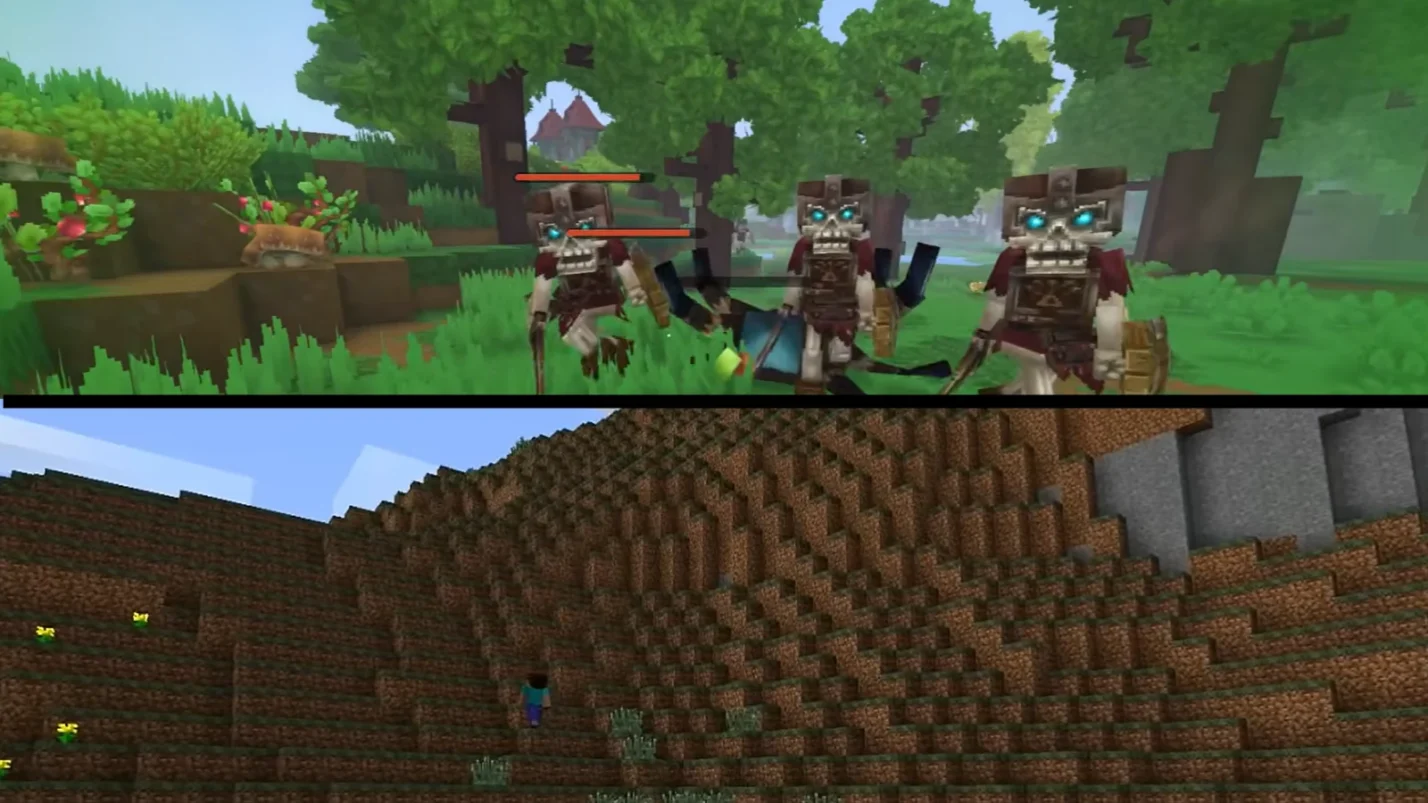
Choosing between Hytale and Minecraft isn’t about which game is better overall, but which one better matches how you like to play. Both offer sandbox freedom, yet they cater to very different player expectations.
Hytale is best for players who enjoy structured progression and RPG-style combat. If you like clear goals and systems that feel purpose-built rather than improvised, this game is going to hit home.
Minecraft is best for players who value total creative freedom and long-term replayability. If you enjoy setting your own goals, experimenting endlessly, and shaping the experience through mods and community servers, Minecraft remains unmatched.
GAMES LIKE MINECRAFT
FAQs
No. Hytale isn’t objectively better than Minecraft; the word we’re looking for is different. Hytale focuses on structured progression, RPG-style combat, and guided content, while Minecraft prioritizes total freedom and creativity. The decision comes down to choosing between direction and systems or open-ended sandbox play.
Yes. Hytale leans heavily into RPG elements like quests, progression systems, enemy variety, and ability-focused combat. These systems give players clearer goals and a sense of advancement, making it feel closer to a traditional RPG layered on top of a sandbox world.
Yes. Hytale supports modding, but the approach is different. Mod tools are built directly into the game, allowing creators to modify systems, assets, and behaviors more cleanly. Minecraft relies on a massive mod ecosystem developed over many years.
Hytale is generally better for structured co-op play thanks to shared progression, quests, and combat systems designed for group play. Minecraft works well for co-op too, but it’s more freeform, relying on player-created goals rather than built-in cooperative structure.