

How To Sell on Amazon: 8 Legit Business Models in 2026



Understanding how to sell on Amazon means realizing there are multiple distinct business models to choose from. Some are easy to set up in just a few days, like selling a self-published Kindle book. Others take months and significant capital to launch, including building a private-label brand.
This guide breaks down eight ways to sell on Amazon, with details on costs, timelines, and skills required for each. The methods are ordered from low commitment to high investment instead of speed.
None of the methods listed here are instant-profit schemes that sound too good to be true. Backed by marketplace data, the honest reality of how to sell on Amazon is that the platform has grown more competitive and capital-intensive recently, though viable low-cost options still exist.
| QUICK VERDICT |
| Realistic? Yes, but the range is wide by design. Zero-capital creator paths (KDP, Merch on Demand, the Amazon Influencer Program) are the accessible, low-risk entry points. Inventory-based paths (private label, wholesale, arbitrage) can pay more, but need real capital, months of runway, and tolerance for rising fees and shrinking margins. |
Jump to:
Is Selling on Amazon Still Worth It in 2026?
Third-party sellers generated roughly $575 billion in global sales in 2025, about $305 billion of that in the US. But seller-facing costs are climbing faster than seller revenue: referral fees, fulfillment fees, shipping, and advertising combined totaled $172 billion in 2025, an 11% jump year over year and now around 24% of Amazon‘s total net sales, according to Marketplace Pulse.
The seller count tells the same story. Active sellers on Amazon.com fell from 584,000 in January 2025 to 500,000 by March 2026. Only 165,000 new sellers launched a listing in 2025, the lowest annual total Marketplace Pulse has recorded since it started tracking in 2015, down 44% from 2024.
The market is also consolidating: fewer than 8,000 sellers now generate half of Amazon‘s roughly $300 billion in US third-party sales, down from 15,000 sellers just three years ago. That’s real evidence that the platform is tilting toward well-capitalized, established operators.
None of that means selling on Amazon is a dead end. It means the “start today, profit tomorrow” hype doesn’t match reality, while the zero-inventory creator paths below remain genuinely low-cost, low-risk ways in.
8 Real Ways To Start Selling on Amazon
Each method below follows the same format: how to actually start, an honest reality check on what it pays and what it costs, and a direct link to the official program.
1. Retail / Online Arbitrage
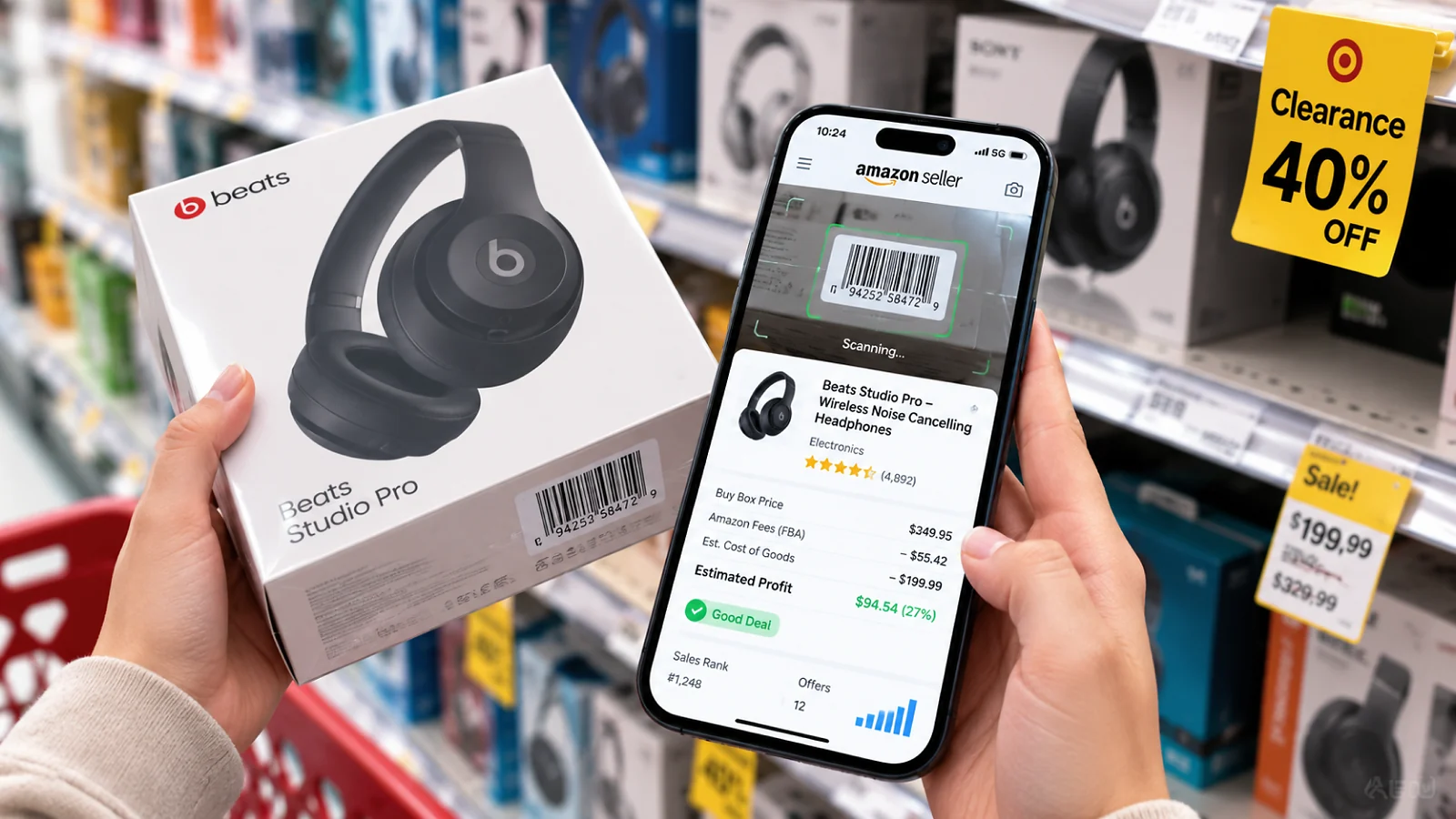
Retail and online arbitrage means buying discounted products (clearance racks, online deals) and reselling them on Amazon for a markup. It’s a great small business idea since it simply runs on a standard seller account, not a dedicated Amazon program, so there’s no special application to wait for.
How to start:
- Open a seller account: Register for an Individual or Professional account at sell.amazon.com and enroll in FBA.
- Scan before you buy: Use a barcode-scanning app in-store or on clearance sites to check an item’s current sell price, sales rank, and competition before purchasing.
- Ship and list: Prep and ship qualifying units to an Amazon fulfillment center under current labeling rules, then let FBA handle picking, packing, and shipping.
💡 Reality Check: Margin claims online swing wildly. Some guides tout 20% to 50% per item, but 2026 sources caution realistic net margins after all fees run closer to 10% to 20%, far below the inflated 50%+ claims common in marketing copy.
A widely cited Side Hustle Nation case study describes a couple turning $100 into $180,000 in sales within 12 months, though the write-up dates to 2020, so treat it as illustrative rather than a current benchmark.
Also, budget time for gating: several categories now ask for a wholesale invoice rather than a retail receipt to get approved, so confirm current requirements in Seller Central before you buy inventory.

2. Amazon Influencer Program
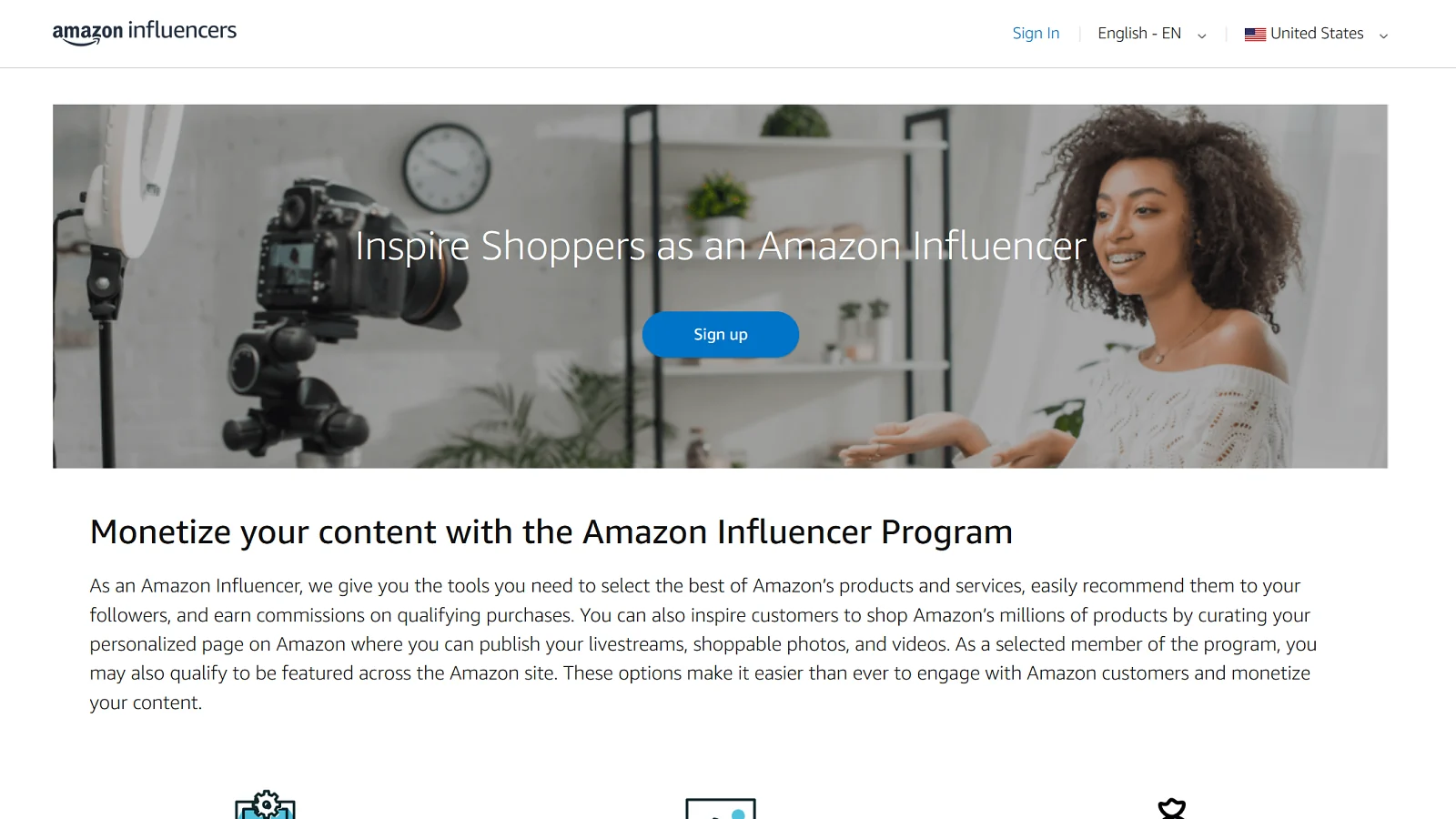
The Amazon Influencer Program turns an existing social following into a shoppable storefront, earning fixed commissions on qualifying sales. It costs nothing to join, but approval in practice favors accounts with real engagement, roughly 1,000+ followers, even though Amazon publishes no hard minimum.
How to start:
- Sign up as an Influencer: Go to affiliate-program.amazon.com and connect a primary social account (Instagram, TikTok, YouTube, or Facebook).
- Complete the tax interview: Submit a W-9 and US bank details so payouts have somewhere to land once you’re approved.
- Build your storefront: Once approved, set up your amazon.com/shop page and start posting shoppable photo and video content on product pages.
💡 Reality Check: Commission rates are fixed and modest, mostly 3% to 4.5% depending on category, up to 10% for luxury beauty. Self-reported creator income (not Amazon-published data) ranges widely: new influencers commonly report $50 to $300/month, established creators $500 to $2,000/month, and a few top earners $5,000+.
One 2026 aggregate figure puts the average micro-creator at around $312/month in pure affiliate commissions. Most successful creators earn more from brand deals via Creator Connections than from base commissions alone.
3. Merch on Demand
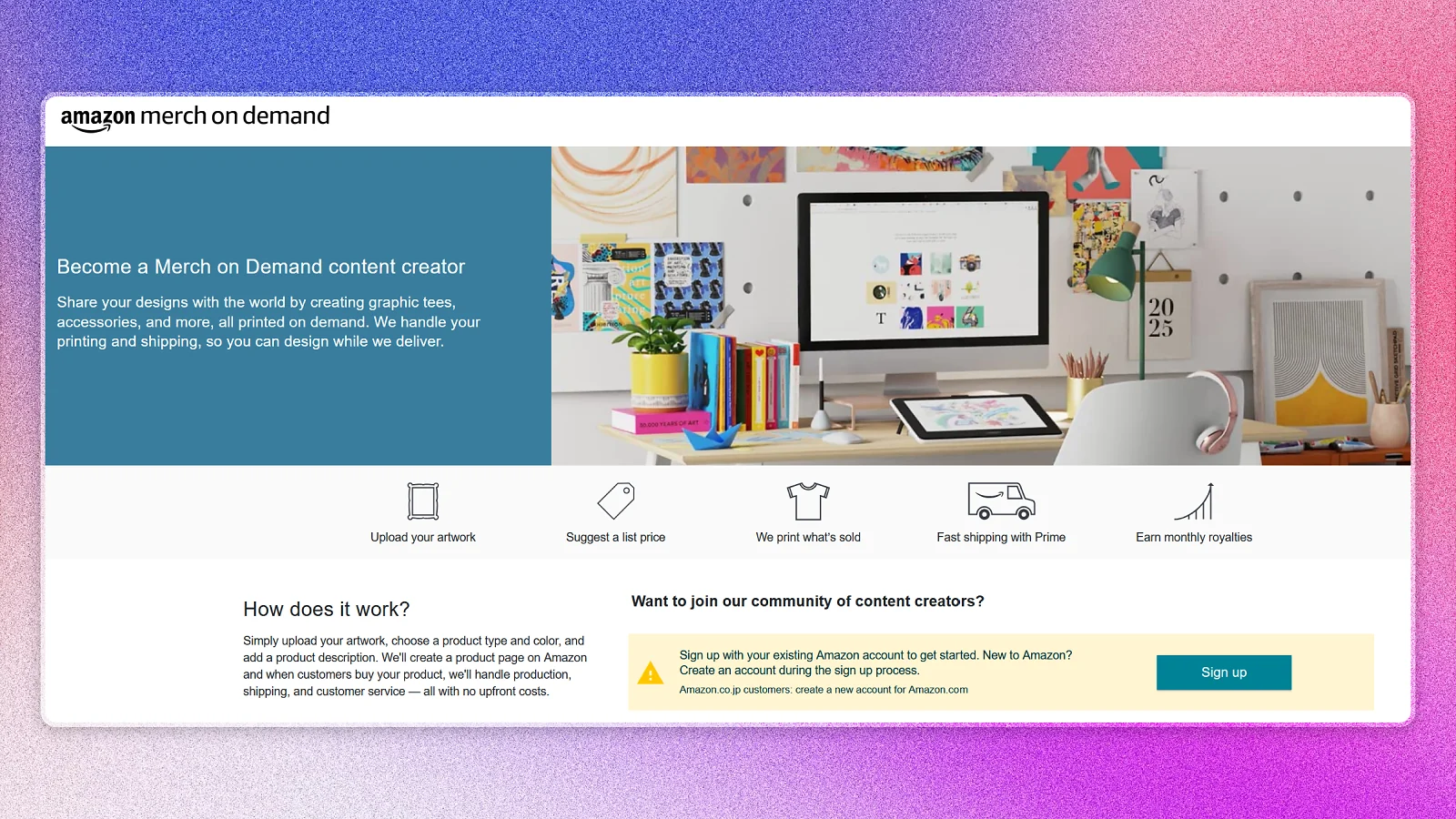
While some prefer playing games that pay money for quick cash, building a real asset is a smarter path. Merch on Demand lets you upload original apparel designs that Amazon prints and ships only after a sale, so there’s no inventory and no printing cost upfront. It’s invite-based, so approval isn’t instant.
How to start:
- Request an invitation: Apply at merch.amazon.com using an Amazon account and describe your design ideas.
- Prep designs while you wait: Approval can take anywhere from about a week to a few months, depending on open capacity, so use the wait to build a batch of original, non-infringing designs with keyword research for each.
- Upload and price: Once approved, upload designs across available product types and price within Amazon‘s allowed range for your royalty tier.
💡 Reality Check: Royalties were restructured into tiers in June 2026, based on how much traffic you drive yourself, per Merch on Demand‘s own dashboard: a $19.99 shirt earns about $2.44 at the default Creator Tier (Amazon organic traffic only), rising to roughly $4.88 to $5.27 if 15% or more of your traffic comes from outside Amazon.
One seller sold their Merch business for $93,077, netting $79,116 after commission. A separate income report cites an average of just $652.55/month over six months, a wide gap worth keeping in mind.
4. Kindle Direct Publishing (KDP)
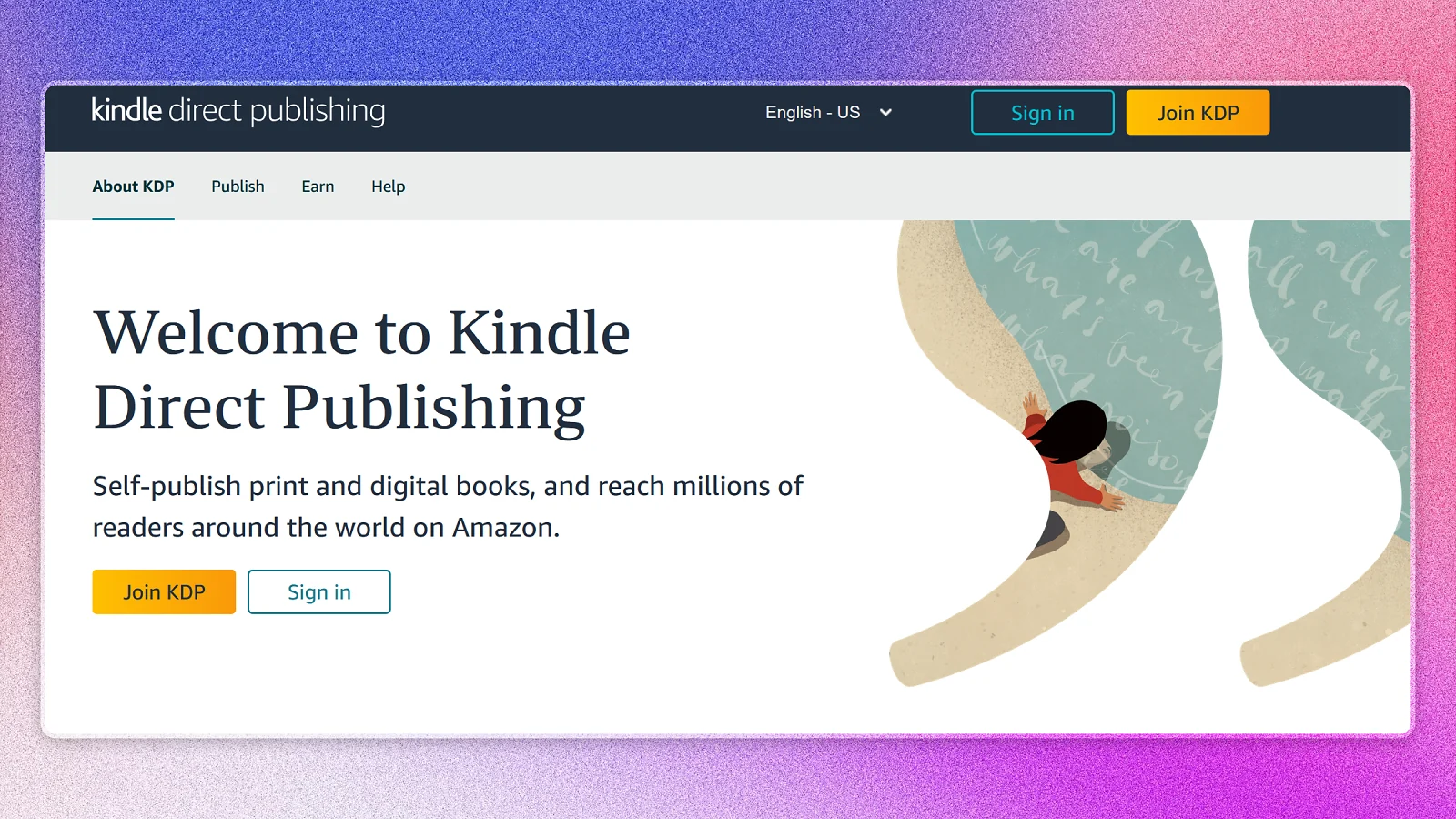
Kindle Direct Publishing lets anyone self-publish an eBook or paperback directly to Amazon, for as little as $0 if you handle editing and cover design yourself. Per Amazon‘s own KDP page, a published book goes live in about 72 hours. If you already write professionally, this method is a good alternative to freelance jobs online.
How to start:
- Create a free account: Sign up at kdp.amazon.com, no cost to join.
- Format and design: Write or convert a manuscript using KDP‘s free tools or Kindle Create, then design or commission a cover.
- Choose royalty and publish: Pick the 35% or 70% royalty plan, decide on KDP Select enrollment, and publish.
💡 Reality Check: The 70% royalty tier only applies to books priced $2.99 to $9.99 in eligible territories (35% otherwise). KDP Select‘s 70% eligibility comes with a 90-day exclusivity requirement, so the book can’t sell on Kobo or Apple Books at the same time.
Royalty payouts follow roughly 60 days after the sales month ends, a widely reported standard worth confirming on KDP‘s own payment help page. A secondary summary of a 2025 indie author survey reports that around 44% of authors earn $100/month or less, while active authors with a real catalogue and marketing plan see a median of $12,000 to $15,000/year.
5. Dropshipping via Amazon (Done Compliantly)

Dropshipping on Amazon is legal only in one specific form: you must be the seller of record, meaning only your business name appears on packing slips, invoices, and packaging. Buying from a retailer or another seller and having them ship directly under someone else’s branding is explicitly against Amazon‘s policy, not a gray area.
How to start:
- Secure a compliant supplier agreement: Sign a written agreement with a legitimate supplier or 3PL confirming only your business name appears on all packing slips, invoices, and packaging.
- Register and list carefully: Open a Professional seller account and list products only where compliant fulfillment can genuinely be guaranteed.
- Test your own listings: Place a test order on your own product before scaling, to confirm the packaging and paperwork actually comply with Amazon‘s Drop Shipping Policy.
💡 Reality Check: This is the weakest-sourced model in this guide. Cost, margin, and proof-point data online almost always describe the prohibited retailer-direct-ship version, not the compliant one, so treat any specific dollar figures you see elsewhere with real skepticism.
Expect thin margins once referral fees and 3PL/supplier costs are counted, and see Amazon‘s official Drop Shipping Policy before signing any supplier agreement.
6. Wholesale

Wholesale means buying an already-proven product in bulk directly from its manufacturer or an authorized distributor, then reselling it on Amazon. Because the product already has demand, it can move faster than building a brand from scratch.
How to start:
- Find a proven product: Identify an established, ungated product with existing Amazon demand, then contact the manufacturer or an authorized distributor for wholesale pricing.
- Get real proof of authorization: Obtain a wholesale invoice or Letter of Authorization, since Amazon‘s ungating process requires proof you’re an authorized reseller.
- List and fulfill: Register a Professional seller account, get approval to sell the listing, and ship inventory to FBA or fulfill orders yourself.
💡 Reality Check: Expect to need $1,000 to $2,000 minimum to start small, more typically $2,000 to $10,000 to meet distributor minimum order quantities.
Margin estimates disagree meaningfully across sources. Some cite 10% to 25%, others up to 50%, others describe wholesale as steadier at 8% to 15%; roughly 10% to 20% net after fees is the most defensible range.
Verify any supplier the same way you’d verify a wholesale invoice: a real wholesaler has a physical warehouse and a phone line, not just an email or Telegram handle.
7. Private Label via Amazon FBA
Private label means sourcing a generic product from a manufacturer, branding it as your own, and selling it through FBA. It’s the most capital- and time-intensive path in this guide, typically two to four months from product selection to first live sale once sourcing, samples, and shipping are accounted for.
How to start:
- Research the product: Use a research tool such as Jungle Scout (from $29/month) to find a small, lightweight product priced $20 to $80 with 100 to 500 existing reviews and clear, undersaturated demand.
- Source and sample: Find a manufacturer, commonly through Alibaba, and order samples from more than one supplier before committing to a bulk minimum order quantity.
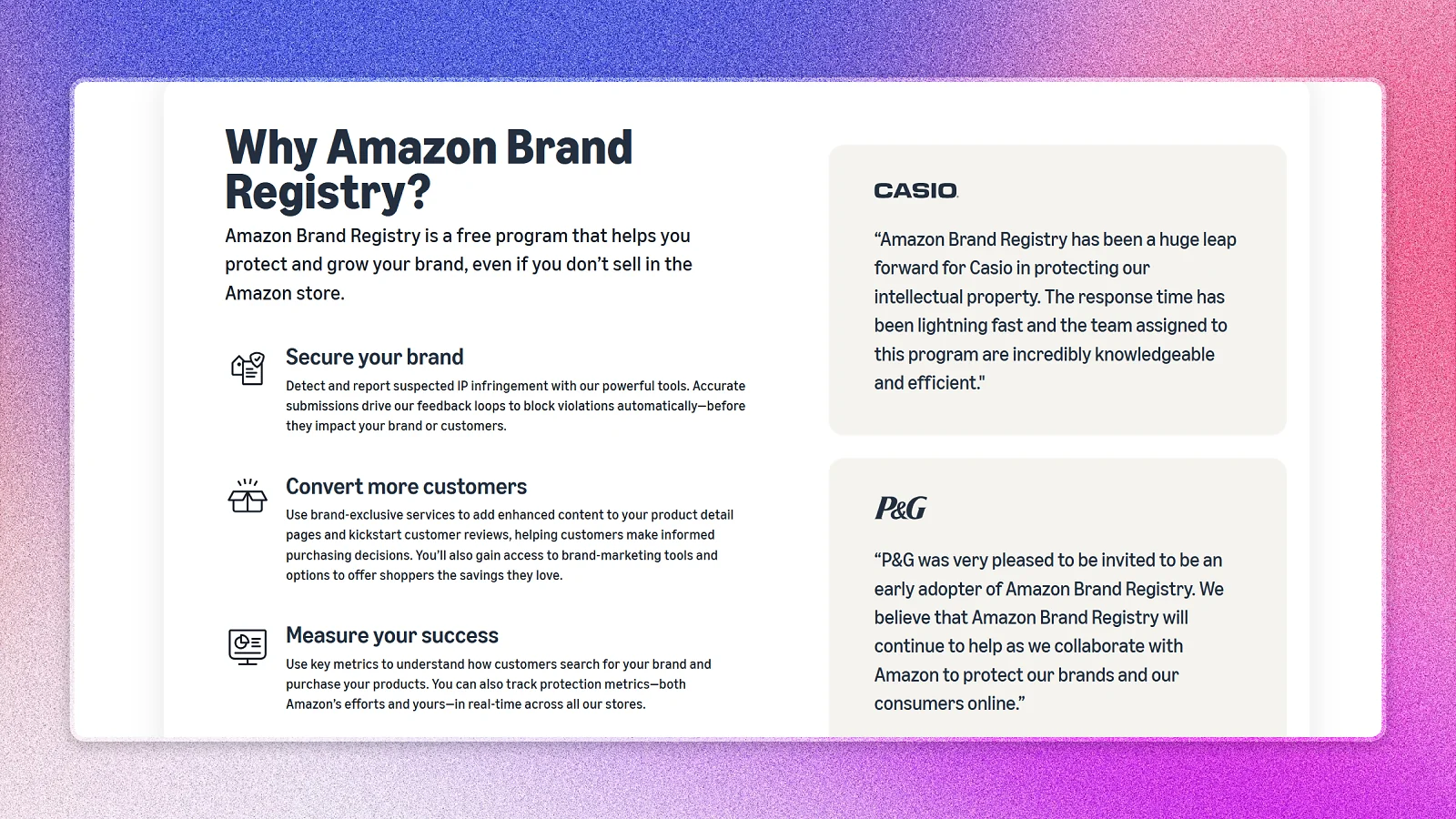
- Register and launch: Open a Professional seller account, enroll in FBA, create the listing, and register your trademark with Amazon Brand Registry once available.
Order samples from at least two different manufacturers before committing to a bulk order. It costs a little more upfront, but a single bad supplier can otherwise sink your entire launch budget.
💡 Reality Check: No single authoritative source confirms one startup-cost figure. Trade sources commonly cite $2,000 to $10,000 to cover samples, initial inventory, and a PPC launch budget.
A frequently cited case study reports one seller generating $75,762 in a single month, netting $57,033 after fees, though this comes from the seller’s own community and isn’t independently audited, so treat it as a striking outlier, not a typical result.
A secondary aggregator compilation (not Amazon‘s own data) puts average FBA seller revenue around $160,000/year, with a median closer to $35,000/year.
8. Amazon Handmade
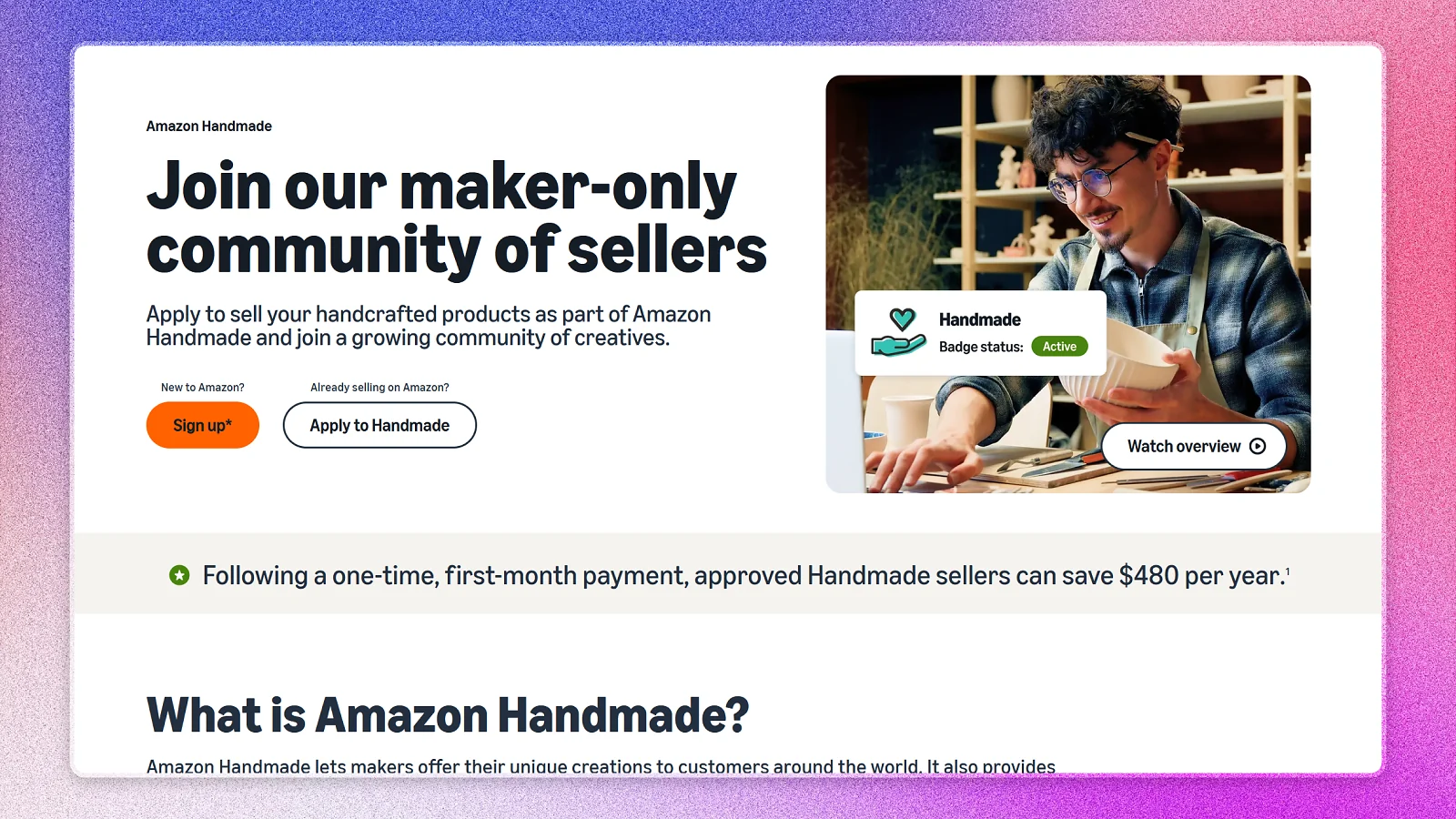
Amazon Handmade is for genuinely handmade, hand-altered, or hand-assembled goods made by a team of 20 or fewer using hand tools or light machinery, not mass-produced, factory-made, or resold items. Approval waives the $39.99/month Professional plan fee, saving roughly $480/year, confirmed directly on Amazon‘s own Handmade page.
How to start:
- Get a Professional account: Sign up for or upgrade to a Professional Selling Account.
- Apply to Handmade: Apply at sell.amazon.com/programs/handmade, describing your products and production process in detail.
- List and build your profile: Once approved, add the Handmade classification to listings and build a maker profile describing your creative process.
💡 Reality Check: Approval typically takes up to two weeks, sometimes just a few days. The referral fee is 15% of the sale price or $0.30, whichever is greater, confirmed on Amazon‘s own Handmade page.
This research turned up no strong, verifiable earnings proof point specific to Handmade sellers, so rather than force a weak anecdote, the honest takeaway is that net margin depends entirely on your own materials and production time, not a platform-wide average.
Best Amazon Seller Tools for Beginners
The right tools can make selling on Amazon much easier, especially if you’re just getting started. The good news is that you don’t need to spend hundreds of dollars on software right away.
Several trusted platforms offer free plans or useful free features that help you research products, estimate profits, optimize listings, and manage your business. As your sales grow, you can always upgrade to paid plans with more advanced features.
- Amazon Seller App (Free) – Amazon‘s official app lets you scan product barcodes, compare current prices, estimate profitability, manage inventory, and monitor orders from your smartphone. It’s an essential tool for beginners, especially those interested in retail or online arbitrage.
- Amazon Revenue Calculator (Free) – Before sourcing inventory, use Amazon‘s free calculator to estimate fulfillment fees, referral fees, shipping costs, and potential profit margins. It also compares Fulfillment by Amazon (FBA) with Fulfilled by Merchant (FBM) to help you choose the best fulfillment option.
- Keepa (Free Features) – Keepa tracks historical pricing, Best Sellers Rank (BSR), and stock availability. Instead of judging a product based only on today’s price, you can see long-term sales and pricing trends before making a buying decision.
- Helium 10 Free Plan – Helium 10 offers limited access to product research, keyword research, listing optimization, and profit estimation tools. While the free plan has usage limits, it’s an excellent introduction to the platform and the tools many experienced Amazon sellers use every day.
- Google Trends (Free) – Compare search interest over time to identify seasonal products and growing niches. It’s a simple way to validate demand before investing in inventory.
- Canva (Free) – Create product images, social media graphics, and promotional content without professional design skills. It’s particularly useful for KDP, Merch on Demand, Handmade, and Influencer creators.
Starting with these free tools allows you to learn the fundamentals while keeping costs low. Once your business becomes profitable, upgrading to premium software is a much easier decision.
Best Amazon Courses To Improve Your Selling Skills
A structured course can help you build the right skills faster than learning through trial and error alone. Unlike many expensive coaching or mentorship programs, these courses follow a self-paced curriculum with organized lessons and practical exercises. Start with the free options to learn the fundamentals, then choose a paid course that fits your goals.
Free & Freemium Courses
- Amazon Seller University – Amazon‘s official training platform with lessons on account setup, product listings, FBA, advertising, inventory management, pricing, account health, and Seller Central. It’s the best starting point for learning Amazon‘s latest policies, Seller Central features, and recommended best practices.
- Amazon Ecommerce Marketing & Sales: SEO & Ads (Coursera) – Self-paced course covering Amazon SEO, keyword research, listing optimization, sponsored ads, and strategies for increasing product visibility. You can audit the course for free or pay for a certificate.
- Amazon Dropshipping and Retail Arbitrage With AI (Coursera) – Beginner-friendly course covering Amazon dropshipping and retail arbitrage with an emphasis on Amazon‘s dropshipping policy and compliant selling practices. It also introduces product research, supplier sourcing, and FBM fundamentals.
- Become a Bestseller on Amazon as an Independent Author (Coursera) – A KDP-focused course teaching Amazon SEO for books, keyword research, category selection, and marketing strategies to improve discoverability.
Paid Courses
- 5-in-1 Amazon FBA Course: Beginner to 7-Figure Seller (Udemy) – A beginner-friendly introduction to Amazon FBA covering product research, sourcing, listings, launches, and business growth.
- Selling on Amazon Complete Course: FBA, FBM, Sponsored Ads (Udemy) – Covers both FBA and FBM, along with listing optimization, Amazon PPC, Brand Registry, pricing strategies, and day-to-day business management.
- How to Start an Amazon FBA Store on a Tight Budget (Udemy) – Bestselling course focused on launching an Amazon FBA business with minimal upfront investment while covering sourcing, listings, fulfillment, and cost-saving strategies.
- Freedom Ticket: Amazon FBA Course by Helium 10 – Comprehensive private label Amazon FBA training program covering product research, supplier sourcing, branding, listing optimization, product launches, Amazon PPC, and scaling a branded business. Access is included with eligible Helium 10 plans.
These courses on how to sell on Amazon offer a more structured learning path than learning solely from individual YouTube videos while remaining more affordable than many premium coaching programs.
Keep the Income Coming While Your Amazon Store Ramps Up
Even the fastest paths above rarely pay out immediately. KDP royalties typically follow about 60 days after the sales month ends; Influencer commissions run on a similar 60-day cycle; and standard Amazon seller disbursements land about every 14 days after your first sale, not your first listing.
While that first payout is still on its way, it’s worth having a low-effort backup that pays out sooner. Eneba’s guide to the 27 best online side hustles is a reasonable place to look for something to run alongside your Amazon store, not instead of it.
What Doesn’t Work: Amazon Selling Scams To Avoid
- “Done-for-you” Amazon automation agencies: The FTC’s case against Click Profit (also operating as FBALaunch, Automation Industries, PortfolioLaunch) alleges the company took at least $14 million from consumers who paid $45,000 to $75,000 upfront plus roughly $10,000 more for inventory, on promises of a passive-income Amazon store.
Amazon itself suspended or shut down 95% of Click Profit‘s storefronts for policy violations. Final judgments totaled $13.6 million and $7.3 million against the operators. Source: FTC press release.
- “AI-powered” e-commerce opportunity schemes: The FTC permanently banned the operators of Ecommerce Empire Builders in May 2025 after training programs costing around $2,000 and “done-for-you” storefronts costing up to $35,000 were marketed with unsupported claims of $10,000/month earnings. Source: FTC press release.
- Guaranteed “$100K/month” consulting schemes: Ecom Genie Consulting took more than $12 million from consumers with claims of “$100K+ per month” Amazon and Walmart stores before a 2025 settlement banned its operator from the business-opportunity industry with a judgment of nearly $14 million. Source: FTC press release.
- Fake “verified wholesale supplier” lists: Red flags include suppliers reachable only by email or Telegram with no verifiable warehouse address, prices 30% or more below market, and “wholesale club” directories charging recurring access fees. A real wholesaler earns money on margin, not membership dues.
- Paid reviews and review-manipulation schemes: Amazon sued AMZ Mastery in May 2024 for selling fake reviews and seller feedback and fraudulent seller accounts. And in August 2025, a King County court ordered the transfer of 75+ fraudulent domains tied to a review-broker network.
Amazon says it blocked over 275 million suspected fake reviews in 2024 alone, and has permanently banned established, multi-million-dollar brands for review manipulation. Source: Amazon‘s own account.
Final Verdict on How To Sell on Amazon
Learning how to sell on Amazon is still a real opportunity, but it’s a menu of eight genuinely different businesses, not one shortcut. The zero-capital creator paths, KDP, Merch on Demand, and the Influencer Program, remain the most accessible way in for anyone starting from zero today.
The inventory-based paths, arbitrage, wholesale, and private label, can pay more at scale, but they demand real capital, real time, and a tolerance for fees that are rising faster than seller revenue, in a market that’s consolidating toward well-capitalized sellers.
Start with whichever method matches what you actually have right now: a following, a skill, some capital, or spare time, rather than chasing whichever one looks fastest online.
FAQs
It takes a few days to several months to start selling on Amazon, depending on the method. KDP books can go live within 72 hours, while Merch on Demand and Influencer approvals take days to weeks. Retail arbitrage takes one to two weeks, and private label launches can take two to four months.
To start selling on Amazon with no experience, Merch on Demand and KDP are the easiest options because they require no inventory and no upfront investment. The Influencer Program is also free to join, but you need an established social media audience with genuine engagement to qualify.
Yes, you can sell on Amazon for free with KDP, Merch on Demand, or the Influencer Program. For physical goods, an Individual seller account has no monthly subscription fee; Amazon simply charges $0.99 per item sold instead of the $39.99 Professional plan.
Yes, Amazon dropshipping is legal, but only if you’re the seller of record. Your business name must appear on all packaging and invoices. Having a retailer or another seller ship directly to the customer under a different branding is against Amazon‘s policy and risks suspension.
The cost to start selling on Amazon depends on how you sell. It starts at $0 for KDP, Merch on Demand, and the Influencer Program, $100 to $2,500+ for arbitrage, and $1,000 to $10,000 for wholesale. For private label, it’s about $2,000 to $10,000 or more.
Yes, Amazon FBA is still profitable for well-run operations, but margins are thinner than many expect, realistically 10% to 30% after fees, storage, and advertising. Rising seller fees and increasing market consolidation favor better-capitalized, efficient sellers, per Marketplace Pulse.