



How To Become an Ethical Hacker: Salary and Steps for 2026

Eneba Hub contains affiliate links, which means we may earn a small commission if you make a purchase through them—at no extra cost to you. Learn more


Recent update
Explore Udemy for guided practice with Kali Linux and VirtualBox. Build confidence in an isolated lab before considering certification.
Here’s how to become an ethical hacker: learn networking and Linux basics, practice in an authorized lab, document your tests in a portfolio, and apply for junior penetration tester or security analyst roles. Job-ready skills typically take several months of self-study to about a year with a structured course path.
ZipRecruiter puts average US annual pay at $135,269. That ethical hacker salary averages every listing, so check individual openings for entry-level pay. Readiness depends on your starting skills and your ability to run and explain tests independently.
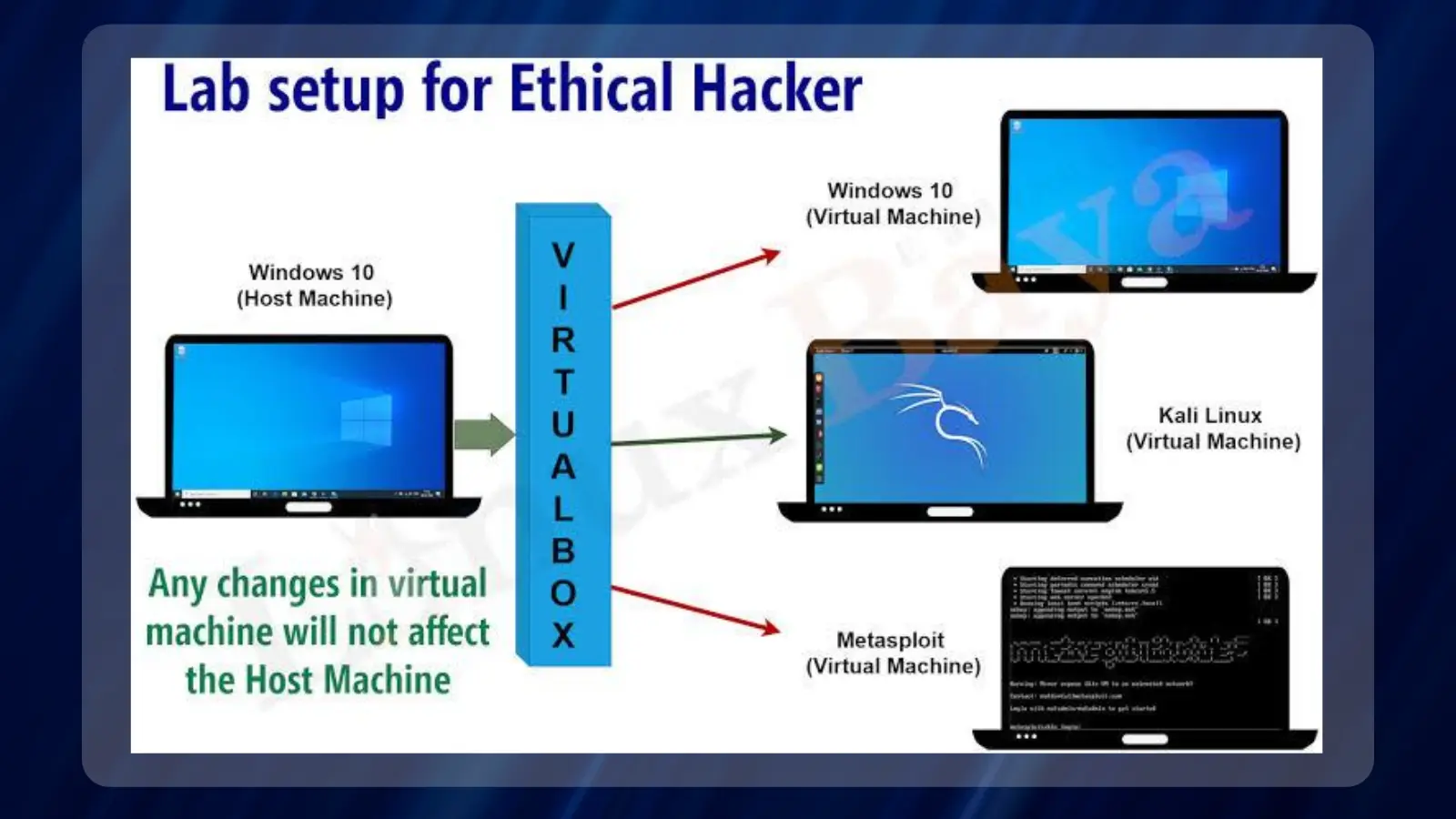
Start by installing Kali Linux inside a VirtualBox virtual machine and following a setup tutorial. Keep practice separate from your everyday systems, and postpone a paid ethical hacker course until you understand what you need to learn.
This guide covers qualifications, tools, salary, practical steps, courses, and alternate careers. It’s for IT workers, students, and self-taught learners who want to learn how to become an ethical hacker and need proof of ability that goes beyond a training certificate.
Jump to:
What Is an Ethical Hacker?
An ethical hacker is hired to break into systems with permission and find security weaknesses before criminals do. Permission and an agreed scope distinguish the work from unauthorized intrusion. The scope defines the systems and activities covered by that permission. Ethical hackers are often called white hat hackers, while black hat hackers break in without permission.
Ethical hackers work in security consultancies, internal security teams, and freelance penetration testing. Learning how to become an ethical hacker means accepting those boundaries even when a technical weakness is easy to investigate.
What Does an Ethical Hacker Do?
An ethical hacker job combines controlled attack simulation with evidence collection and practical recommendations. The work should help a system owner understand the problem and decide how to fix it.
Typical responsibilities include:
- Map the permitted environment: Identify systems, services, and exposed information within the agreed scope. This information-gathering stage, often called footprinting, establishes what needs closer examination without treating every reachable system as a permitted target.
- Validate weaknesses: Test known vulnerabilities on permitted systems to confirm which scanner warnings point to a genuine security issue. Keep evidence proportionate to the engagement and avoid collecting unnecessary sensitive information.
- Assess wireless security: Review approved wireless networks and their configuration. In a lab, that can mean putting a wireless card into monitor mode, capturing a handshake, and cracking the WPA/WPA2 key on a network you own. Tools like Aircrack-ng belong in an owned lab or an explicitly authorized engagement, never on a nearby network chosen for convenience.
- Evaluate human-facing risks: Support approved phishing simulations or other social-engineering assessments. These activities require their own scope and safeguards because they involve people, not only software.
- Write findings and retest fixes: Explain the affected system, supporting evidence, business impact, and recommended correction. Retesting establishes if the correction addressed the original issue.
Hands-on testing is only part of the work. Documentation, discussions with system owners, and careful preparation also occupy working time, so learning how to become an ethical hacker requires patience with writing as well as technical curiosity.
Roles in Ethical Hacking
The main tracks are penetration testing, security analysis, and red-team operations. They share security fundamentals, but an ethical hacker job can involve very different amounts of offensive testing.
Use the work itself, rather than the title alone, to compare these tracks:
|
Role |
What you’d do |
How much code |
First portfolio piece |
|---|---|---|---|
|
Penetration tester |
Run authorized attacks against networks and apps |
Light scripting (Bash, Python) |
A documented test on a home lab network |
|
Security analyst |
Monitor systems and respond to alerts |
Minimal |
A written incident-response walkthrough |
|
Red-team operator |
Simulate adversary activity against agreed objectives |
Moderate to heavy scripting |
A full attack-chain writeup from a lab environment |
Most beginners start in penetration testing, the broadest entry point, because lab exercises give learners a direct introduction to assessment work. A security analyst position can also build useful operational experience, but its duties may differ substantially from offensive testing.
A setup-focused ethical hacker course can help you build that first controlled environment.
Pros and Cons of Becoming an Ethical Hacker

Anyone weighing how to become an ethical hacker should know the role suits people who enjoy technical investigation and careful documentation. The trade-off is responsibility: curiosity must stay within the authorization you have.
These are practical considerations before you pursue an ethical hacker job:
| Pros | Cons |
|---|---|
| ✅ Clear entry tools – Kali Linux and VirtualBox are free, so you can start practicing in your own lab at no software cost. ✅ Transferable knowledge – networking and Linux skills support other technical careers. ✅ Growing demand – the Bureau of Labor Statistics (BLS) projects 21% growth from 2025 to 2035 for information security analysts, the closest category it tracks. ✅ Flexible entry routes – certifications and a documented portfolio can support an application, and BLS notes some information security analysts enter with a high school diploma plus training and certifications. ✅ Strong listed pay – ZipRecruiter shows annual ethical hacker salaries from $101,500 to $162,000. | ❌ Strict legal boundaries – testing without written permission is illegal. ❌ Pay plateaus quickly – ZipRecruiter reports that pay varies by only about $14,500, with few chances for raises even after several years. |
The biggest limitation is how little an ethical hacker salary changes with experience. Judge this path by its daily work and the responsibilities of actual openings, and do not count on seniority alone to raise your pay.
An ethical hacker certification may support an application, but it cannot remove these working constraints.
Ethical Hacker Qualifications
A four-year degree is not strictly required for anyone studying how to become an ethical hacker in the US, though many employers prefer one: BLS lists a bachelor’s degree as the typical entry-level education for information security analysts. Requirements differ by employer, so compare relevant openings before deciding that a degree or credential is necessary for your target role.
Readers researching how to become an ethical hacker without a degree should build evidence of practical ability while checking those requirements. A self-taught route still needs structure, feedback, and a way to demonstrate what you can do.
Build your preparation around these core areas:
- Education: Computer science or IT study can provide useful foundations in operating systems and networking. If you already have a degree in another subject, compare your knowledge with the role requirements before committing to another degree.
- Alternative study: Combine an ethical hacker course with independent exercises in a controlled lab. Reproduce a lesson, explain why each action was appropriate, and repeat the exercise without following the instructor’s sequence.
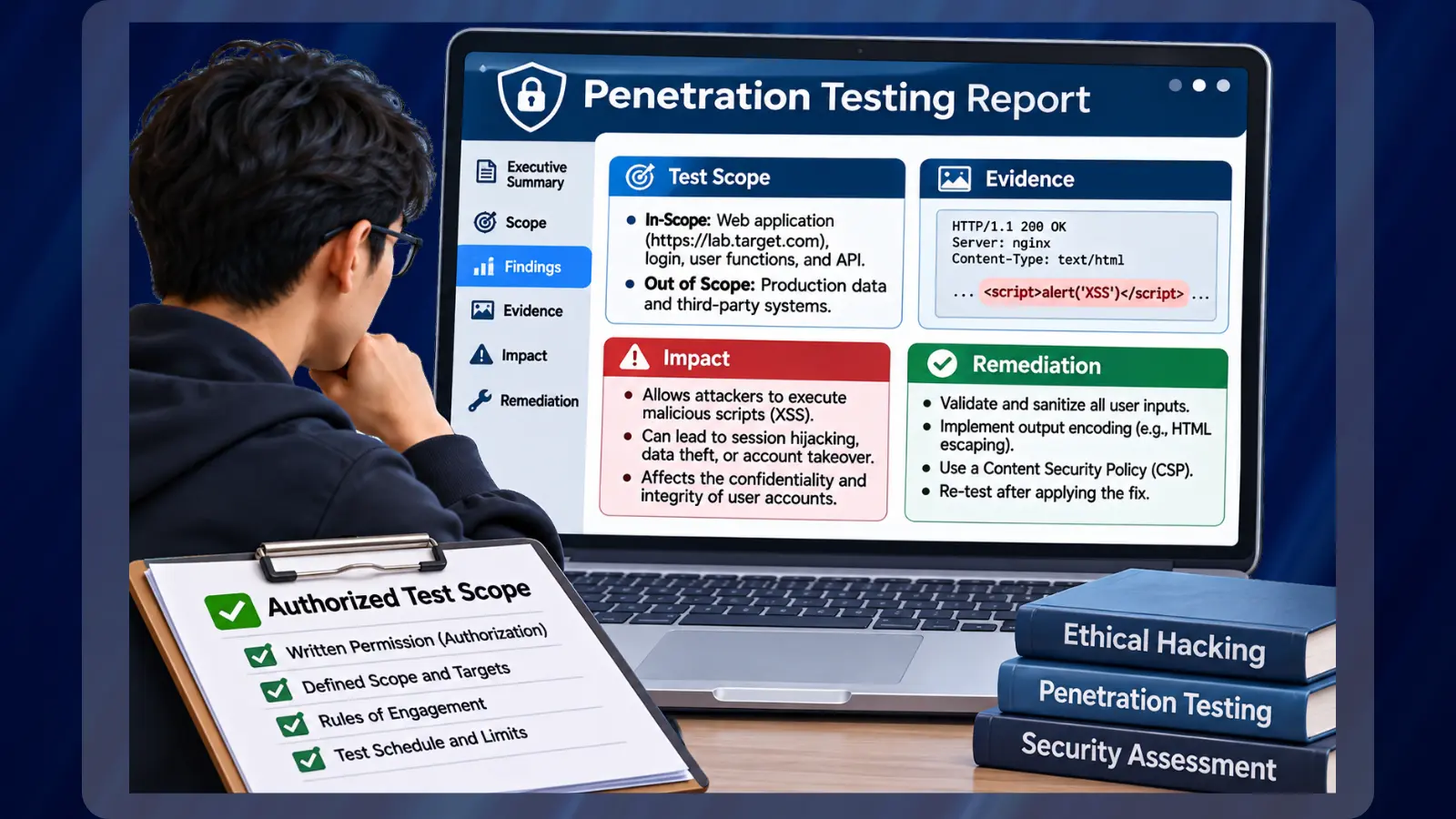
- Portfolio and experience: Keep sanitized reports from permitted tests. Include the scope, environment, evidence, impact, and remediation advice. If you supported a team exercise, identify your own contribution instead of presenting the entire project as individual work.
- Certifications: Compare an ethical hacker certification like EC-Council’s Certified Ethical Hacker (CEH), a vendor credential, with the requirements of jobs you want. A course that covers related subjects does not automatically award the vendor credential.
- Communication: Practice concise report writing and clear explanations for non-specialists. State what the evidence supports, separate uncertainty from confirmed findings, and avoid overstating the impact of a lab result.
These areas reinforce each other. An ethical hacker certification can signal structured study, while a portfolio shows how you apply that knowledge. Neither should be presented as a substitute for experience when an employer explicitly requires it.
A useful portfolio includes unsuccessful investigations too, provided they explain your reasoning. Recording why a suspected weakness was not exploitable demonstrates judgment and helps prevent exaggerated findings.
The deciding factor is a working portfolio of documented, permitted tests. When you plan how to become an ethical hacker, aim to discuss both the technical result and the limits of your assessment. A portfolio like that carries more weight than a credential alone or a list of tools you have opened.
Use an ethical hacker salary figure as context for the occupation. Training decisions should follow skill gaps and hiring requirements.
Kali Linux and the Tools Ethical Hackers Rely On
Every beginner needs one tool first: Kali Linux, a Linux distribution built for penetration testing. The setup-focused course below runs it inside VirtualBox. You do not need to master every bundled utility when planning how to become an ethical hacker.
The tools named in the training serve different purposes:
|
Tool |
Best for |
Price |
|---|---|---|
|
A penetration-testing environment |
Free (open-source) |
|
|
Separate virtual machines for lab exercises |
Free (open-source) |
|
|
Wireless assessment on permitted networks |
Free (open-source) |
|
|
Anonymity concepts and traffic-routing limits |
Free (open-source) |
Learn the virtual-machine setup and Linux terminal before adding specialist tools. An ethical hacker course should help you understand the purpose and limits of a tool instead of copying its commands.
Tor or a VPN does not authorize an activity or replace engagement rules. Tool familiarity also does not establish eligibility for an ethical hacker certification.
Ethical Hacker Salary and Career Progression
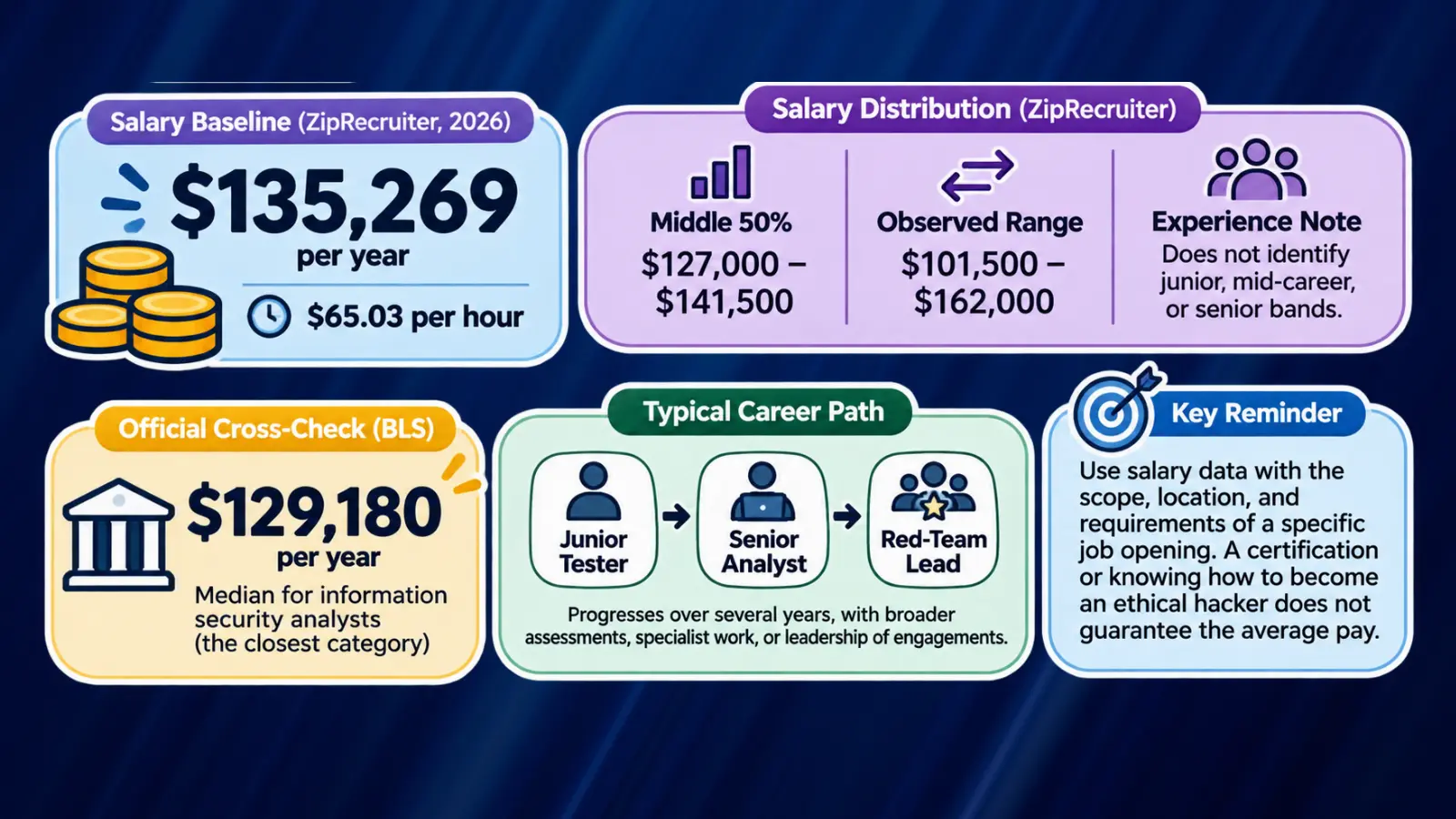
The ethical hacker salary baseline from ZipRecruiter is $135,269 a year in the US, or about $65.03 an hour, based on 2026 data. That is an occupational average across all listings, so it does not describe a starting salary.
The same source provides key distribution context:
- Middle of the distribution: The middle 50% spans $127,000 to $141,500.
- Observed range: Listed annual salaries extend from $101,500 to $162,000.
- Experience interpretation: These figures do not identify junior, mid-career, or senior bands.
For an official cross-check, the Bureau of Labor Statistics lists a median of $129,180 a year for information security analysts, the closest category it tracks.
A typical ethical hacker career path runs from junior tester to senior analyst or red-team lead over several years, with broader assessment ownership, specialist technical work, or leadership of engagements along the way. An ethical hacker job title alone does not tell you the level of responsibility.
Use ethical hacker salary data alongside the scope, location, and requirements of an individual opening. Knowing how to become an ethical hacker does not imply immediate access to the average, and an ethical hacker certification does not establish a particular pay band.
How To Become an Ethical Hacker: A Step-by-Step Guide
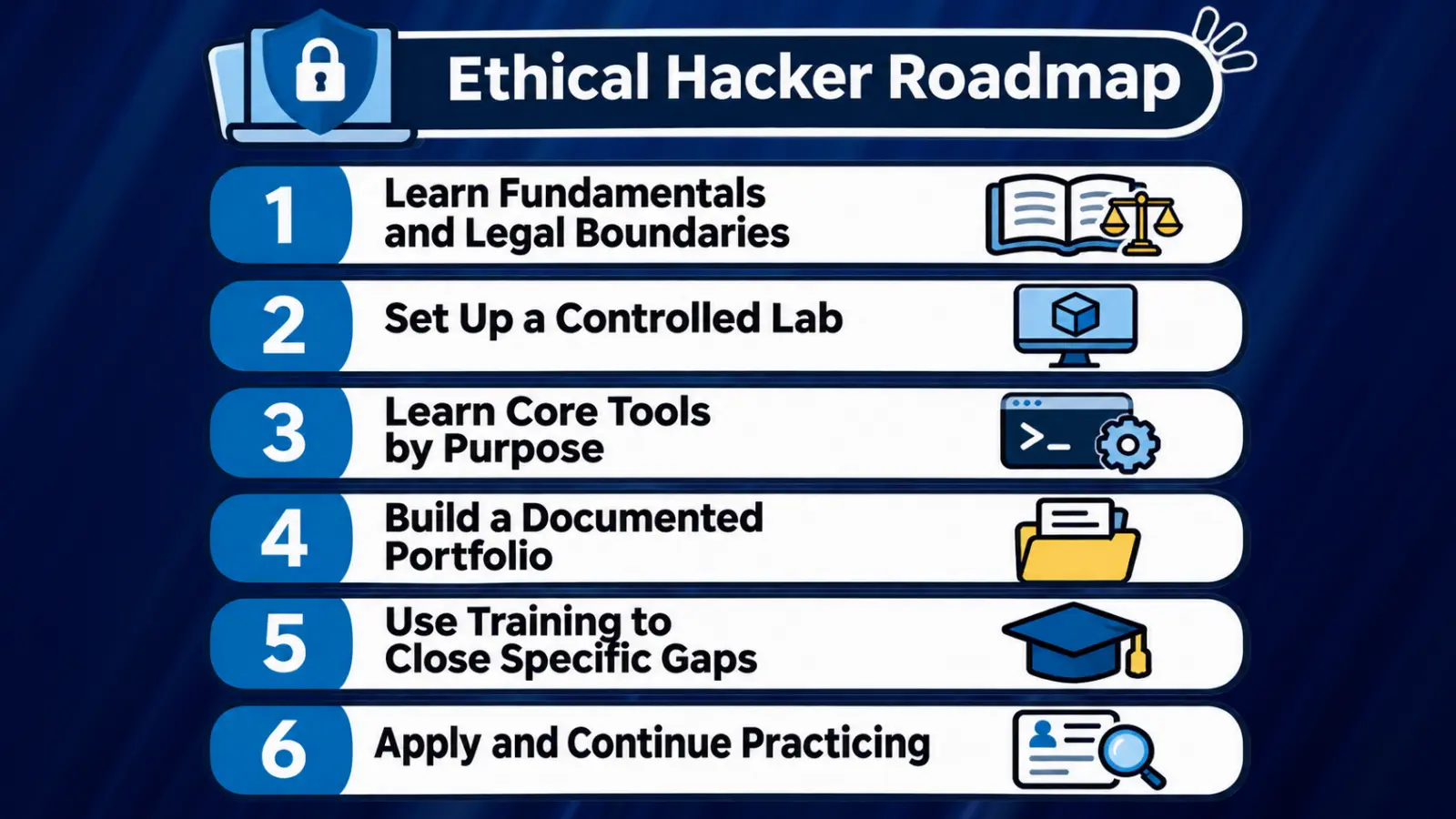
Job-ready skills typically take several months of self-study to about a year with a structured course path. Your progress depends on your existing IT knowledge and the quality of your practice, and the six steps below build toward independent, authorized testing and clear reporting.
Step 1: Learn Fundamentals and Legal Boundaries
Study networking and operating-system basics before using assessment tools. Learn how services communicate, how permissions work, how white hat, grey hat, and black hat hackers differ, and what separates an authorized test from activity outside scope.
Write a short practice agreement for your own lab that names the permitted systems and activities. This habit makes permission concrete. Becoming an ethical hacker requires restraint as much as curiosity, and your ethical hacker course should reinforce that distinction rather than treat legality as an introductory formality.
Step 2: Set Up a Controlled Lab
Install VirtualBox, then run Kali Linux inside a virtual machine. Follow the setup instructions carefully, and keep the practice environment separate from everyday devices and accounts. The Udemy setup course covers VirtualBox installation on Windows, Mac, and Linux.
Check the lab’s network configuration before beginning an exercise, because a virtual machine in its own window can still reach your home network. As you work through how to become an ethical hacker, learn to explain where your test traffic can go and which systems the exercise can affect.
Step 3: Learn Core Tools by Purpose
Practice Linux terminal basics, then study tools in relation to a defined assessment question. Aircrack-ng concerns wireless assessment, while Tor, VPNs, and proxychains relate to traffic routing and anonymity concepts, and macchanger changes a network card’s MAC address.
Keep wireless exercises on owned or explicitly permitted equipment. Learn the limits of each tool before interpreting its output as a finding. An ethical hacker certification syllabus can organize topics, but practical understanding requires explaining what a result means and what it does not establish.
Step 4: Build a Documented Portfolio
Write a report for each substantial lab exercise. Describe the authorized scope, the environment, your observations, and the correction you recommend.
A footprinting exercise or a WPA2 handshake captured from your own router can become a useful work sample when the reasoning is clear. Remove credentials and sensitive details before sharing it. Learning how to become an ethical hacker involves translating technical observations into decisions, so make the report understandable to someone who did not watch you perform the exercise.
Step 5: Use Training To Close Specific Gaps
Choose an ethical hacker course that addresses a specific gap, like virtual-machine setup or wireless-security concepts. The Recommended Courses section below distinguishes a setup-focused option from an intermediate specialist course.
Compare any ethical hacker certification, like the CEH, with your target role requirements separately. Course completion and passing a vendor’s certification requirements are different outcomes. Training should help you demonstrate practical ability as you work through how to become an ethical hacker. Collect credentials only when they serve a clear purpose.
Step 6: Apply and Continue Practicing
Apply to junior penetration tester or security analyst openings that match your current evidence. Tailor each application to the duties, and explain how your lab work relates to them without presenting practice as professional employment.
Read every ethical hacker job description closely: titles can conceal different technical responsibilities. Compare the advertised compensation with the ethical hacker salary baseline without treating the average as an entitlement. Keep improving your reports and technical explanations as you apply, since the field’s tools change constantly.
Kali Linux is the free starting point for the lab in Steps 2 and 3.

Recommended Ethical Hacker Courses
Choose an ethical hacker course by the skill gap it addresses. These options differ in scope, so each one suits a different starting point for anyone learning how to become an ethical hacker.
The setup-focused course on Udemy runs about four hours of video. Coursera lists its wireless, mobile, IoT, and OT course as intermediate level. IoT means connected devices, and OT means operational technology.
|
Provider |
Course |
What It Covers |
Duration |
|---|---|---|---|
 |
Start Kali Linux, Ethical Hacking and Penetration Testing! |
Kali Linux, VirtualBox, terminal basics, and introductory testing |
About 4 hours |
 |
Ethical Hacking: Wireless, Mobile, IoT and OT Hacking |
Wireless, mobile, connected-device, and operational-technology security |
3 hours |
Start with setup instruction if you need a working lab. Consider the specialist option after you have the foundations. Course completion certificates differ from vendor credentials like the CEH.
The focused Coursera option suits learners ready for specialist environments.
Alternate Careers in Ethical Hacking
Adjacent technical careers may fit better if you prefer building systems or reviewing controls to offensive testing. Consider these options before narrowing every application to an ethical hacker job. Median pay comes from the BLS for 2025:
- Security analyst: Monitor systems, investigate alerts, and respond to incidents. BLS lists $129,180 a year for information security analysts, and the trade-off is less offensive testing in favor of monitoring and response.
- Compliance and risk analyst: Examine controls, policies, and audit evidence. Median pay for compliance officers, the closest BLS category, is $80,730 a year. This offers less hands-on exploitation work and more interpretation and documentation.
- Software developer: Build applications and fix implementation problems. Median pay is $135,980 a year, according to BLS. The work places more emphasis on programming and product requirements than attack simulation.
The networking knowledge and reporting habits developed while learning how to become an ethical hacker can support these technical alternatives. Compare their daily responsibilities separately instead of assuming they share an ethical hacker salary range.
Final Verdict on How To Become an Ethical Hacker
An ethical hacker career is a strong fit if you enjoy investigation within clear boundaries and can explain technical problems in writing. The $135,269 ZipRecruiter average sets a baseline, and pay moves little with experience. Start with a controlled lab, then use a focused course to address gaps. An ethical hacker certification makes more sense when it matches requirements in the openings you target.
It is less suitable if you want pay growth through seniority alone or prefer unrestricted experimentation to permitted testing. Consider security analyst work for a less adversarial path, or compliance and risk work if you prefer evaluating controls. Planning how to become an ethical hacker requires comfort with permission, documentation, and the limits of your evidence.
Training supports that process and does not guarantee an offer. Keep this rule in mind when you map out how to become an ethical hacker: build skills you can demonstrate, document permitted work, and apply where that evidence fits.
The named Udemy course offers guided lab setup practice as you learn how to become an ethical hacker:
FAQs
ZipRecruiter reports that top earners at the 90th percentile make $154,000 a year. To avoid overpaying, compare each syllabus with the requirements in your target job posts, and buy a certification exam only when employers ask for it.
Learning how to become an ethical hacker takes several months to a year for job-ready skills. The CEH adds its own prerequisite: EC-Council asks for two years of IT security experience or official training before you sit the exam.
No, a degree is not a universal requirement across US roles. BLS notes that many information security analysts previously worked in IT, often as network or systems administrators, so an IT job can be a route in.
Yes, if you enjoy technical investigation and detailed reporting. BLS projects about 14,100 openings a year for information security analysts through 2035, mostly from workers who change occupations or leave the labor force.
Networking, Linux command-line skills, basic scripting, and clear report writing are the foundations. Learn enough Bash or Python to automate small checks, and read tool output critically before you report a finding. That mix is the core of how to become an ethical hacker.