


Get Paid to Learn a Trade: Paid Apprenticeships and Routes to Try in 2026

Eneba Hub contains affiliate links, which means we may earn a small commission if you make a purchase through them—at no extra cost to you. Learn more



Recent update
Use Indeed to compare advertised apprentice and trainee roles, then ask each employer about paid instruction, equipment costs, and progression.
You can get paid to learn a trade through an employer-sponsored apprenticeship or paid trade training programs with structured instruction. Starting costs and start dates vary by sponsor; confirm tuition, tools, fees, intake dates, and your first payday before accepting an offer.
Enrolling in paid trade training programs suits someone who wants to earn while developing practical skills rather than pay for classroom-only study first. Training length, tuition support, and entry requirements depend on the program. The trade-off is committing to an employer’s schedule and training structure, so judge the whole offer before you accept.
The guide covers pay, apprenticeship structure, and the steps to learn a trade and get paid.
Jump to:
Get Paid to Learn a Trade at a Glance

To get paid to learn a trade, compare employment terms and training commitments. These details separate a useful learning opportunity from a job that offers little structured instruction.
|
Startup cost |
Ask who pays for tuition, tools, safety gear, travel, and program fees |
|---|---|
|
Launch time |
Hiring, intake dates, and qualification timelines depend on the sponsor and trade |
|
Day-to-day responsibilities |
Supervised practical work and any required classroom or online instruction |
|
Main risks |
Limited early pay, physical demands, irregular schedules, and unclear training commitments |
|
Beginner suitability |
High when the opening explicitly accepts beginners and provides supervised training |
Paid trade training programs need more than an attractive job title. Start by identifying who employs you and who teaches you.
Who Pays You and How Paid Apprenticeships Work
The employer or sponsor pays your wage, while a training provider handles any separate instruction. A registration agency may also oversee a registered apprenticeship. Employment, instruction, and registration are distinct responsibilities, even when one organization coordinates them.
To get paid to learn a trade, establish who owns each part of the arrangement:
- Employer or sponsor: Hires you, assigns supervised work, and explains the wage and advancement terms.
- Training provider: Teaches the classroom or technical component, which may come through a union, college, or another provider.
- Registration agency: Maintains the program’s registered status where applicable. Registration is separate from an employer simply calling a vacancy an apprenticeship.
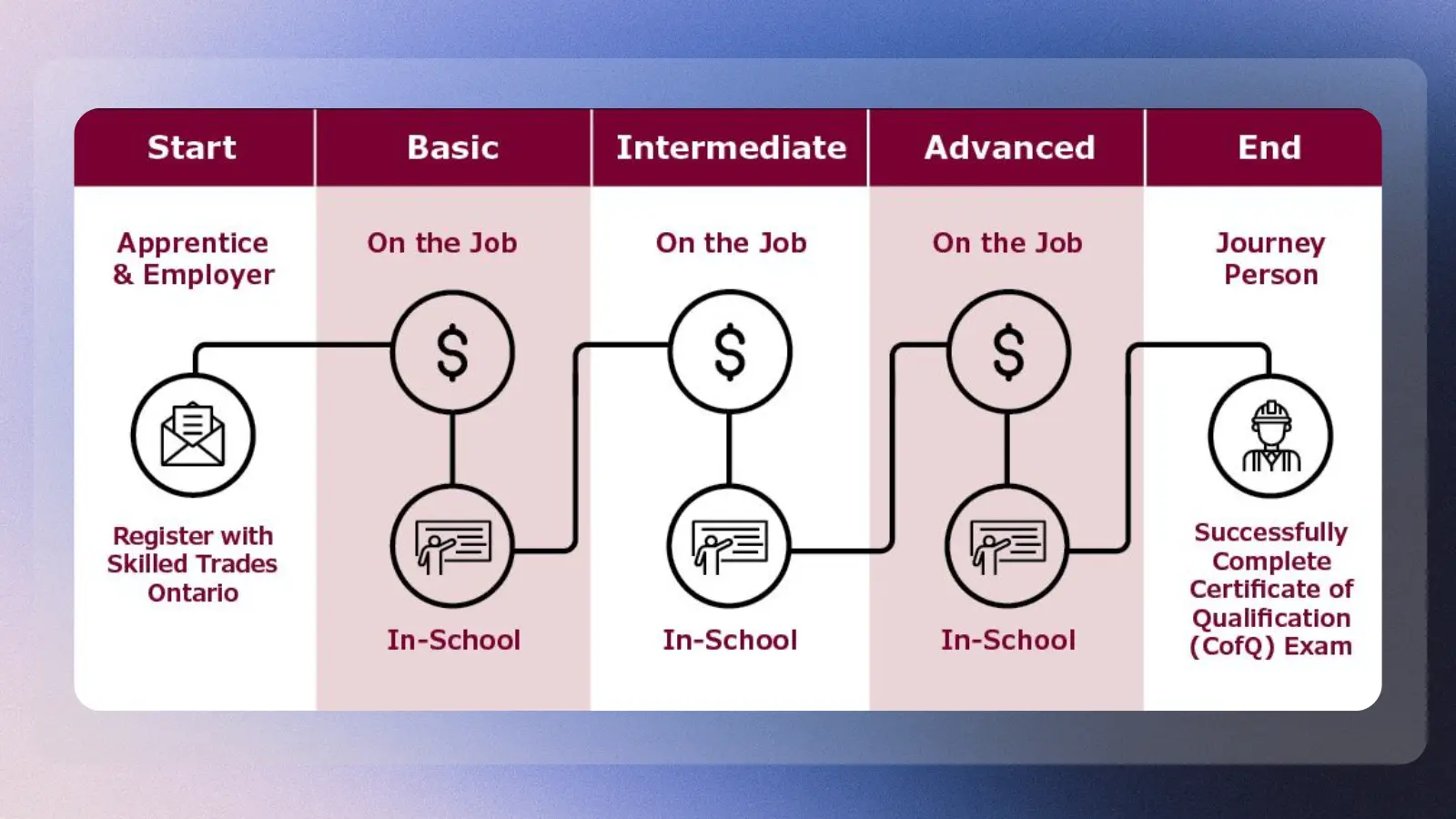
An apprenticeship that pays while you learn should have an understandable progression. Use this sequence to assess the route:
- Find an opening: Apply to registered paid trade training programs or an employer-run trainee role with explicit paid-training terms.
- Receive an offer: Review the wage, duties, start date, and conditions before accepting.
- Combine work and instruction: Complete supervised tasks and the coursework specified by the program.
- Meet advancement requirements: Ask how demonstrated competence, completed instruction, or logged hours affect pay.
- Complete the pathway: Establish which completion credential you receive and which licensing requirements remain.
Tools and Resources for Finding a Paid Trade Apprenticeship
You need a vacancy search and a way to compare offers before you need extra courses. Keep applications organized, and add supplemental learning or secondary income options like ways to get paid to complete online surveys, only when it supports your financial transition into an employer’s requirements.
These resource categories can help you get paid to learn a trade and find reputable paid trade training programs:
- Job search: Indeed lists apprentice and trainee vacancies with employer-specific conditions.
- Supplemental learning: CourseHorse offers a route to explore local skills classes when practical preparation is useful.
The platforms below serve different purposes within paid trade training programs.
|
Tool |
Best for |
Price |
|---|---|---|
 |
Local, hands-on skills classes |
Paid |
 |
Self-paced supplemental study |
Paid |
 |
Structured, trade-adjacent learning |
Paid |
 |
Apprentice and trainee vacancies |
Free |
Use job listings to establish what employers want before purchasing instruction. A course platform cannot replace a sponsor’s employment offer.
How Much Does It Cost to Get Paid to Learn a Trade?
There is no universal upfront price to get paid to learn a trade. An employer-paid wage does not establish who covers every training expense, so request a written cost breakdown rather than assuming the entire pathway is tuition-free.
Ask about these costs before accepting an offer to get paid to learn a trade through a paid trade apprenticeship:
- Tools and safety gear: Establish what the employer supplies and what you must bring before starting.
- Program or union charges: Ask about dues, enrollment charges, and deductions from wages.
- Transportation: Confirm the work location and any requirement to travel between sites.
- Instruction and exams: Identify who pays for coursework, study materials, licensing applications, and test attempts.
The overlooked cost is often the household budget during training. Compare the offered wage with your essential expenses and ask how advancement works. A strong future career path still needs to be affordable at its starting wage, especially if you need options to get paid quickly during initial low-wage periods.
Pros and Cons of Paid Trade Apprenticeships
A paid trade apprenticeship offers income alongside practical learning, but its value depends on the training commitment behind the job. Compare that commitment with the demands on your schedule and finances.
These are the advantages to seek and the trade-offs to assess when you get paid to learn a trade.
| Pros | Cons |
|---|---|
| ✅ Paid practical work – earn through an employment arrangement while developing skills ✅ Supervised learning – receive instruction during assigned work ✅ Potential tuition support – some sponsors cover related instruction ✅ Visible progression – a written schedule can explain advancement milestones ✅ Relevant experience – practice tasks connected to the occupation | ❌ Early-pay constraints – the starting wage may not cover your household needs ❌ Workplace demands – duties may involve physical labor, heights, travel, or irregular hours |
Compare the starting wage alongside supervision and advancement requirements. Favor affordable terms and a credible route toward the work you want to do independently.
Step-by-Step: How to Get Paid to Learn a Trade
Choose a trade, find suitable paid trade training programs, and assess the offer before starting work. A clear training agreement is more useful than a promise of fast advancement; hiring dates and program intake schedules differ.
Use the following roadmap to get paid to learn a trade without confusing a trainee vacancy with a complete qualification pathway.
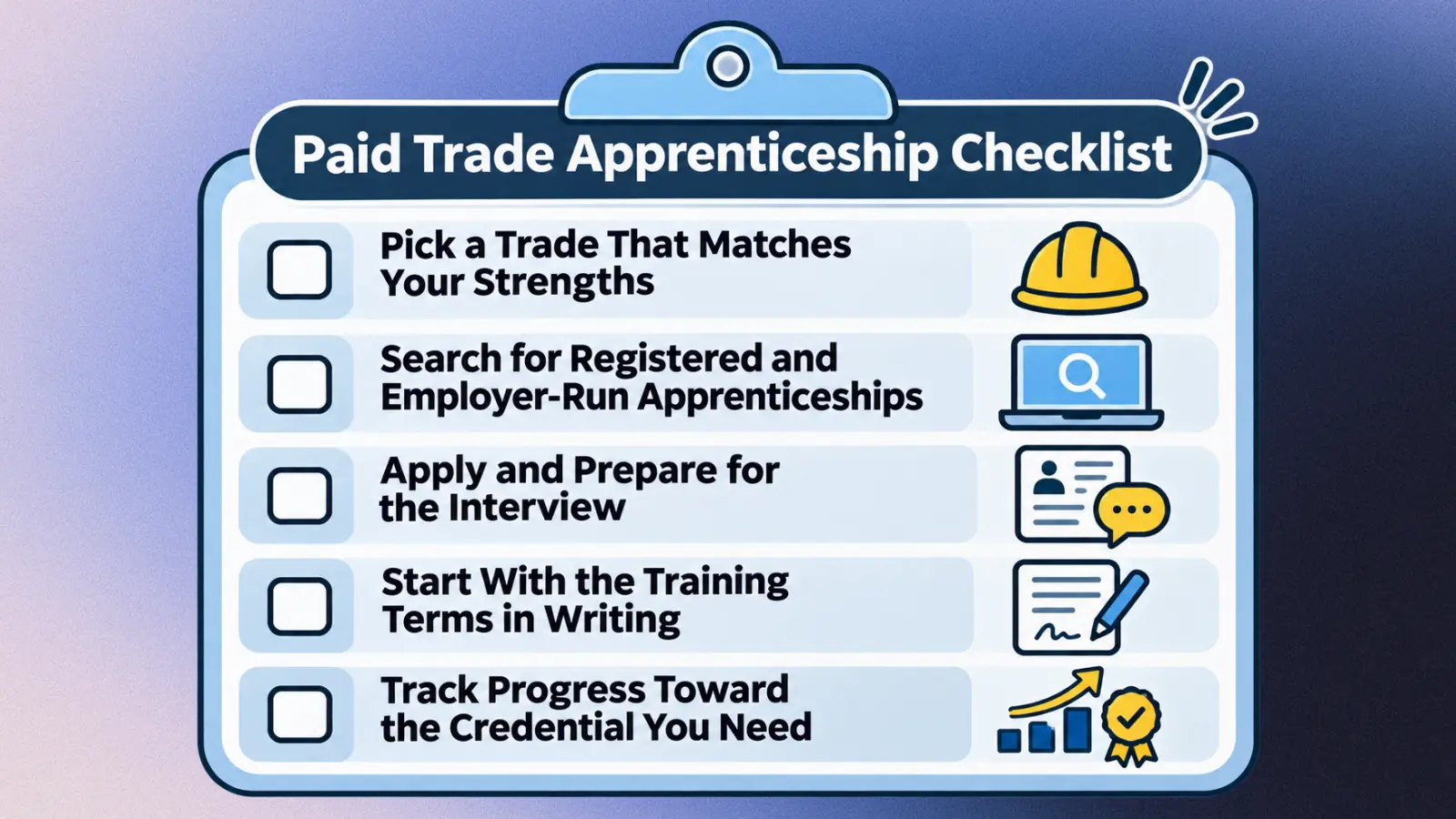
Step 1: Pick a Trade That Matches Your Strengths
Compare the daily work before comparing career headlines. HVAC involves heating, ventilation, and air conditioning; electrical work, plumbing, and elevator maintenance involve different tasks and working conditions. Ask about lifting, confined spaces, travel, and outdoor work rather than treating all trades as interchangeable.
Read the requirements for the occupation and location you are considering. Select work you can sustain, not simply the posting with the largest advertised pay figure.
Step 2: Search for Registered and Employer-Run Apprenticeships
Search Apprenticeship.gov and employer listings for your trade and location. Use terms like “apprentice,” “trainee,” and “paid training,” then read the full description. A search label alone does not establish registered status or payment for classroom time.
Look for an apprenticeship that pays while you learn and explains the learning structure. Compare the sponsor’s own information with the vacancy. Save the listing so you can refer to its wage and training promises during the interview.
Step 3: Apply and Prepare for the Interview
Tailor your resume to the opening’s stated requirements. Highlight reliability, practical tasks you have completed, and examples of following instructions safely. Describe transferable experience accurately, including remote skills if you’re earning money online from home, instead of claiming trade competence you have not developed.
Prepare questions about supervision, scheduling, and the work assigned to new hires. Bring any documents the employer requests through its legitimate application process. Someone seeking to get paid to learn a trade should be ready to discuss learning habits as well as availability.
Step 4: Start With the Training Terms in Writing
Review the employment offer before your start date. Confirm the wage, working hours, instruction schedule, and responsibility for equipment. Ask how your supervisor will introduce unfamiliar tasks and whom you should approach when a job exceeds your training.
Separate the base wage stated in your written offer from conditional bonuses and pay increases. Overtime, bonuses, and advancement may depend on conditions that are not part of base pay. A paid trade apprenticeship should make those distinctions understandable before you rearrange your finances around the offer.
Step 5: Track Progress Toward the Credential You Need
Record completed instruction and supervised work in the format your sponsor requires. Keep copies of assessments and completion documents, and ask how the program recognizes progress. Address missing records promptly rather than waiting until you apply for a qualification.
Confirm which requirements belong to the apprenticeship and which belong to a licensing authority. If you change employers, ask about credit transfer before leaving. Your goal is to get paid to learn a trade through a pathway whose progress you can document.
Keep those records accessible throughout training.

Build Trade Knowledge With Supplemental Study
Supplemental study can support a specific learning gap when participating in paid trade training programs. A completion certificate from these platforms is not a trade license or an exam-based vendor certification. Do not assume coursework counts toward either credential. Ask your sponsor which subjects need attention, and confirm any course’s recognition with the relevant licensing or certification body before enrolling.
Compare learning formats by their role in your preparation.
|
Course / Certification |
Provider |
What It Covers |
Pricing / Wage Details |
|---|---|---|---|
|
Practical Trade & Technical Workshops |
[FILENAME: coursehorse-logo] |
Local hands-on skills classes, woodworking, basic carpentry, and machinery operation workshops |
$45–$250 per workshop |
|
Construction Engineering & Management Certificate |
[FILENAME: coursera-logo] |
Structured online courses covering construction scheduling, blueprint reading, project management, and safety protocols |
$49/month (Subscription) |
|
Registered Trade Apprenticeship Pathways |
[FILENAME: apprenticeship-logo] |
Paid, employer-sponsored programs in electrical work, plumbing, HVAC, and carpentry with structured on-the-job training |
$16–$30/hr while learning |
|
Basic Electrical & Plumbing Fundamentals |
[FILENAME: udemy-logo] |
Self-paced video courses detailing wiring basics, pipe fitting fundamentals, trade math, and tool safety theory |
$19.99–$89.99 per course |
|
OSHA 10-Hour & 30-Hour Construction Safety Certification |
[FILENAME: osha-education-center-logo] |
Essential job site safety, hazard recognition, personal protective equipment (PPE), and health regulations |
$60–$180 (Often employer-paid) |
A course completion certificate is not a trade license. Keep supplemental learning tied to your sponsor’s training plan if your priority is to get paid to learn a trade.
High-Paying Trades Where You Can Earn While You Learn
Paid apprenticeships and on-the-job training programs allow you to get paid to learn a trade while working toward full certification or journeyworker status. While individual job postings fluctuate based on local market demand, looking at national wage data from government and workforce databases provides a reliable baseline for what you can expect as an entry-level trainee versus a fully certified professional.
The following trades offer structured pathways to paid training alongside benchmark wage data:
- HVAC apprentice: HVAC apprentices earn an average of $18 to $20 per hour (~$34,000 to $42,000 annually) while completing classroom and on-the-job hours.
- Window and door installation apprentice: Starting wages for installation helpers and apprentices typically fall between $19 and $25 per hour ($40,000 to $52,000 per year).
- Fire alarm and security systems trainee: Starting wages for these apprenticeships generally range from $18.50 to $25 per hour ($38,500 to $52,000 annually), with an average starting benchmark around $22.80/hour.
- Elevator mechanic trainee: Elevator mechanic apprentices earn an average national wage of $45,806 per year ($22.02 per hour). Starting probationary wages generally sit around 50% of the local journeyworker rate and scale upward annually as you complete classroom modules and required on-the-job hours.
- Entry-level fiber installer: Trainees and junior fiber pullers usually start between $19 and $23 per hour ($800 to $920 weekly).
When evaluating prospective opportunities to get paid to learn a trade, look beyond the initial base rate. Registered apprenticeships feature mandated wage progressions, meaning your pay increases automatically as you hit specific classroom and work-hour milestones.
Weigh factors like paid tuition, health coverage, pension contributions, and tool allowances alongside starting pay to understand the true long-term value of the training. Meanwhile, skills learned during hands-on projects can also help you make money with a hobby in your spare time.
Finding a Registered Apprenticeship Program You Can Trust
Start with an official apprenticeship resource, then verify the sponsor and written terms. Registered status and a clear agreement are separate checks; neither removes the need to understand your particular offer.
Follow this sequence before agreeing to get paid to learn a trade through a specific sponsor:
- Search the official resource: Use Apprenticeship.gov to explore the occupation and location. Follow the program’s application instructions rather than assuming every sponsor uses the same process.
- Identify the employer: Establish the organization’s legal name, work location, and contact details. An identifiable workplace and a named training contact make the arrangement easier to assess.
- Request the wage schedule: Ask for base pay, advancement conditions, and any deductions in writing. Separate pay you receive upon starting from increases tied to later milestones.
- Confirm the instruction provider: Ask who teaches the classroom component, where it takes place, and how it fits around work. Establish responsibility for tuition and materials.
- Speak with an apprentice: If possible, ask a current participant about supervision, scheduling, and access to instruction. Their account adds context but does not replace written terms.
Before accepting, review these essentials:
- Program status: Confirm any claimed registration through the relevant official resource.
- Costs and pay: Understand charges, deductions, and advancement conditions.
- Completion outcome: Identify the credential and any remaining licensing requirements.
Pause if a recruiter demands payment without explaining the employer, training agreement, or refund terms. Pressure to commit is a reason to investigate further, not a reason to rush.
Where Paid Apprentices Get Stuck
Unclear commitments in paid trade training programs can undermine otherwise useful instruction. Resolve scheduling, supervision, and progression questions early so your paid trade apprenticeship remains workable alongside your financial responsibilities.
These problems deserve attention before and after you get paid to learn a trade:
- Unclear advancement: Request the wage schedule and assessment criteria before starting. If an increase depends on demonstrated skills, ask how the sponsor records and evaluates them.
- Unexpected physical demands: Discuss the actual tasks and required protective equipment. Ask about a workplace visit or observation opportunity when available, and raise accommodation needs through the employer’s process.
- Conflicting classroom schedules: Establish when instruction occurs and how it interacts with shifts. Ask whom to contact if assigned work prevents attendance.
- Lost training records: Keep copies of approved hours and assessments. Ask a prospective new sponsor about recognition of completed work before changing employers.
- Too much supplemental study: Focus outside learning on the gaps your supervisor identifies. Purchasing unrelated certificates can consume money without advancing your program.
Vetting the sponsor reduces avoidable uncertainty. Once employed, raise problems with the designated training contact and document the response rather than allowing a misunderstanding to persist.
Apprentice Pay, Hours, and Safety Rules to Know
In the U.S., employment status, location, and program terms affect apprentice pay and workplace protections. Ask for applicable rules and safety procedures rather than assuming a training label explains them all.
Pay: Confirm your employee classification, base rate, deductions, and the wage rules that apply in your state. Ask the relevant labor agency about any apprenticeship-specific provisions.
Safety: Establish which training and protective equipment are required before assigned fieldwork. If an employer requests a particular safety credential, ask who provides it and who pays. Never treat an online course as permission to perform hazardous work without supervision.
Hours and overtime: Ask how the employer records fieldwork, required instruction, travel, and overtime. The treatment of these activities can depend on the arrangement and applicable law.
Licensing: A registered apprenticeship and an occupational license are different. Ask the licensing authority what you may do during training and what is required for independent practice.
Keep employment and training documents together as you get paid to learn a trade. This is general guidance, not legal or tax advice. Confirm applicable rules with your state’s labor agency.
Final Verdict on Getting Paid to Learn a Trade
A registered, employer-sponsored apprenticeship is a strong starting point for someone who wants paid work with structured learning. Favor an offer with clear supervision, affordable starting terms, and a defined completion outcome over a larger wage attached to vague training promises.
This route suits people ready to organize their lives around work and required instruction. It is a weaker fit if the available schedule conflicts with caregiving or if local starting pay cannot cover essential expenses. A school-based route may offer a more workable timetable, but compare tuition and employment implications before choosing it.
The best way to get paid to learn a trade is to select a credible sponsor whose written commitments match your needs. Decide on the starting offer you can accept, not an advertised future income.
FAQs
You can get paid to learn a trade by applying for a paid apprenticeship or trainee job. Review the wage, training terms, registered status, and completion credential before accepting an offer.
Your upfront cost depends on the sponsor, and paid employment does not automatically cover every training expense. Ask who pays for tuition, tools, safety gear, transportation, dues, and exams.
You earn under the employment terms once paid work begins. Application periods, hiring dates, and payroll schedules differ, so ask the sponsor for your start date and first payday before budgeting around the offer.
Yes, if the starting wage supports your budget and the program provides useful supervised training. Base your decision on the offered starting pay, schedule, costs, and completion requirements.
No, not every opening to get paid to learn a trade requires prior trade experience. Entry requirements differ by sponsor, so choose vacancies that explicitly accept beginners and explain the training provided.
Use Apprenticeship.gov to explore apprenticeship pathways and Indeed to compare advertised vacancies. Keep a focused resume and application log. Buy supplemental courses only when they address a specific training need.
No, 25 is not too old to start a trade apprenticeship. Many people begin apprenticeships in their 20s, 30s, and beyond as career changers, and employers frequently value the maturity, reliability, and work experience that older adult apprentices bring to the job.
Yes, if the employer or program accepts applicants without one; requirements differ by sponsor and occupation. Read the entry criteria before applying to get paid to learn a trade.