


How To Become a VR Developer: Tools and Steps for 2026

Eneba Hub contains affiliate links, which means we may earn a small commission if you make a purchase through them—at no extra cost to you. Learn more


Recent update
Start with Unity and its free learning resources to practice VR interaction, troubleshooting, and project building. Its certification pathway offers an optional way to validate your skills once you've gained practical experience.
Learning how to become a VR developer means building programming skills, learning a real-time engine, and finishing a playable project that demonstrates VR interaction and testing. While courses can help you develop these skills, employers may also look for practical experience and a portfolio that demonstrates your ability to build, troubleshoot, and optimize VR applications.
Start by exploring Unity Learn and building a small interactive scene. A finished room with usable controls is a better learning target than an ambitious game you cannot complete.
The guide covers qualifications, tools, pay, a practical augmented reality and virtual reality (AR/VR) developer roadmap, courses, and adjacent careers. It suits programmers, students, and engine hobbyists considering becoming a VR developer, with an emphasis on demonstrating skills before spending heavily on credentials.
Jump to:
What Is a VR Developer?
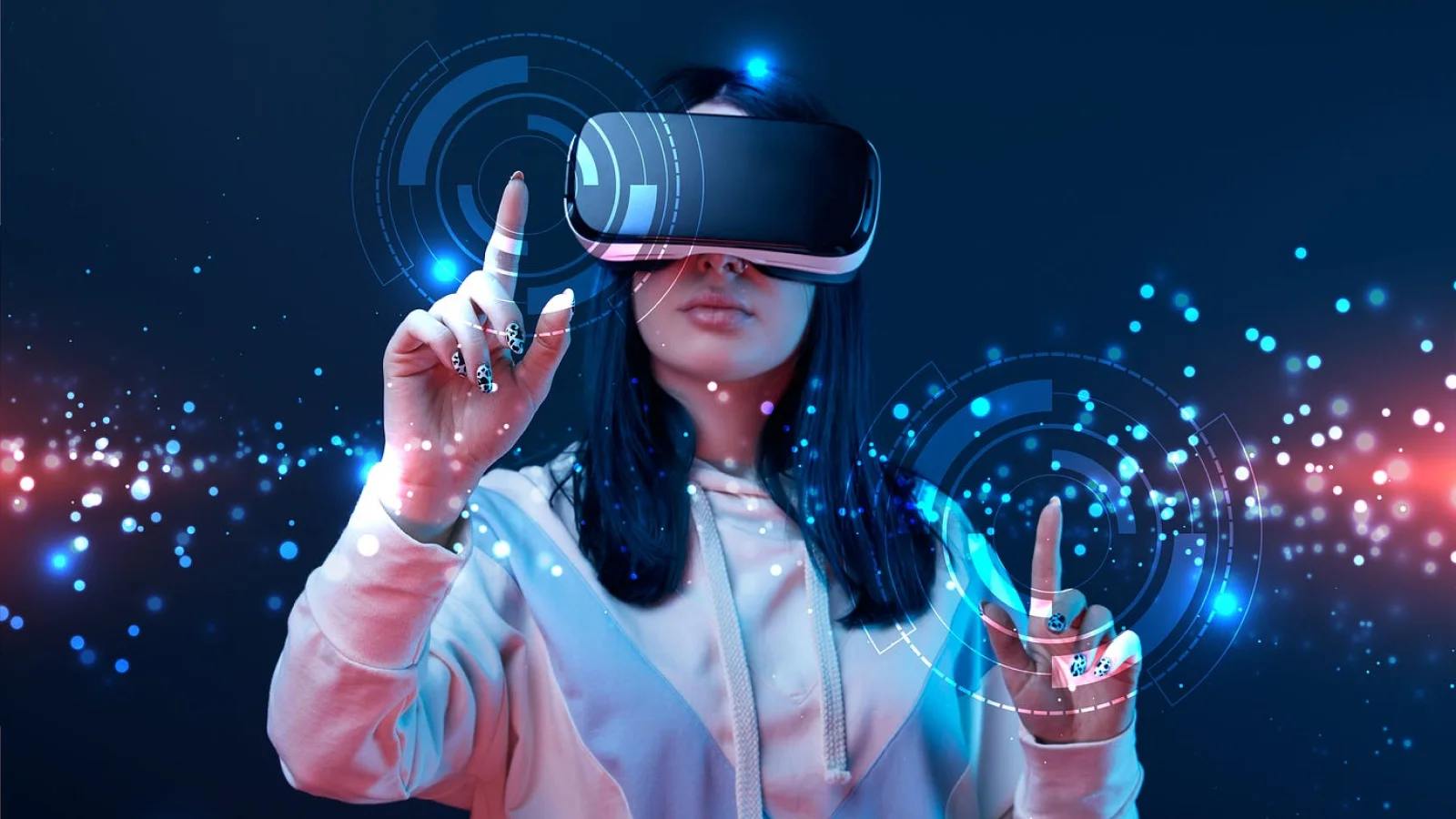
A VR developer builds interactive virtual environments that users experience through a headset. Projects include games, training simulations, and virtual walkthroughs, often built in a real-time engine like Unity, which updates the scene as the user moves.
Developers work at game studios, simulation companies, and enterprise training teams, or take freelance projects. To become a VR developer, you need to understand both software behavior and how an experience works around a user’s body.
What Does a VR Developer Do?
The job combines building immersive experiences with repeated testing. Work in AR/VR developer jobs can involve as much troubleshooting as writing new features.
Typical responsibilities include:
- Building scenes and interactions – Arrange environments, connect scripts, and make objects respond to the player. In an escape-room game, that might mean a key that opens a drawer and updates the puzzle state.
- Integrating hardware – Connect headset tracking and controllers through a software development kit, or SDK, which supplies tools for communicating with a device.
- Optimizing performance – Reduce unnecessary rendering with methods like occlusion culling, which hides objects blocked from view, and level of detail, which simplifies distant objects.
- Playtesting and troubleshooting – Investigate missing collision boundaries, incorrect physics behavior, and broken object references. Test the experience in the headset rather than judging it entirely from the editor.
- Collaborating with specialists – Work with artists, designers, and clients to turn assets or training requirements into usable interactions.
Coding, asset integration, and testing overlap throughout a project. Becoming a VR developer involves learning to identify which part of that system caused a problem, rather than repeatedly changing scripts without a diagnosis.
AR/VR developer jobs may share engine skills, but augmented reality overlays content on the physical world. That changes the testing environment and interaction requirements.
Roles in VR Development

The main tracks are VR games, enterprise training, 360° production, and AR applications. Responsibilities in AR/VR developer jobs differ substantially across these tracks, so compare the work before choosing a portfolio project.
|
Role |
What You’d Do |
Coding Focus |
First Portfolio Piece |
|---|---|---|---|
|
VR game developer |
Build interactive environments and mechanics |
C# scripting and gameplay systems |
A playable escape room |
|
Enterprise training developer |
Simulate a workplace procedure |
Interaction logic and assessment systems |
A guided equipment walkthrough |
|
360° video producer |
Create immersive filmed experiences |
Production tools rather than gameplay code |
A short immersive video |
|
AR developer |
Place interactive digital content in physical surroundings |
App logic and device integration |
An image-triggered AR demonstration |
A small engine project is a practical starting point for becoming a VR developer because it exposes interaction and debugging problems directly. AR/VR developer jobs can overlap, but a video-production portfolio won’t demonstrate the same abilities as a scripted application.
For a programming-focused start, use Unity Learn‘s VR Beginner: The Escape Room to practice building an interactive project.
Pros and Cons of Becoming a VR Developer
VR is a specialization within software and immersive production, not a shortcut into either field. Assess becoming a VR developer against the daily work, rather than a headline VR developer salary.
The trade-offs are practical:
| Pros | Cons |
|---|---|
| ✅ Transferable programming – C# and debugging skills apply beyond VR. ✅ Visible portfolio work – playable projects demonstrate interaction decisions. ✅ Different industries – games and training offer distinct project goals. ✅ Free learning resources – Unity Learn supports practice without a paid course. | ❌ Specialized job search – VR developer jobs are a narrower target than general software roles. ❌ Device-specific testing – editor success doesn’t establish headset compatibility or comfort. |
A broader AR/VR developer roadmap should preserve general programming skills alongside headset-specific knowledge. That gives you more options if your preferred local employers aren’t hiring.
VR Developer Qualifications
There is no single mandatory degree route to becoming a VR developer. Requirements for AR/VR developer jobs differ, and a vendor certification has its own eligibility rules rather than setting hiring requirements for the entire industry.
Unity describes its Unity Certified User: VR Developer credential as intended for people with foundational Unity and C# skills. Its stated audience does not require a degree. That makes certification accessible, but it doesn’t mean every employer accepts the same preparation.
Readers investigating how to become a VR developer without a degree should organize their preparation around demonstrable abilities:
- Education: Compare each employer’s requirements rather than treating a degree as universally necessary or irrelevant. Formal study can provide programming foundations, but the application still needs evidence relevant to the role.
- Alternative paths: Combine self-directed C# study with engine exercises and structured courses where you need guidance. Evaluate any bootcamp by its curriculum and project feedback, not its career-change promises.
- Portfolio or experience: Publish a working demonstration with setup instructions, a short video, and an explanation of your contribution. Show how an interaction works and how you resolved a technical problem.
- Certifications: Consider the Unity Certified User: VR Developer exam after developing the underlying skills. Its focus includes VR concepts, user experience implementation, and troubleshooting.
- Soft skills: Practice accepting playtest feedback and explaining technical constraints to artists or clients. Clear communication helps teams distinguish a design change from a software defect.
A useful AR/VR developer roadmap connects every learning activity to an observable result. Completing an exercise might produce an object-grabbing mechanic; studying troubleshooting should help you diagnose why that mechanic fails.
For junior AR/VR developer jobs, a working project supports the credential by showing what you can build. A certificate alone cannot demonstrate your judgment during an unfamiliar problem.
Treat VR developer salary figures as context, not a qualification checklist. Higher compensation figures don’t tell you which skills a particular employer needs.

The Software and Tools Every VR Developer Starts With
Start with a real-time engine and its interaction workflow. Unity is the central engine in this guide, and learning how to become a VR developer is easier when you avoid switching toolchains midway through your first project.
These tools serve different parts of an AR/VR developer roadmap:
|
Tool |
Best for |
When To Add It |
Price |
|---|---|---|---|
 |
Building scenes and scripted interactions |
At the start |
Free for eligible users; paid plans available |
|
|
Practicing VR interaction workflows |
After basic engine exercises |
Free |
 |
Following Cardboard-based project material |
For a compatible course project |
Free |
 |
Building and testing Android applications |
When the target project requires it |
Free |
Learn the engine before adding platform-specific packages. Becoming a VR developer requires understanding the tools you use, not installing every available SDK.
Check the target device and software version before following older course instructions. Package compatibility is part of project planning.
VR Developer Salary and Career Progression
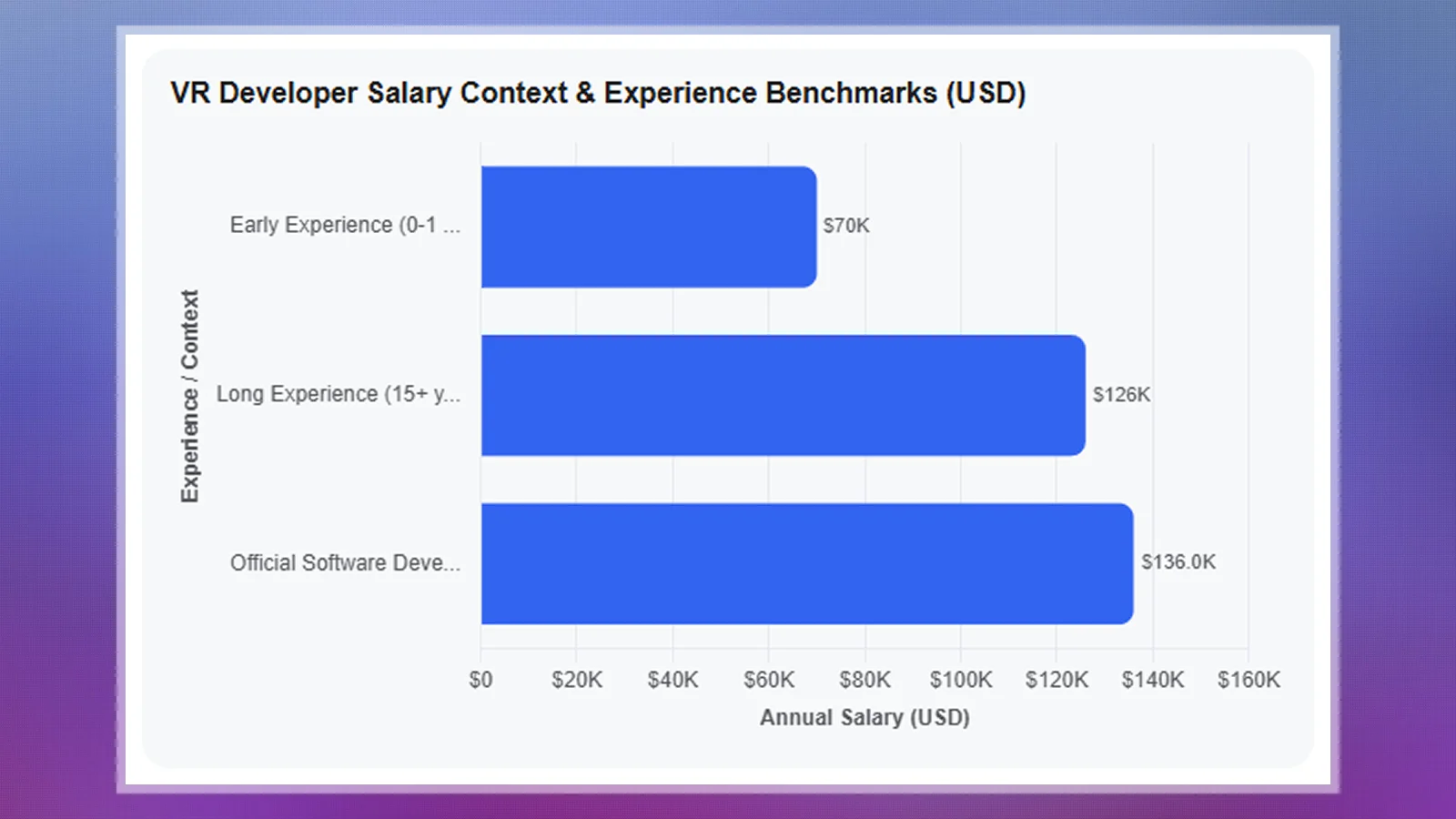
The closest official pay baseline is software development, not a VR-specific occupation. The U.S. Bureau of Labor Statistics reports a median annual software developer wage of $135,980 in May 2025.
For VR developer salary context, Coursera summarizes experience-based pay figures attributed to Glassdoor. These are a secondary account of that dataset, separate from the official software developer median:
- Early experience: $70,000 for 0–1 year.
- Long experience: $126,000 for 15+ years.
Read these endpoints as comparisons between experience groups, rather than pay milestones within one career. Use the responsibilities and location of an advertised role to assess its VR developer salary.
Progression generally involves taking responsibility for larger systems, then technical planning or team leadership. Compare VR developer jobs by responsibilities, location, and compensation structure.
AR/VR developer jobs may combine multiple specialties under one title. A VR developer salary comparison is useful only when the underlying duties are comparable.
How To Become a VR Developer: A Step-by-Step Guide
Build programming, engine, and project competence before treating yourself as job-ready. An AR/VR developer roadmap should use completed milestones rather than a promised hiring deadline.
Step 1: Build Programming and 3D Math Foundations
Practice C# with small programs before adding headset input. Learn how variables, functions, and object references work, then apply vectors and rotations to moving objects in a scene.
To become a VR developer, you need to explain why your code behaves as it does. Write a simple interaction, deliberately break it, and use the error messages to locate the fault. A debugging habit built this way can serve you throughout your AR/VR developer roadmap.
Step 2: Learn Unity’s VR Workflow
Work through basic Unity scenes, components, and scripts before exploring its VR packages. Learn how the Package Manager installs dependencies, then use the XR Interaction Toolkit to study interaction behavior.
Unity offers more than 750 hours of free learning content and live learning sessions. Becoming a VR developer doesn’t require consuming the entire catalog. Select material that supports the interaction you are currently building, then reproduce it without copying every instruction.
Step 3: Finish a Small Portfolio Project
Build a compact escape room with an understandable objective and working interactions. Unity Learn‘s VR Beginner: The Escape Room provides a concrete practice starting point.
Keep the scope manageable enough to test thoroughly. Record a demonstration, document setup requirements, and explain a bug you fixed. To become a VR developer, you need evidence of independent decisions, so adapt the exercise rather than presenting an unchanged tutorial as original work.
Step 4: Use a Course To Address Specific Gaps
Choose material from Recommended Courses based on the problem your project exposed. Environment-building instruction serves a different need from immersive video production.
A useful AR/VR developer roadmap connects course exercises back to your own project. Rebuild the relevant technique independently and explain its limitations. Course duration measures the learning material, not how long it takes to become a VR developer or secure employment. Keep practicing after the final lesson.
Step 5: Consider the Vendor Certification
Prepare for the Unity Certified User: VR Developer exam once you can work through its objectives independently. Review VR concepts, user experience implementation, and troubleshooting against your project.
Treat the exam as an optional skills signal rather than permission to apply. Becoming a VR developer also requires adapting to unfamiliar requirements, which a completed exam cannot fully demonstrate. Keep your playable build and technical explanation available alongside any credential you earn.
Step 6: Apply With Evidence of Your Work
Apply for junior AR/VR developer jobs whose requirements match your project and programming abilities. Include a direct route to the demonstration and explain your individual contribution.
Search AR/VR developer jobs and general junior software roles too, but tailor each application to its actual duties. Compare any advertised VR developer salary with location and responsibilities. Use interview feedback to improve a specific weakness rather than restarting your entire learning plan. A finished, explainable project is your starting evidence.
Recommended Courses
Choose project-relevant instruction from the options below. Your AR/VR developer roadmap may need environment-building practice, immersive production, or help completing an engine project.
|
Course |
Provider |
What It Covers |
|---|---|---|
|
Virtual Reality Specialization |
 |
Beginner-level, five courses, approximately two months at ten hours a week. Covers VR fundamentals, 3D graphics, interaction design, and Unity development. Includes hands-on projects culminating in a playable VR game and a shareable certificate from the University of London. |
|
Build and Craft Virtual Reality Experiences |
 |
Requires basic Unity knowledge; six sections, 34 lectures, and approximately 2.5 hours of video. Covers Unity 3D, Google Cardboard, character movement, VR environments, and gaze-based interactions through projects including a virtual gallery. |
|
3D Models for Virtual Reality |
|
Intermediate-level, four modules, approximately two weeks at ten hours a week. Covers 3D graphics, Unity, materials, texturing, spatial audio, and VR performance optimization. Includes a practical virtual environment project and a shareable certificate from the University of London. |
|
Designing for Virtual Reality |
 |
Beginner-to-intermediate course lasting 38 minutes. Covers user-centered VR design, concept testing, digital and physical prototyping, usability testing, and collecting user experience data. Includes a shareable certificate of completion and an eligible one-month free trial. |
|
VR Beginner: The Escape Room |
|
Free beginner-level course lasting approximately three hours. Covers Unity’s XR Interaction Toolkit, VR controller input, teleportation, interactable objects, sound effects, and user interface setup through a practical escape-room project. |
Becoming a VR developer requires applying the material independently. Choose a course that addresses a specific project problem, then test the technique in your own build.
Alternate Careers in VR Development
Consider adjacent technical work if headset-focused development doesn’t suit your interests. These options change the daily work rather than simply changing the application platform:
- Computer and information research scientist: Investigate computing methods and experimental systems. The trade-off is a stronger research focus than building user-facing interactions.
- Computer hardware engineer: Work on physical computing devices, potentially including headset components. This shifts the focus away from application programming.
- Computer systems analyst: Study organizational technology needs and improve systems. Business requirements take priority over game-engine mechanics.
Programming and structured troubleshooting remain useful across these directions. You can develop those abilities while evaluating becoming a VR developer.
Final Verdict on How To Become a VR Developer
VR development suits people who enjoy interactive programming and repeated testing. Start with an engine project and use targeted instruction to address weaknesses. Use that work to judge whether the specialization suits you, rather than relying on VR developer salary headlines.
It is a less suitable choice for someone who dislikes debugging hardware interactions or prefers work without headset-specific testing. General software development offers an alternative if headset-specific constraints distract from the programming work you enjoy.
Understanding how to become a VR developer comes down to building something you can demonstrate, explain, and improve. Consider certification after that foundation is in place.
FAQs
Yes, you can learn how to become a VR developer through C# programming, Unity, and free online resources. Build a portfolio of VR projects to demonstrate your skills, although some employers may require formal qualifications or experience.
Pay varies by role, location, and experience. When learning how to become a VR developer, compare offers with similar duties; the broader software developer median isn’t a VR-specific starting salary.
There is no fixed job-ready timeline. Programming experience, project scope, and independent practice affect progress. Finishing a course is different from being able to build and troubleshoot a VR application independently.
Yes, it can suit programmers who enjoy spatial interaction and device testing. General software development may fit better if you prefer programming without headset-specific constraints.
C#, 3D math, engine workflows, and VR interaction design are useful foundations. Practice troubleshooting and headset testing too. Your AR/VR developer roadmap should connect those skills to a working project.
VR developer jobs belong to a broader market: the U.S. Bureau of Labor Statistics projects about 106,100 annual openings across developers, QA (quality assurance) analysts, and testers, not VR alone.
You can create a simple VR game using free tools and resources from Unity Learn. However, costs can increase if you need to purchase a VR headset, 3D assets, or additional software, which you need to consider when learning how to become a VR developer.