


15 Best Dragon Commanders in MTG 2026: Power & Playstyles


Building around the best Dragon commanders in MTG is one of the most satisfying ways to play Commander, but choosing the right leader makes a bigger difference than most players expect. Dragons are expensive, color-intensive, and demand strong ramp and synergy to function smoothly.
I learned this the hard way years ago when my first Dragon deck looked powerful on paper, but stalled every game because the commander did not support the tribe properly. Since then, I have tested Dragon commanders across casual pods and higher-power tables, and the gap between good and great choices is very real.
This guide breaks down the strongest Dragon commanders by power level, playstyle, and color identity to help you choose a leader that actually delivers at the table.
Jump to:
15 Best Dragon Commanders
This list focuses on the best Dragon commanders in MTG for players who want a clear, practical breakdown before choosing a leader.
Instead of summarizing every option, this section transitions into individual commander analyses, highlighting what truly separates top-tier Dragon commanders in real Commander games.
1. The Ur-Dragon
| Color identity | WUBRG (5-color) |
| Dragon tribal support | Very high |
| Primary win condition | Go-wide Dragon beats + value snowball; sometimes extra combats |
| Mana intensity | Very high |
| Power level | High |
| Budget friendliness | Low–Medium |
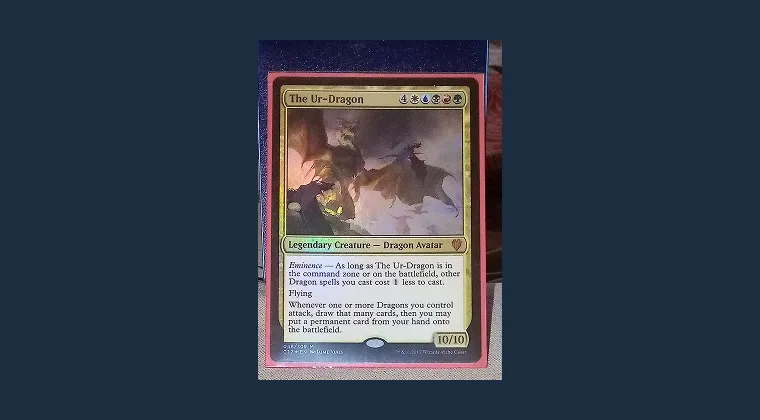
The Ur-Dragon is the classic “go big” Dragon commander: even from the command zone, Eminence makes your Dragons cheaper, which adds up fast and lets you start dropping threats earlier than people expect. If you like building a board full of huge fliers, it delivers that fantasy immediately.
Once it actually hits the battlefield, the deck can snowball hard. Attacking with Dragons draws you cards and can drop extra permanents for free, so combat turns into a steady stream of value instead of “swing and pass.”
Focus heavily on early ramp and color fixing so the cost reduction matters as early as possible.
The main catch is the mana base: five colors punishes shaky fixing, so having the best dual lands (or at least strong substitutes like shocks/triomes) makes the deck feel much smoother.
2. Tiamat
| Color identity | WUBRG (5-color) |
| Dragon tribal support | High |
| Primary win condition | Tutor “package” into combo-ish lines or overwhelming board |
| Mana intensity | Very high |
| Power level | High |
| Budget friendliness | Low–Medium |
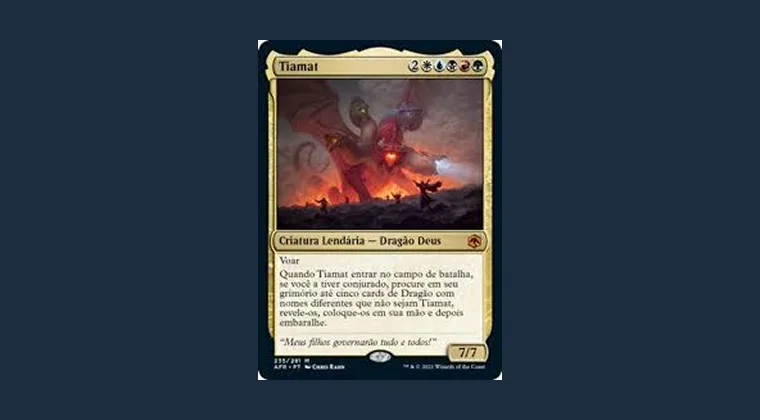
Tiamat is a straightforward, powerful Dragon commander: when she enters, you search your library for up to five different Dragons and put them into your hand. That means once you cast her, you’re instantly loaded with the best threats and answers in your deck, instead of relying on topdecks.
Her biggest strength is flexibility. You can grab removal dragons, token/value dragons like Miirym or Lathliss, or pure damage finishers – whatever fits the board. It makes every game feel more controlled and less random.
Choose your five Dragons before casting Tiamat so you fetch a cohesive package, not just raw power.
She’s slow at seven mana, so you’ll want plenty of ramp. But if you like big, splashy Dragon tribal plays and winning through overwhelming threats, Tiamat does the job cleanly.
3. Miirym, Sentinel Wyrm
| Color identity | Temur (URG) |
| Dragon tribal support | Very high |
| Primary win condition | Explosive board via doubled Dragons; value overwhelm |
| Mana intensity | High |
| Power level | High |
| Budget friendliness | Medium |
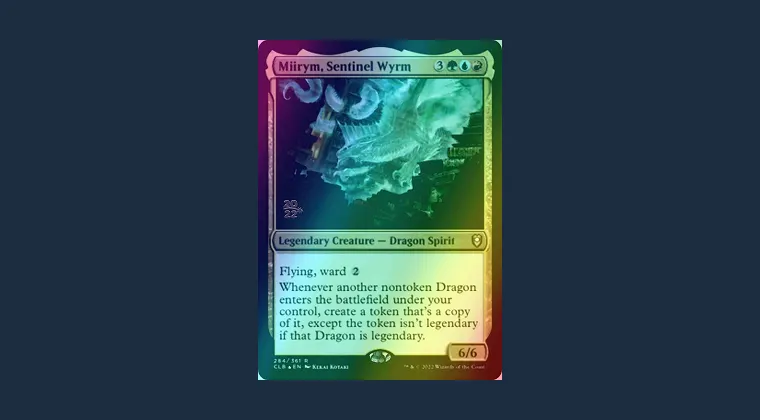
Miirym, Sentinel Wyrm is one of the most popular Dragon commanders for a reason. Whenever you cast a nontoken Dragon, Miirym creates a token copy of it, instantly doubling your value. This makes every Dragon spell feel powerful and rewarding, even without complicated combos.
The deck is easy to understand and fun to pilot. You play Dragons, Miirym copies them, and the board fills up fast with flying threats. Cards that care about enter the battlefield effects or Dragon synergies become much stronger when they happen twice.
Prioritize Dragons with impactful ETB or attack triggers so each copy immediately generates value.
Miirym shines in casual and mid-power Commander games where big creatures matter. It can get out of hand quickly if left alone, but it is still fair and interactive.
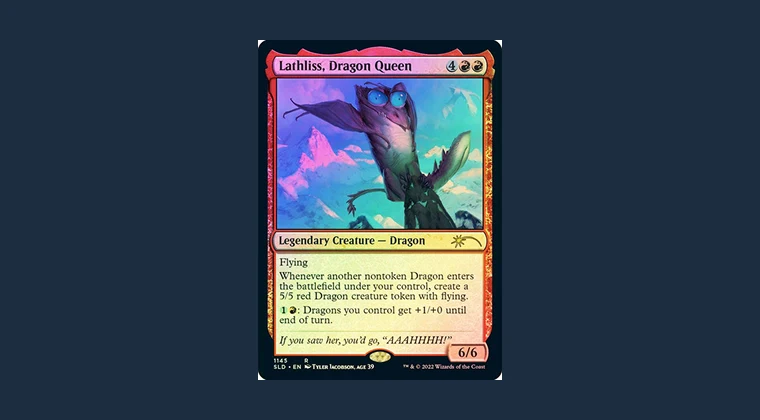
4. Lathliss, Dragon Queen
| Color identity | Mono-Red (R) |
| Dragon tribal support | High |
| Primary win condition | Go-wide Dragons + damage doublers / combat |
| Mana intensity | High |
| Power level | Medium–High |
| Budget friendliness | High |
Lathliss shines by creating a 5/5 Dragon token every time you cast a Dragon, letting a mono-red deck snowball far faster than expected.
This makes her a natural reference point when discussing the best token commanders in MTG, as each spell immediately adds pressure without extra setup or combos.
Curve Dragons tightly and include haste enablers so new tokens impact the board the turn they arrive.
Her unique selling point is scalable board growth in a simple, aggressive shell, ideal for players who want consistent Dragon value without complex sequencing.
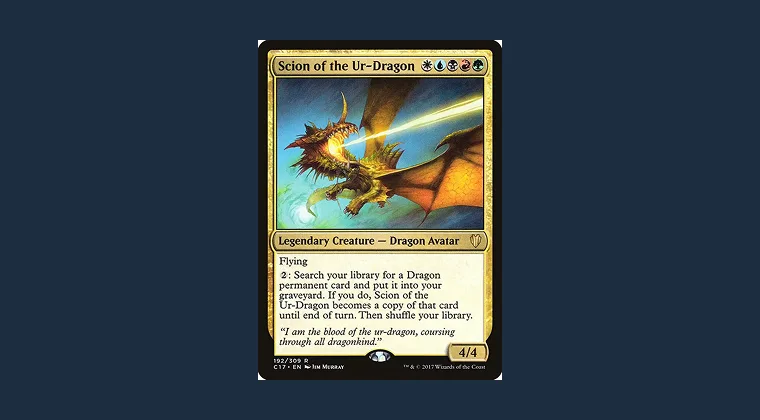
5. Scion of the Ur-Dragon
| Color identity | WUBRG (5-color) |
| Dragon tribal support | High |
| Primary win condition | “Toolbox” transformations; often 1-shot commander damage or combo lines |
| Mana intensity | Very high |
| Power level | High |
| Budget friendliness | Low |
Scion of the Ur-Dragon is a flexible five-color commander that acts like a toolbox rather than a traditional dragon. By paying two mana, you can turn Scion into any dragon from your deck for a turn, which means you always have access to the exact ability you need at the right moment.
This ability makes Scion especially strong for players who enjoy planning ahead and learning their deck well. You can grab a defensive dragon when under pressure, a damage-focused one to end the game, or a utility dragon to answer a problem on the board.
Keep key Dragons in the graveyard early so Scion can threaten lethal lines without committing mana.
Scion is not the flashiest dragon commander, but in the hands of a thoughtful player, it can be one of the most reliable and versatile options in dragon tribal.
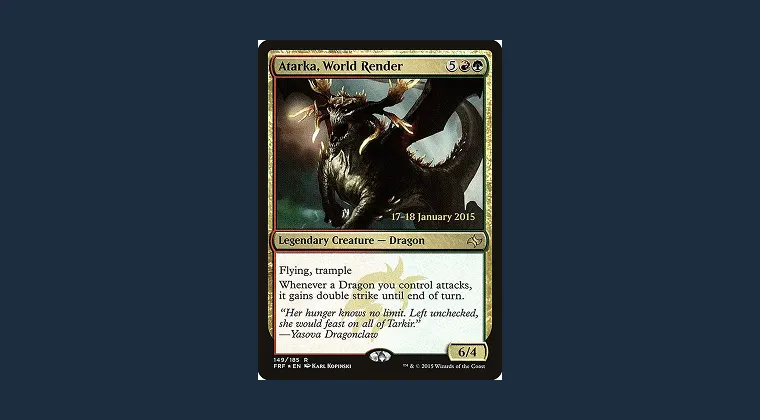
6. Atarka, World Render
| Color identity | Gruul (RG) |
| Dragon tribal support | Medium–High |
| Primary win condition | Burst combat damage (double strike) to delete players |
| Mana intensity | High |
| Power level | Medium–High |
| Budget friendliness | Medium–High |
Atarka, World Render is a brutally simple commander that turns Dragons into instant game closers. Giving all attacking Dragons double strike means every swing hits twice as hard and life totals disappear fast. If you enjoy straightforward combat wins this card delivers exactly that.
Atarka works best in Dragon tribal decks that want to attack early and often. You do not need complicated combos or tricky setups just a board of Dragons and a clear attack step. This simplicity is why many players still rank Atarka among the best MTG cards for aggressive Commander strategies.
Focus on haste and extra combat enablers so Dragons benefit from double strike the turn they enter.
The unique selling point is brutal simplicity, making Atarka ideal for players who want straightforward, lethal Dragon combat without complex setup or combos.
7. Klauth, Unrivaled Ancient
| Color identity | Gruul (RG) |
| Dragon tribal support | Medium |
| Primary win condition | Attack → huge mana → dump hand / extra combats to close |
| Mana intensity | High |
| Power level | High |
| Budget friendliness | Medium–High |
Klauth’s standout strength is turning Dragon combat damage into enormous mana bursts, often generating enough mana to cast multiple Dragons or finishers in a single turn.
This explosive scaling rewards aggressive sequencing and mirrors the high-ceiling play patterns seen in some of the best partner commanders in MTG, where momentum compounds quickly once combat connects.
Attack with multiple Dragons before second main to maximize mana output and chain spells efficiently.
The unique selling point is combat-fueled ramp, making Klauth perfect for players who want Dragon decks that convert pressure directly into game-winning turns.
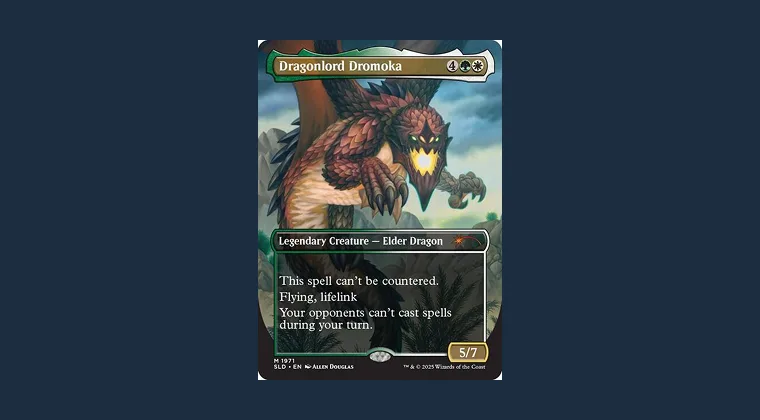
8. Dragonlord Dromoka
| Color identity | Selesnya (GW) |
| Dragon tribal support | Low |
| Primary win condition | Safe combat pressure + lock out interaction on your turn |
| Mana intensity | Medium |
| Power level | Medium |
| Budget friendliness | High |
Dragonlord Dromoka is a calm, unshakeable commander that rewards you for playing fair, big Magic. A 5/7 flying, lifelink dragon for five mana is already solid, but her real power comes from stopping opponents from casting spells during your turn. That single line of text makes your attacks, board wipes, and win conditions much safer.
In Commander, Dromoka naturally fits creature-heavy, midrange strategies that want to apply pressure without worrying about counterspells or combat tricks.
Time your most important spells post-combat so opponents remain unable to respond during your turn.
Dragonlord Dromoka often appeals to players who enjoy the playstyle of the best Angel commanders in MTG but want something a little different. She offers the same sense of inevitability and control, just wrapped in scales instead of wings.
9. Korvold, Fae-Cursed King

| Color identity | Jund (BRG) |
| Dragon tribal support | Low |
| Primary win condition | Sacrifice value engine → massive Korvold + card advantage (sometimes combo) |
| Mana intensity | Medium–High |
| Power level | Very high |
| Budget friendliness | Medium |
Korvold, Fae-Cursed King is one of those commanders that turns every small sacrifice into pure value. A Treasure, a Blood token, a random creature – nothing goes to waste. Each time you sacrifice something, Korvold grows bigger and replaces itself with a card, so your board keeps moving while your hand stays full.
Even though he isn’t a Vampire, Korvold fits surprisingly well into the same playstyle as many of the best Vampire commanders in MTG. The sacrifice-heavy, aristocrats-style game plan feels right at home with Blood tokens, death triggers, and drain effects.
Run treasure producers and sacrifice outlets so Korvold draws cards without costing you key Dragons.
Overall, Korvold is powerful, flexible, and borderline unfair in longer games. He scales fast, punishes board wipes less than most commanders, and snowballs out of control with minimal setup.
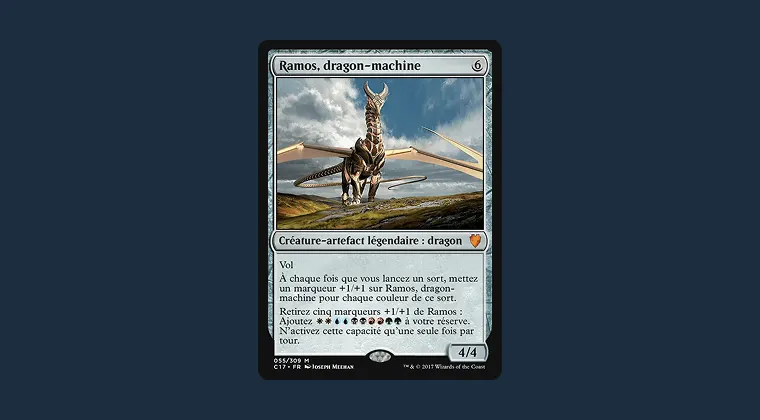
10. Ramos, Dragon Engine
| Color identity | WUBRG (5-color) |
| Dragon tribal support | Low–Medium |
| Primary win condition | Cast multicolor spells → counters → burst mana → big turns/combos |
| Mana intensity | High |
| Power level | High |
| Budget friendliness | Low–Medium |
Ramos’s defining strength is converting multicolor spells into massive bursts of mana, letting Dragon decks leap far ahead in a single turn.
In five-color builds packed with gold Dragons and interaction, Ramos quickly stockpiles counters and then unloads them to cast multiple threats or pivot into a decisive sequence.
Prioritize multicolor Dragons and cheap gold spells so Ramos charges quickly before you cash in the mana.
The unique selling point is spell-driven acceleration, making Ramos ideal for players who want Dragons backed by explosive, flexible turns rather than slow, incremental ramp.
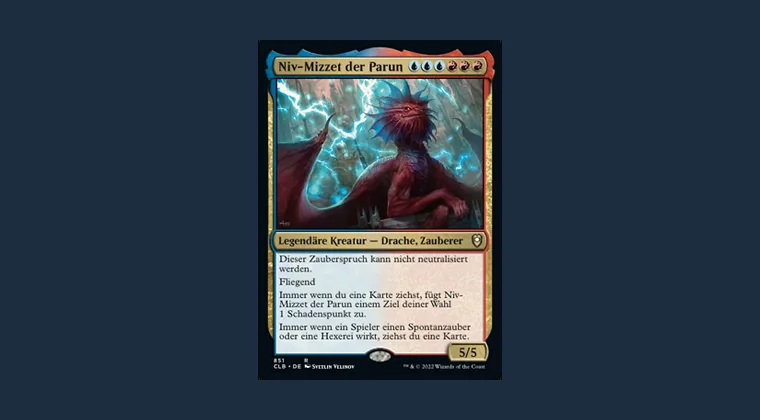
11. Niv-Mizzet, Parun
| Color identity | Izzet (UR) |
| Dragon tribal support | Low |
| Primary win condition | Draw engines + ping loops; often combo finish (Curiosity effects) |
| Mana intensity | High |
| Power level | Very high |
| Budget friendliness | Medium |
Niv-Mizzet’s standout strength is turning every card drawn and spell cast into direct damage, allowing Dragon decks to win without relying solely on combat.
As a Dragon itself, it fits naturally into spell-heavy builds that generate constant card advantage while pressuring life totals at the same time.
Lean into cheap instants and cantrips so Niv-Mizzet triggers repeatedly in a single turn.
The unique selling point is spell-driven inevitability, making Niv-Mizzet ideal for players who want a Dragon commander that controls the table while closing games through precision damage.
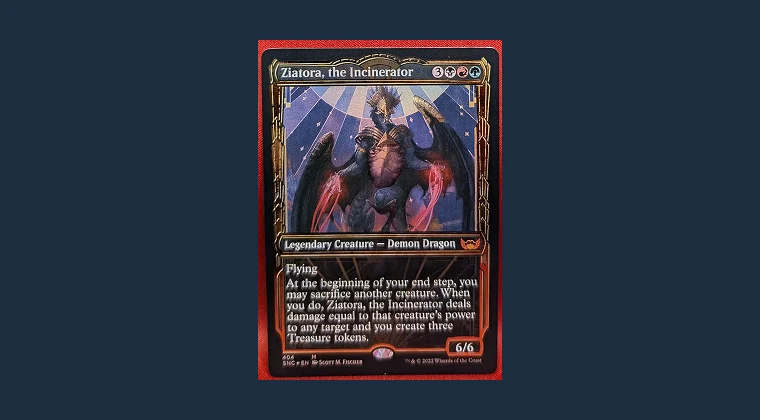
12. Ziatora, the Incinerator
| Color identity | Jund (BRG) |
| Dragon tribal support | Low |
| Primary win condition | Sac big creature → direct damage + Treasures → grind/close |
| Mana intensity | Medium–High |
| Power level | Medium–High |
| Budget friendliness | Medium |
Ziatora’s core strength is turning sacrificed creatures into direct damage and Treasure, letting Dragons convert raw power into immediate impact and mana.
Flinging a large Dragon pressures life totals while fueling follow-up plays, keeping momentum even after board wipes.
Include Dragons with death triggers or recursion, so sacrifices generate value beyond the initial damage.
The unique selling point is damage that doubles as ramp, making Ziatora ideal for players who enjoy aggressive Dragon strategies supported by sacrifice synergies and resource loops.
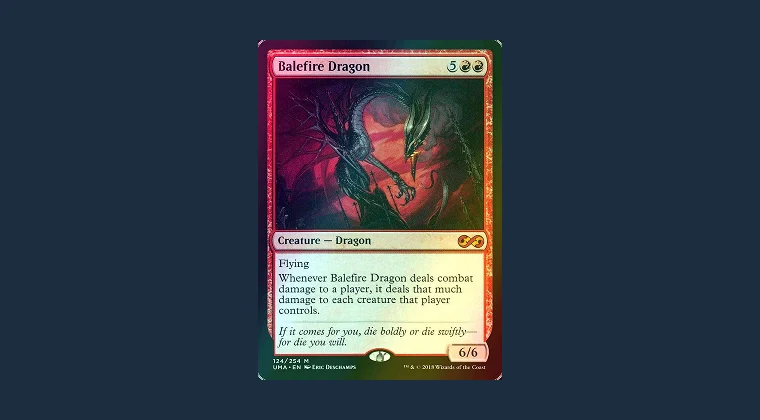
13. Balefire Dragon
| Color identity | Mono-Red (R) (not a commander unless rule-0) |
| Dragon tribal support | Low |
| Primary win condition | Connect in combat → one-sided board wipe → win by beats |
| Mana intensity | High |
| Power level | High as a finisher |
| Budget friendliness | Low–Medium |
Balefire Dragon is a brutal reset button with wings. A 6/6 flyer is already a threat, but the moment it hits a player, it can wipe their entire creature board and clear the way for your next attacks. It’s easily one of the best red cards in MTG for smashing through stalled games.
It doesn’t need much help – just haste or an open lane – and suddenly tokens, blockers, and creature piles vanish. In Dragon decks, it’s an all-in-one finisher and board-control tool that turns one clean connection into a huge tempo swing.
Prioritize haste and evasion so Balefire Dragon connects at least once and resets the board in your favor.
It’s usually best in the 99, but you can run it as your commander too, since it’s a legendary creature. Either way, if your meta is creature-heavy, Balefire is the kind of card that ends arguments fast.
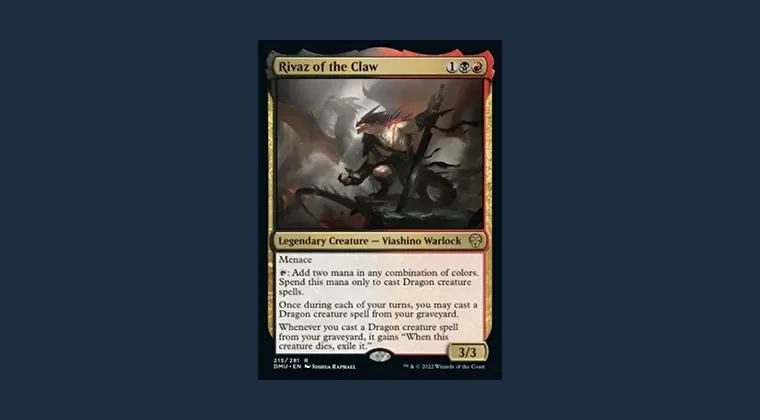
14. Rivaz of the Claw
| Color identity | Rakdos (BR) |
| Dragon tribal support | High |
| Primary win condition | Reanimate/value Dragons; steady pressure with recursion |
| Mana intensity | Medium |
| Power level | Medium–High |
| Budget friendliness | High |
Rivaz of the Claw’s standout strength is combining early mana acceleration with repeatable Dragon recursion, giving Dragon decks resilience that most aggressive builds lack.
By helping cast Dragons faster and bringing them back from the graveyard, Rivaz keeps pressure high even after removal or board wipes.
Discard or sacrifice Dragons proactively so Rivaz always has strong reanimation targets ready.
The unique selling point is built-in recovery without slowing your curve, making Rivaz ideal for budget-conscious players who want consistent Dragon threats across longer games.
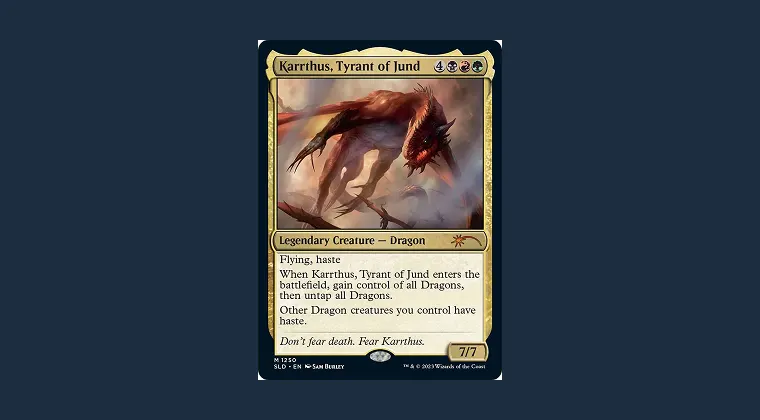
15. Karrthus, Tyrant of Jund
| Color identity | Jund (BRG) |
| Dragon tribal support | High |
| Primary win condition | Slam Dragons → immediate hasty damage; blowouts vs other Dragon decks |
| Mana intensity | High |
| Power level | Medium–High |
| Budget friendliness | Medium |
Karrthus’s defining strength is stealing all Dragons on entry and granting them haste, instantly flipping the board and enabling surprise kills.
In Dragon-heavy metas, this swing can end games on the spot, while haste ensures every Dragon you control becomes an immediate threat.
Hold Karrthus until at least one opponent commits Dragons, then cast it post-wipe for maximum impact.
The unique selling point is unpredictable, game-ending tempo, making Karrthus ideal for players who want explosive finishes and high-risk, high-reward Dragon plays.
How to Build a Dragon Commander Deck in MTG
Building a Dragon Commander deck starts with accepting one reality: Dragons are powerful, but they are expensive and demand structure.
This section breaks down the core deckbuilding priorities that turn a pile of Dragons into a consistent, threatening Commander strategy.
- Choose a Dragon-focused commander with a clear payoff
Start with a commander that does one main thing extremely well, such as cost reduction, token generation, tutoring, combat amplification, or mana generation. Your commander should actively solve a Dragon problem, not just sit at the top of the curve as another threat. - Commit heavily to ramp and fast mana
Dragons do not function on normal land drops alone. Include early ramp, mana rocks, and acceleration, so your first Dragon hits the table before opponents stabilize. Falling one turn behind often means falling permanently behind. - Prioritize Dragon-specific synergies
Haste enablers, attack triggers, damage-based payoffs, and Dragon-only bonuses dramatically increase pressure. These effects ensure Dragons impact the game immediately, not one turn later when removal becomes available. - Build a reliable mana base
Multicolor Dragon decks fail more often to bad mana than bad cards. Favor efficient dual lands, fetchable fixing, and color smoothing so you can cast Dragons on curve without hesitation. - Protect your investment
Dragons attract removal. Include protection, recursion, and selective interaction to keep key threats alive and punish opponents who overextend answers. - Define clear win conditions
Finish games through overwhelming combat damage, repeatable burn triggers, or Dragon-enabled combos. A Dragon deck that cannot close will eventually be outpaced.
When these elements work together, Dragon decks stop feeling clunky and start feeling inevitable, powerful, and decisive at the table.
FAQs
The best Dragon commander in MTG is The Ur-Dragon excels for classic tribal value, Tiamat offers precise tutoring and combo setup, and Miirym dominates with explosive board states. The strongest choice is the one that best supports how you want your Dragon deck to win.
Yes, Dragon Commander decks are powerful when built correctly. They offer high-impact threats, strong combat pressure, and dramatic finishers. Their main weakness is mana cost, but with proper ramp and fixing, Dragon decks perform well at casual and mid-to-high power Commander tables.
The best colors for Dragon Commander decks are green, which is the most important color due to ramp, while red provides Dragons, haste, and damage. Five-color decks offer maximum flexibility, but Gruul, Jund, and Temur builds are popular for balancing power.
The best budget Dragon Commanders are Lathliss, Dragon Queen, and Rivaz of the Claw. They provide strong tribal payoffs without requiring expensive mana bases. Both allow Dragon decks to function smoothly with fewer colors and lower overall deck costs while remaining threatening.
The best lands for Dragon Commander decks are the most efficient dual lands, fetchable fixing, and lands that enter untapped. Multicolor builds should prioritize consistency over utility, while budget decks can rely on tapped duals and ramp to offset slower starts.
Yes, Dragon Commander decks are good for beginners, especially mono-color or two-color Dragon decks. Dragons offer straightforward game plans focused on ramp and combat, making them easy to understand.