

How To Play Riftbound: The 2026 League of Legends TCG Guide

Eneba Hub contains affiliate links, which means we may earn a small commission if you make a purchase through them—at no extra cost to you. Learn more

Learning how to play Riftbound is much easier than you might expect. This points-based strategy card game from Riot Games puts you in command of iconic League of Legends champions as you battle for control of battlefields.
This guide breaks down the Riftbound rules, turn structure, card types, and win conditions in simple terms. I’ll walk you through everything you need to start playing right away.
Jump to:
What’s the Goal in Riftbound?
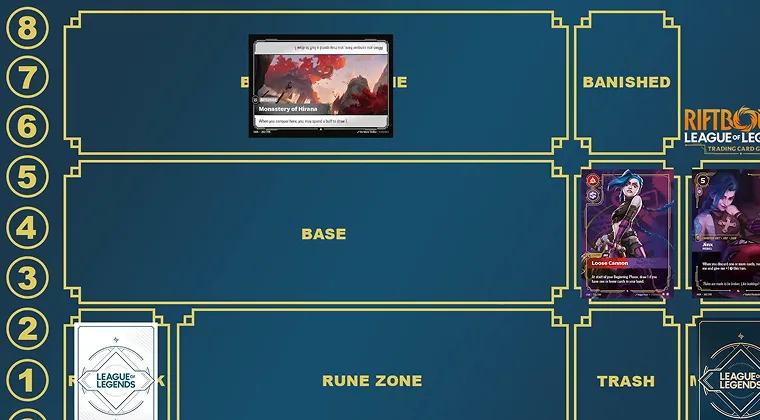
Understanding how to play Riftbound starts with knowing the win condition. Riftbound is a trading card game where the goal is to reach 8 (or 11 in a 2v2) points before your opponent. This applies to 2, 3, and 4-player games alike.
You earn points by conquering battlefields (moving your units there successfully) and holding them into your next turn. There’s one catch: your final point must come from holding a battlefield or conquering both battlefields in the same turn – otherwise, you just draw a card instead of winning.
Required Game Materials & Deck Construction
Before you learn how to play Riftbound, you’ll need the right components. Here’s what every player brings to the table:
• 1 Legend – The card you build your entire deck around
• 40-card Main Deck – Units, Spells, and Gear that match the colors of your Legend
• 12-card Rune Deck – Resource cards that power your plays
• 3 Battlefields – Colorless locations you’ll fight to control
Your Legend defines which domains (colors) you can use. You’ll also choose one Champion Unit that matches your Legend‘s name and at least one of its colors. This champion starts the game ready to deploy. Building your deck with the best Riftbound cards for your Legend gives you a competitive edge. Selecting the right cards becomes much simpler when you have the full picture. A dedicated Riftbound TCG card list guide helps you browse the entire set to find the perfect units and spells for your strategy.
Establishing your strategy begins with identifying the right commander to lead your forces. A complete Riftbound legends list lets you compare the unique skills and color identities of every character so you can confidently select the best option for your game plan.
Understanding Cards and Decks
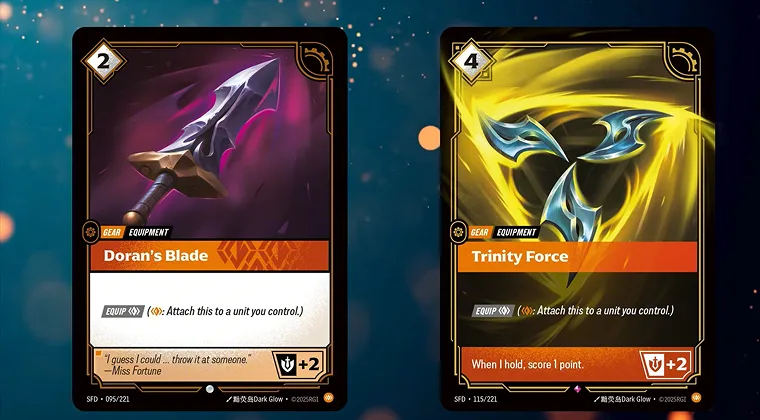
A big part of learning how to play Riftbound is understanding what you’re actually playing with. This section explains card roles at a high level so you know what each piece does in your deck. Let’s start with the six card types you’ll encounter.
Card Types in Riftbound
Each card type serves a distinct purpose in the Riftbound gameplay guide. Reviewing the full Riftbound TCG card list will help you understand what’s available, but here’s a quick breakdown:
• Legends – Define your deck’s identity, colors, and available champion
• Units – Characters that move, fight, and control battlefields
• Spells – One-time effects that deal damage, buff units, or disrupt opponents
• Gear – Persistent equipment providing ongoing support from your base
• Battlefields – Locations where combat happens, and points are scored
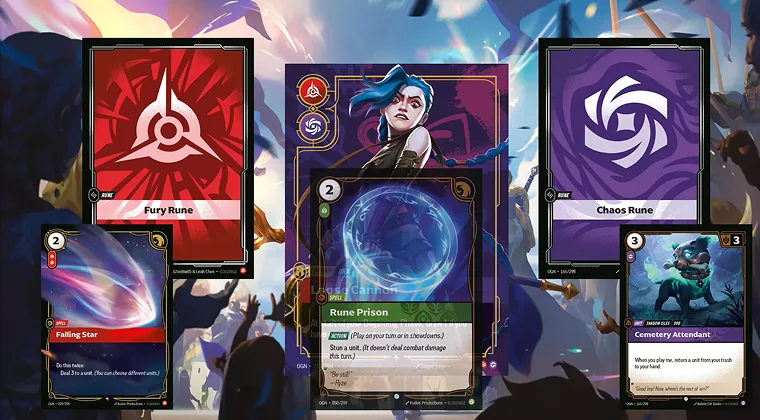
• Runes – Resource cards that generate Energy and Power to pay for your plays
What a Deck Represents
In Riftbound, a deck is more than a collection of powerful cards, it’s the mechanical expression of your strategy. Each card type fills a specific role in bringing your game plan to life. Units contest space and apply pressure across Battlefields, while Spells and Gear let you influence tempo, protect key pieces, or swing crucial moments.
Understanding what each card type represents (and how it supports your Legend’s strengths) is the foundation of any strong deck-building game. The table below breaks down those roles at a glance.
| Card Type | Primary Role | Playstyle Fit | Deck Usage |
|---|---|---|---|
| Legends | Define deck identity | All playstyles | Chosen once; determines colors and abilities |
| Units | Board presence | Aggressive, Midrange, Control | Main Deck; move, fight, control Battlefields |
| Spells | Tactical effects | Control, Tempo, Combo | Main Deck; one-time effects |
| Gear | Ongoing support | Control, Midrange | Main Deck; persistent base effects |
| Battlefields | Scoring locations | All playstyles | Three selected; one used per game |
| Runes | Resource generation | All playstyles | Rune Deck; pay Energy and Power costs |
Setting Up the Game
Once you understand the basics of Riftbound, setup is straightforward. Follow these steps:
- Present your Legend – Place it face-up in your Legend Zone
- Choose your Champion – Put your chosen Champion face-up next to your Legend
- Shuffle both decks – Keep your Main Deck and Rune Deck separate
- Select battlefields – In a 1v1 game, each player presents one battlefield (randomly selected from their three)
- Draw your opening hand – Draw 4 cards from your Main Deck
- Mulligan (optional) – Set aside up to 2 cards, draw that many replacements, then shuffle the set-aside cards into your deck
Determine who goes first randomly, then you’re ready to play. The Riftbound rules give the second player an extra Rune on their first Channel phase to balance going second.
Going through multiple Riftbound champion decks can help you decide which Legend to start with. With setup complete, it’s time to learn how turns actually work.
Deckbuilding Rules (Beginner Level)
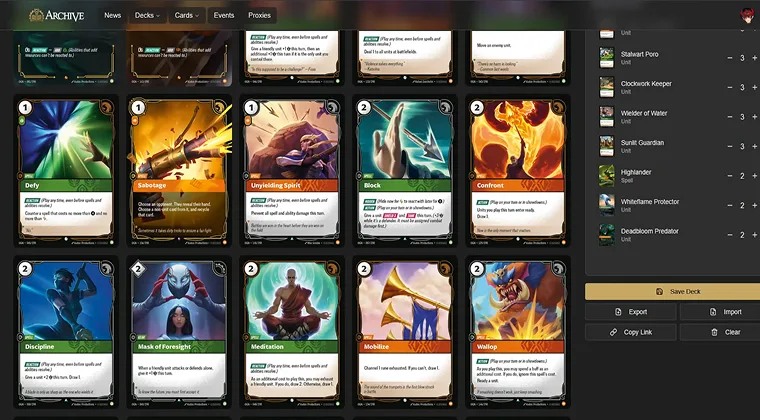
Deckbuilding sounds intimidating, but the rules are simple. This is where your strategy starts to take shape. Here are the essential rules:
- Choose a Champion Legend – this defines your available colors and champion identity
- Select one Champion Unit matching both the Legend’s name and one of its colors
- Build a deck of exactly 40 cards (including your Champion). You can have a maximum of 3 copies of any single card, and all cards must match your Legend’s domain colors.
- Choose 3 Battlefields (colorless, so any are legal). In a best-of-three match, you pick which battlefield to present each game – but you can’t reuse the same one twice.
Once you’re comfortable with the basics, exploring different Riftbound decks will help you find your playstyle. If you’ve played other great trading card games, you’ll pick up deckbuilding fast.
Turn Structure: How a Round Works
Every turn in the Riftbound tutorial follows the same structure. The early phases use an easy-to-remember sequence: A-B-C-D.
- Awaken (A) – Ready all your exhausted cards by turning them upright.
- Beginning (B) – Score points for each battlefield you hold, then resolve start-of-turn effects.
- Channel (C) – Draw 2 Runes from your Rune Deck (3 if you’re going second on turn one).
- Draw (D) – Draw 1 card from your Main Deck.
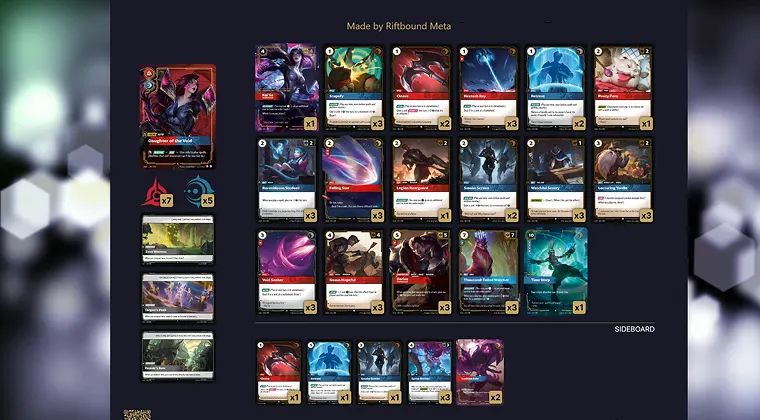
After A-B-C-D completes, you enter the Action Phase – the heart of Riftbound gameplay. Here you play cards, move units, start combat, and use abilities. Take as many actions as you can afford until you decide to end your turn. Studying a Riftbound Origins Proving Grounds decklist shows how competitive players sequence their turns.
The round continues with each player taking turns until someone reaches 8 points (or 11 in a 2v2) and satisfies the final-point rule. Understanding turn flow is essential for mastering Riftbound gameplay effectively.
Step-by-Step Gameplay
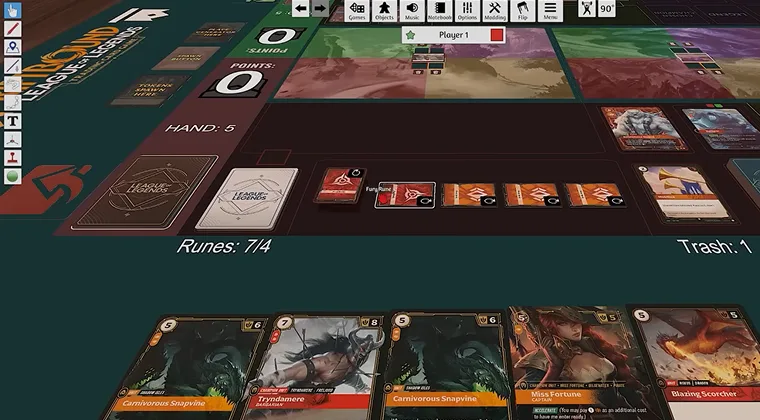
Each Riftbound turn follows the same sequence of phases. This section of the beginner guide for Riftbound explains what happens in each phase and what you can do, using simple, practical language.
1. Awaken Phase
The Awaken Phase is when you ready your cards. In Riftbound, cards exist in two states: ready (upright) or exhausted (turned sideways). Ready cards can be used. Exhausted cards can’t.
During this phase, turn all your exhausted cards upright – Runes, Units, Gear, and your Legend. This refreshes your resources for the turn ahead.
2. Beginning Phase
The Beginning Phase handles automatic start-of-turn effects. Most importantly, you score points for each Battlefield you currently hold. “Holding” means you have at least one unit at a battlefield at the start of your turn, and no opponent contests it.
3. Channel Phase
After scoring, you channel 2 Runes from your Rune Deck (place them face-up). If you’re the second player on your very first turn, channel 3 instead – the Riftbound rules explained this as a catch-up mechanic.
4. Draw Phase
Draw one card from your Main Deck. At the end of this phase, your Rune Pool empties – any unspent Energy or Power is lost.
Although this makes it sound like you choose one or the other, it is important to point out that Rule 163 in the most recent rendition of the Riftbound Core Rules also specifies that every player’s Rune Pool empties at the end of each player’s draw phase and the end of each player’s turn.
5. Action Phase
This is where real decisions happen. During the Action Phase, you can:
- Play cards – Units, Spells, Gear, or your Chosen Champion
- Move units – Between your base and battlefields
- Start Showdowns – By moving to an enemy-controlled battlefield
- Activate abilities – On your Legend, Gear, or Units
Paying for your cards is all about managing Runes. To cover a Energy cost, you exhaust Runes to generate generic Energy. For Power costs, you recycle Runes, sending them back to your Rune Deck, which gives you the colored Power you need.
Sometimes you can even exhaust and then recycle the same Rune to pay both parts of a card’s cost, giving you more flexibility on your turn.
Most Units enter play exhausted, so they usually cannot move or attack right away. During your Action Phase, you can take as many actions as you are able before ending your turn.
Learning to balance when and how to use your actions, while managing your Energy and Power from Runes, is what separates new players from experienced ones. Mastering this action economy can make the difference between winning and losing.
Reactions and Timing Rules
In Riftbound, Reactions are a special kind of card timing that lets you respond to things your opponent does, even in tight timing windows when other card types can’t be played.
When a Unit moves into a contested or uncontrolled battlefield, the game enters a state where only Action or Reaction cards may be played before combat resolves. In these moments, Reactions are critical because they enter the chain and resolve before the effect you are responding to, letting you interrupt your opponent’s actions.
Unlike normal play outside of tight timing windows, once a chain exists, only Reactions and triggered abilities can be added until the chain fully resolves. During this state, players alternate adding Actions and Reactions to the chain when timing allows, and once neither player wants to add more, the chain resolves in last‑in, first‑out order.
That means your Reaction may resolve before the original event it responded to, changing the outcome of key moments like contested battlefield moves or combat interactions. Mastering when to hold and when to use your Reactions within these timing states is one of the most important strategic skills in Riftbound.
Battlegrounds, Combat, and Control
Battlefields are the locations where you earn points in Riftbound. Each player chooses one Battlefield to add to the game, creating the contested areas where units fight for control.
When you move a Unit to an empty Battlefield, you immediately conquer it and score 1 point. If the Battlefield is already occupied by an enemy Unit, a contested state begins. Both players can play Actions and Reactions in response to each other as allowed by the timing rules, and then combat resolves.
Units deal damage according to their Might, and whichever side has surviving Units standing at the end gains control of the Battlefield.
You keep control of a Battlefield as long as you have at least one Unit there. If both players have Units present, the Battlefield is contested, and no one scores points. To gain an edge, a Riftbound rarity guide can help you spot powerful Units worth building your deck around, giving you a better shot at dominating key Battlefields.
How To Win the Game?
Victory in Riftbound comes from being the first player to reach 8 points (or 11 in a 2v2). You score points in two ways: conquering a Battlefield (1 point the moment you take control) and holding a Battlefield (1 point at the start of your turn for each Battlefield you control).
The final-point rule adds extra tension. Your 8th point must come from holding a Battlefield or conquering all Battlefields in the same turn. If you reach 8 points in any other way, you draw a card, keeping the game competitive right to the end.
Different deck archetypes approach victory in unique ways. Aggressive decks aim to conquer Battlefields quickly and overwhelm opponents. Control decks focus on stabilizing the board and grinding out points from holding Battlefields. Combo decks set up powerful turns that can swing multiple points at once.
For fans of strategy board games, Riftbound offers similar tactical depth, rewarding players who plan several moves ahead and master the timing of their Actions and Reactions.
Additional Rules & Clarifications
Beyond the basics, there are a few important Riftbound rules and nuances to keep in mind while playing tp prevent misunderstandings and ensure your games run smoothly:
- Battlefield scoring limits – You can only score each Battlefield once per turn. Moving away and returning with a different Unit won’t earn you a second point.
- Final point restrictions – Your 8th (or 11 in a 2v2) point must come from holding or conquering all Battlefields in the same turn. This prevents unexpected or “cheesy” wins from random effects.
- Signature card limits – Signature cards are powerful spells tied to specific Legends. You can include a maximum of three Signature cards in your deck.
- Card legality – All cards in your Main Deck and Rune Deck must match your Legend’s domain colors. Battlefields are colorless and always legal.
Following these Riftbound basics helps keep games fair, balanced, and strategically satisfying.
Final Thoughts on How To Play Riftbound
Now you have a solid grasp of the fundamentals of Riftbound – but there’s much more depth to explore. Each Legend offers unique strategies, card interactions can create surprising combos, and reading your opponent’s moves becomes second nature with practice.
The best way to truly learn Riftbound is by playing. Grab a preconstructed deck, challenge a friend, or visit your local game store to start battling. Not sure where to buy Riftbound? Don’t worry – I’ve got you covered. Mastery comes from experience, and every game teaches something new.
So sharpen your skills, plan your moves, and get ready to dominate the Battlefields!
FAQs
No, Riftbound is beginner-friendly. The A-B-C-D turn structure is easy to memorize, and preconstructed decks let you start playing immediately. Understanding how to play Riftbound takes about 15 minutes.
Most Riftbound games last 10–20 minutes. The 8-point victory (or 11 in a 2v2) condition keeps matches fast-paced. Best-of-three matches take around 30–45 minutes total.
No, Riftbound is designed for 2–4 players. There’s no official solo mode, though you can practice deckbuilding or simulate games against yourself to learn card interactions.
No. Preconstructed decks include everything you need: a Legend, Champion, 40-card Main Deck, 12-card Rune Deck, and 3 Battlefields. Boosters help customize your collection later.
Yes, it shares DNA with other trading card games, but has unique mechanics. The battlefield-control system and Rune resources feel fresh, while core concepts like deck construction and combat will be familiar. Learning how to play Riftbound is easy if you’ve played TCGs before.