

18 Best Strategy Board Games in 2026: The Perfect Plan

Eneba Hub contains affiliate links, which means we may earn a small commission if you make a purchase through them—at no extra cost to you. Learn more


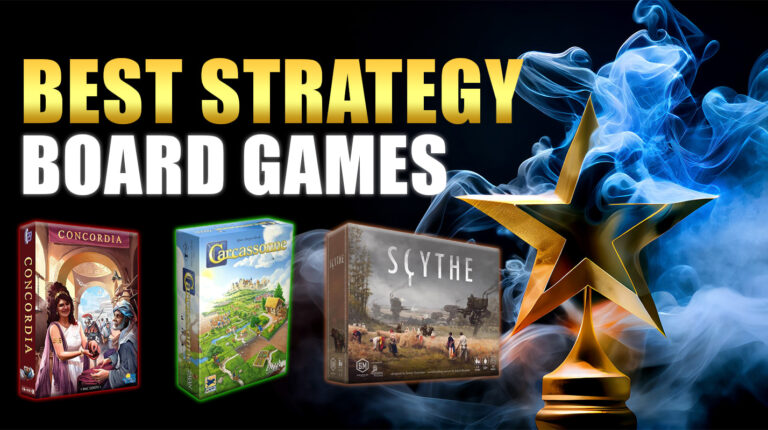
When it comes to the best strategy board games, everyone’s got their own ideal. Some might like games that are simple to learn but difficult to master. Others might prefer games with a massive scope and a lot of complexity.
Still more might prefer a nice balance between the two. Whatever the case, you’ll need a mix of brainpower and daring to succeed in these games.
Whichever you prefer, I’ve got you covered. In this list, we’ll run through 18 of the best strategy board games that you can play right now with either friends on game night, or on your own.
Jump to:
Our Top Picks for Strategy Board Games
While every strategy board game is great, some of them stand well above the others:
- This War of Mine (2017) – Survival in the midst of a siege isn’t just a strategic challenge, but it’s also a harrowing, morally complex affair. How will you live?
- Catan (1995) – This timeless economic strategy board game continues to delight with its simple premise that’s fairly easy to learn but difficult to master.
- Frosthaven (2022) – The sequel to Gloomhaven, Frosthaven blends a little bit of everything: character RPG, mysteries, town building, and more.
If these aren’t your jam, don’t worry. There’s plenty more strategy games to sink your teeth into, so do read on.
18 Best Strategy Board Games for Both Novices and Masterminds
Now, picking out strategy games isn’t a simple matter of “just get the most complicated games possible”. Great strategy board games should be strategically deep enough to satisfy veterans, but also approachable enough that there’s always room for new players at the table.
That said, each of these games offer a nice mix of complexity and strategic depth, as well as accessibility for new players…and maybe a bit of luck to shake things up.
Let’s get on to the list. How many of these great strategy board games have you tried?
1. This War of Mine [Emotional Survival Strategy With Tough Moral Decisions]
| Our Score | Enebameter 10/10
☆
★
☆
★
☆
★
☆
★
☆
★
☆
★
☆
★
☆
★
☆
★
☆
★
|
| Theme | Survival |
| Player Count | 1-6 |
| Play Time | ~2 hours |
| Complexity | Simple |
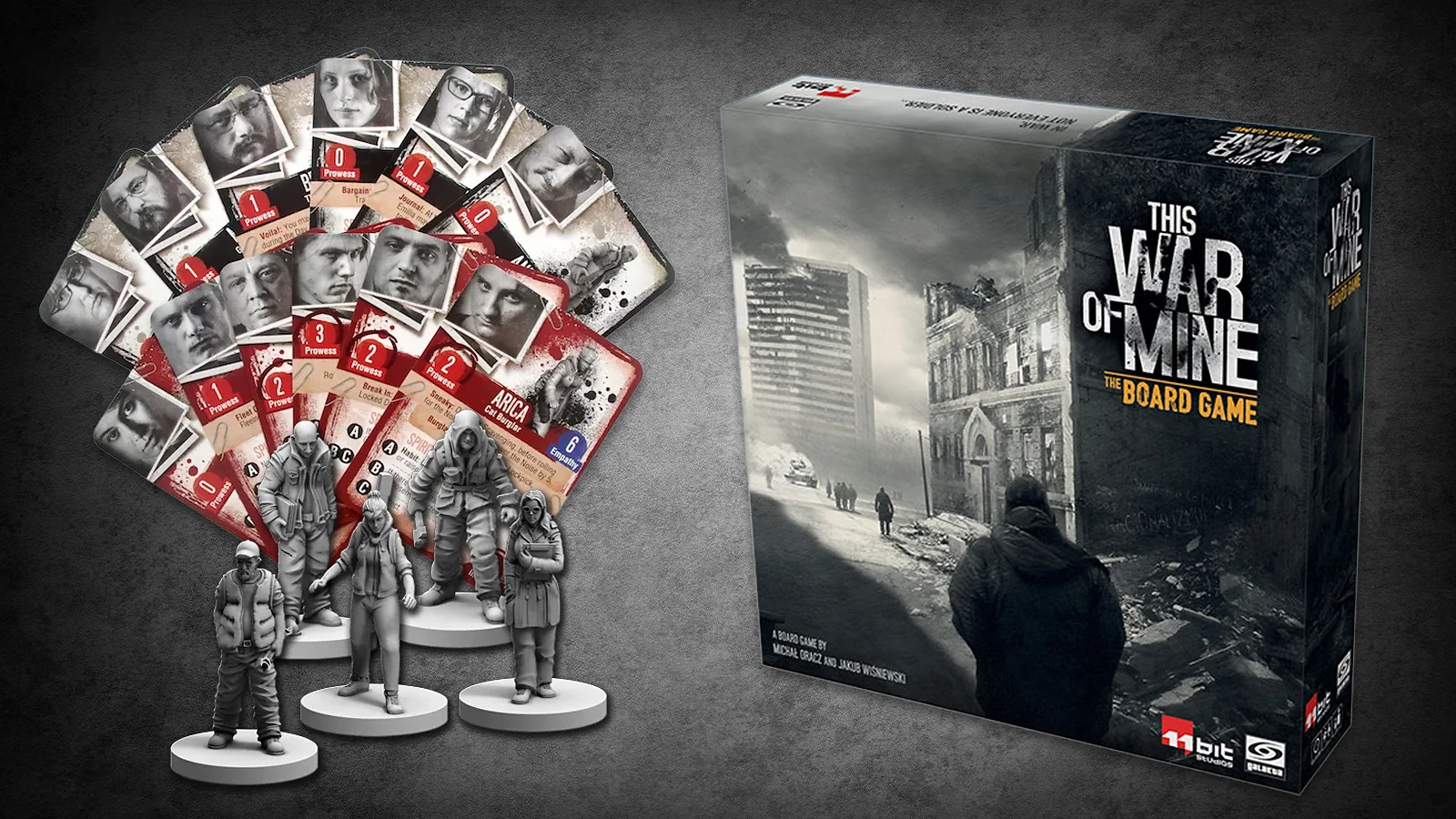
First on this list is This War of Mine, one of the best PC games I’ve had the pleasure of trying out and an absolute gut punch that’s been adapted to board game form. Inspired by the Sarajevo siege, this war sees you not as an elite commando, nor even as a regular platoon, but rather, a group of civilians eking out an existence in a war-torn city.
This War of Mine provides an interesting twist on the usual power fantasy that games offer. It’s moody and honestly kind of depressing at times, but it’s this uniqueness that makes it a must-play.
To survive the siege of Pogoren, you and your handful of survivors have to be wary not only of trigger-happy soldiers (from both sides too), but also find food, water, and medicine among the ruins. Life goes on, even in the midst of this hell, and everything can go south in the blink of an eye.
This War of Mine doesn’t pull any punches when it comes to the naked savagery that survival requires. As you struggle to see just one more day, you’ll be confronted with meaningful, morally challenging decisions, such as whether to risk your life scavenging in the streets, or take supplies from other survivors too weak to fight back.
And when the war ends (because it does eventually end), you’ll be left with the empty echoes of a rubble-strewn city. In the silence that follows as you try to rebuild, you’ll have to answer one simple yet deadly question: did the war show you who you really are?
My Verdict: Both the This War of Mine video game and board game are definitely worth playing for their brutal honesty and moral depth.
2. Catan [Iconic Resource-Trading and Settlement-Building Strategy Game]
| Our Score | Enebameter 9.8/10
☆
★
☆
★
☆
★
☆
★
☆
★
☆
★
☆
★
☆
★
☆
★
☆
★
|
| Theme | Economic |
| Player Count | 3-4, 5-6 with an expansion |
| Play Time | ~2 hours |
| Complexity | Simple |
Back when I was still a student (I have a long and complicated relationship with academia), I had a friend who wouldn’t shut up about Settlers of Catan. Years later, when I finally got to sit down and try it, I realized his hype was completely justified.
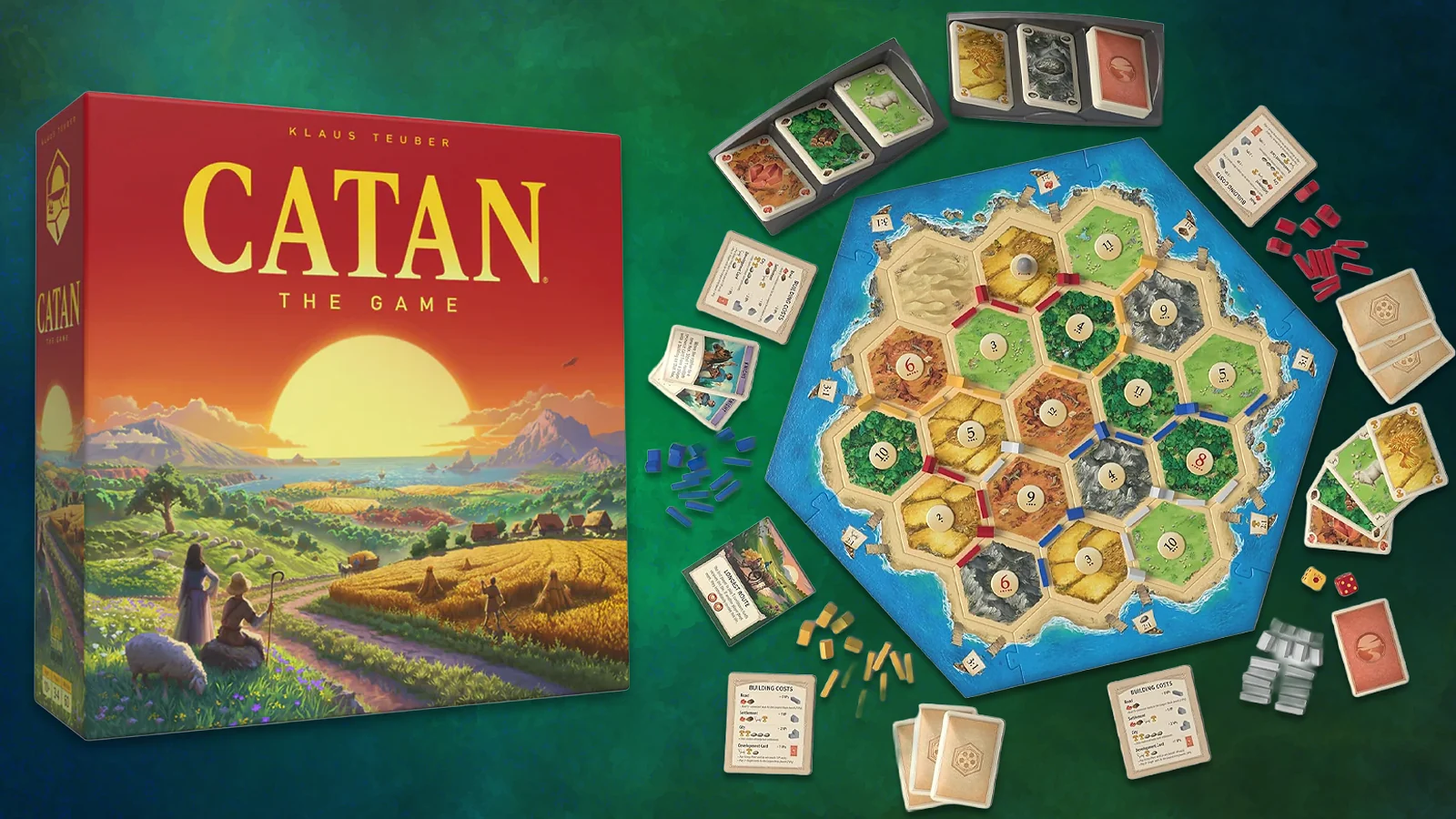
You and your rivals chance upon the lush, unsettled island of Catan, so naturally, you’ll all race to be its lord and master. This is done not just by exploiting and trading resources, but by spending them to build great cities and vast roads. Each great task you complete awards you a certain amount of victory points, and enough points wins you the game.
Every game of Catan plays out very differently, depending on who you’re playing with. Each player has their own strategy, which is in turn molded by how their rivals think. All in all, it’s kind of like playing multiplayer Civilization.
This means that while it’s not strictly a 4X, Catan certainly feels like one. There’s a ton of strategy involved, even when it comes to just trading resources. The supplies your rivals offer you will secure your foothold, sure, but are you willing to run the risk of them getting a massive lead with what they ask in return?
As if the base game didn’t offer enough already, Catan also has a wealth of expansions. Not only does it have a base game expansion to accommodate 5-6 players, but it also has content addons in the form of more lands to explore, external threats to defend against, and different game modes.
My Verdict: Catan is an outstanding gateway strategy game that has a little bit of everything, while remaining accessible enough for even new players.
3. Frosthaven [Deep Tactical Campaign With RPG-Style Progression]
| Our Score | Enebameter 9.5/10
☆
★
☆
★
☆
★
☆
★
☆
★
☆
★
☆
★
☆
★
☆
★
☆
★
|
| Theme | City building, RPG, combat |
| Player Count | 1-4 |
| Play Time | Varied |
| Complexity | Fair |
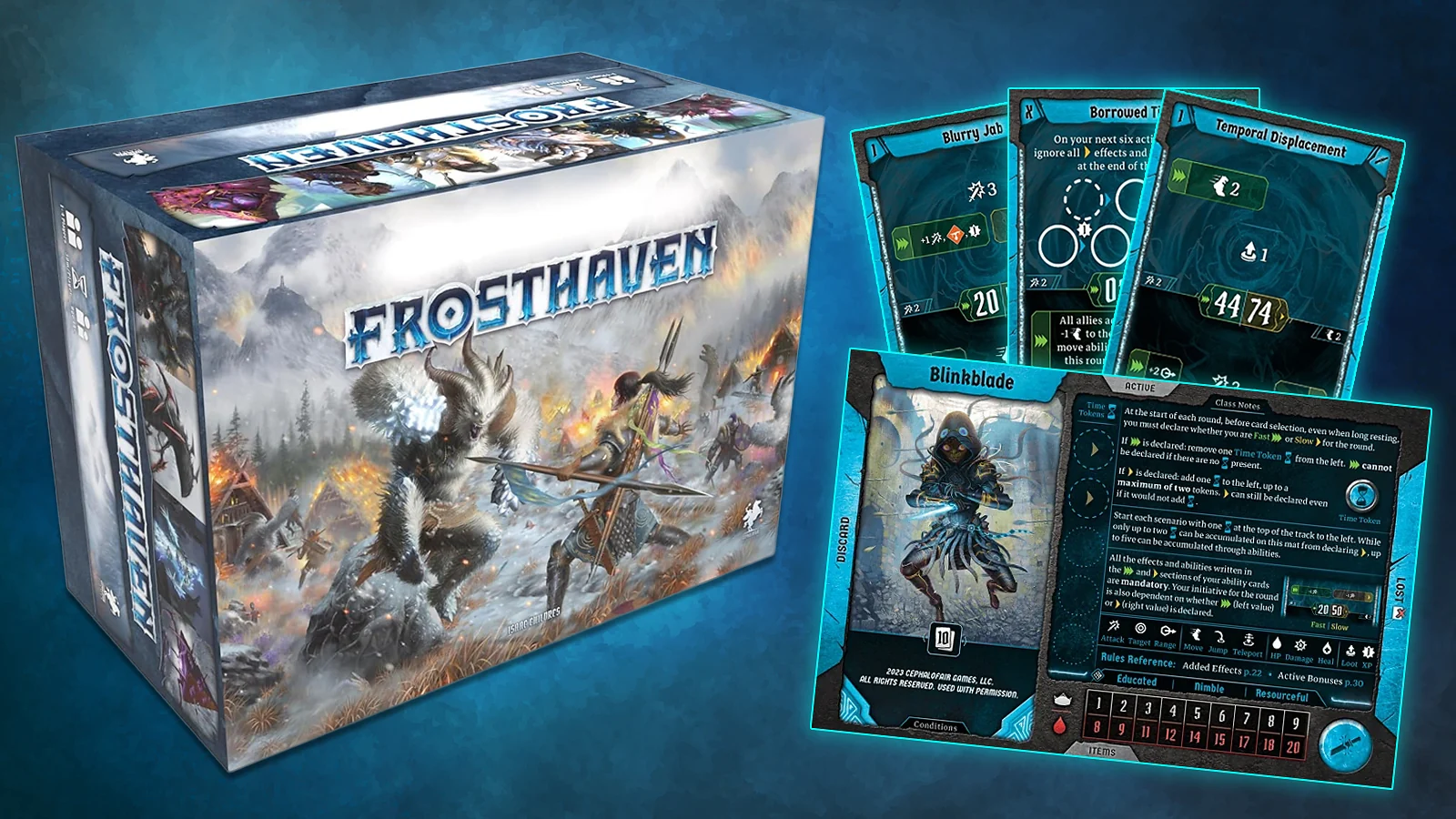
If the name sounds familiar, you’re not alone. Frosthaven is the sequel to the well-renowned Gloomhaven, which was already a deep dive into the lives of adventurers and held to be one of the best tabletop RPG games outside of Dungeons & Dragons. All this to say that the sequel is even bigger and better, not to mention colder and wilder.
Frosthaven takes Gloomhaven up to eleven with just how many systems are added on. It’s dauntingly complex at the start, sure, but once you get used to it, you’ll appreciate just how deep Frosthaven is.
In Frosthaven, you and your party play as adventurers dispatched to a frigid outpost in the northern frontiers. Life here is harsh, not just because of the cold, but also because of the many hostile forces in the area, such as the wild Algox and the bestial Lurkers.
It’s not just adventuring you need to deal with this time, though. You’ll also need to navigate many events, from seasonal shifts between calm summer and unforgiving winter, lots of puzzles to solve, and even some town management as you grow a humble outpost into a livable settlement. At least it’s better than lean-tos and tents.
Of course, it wouldn’t be an Isaac Childres game without character progression, and Frosthaven has oodles of that. With a new 100-scenario campaign, as well as support for characters and items from Gloomhaven, Frosthaven is sure to scratch that RPG itch, even as you struggle to survive in its frozen wastes.
My Verdict: Frosthaven is an utterly massive game that has a bit of everything. If you’re looking to run just one long-term campaign with family or friends, this one’s a fantastic choice.
4. Battleship [Classic Deduction and Strategic Positioning Duel]
| Our Score | Enebameter 9.2/10
☆
★
☆
★
☆
★
☆
★
☆
★
☆
★
☆
★
☆
★
☆
★
☆
★
|
| Theme | Logic, positioning |
| Player Count | 2 |
| Play Time | Varies, usually up to 1 hour. |
| Complexity | Trivial |
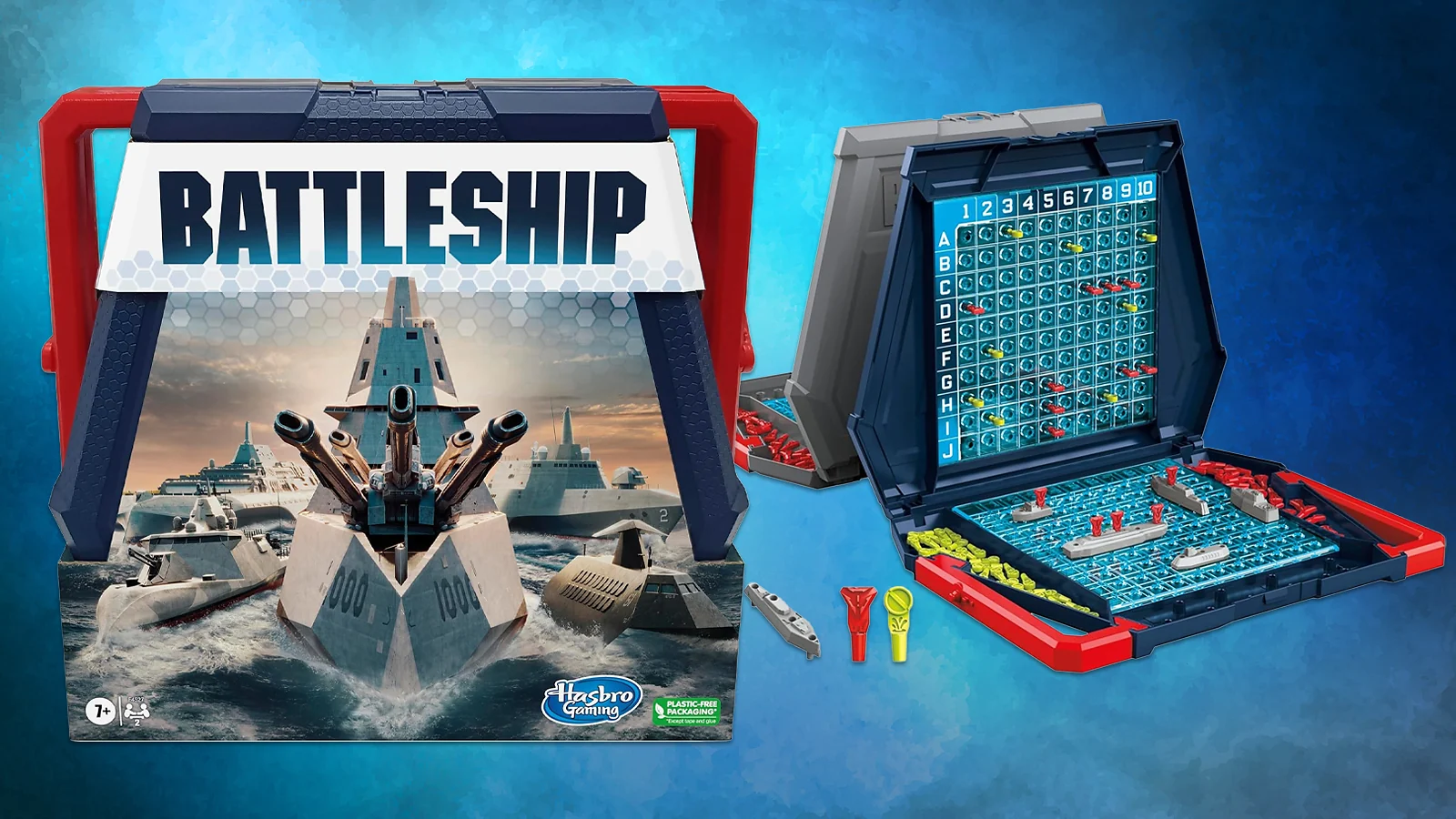
Battleship is a game that’s had a long history, with documents showing it was being played even in 1907. It’s not hard to see why; with its simple yet deep systems and combination of logical deduction and intelligent guesswork, Battleship is a game for the ages.
Battleship is great fun, but its main appeal lies in just how simple it is. If you’re looking to get someone into board games, this is a great starting point.
At its core, Battleship is a simple yet tense head-to-head deduction strategy game. You and your opponent lay out your ships on a grid and take turns shooting spots. Each shot that hits a ship damages it, and once all parts have been hit, the ship is sunk. Naturally, the last player standing wins. Such a dedicated focus on one versus one mechanics ensures that it remains a definitive title among the top two player board games covering this genre.
But while its premise is simple, Battleship still demands some level of strategy. Do you put your ships far apart to make them harder to hit, or do you put them close together because your opponent won’t be expecting that? Do you hit close-together tiles, or do you know your opponent well enough to know that they’ll spread out?
Lastly, because of its simplicity, Battleship can be played virtually everywhere; people back in World War 1 were playing it on paper. I’d still recommend getting a board though as it’s nice to have actual models and a grid…and a way to ensure your opponent isn’t cheating. It’s happened a lot.
My Verdict: Battleship stands out as a simple yet fun and quick game that can be played virtually anywhere.
5. Splendor [Elegant Engine-Building and Resource Optimization Strategy]
| Our Score | Enebameter 9.1/10
☆
★
☆
★
☆
★
☆
★
☆
★
☆
★
☆
★
☆
★
☆
★
☆
★
|
| Theme | Engine building |
| Player Count | 2-4 |
| Play Time | ~20-30 minutes |
| Complexity | Simple |
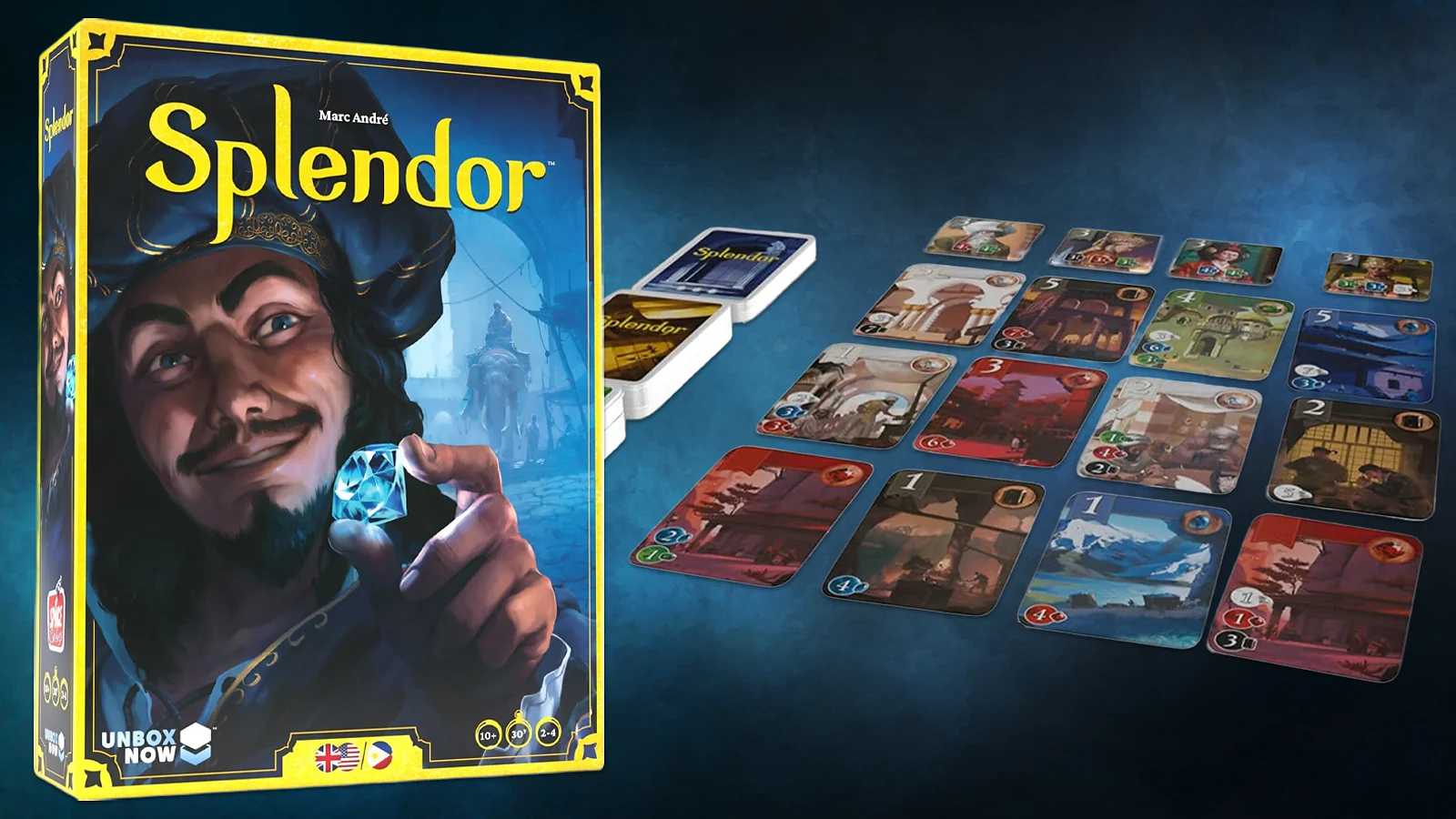
As with Catan, Splendor is a game that revolves around scoring points via economic actions. However, Splendor is also an engine builder, which is a fancy way of saying that you start small, but can invest to make your actions explosively bigger. This means that there’s a large amount of strategy involved in this gem-centered board game.
Splendor is a game for up to 4 players. Each player assumes the role of a gem merchant in the renaissance, and you’ll be competing with your rivals for prestige points. To get these points, you’ll need to use gems. Gems, in turn, can be used to buy developments, upgrade cards that permanently provide you with their listed gems. So yeah, things ramp up rather quickly.
With the random nature of when specific development cards will appear (if at all), Splendor is a delightfully unpredictable game that challenges you to improvise on the fly.
Splendor’s metagame revolves around not just snapping up prime developments to boost your income, but also anticipating and denying key developments your opponents might want. Since you and your opponents will be vying for the most prestige points, reserving developments (especially if they’re one off from a noble’s patronage) is very important.
Now, Splendor is fairly simple to pick up and learn. But while it’s easy to learn, it’s incredibly deep. After all, with how random each of the decks can get as well as the wealth of actions each player can take, who knows how things will play out this round?
My Verdict: Splendor is easy to learn, but even veteran strategists are sure to get a kick out of its elegant engine building and unpredictable nature.
6. Root [Asymmetric Woodland War Strategy With Unique Factions]
| Our Score | Enebameter 9/10
☆
★
☆
★
☆
★
☆
★
☆
★
☆
★
☆
★
☆
★
☆
★
☆
★
|
| Theme | Asymmetric warfare, 4X-ish |
| Player Count | 2-4 (more with expansions) |
| Play Time | ~1 hour |
| Complexity | Complex (asymmetric factions) |
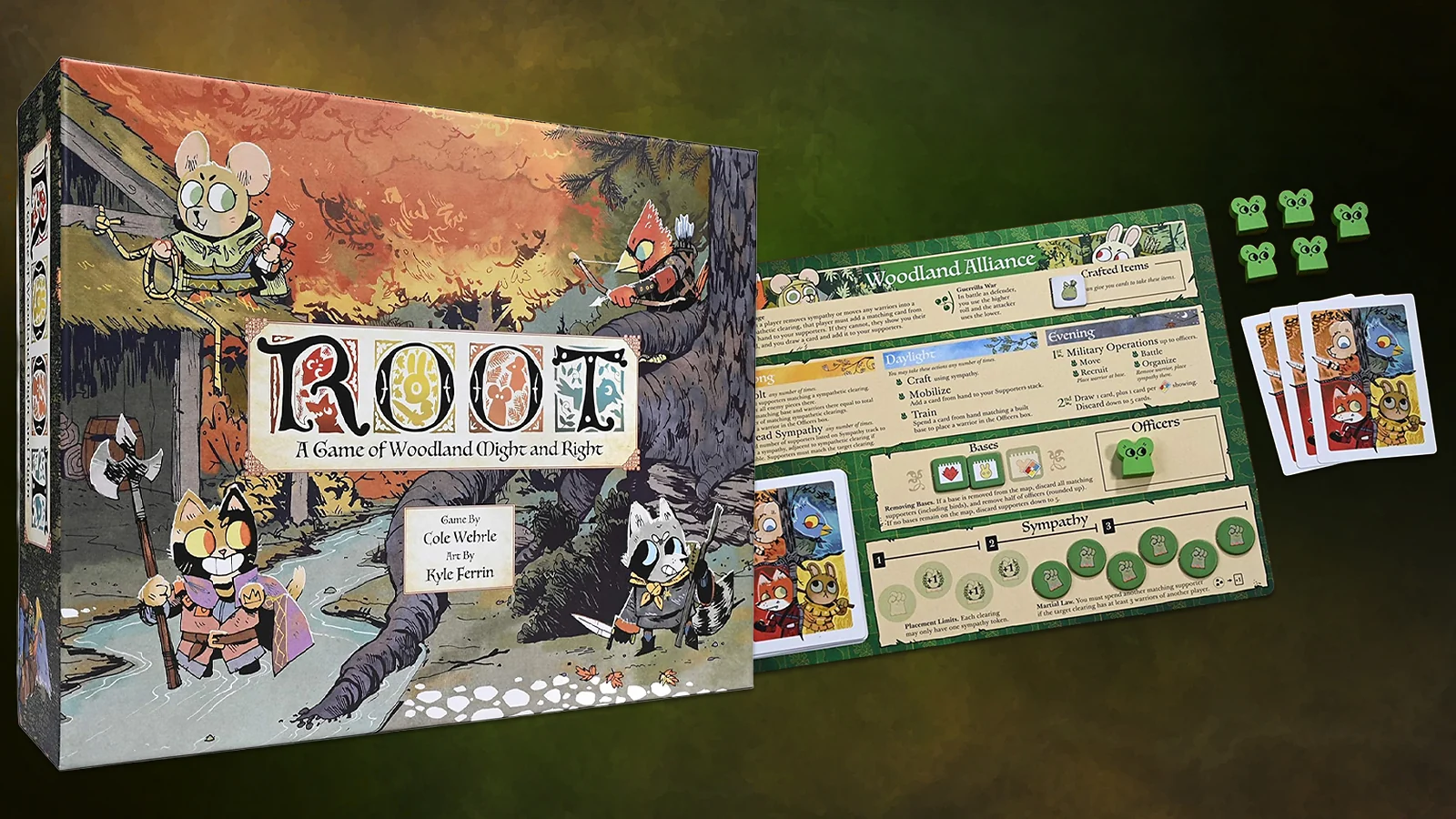
A lot of the board games on this list do their best to give each player an even playing field. However, Root, like Catan, challenges players to play their (figurative) hand of cards. See, unlike other strategy board games about combat, Root distinguishes itself off the bat via its asymmetric factions.
Each player will choose from one of four factions: the engine building Marquise de Cat, the decree-bound Eyrie Dynasties, the guerilla Woodland Alliance, or the opportunistic Vagabond. While they’re all under the umbrella of Root, each of these factions varies in playstyle, so much so that you’ll feel like you’re playing a different game.
Each of Root’s factions requires different tactics to both play as and against. This means that Root’s strategy depth is on a whole other level, and that’s not even factoring in each player’s individual strategies yet.
Root follows the standard formula of scoring points to win, but it also shakes things up by offering each faction unique ways to score points. The Marquise de Cat player, for example, gains points for constructing new buildings for their forest workshops, while the Vagabond player wants to explore ruins and improve relations with everyone.
Because of how deep Root’s strategy is, expect to spend a couple of games learning the ins and outs of each faction. And even once you’ve learned how to play and counter a faction, Root’s unpredictable battlefield also means that you’ll need to master adaptive tactics, as well as clever (and sneaky) impromptu alliances to ensure that your faction comes out on top.
My Verdict: Root is a strategy board game dream. On top of the complexity of adapting to other players’ moves, few games boast as much strategic depth as Root’s factions.
7. Heat: Pedal to the Metal [High-Speed Racing Strategy With Hand Management]
| Our Score | Enebameter 8.9/10
☆
★
☆
★
☆
★
☆
★
☆
★
☆
★
☆
★
☆
★
☆
★
☆
★
|
| Theme | Racing, resource management |
| Player Count | 1-6 |
| Play Time | ~1 hour |
| Complexity | Simple |
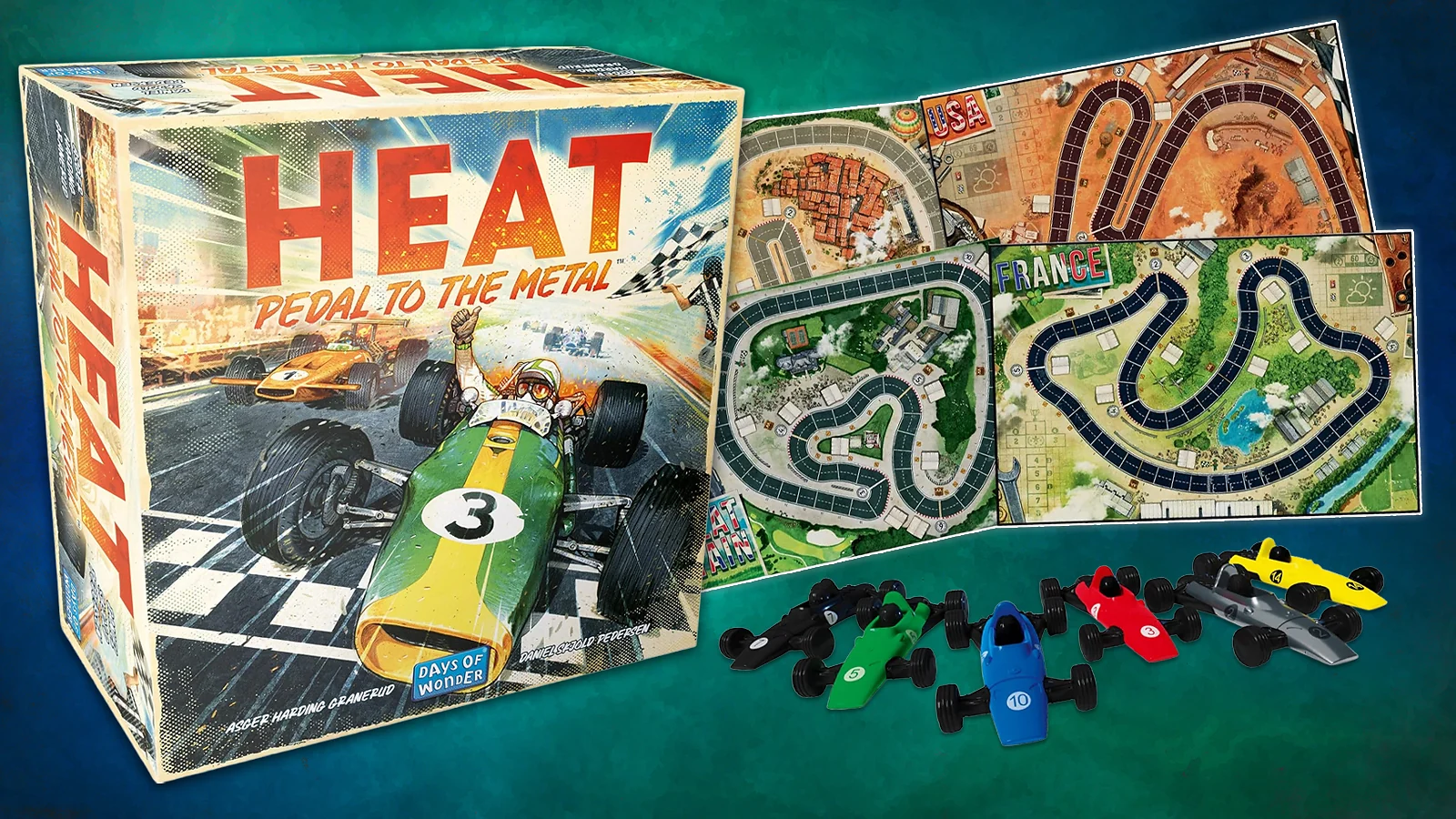
Card games on motorcycles? How about car races on a board game? Because, as ridiculous as it may sound, that’s exactly what Heat offers. And while it may sound silly, it really isn’t; this board game racing game is fast, punchy, and challenges its players to take calculated risks in a bid to win it all.
Heat’s in-your-face action, simultaneous plays, and comeback mechanics mean that each game’s stakes are high from start to finish.
In Heat, you’ll square off against up to six other players in a race to see who can cross the finish line first. As you’ll quickly learn, speed isn’t everything, and Heat revolves around careful risk management and the judicious use of your resources. Going all-in might be a good short-term strategy to seize the lead, but how much heat can your car take?
Unique among games on this list is Heat’s turn system. Rather than each player taking their turn to play, certain actions such as shifting gears or playing cards must be done simultaneously. This lends Heat a sense of urgency, and coupled with how neck and neck races are, things can get really heated really fast.
Apart from its close-range racing action, Heat is also notable for having a lot of extra modules. The garage module, for instance, introduces some neat upgrade cards, while the weather module adds a whole slew of other elements you need to factor in.
My Verdict: Fast and furious yet strategically deep enough to warrant time to think, Heat is a great game for both new board game players and old hands.
8. Carcassonne [Tile-Laying Territory Strategy With Tactical Placement]
| Our Score | Enebameter 8.8/10
☆
★
☆
★
☆
★
☆
★
☆
★
☆
★
☆
★
☆
★
☆
★
☆
★
|
| Theme | Tile placement |
| Player Count | 2-5 |
| Play Time | ~1 hour |
| Complexity | Simple |
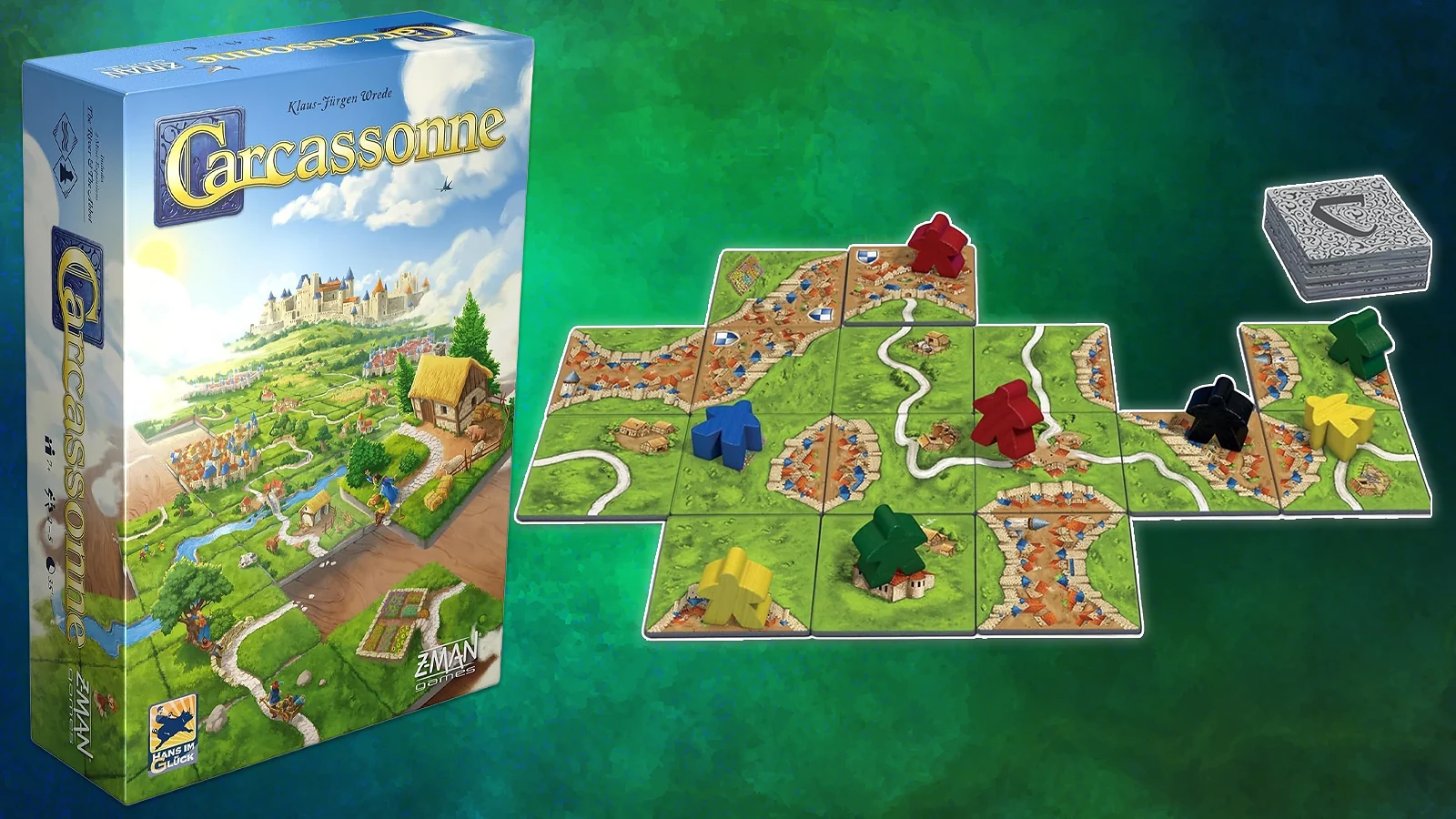
One of the older games on this list, Carcassonne is a medieval city/land builder, where you and your opponents alternate turns to both construct and claim the countryside. This is done by placing tiles to create one complete picture, kinda like a super freeform jigsaw puzzle, and if you’ve played it, kinda like Drop Duchy.
Don’t be fooled by Carcassonne’s age and gameplay. There are a lot of tricks to this game, and you’ll need to become a master not only at placing tiles, but stealing your opponent’s points to win games.
Building the land of Carcassonne isn’t the only objective though, as each player must also invest their meeples to lay claim to certain tiles. Whenever you place a tile, you also have the option of claiming it with one of your limited meeples, which must also be placed on a feature. Don’t worry, it’s a lot simpler than it sounds.
As with many of the games here, Carcassonne runs on a scoring system. However, in Carcassonne, you score points when a feature one of your meeples is on is completed, no matter who finished it. This opens up a whole new metagame of blocking, denying, and sniping features in the race to get ahead. It’s also the only way to get meeples back, so yeah.
One of Carcassonne’s strengths (and what I believe to be its best) is its sheer simplicity. Like chess, you have a very limited amount of moves that you can make on your turn. Yet, it’s the infinite possibilities that each piece (or in this case, tile) creates that makes Carcassonne a strategic masterpiece.
My Verdict: For a game where you really only have two actions, Carcassonne is surprisingly complex and incredibly addictive.
9. March of the Ants: Evolved Edition [4X-Inspired Insect Colony Growth and Evolution Strategy]
| Our Score | Enebameter 8.7/10
☆
★
☆
★
☆
★
☆
★
☆
★
☆
★
☆
★
☆
★
☆
★
☆
★
|
| Theme | 4X |
| Player Count | 1-5 |
| Play Time | ~1 hour |
| Complexity | Fair |
Many games on this list, such as Catan, Splendor, and Root, have inklings of a 4X built into them. Logically, the next step would be to create the entire package in compact form, and that’s exactly what we get with March of the Ants, a nature-centric foray into the 4X genre.
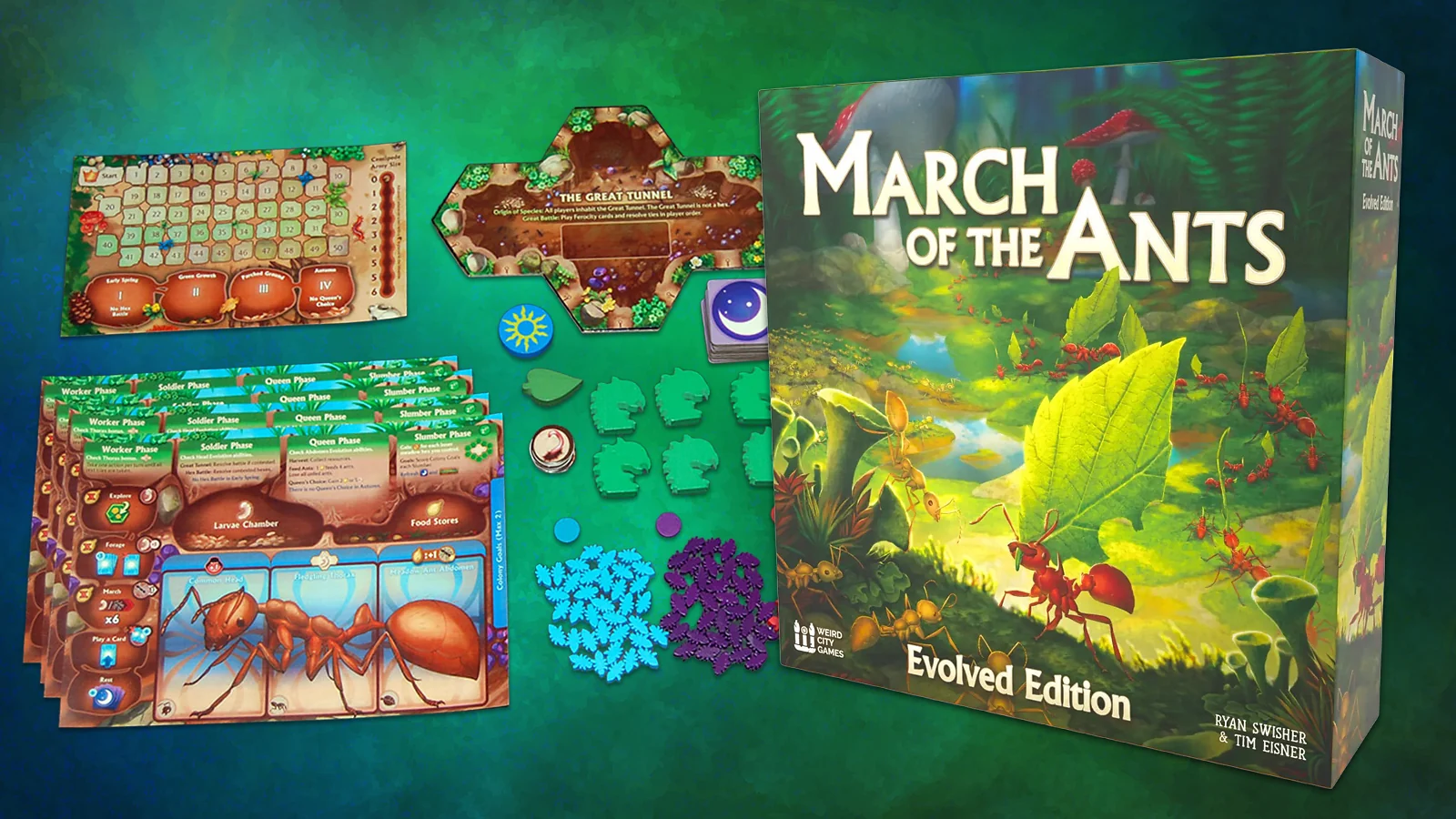
If the name hasn’t tipped you off yet, each player manages their own hive of ants in a bid to control the Great Tunnel. To do that, you’ll need to do as 4X empires do: expand the board by strategically placing tiles, explore the tunnels, exploit their resources, and exterminate the other ants via combat and mutating your brood.
4X players will find themselves easing into this board game easily, and the reactive phases and close quarters means that there’ll be a lot of action from the get-go.
March of the Ants has multiple paths to victory and so much room for strategic thinking, so much so that playing a game feels very close to a nice round of Civilization. The core exception here is the time commitment, as the designers managed to distill the experience into compact sessions that run for roughly over an hour.
One last thing that I should point out here is that this is the Evolved Edition, not the original from 2015. The Evolved Edition, released in 2025, doesn’t just ship with snazzier visuals, but also retooled rules and smoother mechanics for an overall better game…so make sure you’re getting the right version.
My Verdict: March of the Ants manages to condense a 4X playthrough into a succinct yet satisfying board game. Definitely a must-try for hardcore strategists.
10. Plunder [Pirate-Themed Area Control and Resource Conquest]
| Our Score | Enebameter 8.5/10
☆
★
☆
★
☆
★
☆
★
☆
★
☆
★
☆
★
☆
★
☆
★
☆
★
|
| Theme | Exploration, resource management |
| Player Count | 2-6 |
| Play Time | ~2 hours |
| Complexity | Simple |
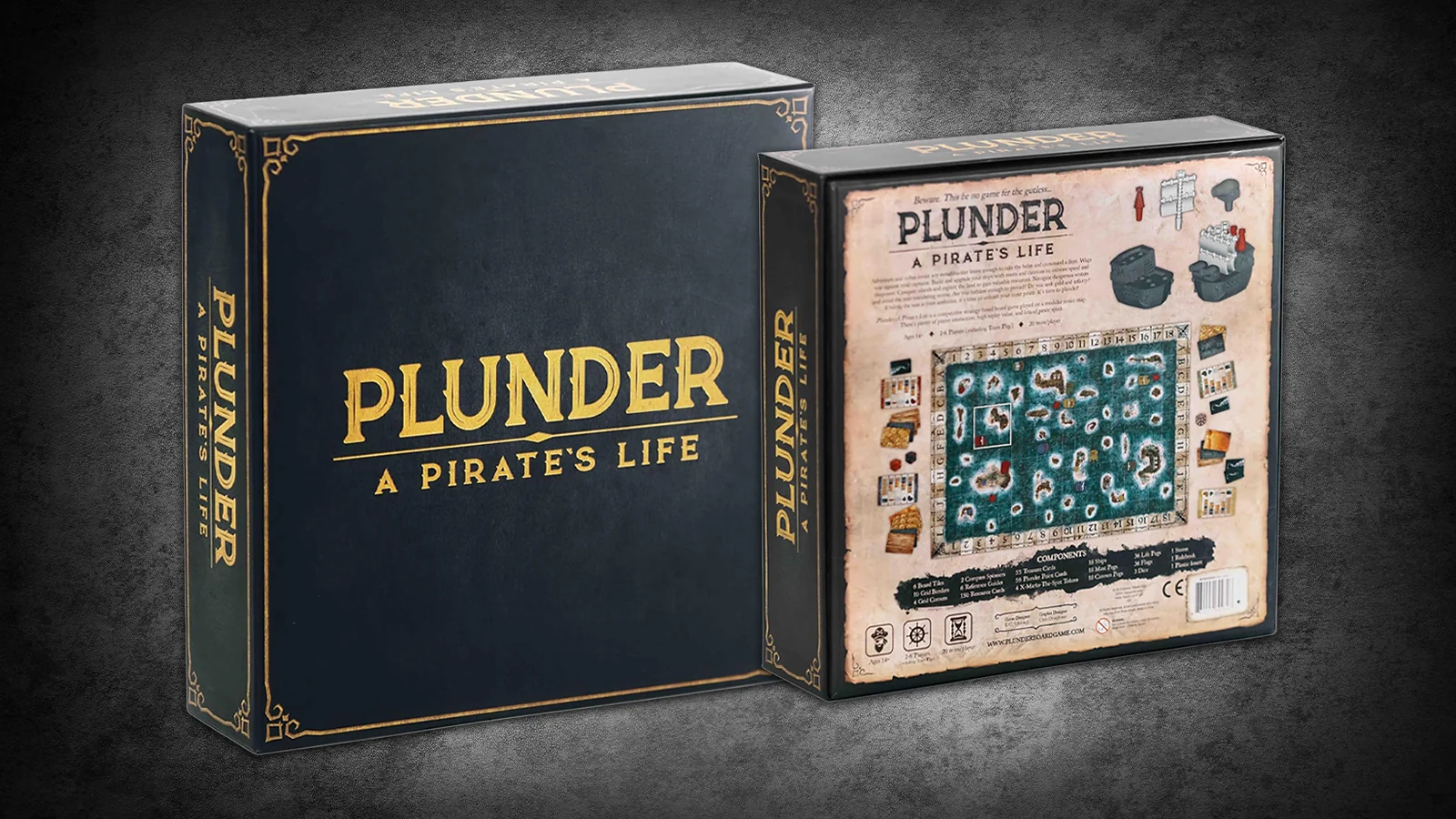
Building empires might be a bit too grandiose for some, and luckily, there are still strategy-rich games with a less intense spin. Plunder, for instance, puts you in the boots of a pirate captain, each of whom will compete to be the richest soul on the seven seas. This is done by comparing booty in the form of plunder points; the first to hit 10 wins.
Plunder stands out with its lack of complexity. Sure, there’s a fair amount of strategy involved, but the luck-based combat and simple mechanics make Plunder a good game for younger or less experienced players.
There are many ways to earn plunder points: capture islands, build a fleet, sink other ships, or go treasure hunting. The world, as they say, is your oyster, and how you get your points doesn’t matter, so long as you have the most of them.
This means that there’s a good deal of strategy involved in Plunder. You can choose to go tall by taking islands and amassing a fleet, or take the adventurous route and chase the X marks on the map for a chance to draw a card from the treasure card deck. The only thing you really need to look out for is plunder points, as anyone getting ten instantly ends the game.
Plunder’s strength lies in just how simple it is. While it’s not as deep as say, Root, the fact that anyone can just jump in, play, and possibly win on their very first game of Plunder makes this an excellent game for game night.
My Verdict: With its basic yet engaging gameplay and easy-to-learn mechanics, Plunder is a great pick for gamers looking for something short, sweet, and fun.
11. Risk [Global Conquest Strategy Focused on Troop Deployment]
| Our Score | Enebameter 8.4/10
☆
★
☆
★
☆
★
☆
★
☆
★
☆
★
☆
★
☆
★
☆
★
☆
★
|
| Theme | World conquest, tactics, diplomacy |
| Player Count | 2-6 |
| Play Time | ~2 hours |
| Complexity | Simple |
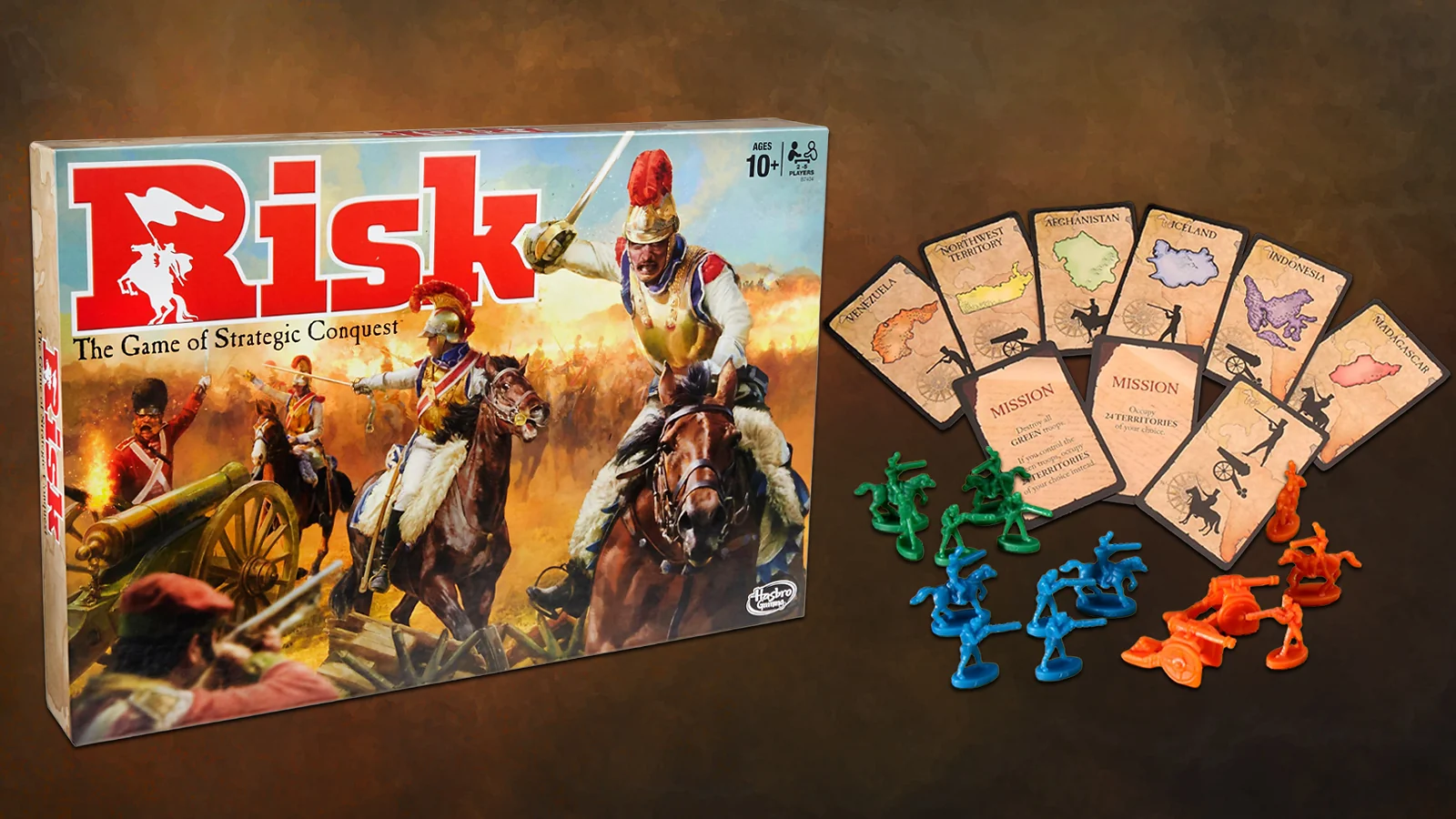
No list of strategy board games can be complete without Risk, the grandfather of a lot of modern strategy games. By today’s standards, Risk is incredibly simple (some might even venture to say crude), but its legacy is so huge that it was inducted into the U.S. National Toy Hall of Fame in 2021.
Risk is a fun, light, and simple childhood classic that can readily serve as an introduction to more advanced games.
Risk’s gameplay is straightforward. Each player controls armies, which they’ll use to conquer 42 territories around the world. Complicating this, of course, is the fact that every player wants to be the new world ruler, so you’ll need to duke it out with everyone else and engage in dice-based combat to take their lands.
Risk is a game that revolves around aggression. Even though you’ll be constantly losing fighting men on both the offense and defense, a steady stream of reinforcements from your controlled territories encourages you to go and stay on the offensive. To the victor go the spoils as well, and cards earned from conquest can be traded in to instantly spawn in new guys.
Last, but definitely not least, is diplomacy. While there are no formal rules about alliances in the Risk rulebook, in general, players will generally create informal alliances and not attack each other. As this is a game about conquest, any alliance is bound to be short-lived. Remember: there can only be one.
My Verdict: This popular strategy board game still has plenty of fun to offer even today, and its low difficulty and uncomplicated rules make it great for new players.
12. 13th Street Crew [Cooperative Tactical Strategy in Urban Conflict]
| Our Score | Enebameter 8.2/10
☆
★
☆
★
☆
★
☆
★
☆
★
☆
★
☆
★
☆
★
☆
★
☆
★
|
| Theme | Social deduction |
| Player Count | 3-7 |
| Play Time | ~1 hour |
| Complexity | Simple |
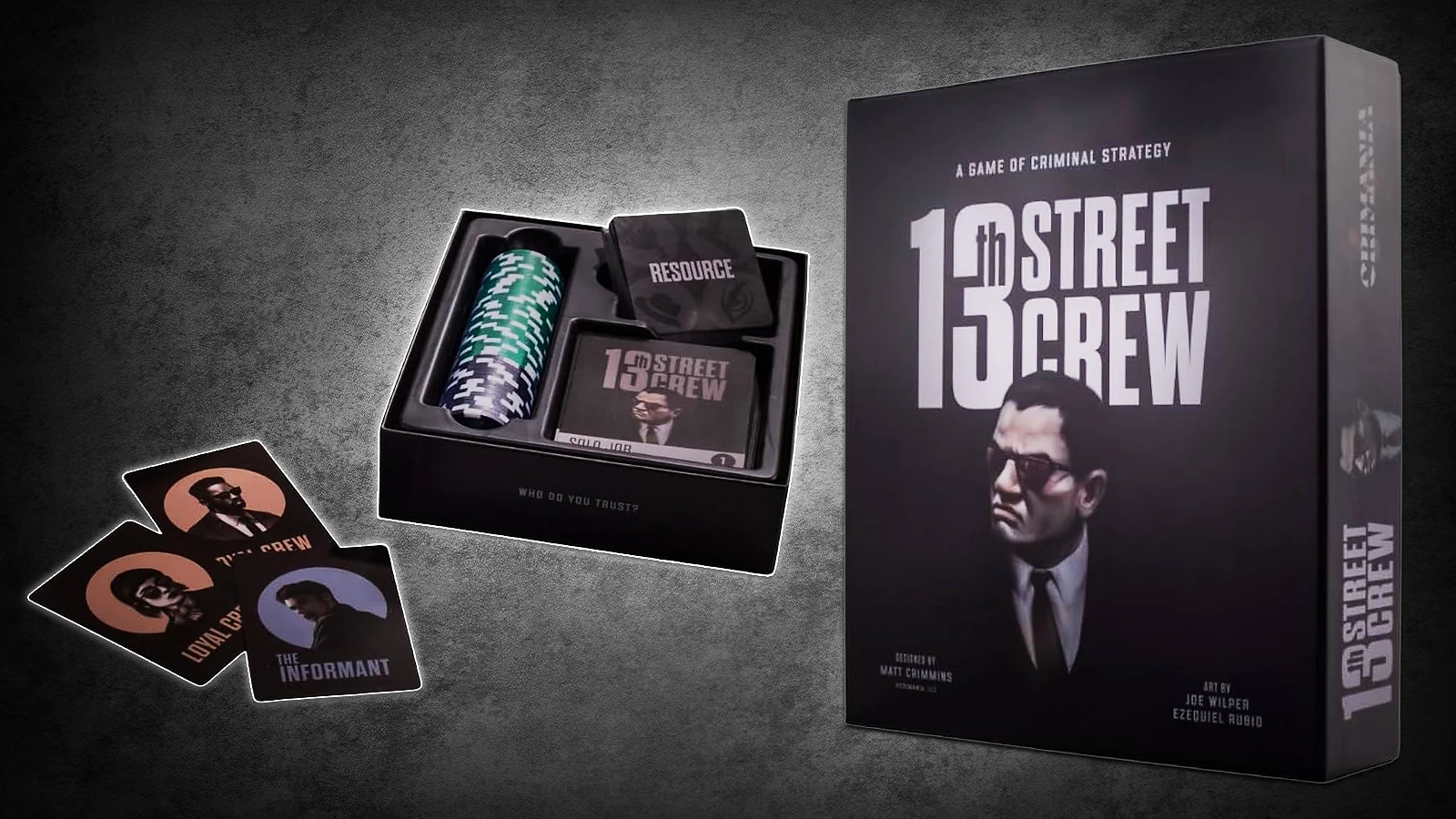
And speaking of alliances, 13th Street Crew is another game that encourages you to work together. This gritty, urban-tactics social deduction game sees the rise (or fall) of a group of grunts in a crime syndicate . Unlike other games in the same genre though, players can win together…but good luck getting there.
Just like many social deduction games, 13th Street Crew gives players hidden roles at the start of a game. While most players will be assigned the rule of thug, there can be police informants hidden among you. Said informant will be seeking to win the game on their own by being the first to amass $15,000, but watch out as sometimes, no one is sus.
13th Street Crew doesn’t just build on the usual hidden identity game tropes, but also adds a unique spin on it via the job system.
Control of the crew is given to the lead player, who rotates after every job and decides which job to take on, as well as who goes with them. Who to bring and who to exclude on a heist is an exercise in itself, as every player, not just the informant, can screw over the whole team by throwing a police presence card into the results pool.
This means that 13th Street Crew is a much richer experience compared to your usual social deduction fare. While it might seem like allying with everyone and winning together is the smart move, rest assured that you can’t truly trust anyone on your crew.
My Verdict: 13th Street Crew offers a deeper yet no less fun take on popular hidden identity games, and will require not just strategy, but charisma and a quick tongue.
13. Twisted Cryptids [Hidden-Movement and Bluffing Strategy With Mythical Creatures]
| Our Score | Enebameter 8/10
☆
★
☆
★
☆
★
☆
★
☆
★
☆
★
☆
★
☆
★
☆
★
☆
★
|
| Theme | Exploration, resource management |
| Player Count | 2-4 |
| Play Time | ~1 hour |
| Complexity | Simple |
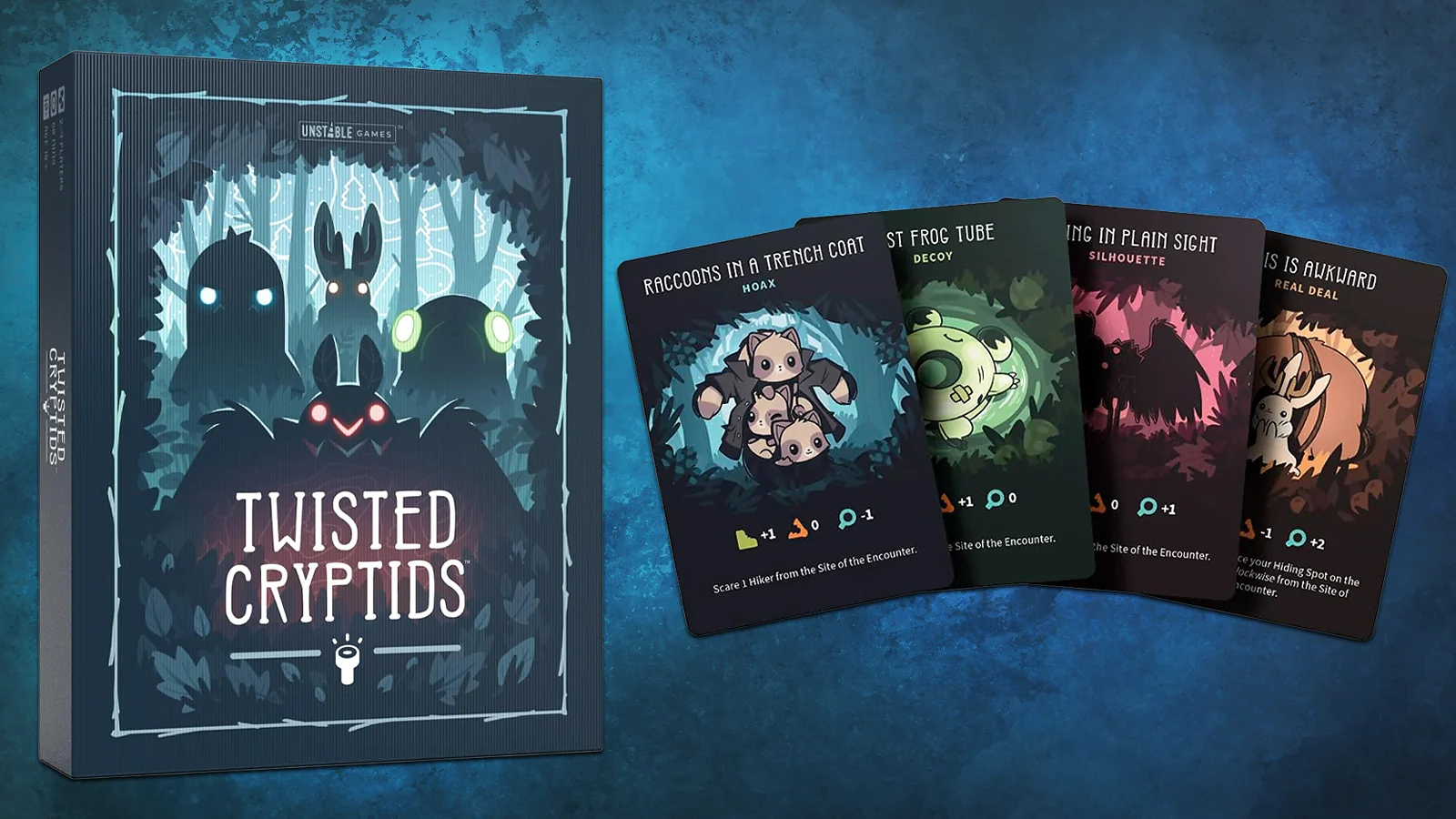
Twisted Cryptids might have a sinister-sounding name, but it’s just an act as all the cryptids here are fluffy, and dare I say, cute. In the words of the creators, this is a game about navigating your love-hate relationship with humans. This means that you’ll need to both give humans a good show and avoid getting shot and/or turned into a hat.
Twisted Cryptids isn’t the deepest game on this list for sure, but it’s easy to pick up and learn, and the character designs do it a great service.
Gameplay is pleasantly simple: you select a hiding spot during setup, stack three decks, then resolve events once the humans come out to play. The right kind of attention provides you myth points, while encounters with the wrong type of humans penalizes you. Rounds are short and sweet, with each game of Twisted Cryptids lasting only five rounds.
There can only be one legendary cryptid, and you’ll need to use your abilities and select your hiding spots wisely to ensure you get the most attention when the humans come knocking. However, you’ll also need to be wary of your fellow beasties, and there are many opportunities to sabotage each other in the form of your “reveal” cards and unique ability.
On top of this, each cryptid also has a unique trait, and fulfilling this trait scores you bonus myth points during scoring. Unlike your abilities, your trait card is hidden from other players until the end, so don’t expect many runaway games.
My Verdict: Twisted Cryptids is a unique, charming strategy game that’s great for players looking for either an easy, fun game or something that isn’t very demanding.
14. Wingspan [Nature-Themed Engine-Building Strategy With Card Synergy]
| Our Score | Enebameter 7.9/10
☆
★
☆
★
☆
★
☆
★
☆
★
☆
★
☆
★
☆
★
☆
★
☆
★
|
| Theme | Engine building |
| Player Count | 1-5 |
| Play Time | ~1 hour |
| Complexity | Fair |
We’ve seen engine builders about gems and taking over the woodland (via the Cats in Root), so you probably won’t be surprised anymore when I tell you that Wingspan is an engine builder about birds. Namely, collecting and raising birds.
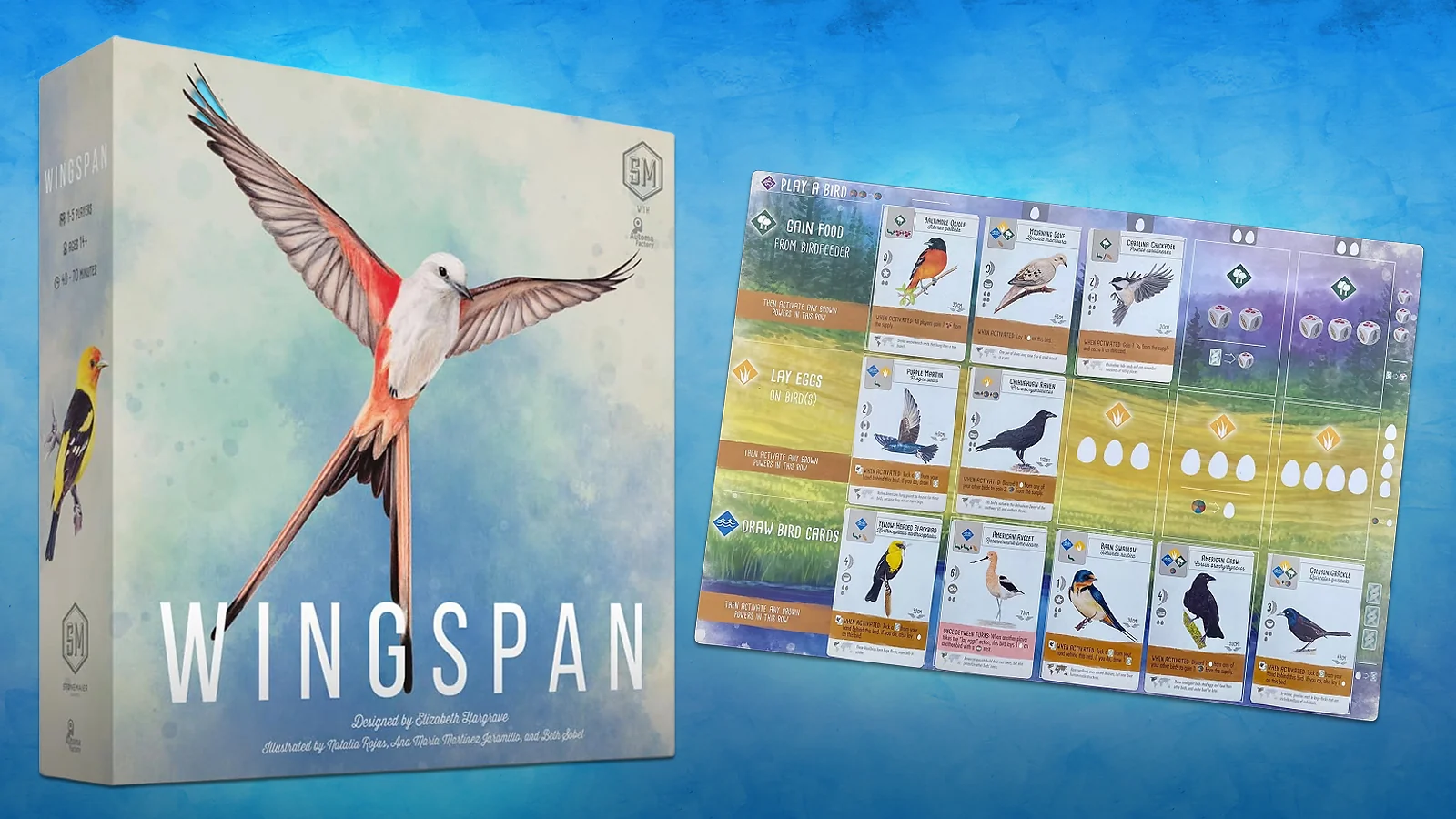
This renowned award-winning board game is a serious contender for one of the best strategy board games of all time. There’s a lot to love here: soothing gameplay that can be played solo, deep card synergy (which includes how you order your cards), wide room for skill expression, and of course, its absolutely stunning production quality and card art.
Wingspan has a lot of things going for it, but my personal favorite thing about it is that it can be played solo. The beautiful art and setting combined with its strategic depth all make for some really zen gameplay.
To complete your aviary, you’ll need to spend your actions wisely over four rounds, each with a decreasing number of available moves. You’ll need to juggle not just scoring points via caches or tucks, but also choose when and where to invest food, eggs, and the order in which you place your birds. All this to say that yes, there is a ton of strategy involved in Wingspan.
Base Wingspan already provides a ton of content, but if you’re looking for even more birds to add to your collection, you’ll be happy to know that the game has several expansion packs featuring birds from locales all over the world, each of which is sure to be a sublime addition to your habitat.
My Verdict: Eye-catchingly beautiful and strategically deep, Wingspan is sure to be a big hit for anyone looking to get their strategy board game fix.
15. Ticket to Ride [Route-Planning and Network-Building Railroad Strategy]
| Our Score | Enebameter 7.8/10
☆
★
☆
★
☆
★
☆
★
☆
★
☆
★
☆
★
☆
★
☆
★
☆
★
|
| Theme | Route building |
| Player Count | 2-5 |
| Play Time | ~40 minutes |
| Complexity | Trivial |
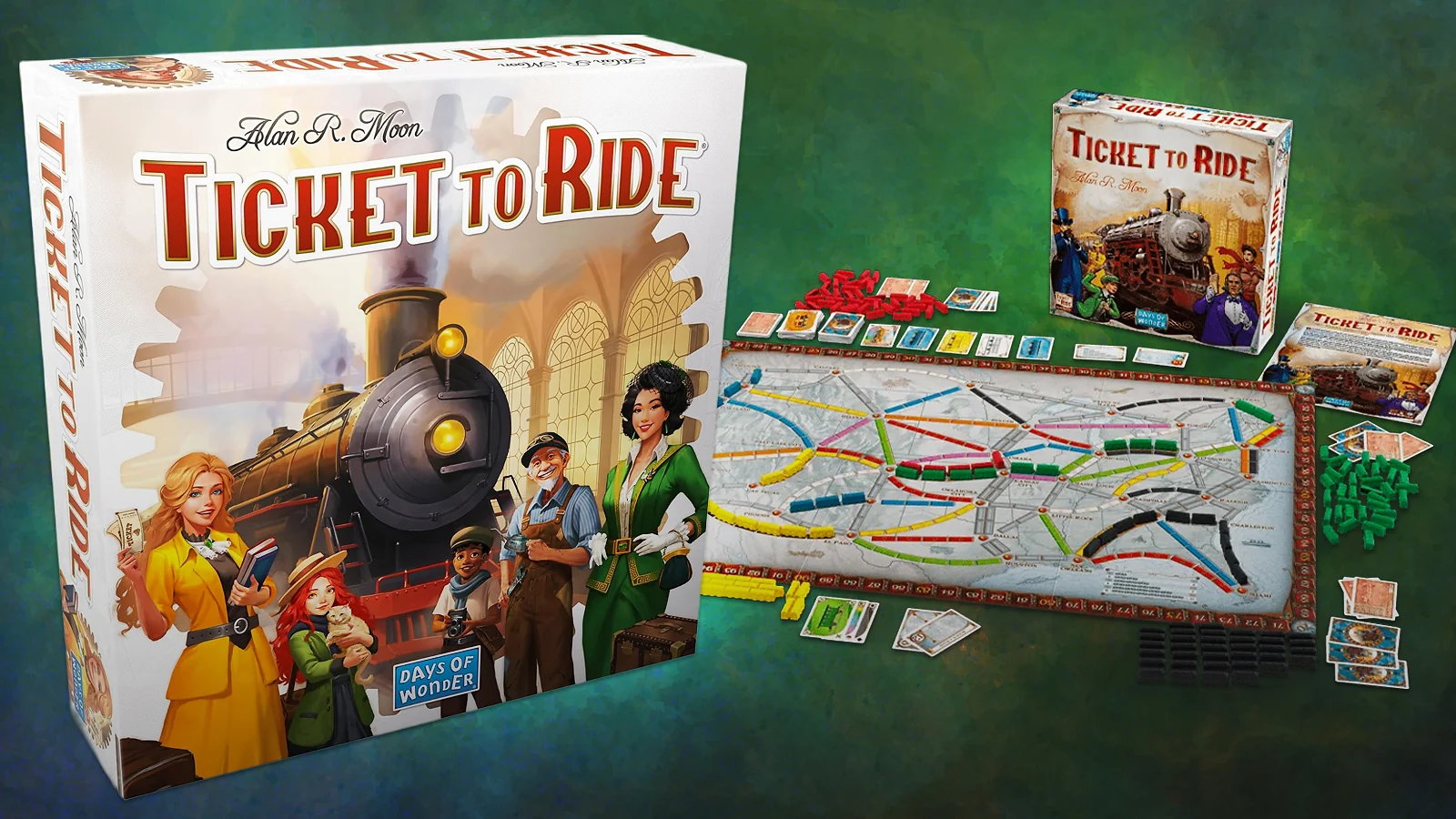
Ticket to Ride parallels the story of the (completely fictional) Around the World in 80 Days by Jules Verne. In both that story and this board game, you’ll play as an enterprising individual attempting to visit as many cities in the U.S. in as short a time as possible.
Ticket to Ride stands out with both its simplicity and its fun. But while it’s simple, Ticket to Ride still provides enough of a risk-reward balance that even hardcore strategists will have fun with it.
Ticket to Ride’s gameplay is a continuous dance between greed and prudence. The easiest way to score points by far is by claiming routes by playing train cards, which you can augment by drawing more cards. Be warned though: expanding your hand comes at the opportunity cost of claiming a route for your turn, and nothing’s stopping your foes from nabbing those.
The more effective but much riskier way of scoring points is by completing destination tickets. Each ticket you complete is worth a ton of points, but each one you fail to complete also penalizes you the same amount of points. Since you can choose to draw more tickets during your turn, it’s entirely up to you whether to gamble on these or play things safe.
Perhaps the best thing about Ticket to Ride is that it’s also incredibly easy to learn, which makes it a fantastic family board game. However, this simplicity doesn’t come at the cost of the game’s depth and while anyone can pick up the game and play proficiently within 20 minutes, it’s still an intensely competitive game that’s tough to master.
My Verdict: Easy to learn but simple and fun, Ticket to Ride is a good strategy board game for both serious sessions and “for fun” playthroughs.
16. Concordia [Elegant Euro Strategy of Trade, Expansion, and Card Efficiency]
| Our Score | Enebameter 7.7/10
☆
★
☆
★
☆
★
☆
★
☆
★
☆
★
☆
★
☆
★
☆
★
☆
★
|
| Theme | Economic |
| Player Count | 2-5 |
| Play Time | ~2 hours |
| Complexity | Fair |
The Roman goddess Concordia (or the Greek Harmonia, if you refer) embodied the concept of concord, harmony, and peace. So it’s quite fitting that this Eurogame named after her is all about peacefully overcoming your opponents through trade. Well, peacefully in a non-violent sense; business is pretty cutthroat, after all.
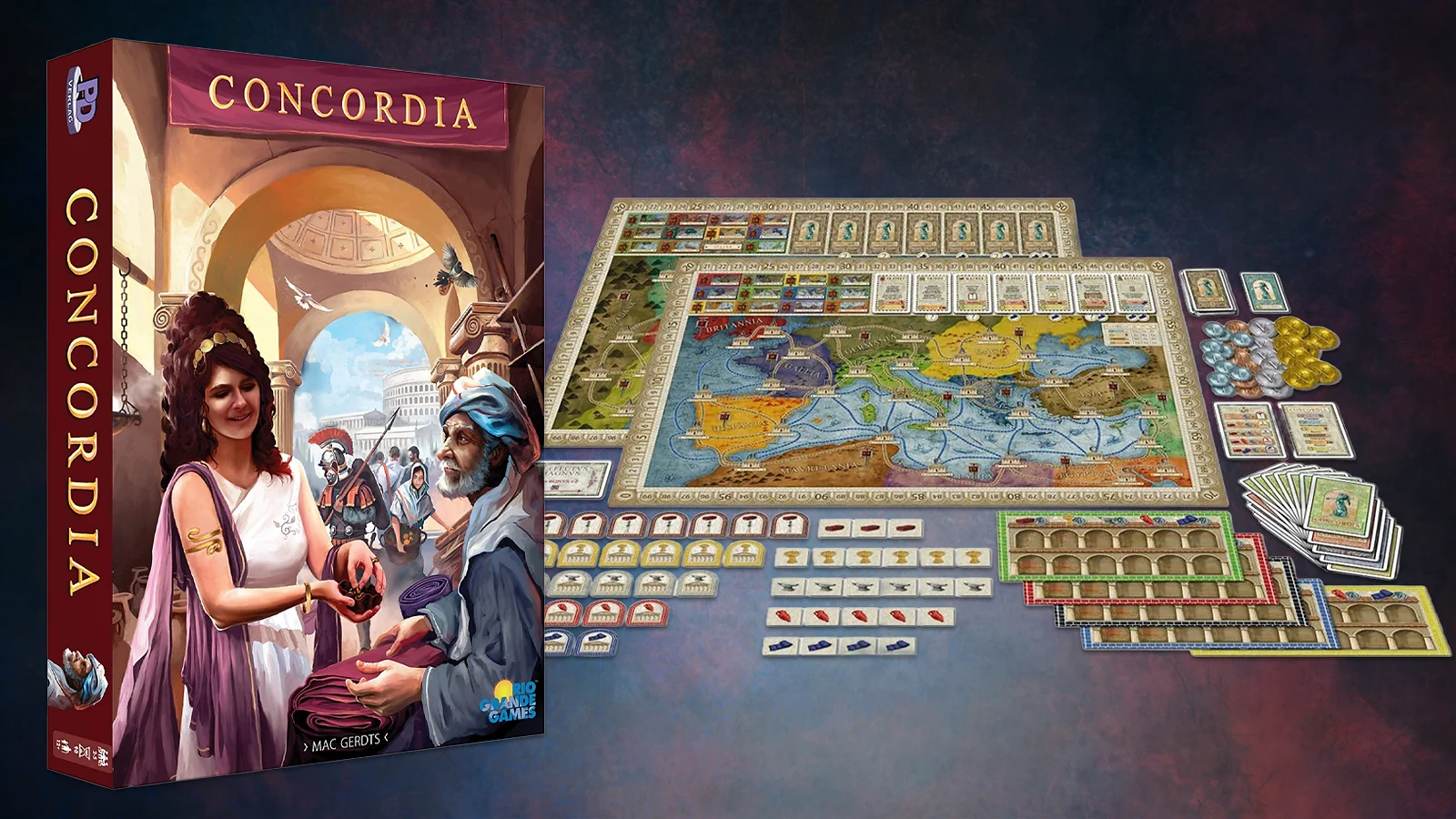
In Concordia, you’ll build a trading network in the Roman era. This means you’ll need to send colonists out to establish settlements (or maybe just trading posts) all across Europe. It’s not a simple matter of just paying money though, as scaling costs mean that you will need to carefully plan your economy and spend your stored resources efficiently.
Concordia isn’t just fun to play. It also has minimal to no luck factors involved, so it’s perfect for thinking types that like to foresee and plan against every move.
Concordia’s gameplay revolves around seven personality cards, each of which is played on your turn. All these personalities have different effects that’ll help you get ahead, and because every player has an identical hand of cards, victory often boils down to who can use their cards the most skillfully.
What’s especially nice about Concordia is that winning comes not from doing well in a single aspect. Victory Points are earned through a huge variety of actions such as your net worth, your city diversity, and more, so ultimately, the more people you have playing the game and doing stuff, the wilder your Concordia games will get.
My Verdict: Concordia is an elegant, low-luck economic strategy game that’s perfect for veteran players looking for something more predictable but still engaging.
17. Monopoly [Classic Economic Strategy of Property Building and Negotiation]
| Our Score | Enebameter 7.5/10
☆
★
☆
★
☆
★
☆
★
☆
★
☆
★
☆
★
☆
★
☆
★
☆
★
|
| Theme | Economic |
| Player Count | 2-8 |
| Play Time | ~2 hours |
| Complexity | Simple |
Ah, Monopoly. That timeless, ruthless economic negotiation and property strategy game that never ends because no one ever reads the rulebook. Specifically the part where you have to hold an auction if someone doesn’t want to buy a property.
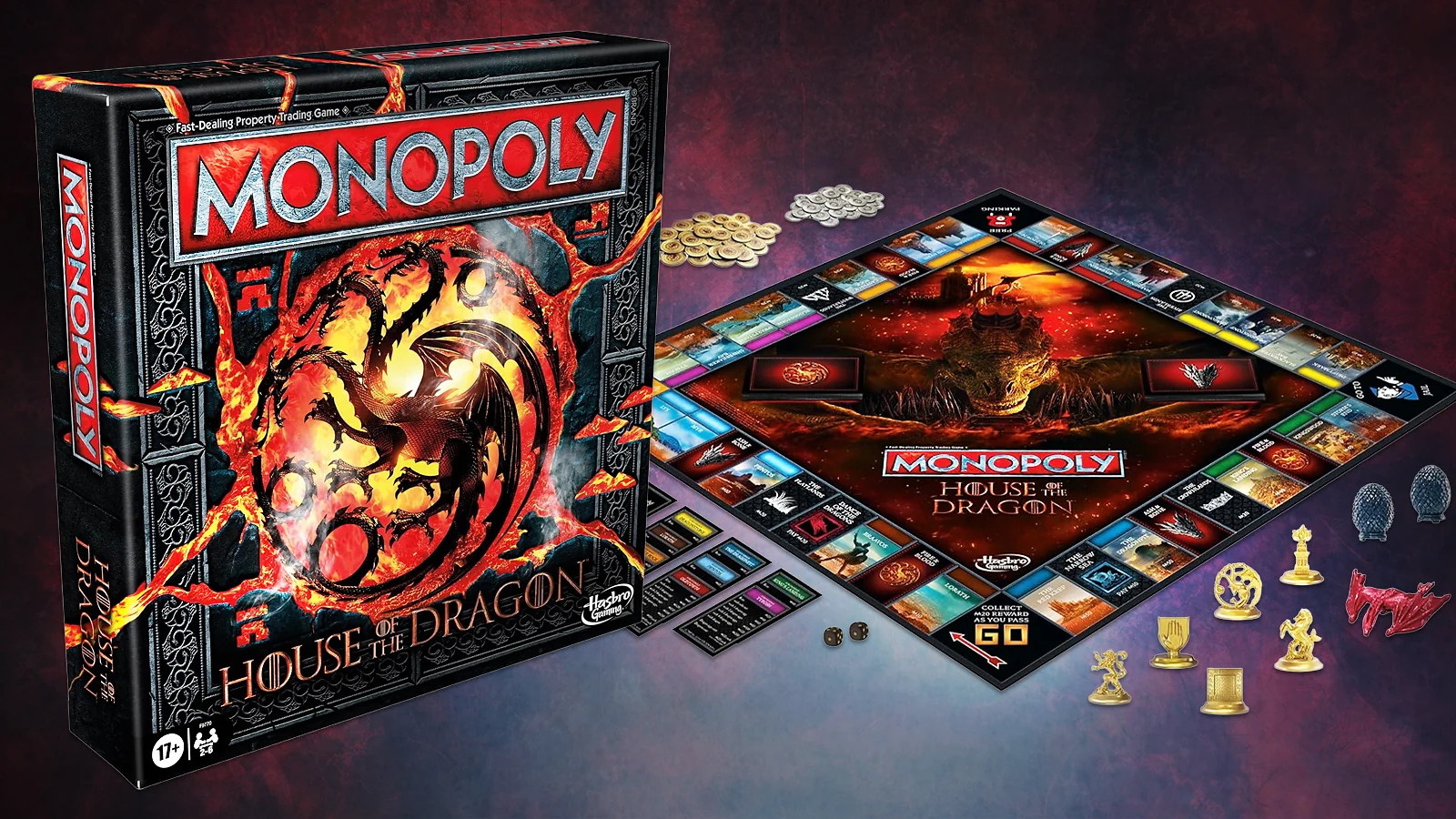
In Monopoly, you and your rivals play the role of land owners trying to establish a monopoly on properties in the area. Players move via dice rolls, and if a player lands on an unowned space (of which there are many), they can buy it. Owned spaces charge non-owners rent if they land on it, and said rent can be bumped up via properties if you own all land of that color.
Monopoly isn’t the most complex game on this list, but it’s both easy for beginners to learn, and the amount of negotiation you’ll need to do with other players does offer quite a bit of depth.
This means that Monopoly quickly becomes a race to snap up properties and drain your opponents of money. There are limited ways to earn money outside of charging rent, and once the entire board is owned, the game becomes a question of who’ll be the last player standing.
Despite this, there’s lots of room for strategy in Monopoly. You’ll not only need to learn when and where to spend your money, but there’s also nothing stopping players from making deals with each other. Just remember that you don’t want to give your opponents too much ammo.
My Verdict: Monopoly remains a solid strategy board game, even today. While there are deeper and more strategic games out there, Monopoly’s simple, cutthroat gameplay makes it easy to pick up and play.
18. Scythe [Engine-Building and Area-Control Strategy in a Dieselpunk World]
| Our Score | Enebameter 7.4/10
☆
★
☆
★
☆
★
☆
★
☆
★
☆
★
☆
★
☆
★
☆
★
☆
★
|
| Theme | Asymmetric warfare, engine building |
| Player Count | 1-5 |
| Play Time | ~2 hours |
| Complexity | Complex (asymmetric factions) |
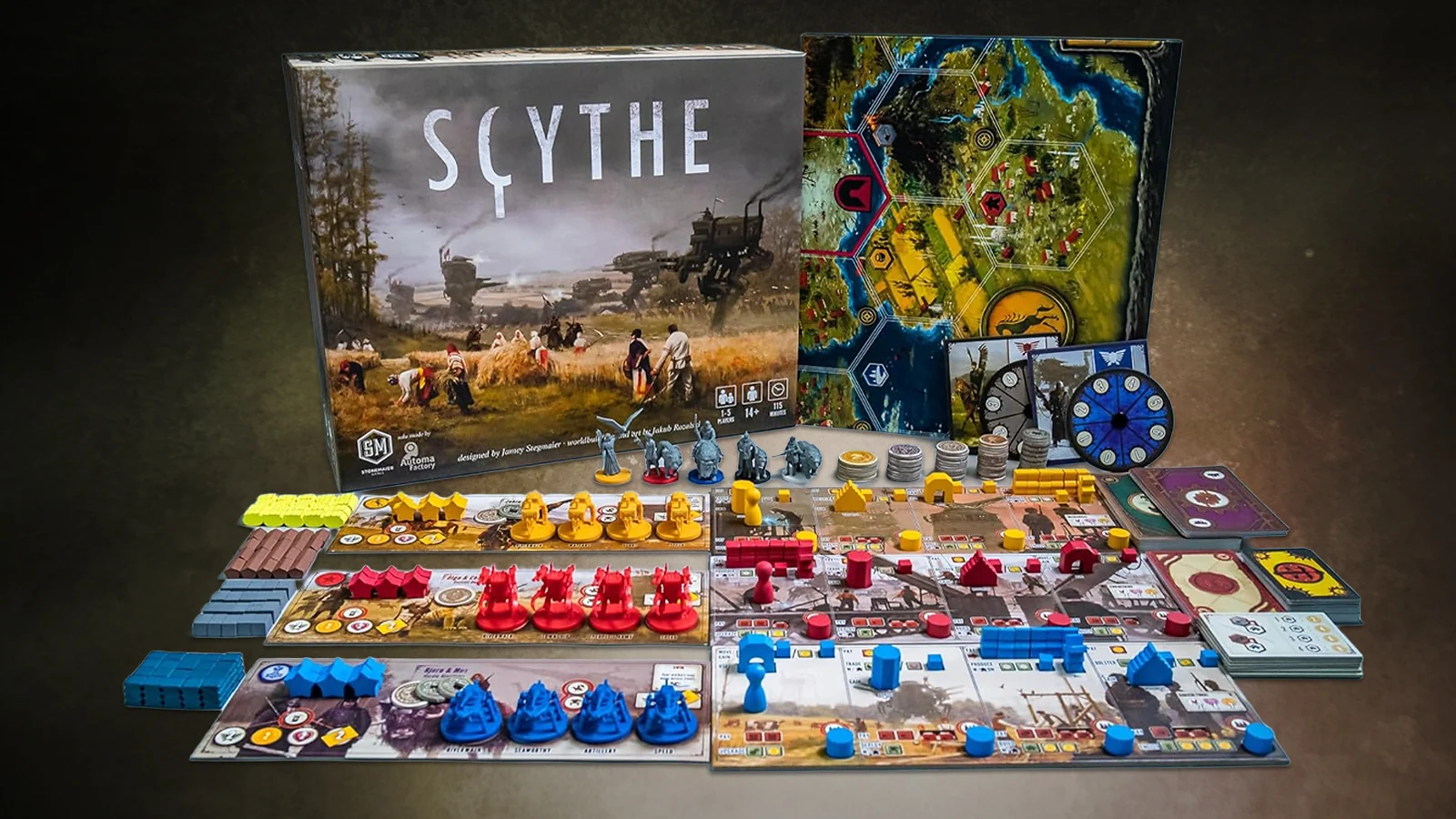
Last on this list is Scythe, a stunning engine building strategy game set in an alternate dieselpunk version of 1920s Europe in the wake of World War 1. This one’s a little bit of everything: engine building, as I mentioned, but also conquest and some 4X. Oh, and the art is crazily good, too.
Scythe is a complex game, perhaps the most complex on this list. Running an empire and currying the favor of the Factory requires you to be skilled in multiple fronts, such as building resource engines, increasing your power and popularity, deploying units to tiles, and more. Truthfully, it’s quite a lot to take in.
Scythe is one of the top strategy board games when it comes to both breadth and width, might take a while to learn, but once you do get it, you’ll find a very rich game waiting for you.
Apart from this, Scythe’s asymmetric factions introduce another learning curve. Each faction has its own quirks, strengths, and weaknesses, so expect to spend some sessions learning the ins and outs of each. Luckily, there’s a single player mode, so you can get some practice in.
Once you’ve pierced through Scythe’s admittedly thick shell, you’ll find a game that expertly combines elements of both American-style board games and Eurogames. And if you find yourself craving more, Scythe also comes with three major expansions that introduce new factions and even more mechanics.
My Verdict: Both visually impressive and strategically deep, Scythe is sure to satisfy strategy gamers looking for an immersive experience.
Practical Tips for Beginners Across Strategy Board Games
Even with how broad the scope of these great strategy board games is, there’s still just one question that everyone asks: how do they win this? Here’s some tips on how to not just win, but also to enjoy your games more.
Key Beginner Strategies
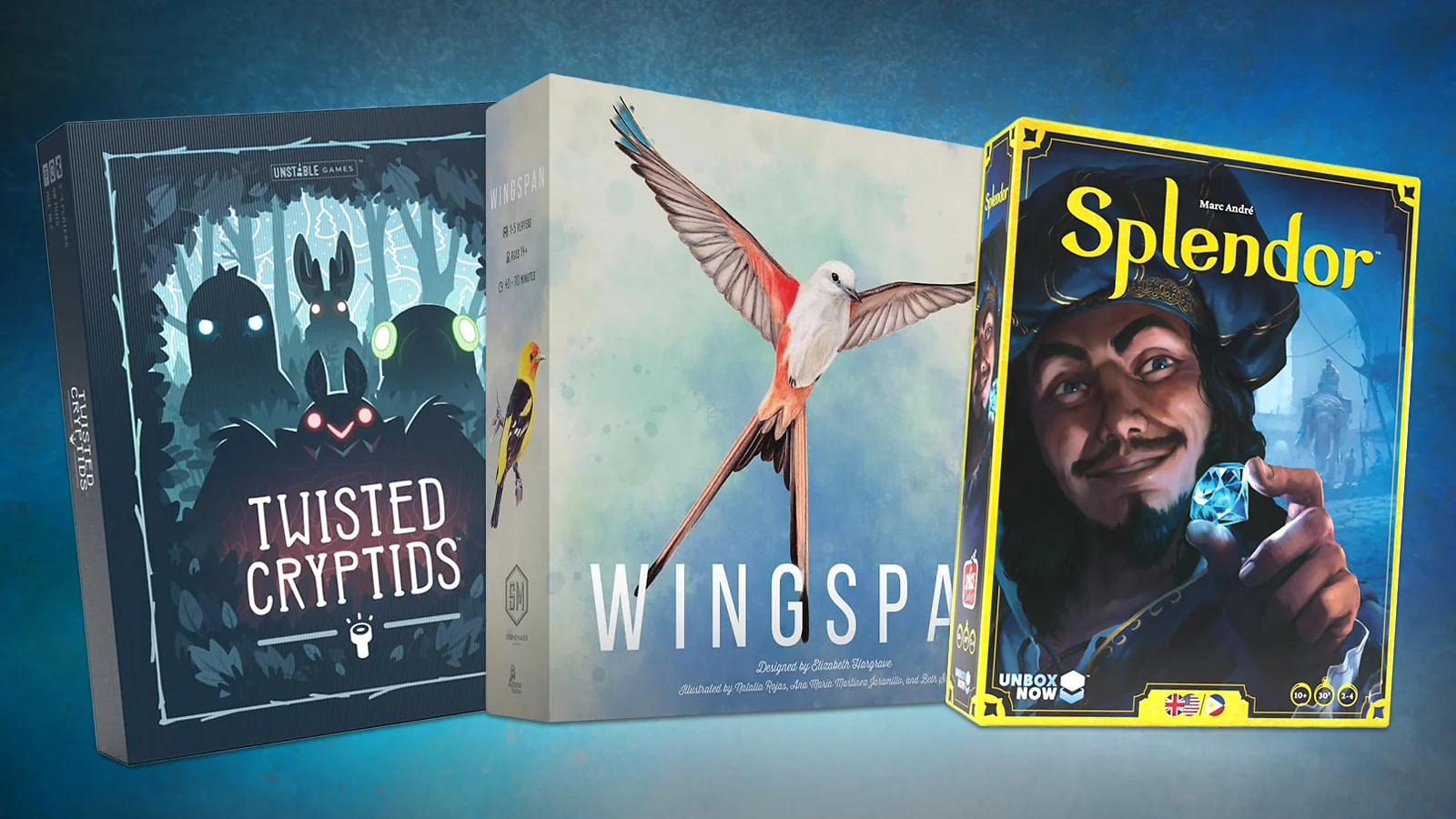
While every game has its own rules, there are several strategies beginners can use to improve their chances of winning.
These strategies need you to:
- Understand the win condition and keep your eyes on it. It’s all too easy to lose sight of the end goal, especially in bigger games like Root.
- Learn the core resource flow. What resources do you get on a regular basis? Where can you spend them? What is the most optimal way to spend them?
- Prioritize long-term planning over impulsive moves. Victory is earned step by step, brick by brick. Having a clear vision of your overall plan will help guide your actions.
- Watch what your opponents are doing. You can be sure your opponents will also be trying to win. What’s their end game? More importantly, what can you do to stop them?
- Balance ramping with execution. This one applies more to resource management and engine builders, but you should find a balance between gathering resources and actively using said resources to push you towards your end goal.
And once you’ve got those down, you can move on to:
- Reading the board. After a few games, you’ll have a general direction of how a game goes. Keep an eye on the board for any opportunities that might arise and any foes you might need to hinder.
- Spending resources efficiently. I like to say that if you have too many resources in any game, you’re not spending them fast enough. These resources won’t matter once the game ends, so be sure to use them to further your game plan whenever you can.
- Recognizing threats. There’s only room for one winner in these games, so it’s important to not just recognize who among your rivals is a very clear threat, but also actively find ways to prevent them from reaching their win condition.
- Learning to improvise. In the same vein, opponents who see you as a threat will move to stop you. What’s your plan B?
Beginner-Friendly Habits
No one’s a master at anything the first time around, so here are some habits to help you learn strategy games better:
- Play your first game expecting to learn, not to win. Winning your first game is a nice bonus, sure, but take your first trip to learn about the intricacies of the game.
- Start with simpler strategies. The more moving parts a plan has, the harder it is to keep it afloat. Stick to simpler stuff until you have a better grasp of the game’s flow.
- Watch your opponents. A good player learns from their mistakes, a great one learns from the mistakes of others. What are your opponents doing? Why are they doing those?
- Review your decisions and outcomes. Some things are better understood once they’re done. Go over key moments in the game, and try to reason out why things happened the way they did.
FAQs
This War of Mine: The Board Game is a strong choice for the best strategy board game if you enjoy survival-focused decision making. It offers deep resource management and tough moral choices that reward careful planning and teamwork.
A strategy board game is a board game where each player needs to carefully think about their moves, as every move can bring them closer to victory or defeat. These games usually have multiple layers to them, such as resource management, engine building, conflict with other players, and more.
The hardest strategy board game of all time depends, once again, on who you ask. There’s a clear difference between hard as in difficult (in which case it’d depend on your opponents) and hard as in complex (in which case there are a lot of games that could take the title).
The easiest strategy board game ever is a subjective question. As with the hardest game, it’s a matter of who you ask, as different opponents can make even an “easy” game hard. That said, in terms of complexity, Battleship is probably the easiest to learn.
The most complex strategy board games depend on who you ask, but it’s generally agreed that games like A World at War, The Campaign for North Africa, and Advanced Squad Leader are hilariously complex.
The strategy board game with the most rules is up in the air as the usual metric here is complexity of rules, not number of rules. While there hasn’t been an official count, the game with the most rules is probably one of the most complex ones, like The Campaign for North Africa, which has a ridiculous pasta rule. Yes, pasta.
Yes, there are strategy board games that are easy to learn but are surprisingly deep. Off the bat, we have chess and checkers; going further, we have stuff like Carcassonne.