


The Best Equipment in MTG: Mystic Arms, Armor, and More

Eneba Hub contains affiliate links, which means we may earn a small commission if you make a purchase through them—at no extra cost to you. Learn more


Only a few equipment cards rightfully compete for the title of the best equipment in MTG, but actually finding said cards can be a slog. After all, there’s literally hundreds of equipment out there, so narrowing down this list is tricky.
That’s why I’ve prepared this list. Together, we’ll go through 15 of the best equipment MTG has to offer, ranging from one-card engines to all-around great pieces and even some strange picks you can break out if you’re feeling spicy.
Jump to:
Our Top Picks for Best Equipments in MTG
While every equipment card on this list is useful or at least historical, some, in particular, stand out:
- Skullclamp – One of the most powerful draw engines Magic has to offer, even up to today.
- Sword of Feast and Famine – An amazing economy card that both hand rips your opponent while doubling your mana income.
- Umezawa’s Jitte – Can single-handedly win you the early game with its impressive selection of effects.
- Sword of Fire and Ice – Card draw and a free Shock with every hit landed on your opponent.
- Lightning Greaves – A cheap but brutally effective card often held to be the premier protection piece.
But while these are the best of the best, we’re just scratching the surface here, and there’s a lot more to love in the list below.
15 Best Equipment Cards in MTG to Unlock the Latest Strategies
Rummaging through Magic’s gigantic equipment library was tough, so I had to impose some limitations. For one, we’ll try to limit the scope, so only mainstream sets. That means we
won’t be talking about cards like Sting, The Glinting Dagger or Mithril Coat from the The Lord of the Rings Set.
Second is the limited space. I tried to get a more or less even spread throughout Magic’s history and unfortunately that means some cards had to fall by the wayside, like Cranial Plating and Basilisk Collar. Don’t worry – those are still great cards.
Finally, I’ll admit to some level of personal bias as well.
Now without further ado, let’s get to the list.
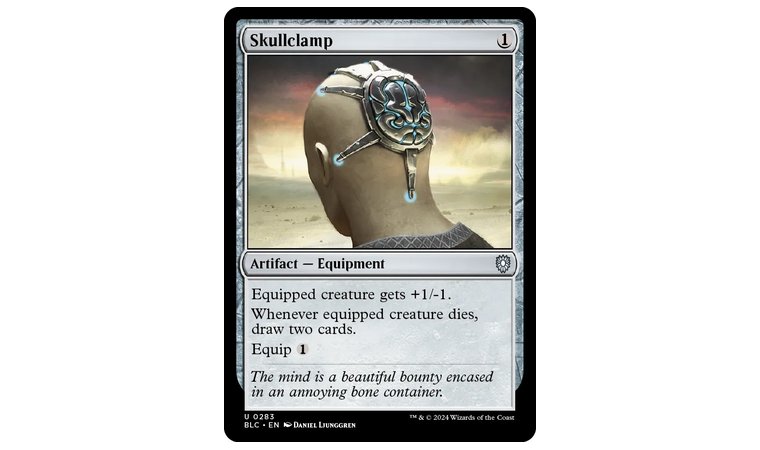
1. Skullclamp [Broken Draw Engine]
| Our Score | 10
☆
★
☆
★
☆
★
☆
★
☆
★
☆
★
☆
★
☆
★
☆
★
☆
★
|
| Set | Multiple, most recent reprint is in Final Fantasy Commander |
| Card Type | Artifact – Equipment |
| Mana Cost | 1 |
| Equip Cost | 1 |
| Effects | – On equipped creature: +1/-1 – Whenever equipped creature dies, draw two cards. |
| Formats | Banned in Modern and Legacy |
If your first reaction to Skullclamp is, “what were they thinking?”, you’re not alone. As for me, if I see a card that can singlehandedly warp the game, sign me up immediately.
Perhaps the single best equipment card MTG has ever released (and a strong contender for the best MTG card too), Skullclamp was so game-warping that Aaron Forsythe of R&D had to write an article. Long story short, they messed up and are sorry.
Aaron Forsythe recalls that “(R&D) knew what the future held, and we were powerless to do anything about it”, and unsurprisingly, Skullclamp was banned after a few months where every deck was either running or hard countering it.
Just like the most powerful cards in other card games, Skullclamp is deceptively simple. All it does is give the equipper +1/-1, and if it dies with Skullclamp on, you draw 2 cards. Ah, there we are.
While it’s often overlooked, don’t forget that Skullclamp also gives +1 Power, allowing you to sacrifice creatures with more power while still getting extra card draw.
Getting card draw when creatures die over the course of the game is already great, but it’s the -1 toughness that really gets this engine running.
While already plenty strong, Skullclamp reaches ridiculous heights if you sacrifice your 1 toughness weenies. What’s even better is that you can subvert the neutral card advantage (sorry Magic, Yu-Gi-Oh! is deeply ingrained in me) by using cards that generate tokens when you do something else.
Drawing cards is already a good effect on its own, but combine it with minimal cost and you get a card that’s straight-up broken. And because Skullclamp is an equipment, with 1 mana as cost and 1 mana to equip, this means that the amount of cards you can draw per turn is only capped by how much X/1 fodder you can bring out.
My Verdict: Skullclamp was so ridiculous that it led to an overcentralizing meta and was swiftly banned. If that doesn’t say anything about how strong this card is, nothing else will.
What do players say?
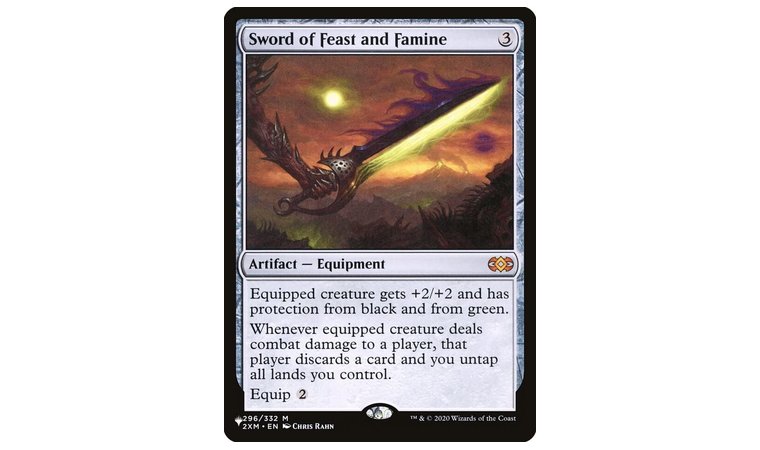
2. Sword of Feast and Famine [Discards and Untaps Land]
| Our Score | 9.5
☆
★
☆
★
☆
★
☆
★
☆
★
☆
★
☆
★
☆
★
☆
★
☆
★
|
| Set | Multiple, most recent reprint is in Assassin’s Creed |
| Card Type | Artifact – Equipment |
| Mana Cost | 3 |
| Equip Cost | 2 |
| Effects | – On equipped creature: +2/+2, protection from B&G – Whenever equipped creature deals combat damage to a player, that player discards a card and you untap all lands you control. |
When it comes to playing Magic, one of the core problems you need to address is how your deck generates mana. If you can circumvent the one land per turn income, you’ll be able to field stronger cards faster. And while there are a lot of cards that just straight-up generate more mana, Sword of Feast and Famine stands out for being an equipment card.
As with Skullclamp, Sword of Feast and Famine is very simple. It gives a respectable +2/+2 equipment to the creature it’s on, as well as protection from Black and Green. Most importantly, however, is that if the equipped guy deals damage via attack to a player, they discard a card and you untap all lands you control.
If your opponent tries to rules lawyer you, the untap effect isn’t conditional on the discard – if your opponent can’t discard, the untap still happens.
While the stat boost is solid, it’s this second effect that makes Sword of Feast and Famine a valued equipment card, as getting double the mana per turn cycle makes for incredibly powerful plays whether you’re trying to establish board control or building up your combo pieces; either way, you’re looking at an incredible tempo swing that can dictate the flow of the match.
This raw power makes Feast and Famine great not just for Voltron decks, but also a stellar addition to any of the best Commander decks as well.
My Verdict: Sword of Feast and Famine offers a killer combination of a solid stat boost and powerful mana economy, all while attacking your opponent’s hand.
What do players say?
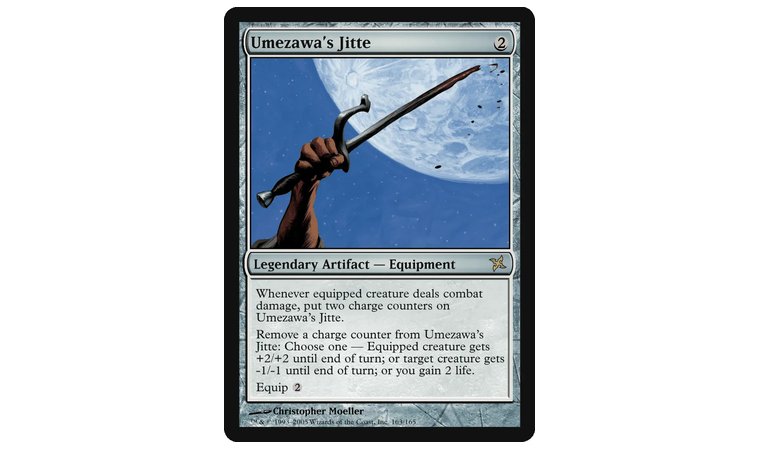
3. Umezawa’s Jitte [Huge Coverage Options]
| Our Score | 9.5
☆
★
☆
★
☆
★
☆
★
☆
★
☆
★
☆
★
☆
★
☆
★
☆
★
|
| Set | Multiple, most recent reprint is in Secret Lair x Final Fantasy: Weapons as “Cloud’s Buster Sword” |
| Card Type | Legendary Artifact – Equipment |
| Mana Cost | 2 |
| Equip Cost | 2 |
| Effects | Whenever equipped creature deals combat damage, put two charge counters on Umezawa’s Jitte. Remove a charge counter from Umezawa’s Jitte: Choose one: – Equipped creature gets +2/+2 – Target creature gets -1/-1 – You gain 2 life |
| Formats | Banned in Modern |
On the surface, Umezawa’s Jitte isn’t that impressive. For 2 mana and a further 2 equip cost, it does nothing (not even a token stat boost) but generate counters when the creature it’s on deals damage via battle. But it’s precisely because of these counters that Umezawa’s Jitte was banned.
As I mentioned at the beginning, Umezawa’s Jitte does too much for too little. Once the card has counters on it, you can choose to remove 1 and get either +2/+2 for whatever is holding Jitte, -1/-1 for a target creature, or recover 2 life. And because this ability is played at instant speed, it gives you the ability to buff, debuff, or heal on the fly.
Umezawa’s Jitte doesn’t need to be equipped to use its 2nd and 3rd abilities.
No matter what deck you’re playing, consistent and repeatable access to either a buff, removal, or self-healing for fighting back aggro provides a ton of value. It’s not that Umezawa’s Jitte just wins the game on its own, rather, it’s because it provides its player with constant boons.
This also means that putting an Umezawa’s Jitte on the board presents your opponent with an immediate threat to which they must respond, lest you gain enough counters for a single, game-ending attack.
My Verdict: Don’t be fooled by Umezawa’s Jitte’s unassuming appearance: it’s a Swiss army knife that can cover a lot of situations.
What do players say?
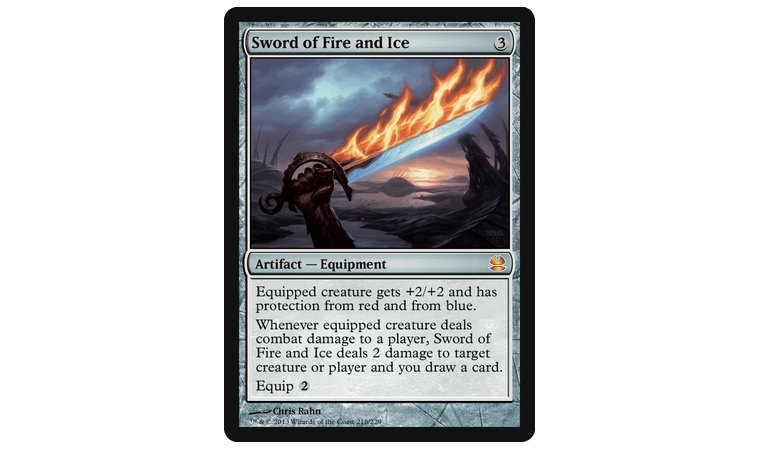
4. Sword of Fire and Ice [Strong Pressure and Draw Power]
| Our Score | 9.5
☆
★
☆
★
☆
★
☆
★
☆
★
☆
★
☆
★
☆
★
☆
★
☆
★
|
| Set | Multiple, most recent reprint is in Bloomburrow as a Special Guest (#62) |
| Card Type | Artifact – Equipment |
| Mana Cost | 3 |
| Equip Cost | 2 |
| Effects | – On equipped creature: +2/+2, protection from R&U – Whenever equipped creature deals combat damage to a player, this Equipment deals 2 damage to any target and you draw a card. |
Unlike Umezawa’s Jitte, the Sword of Fire and Ice displays its power more nakedly.
Like the other Mirran swords, Fire and Ice grants +2/+2 as well as protection from two colors, this time Red and Blue. It also has an extra effect where, if the equipped card smacks your opponent, the sword deals 2 damage to a target of your choice and you get to draw a card.
As with its fellow swords, Sword of Fire and Ice can be made even deadlier if you can get it on something with double strike.
These two respective properties allow you to establish a strong early hold on the board; a free 2 damage proc lets you zap mana dorks (and deny your opponent early economy boosters) and other low toughness combo pieces. If you don’t need to hit anything, you can always hit your opponent directly for some early damage. When choosing equipment, you might also want to explore our best MTG sets roundup to find sets that give you strong value across cards and mechanics.
Meanwhile, the card draw might not look like much, but remember that you’re getting this card draw for free, so long as you can keep up the hits. One extra card per turn is small, but it does add up quickly.
My Verdict: Sword of Fire and Ice combines removal and economy into a compact package that can steamroll the early game.
What do players say?
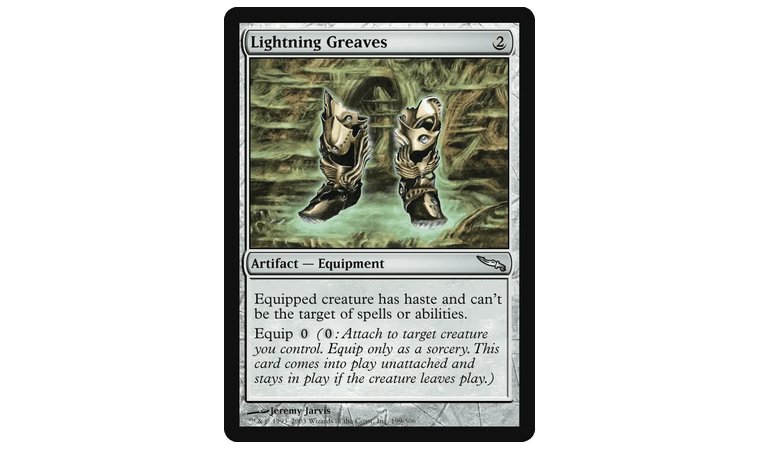
5. Lightning Greaves [Fast and Powerful Protection Piece]
| Our Score | 9
☆
★
☆
★
☆
★
☆
★
☆
★
☆
★
☆
★
☆
★
☆
★
☆
★
|
| Set | Multiple, most recent reprint is in Secret Lair x Sonic: Turbo Gear as “Power Sneakers” |
| Card Type | Artifact – Equipment |
| Mana Cost | 2 |
| Equip Cost | 0 |
| Effects | – On equipped creature: Haste, shroud |
Lightning Greaves is a card that deserves a place in every equipment deck. No matter what your ultimate game plan is, there is no way that you won’t get value out of making a creature essentially invulnerable.
Unlike other equipment, all that Greaves does is provide its bearer with haste and shroud. Haste is nice for getting some early hits in or for using abilities, while shroud serves as the centerpiece, making the wearer of the greaves untargetable by all spells and abilities.
Don’t forget that shroud also locks you out of targeting your creature with buffs or other equipment.
These keywords have a ton of applications, from allowing a powerful monster to get its hits in to protecting a monster whose attack absolutely must go through to lining up a deadly alpha strike in a Voltron deck. And because these effects are so universal, Greaves will easily find a place in any deck, so long as it plays creatures.
With all that Greaves does, you’d expect it to come with a whopping price tag, but no. For a grand total mana cost of just 2 and a free equip cost, you’ll gain constant access to an equipment card that can speed up your attack and preserve your big monsters. Just watch out as your opponent can still play instants when you equip these boots.
My Verdict: Lightning Greaves is the premier protection piece for keeping your monsters alive.
What do players say?
6. Swiftfoot Boots [Great Hexproof Protection]
| Our Score | 9
☆
★
☆
★
☆
★
☆
★
☆
★
☆
★
☆
★
☆
★
☆
★
☆
★
|
| Set | Multiple, most recent reprint is in Secret Lair x Sonic: Turbo Gear as “Air Shoes” |
| Card Type | Artifact – Equipment |
| Mana Cost | 2 |
| Equip Cost | 1 |
| Effects | – On equipped creature: Hexproof, haste |
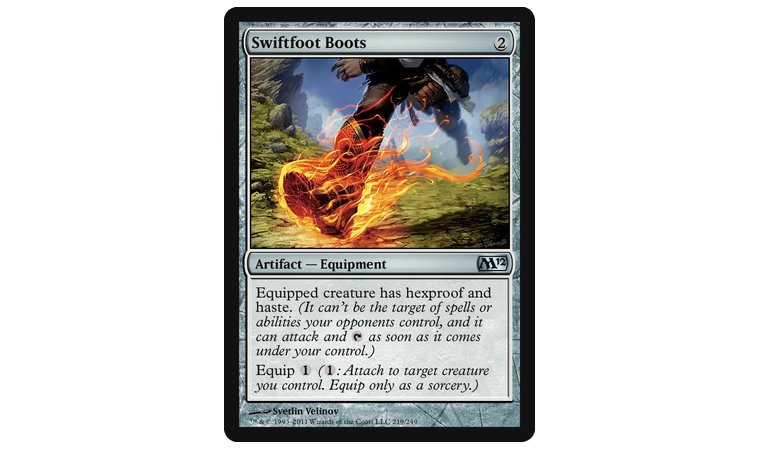
We can’t talk about Greaves without mentioning its sibling, Swiftfoot Boots. And just like any sibling rivalry, it’s ultimately up to you to decide which footwear is better for your deck.
Boots occupies the same niche as Greaves in that it provides protection for your monsters. However, the difference lies in their keywords. Instead of Greaves’ shroud, which blocks all targeted spells and abilities, Boots offers hexproof, which only prevents the equipped monster from being targeted by your opponent’s spells and abilities.
If you want more protection, you can double up and run both Boots and Greaves. If you need even more protection, look at Lavaspur Boots, too.
The debate over which footwear is “best” has raged for years, but the format context is key: Swiftfoot Boots is a Commander staple thanks to its flexibility with targeted effects; it’s Modern-legal yet only shows up sporadically there. Whether you need to constantly target your own monster with buffs or if you love the mana efficient zero equip cost of Greaves is a question only you can answer.
My Verdict: Swiftfoot Boots offers powerful, flexible protection at a higher equip cost.
What do players say?
7. Grafted Exoskeleton [Strong Poison Counter Enabler]
| Our Score | 8.5
☆
★
☆
★
☆
★
☆
★
☆
★
☆
★
☆
★
☆
★
☆
★
☆
★
|
| Set | Multiple, most recent reprint is in Phyrexia: All Will Be One Commander |
| Card Type | Artifact – Equipment |
| Mana Cost | 4 |
| Equip Cost | 2 |
| Effects | – On equipped creature: +2/+2, infect – Whenever Grafted Exoskeleton becomes unattached from a permanent, sacrifice that permanent. |
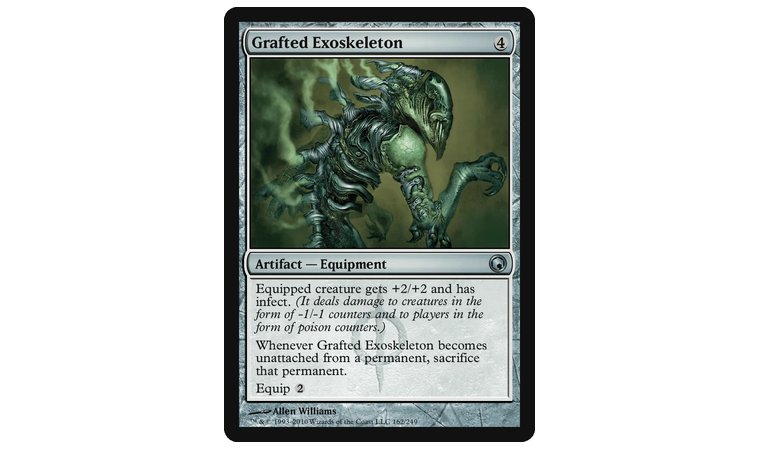
What’s better than turning your own flesh into a collage of steel and sinew? Why, inflicting that on your opponent, of course!
I’ll be up front here: I have a soft spot for the sheer body horror that Phyrexia gave Magic, so the Grafted Exoskeleton gets a few brownie points. Even though Phyrexia is pretty far when it comes to the list of MTG sets in order, its gruesome art is still a sight to behold.
Stat-wise, it’s decent: a 4 mana casting cost and another two mana to put it on. It also gives +2/+2, which is decent but on the low end for a mid-priced card. It’s also worth mentioning that you can’t unsubscribe anytime from Exoskeleton – if it gets removed from a creature, you sacrifice it.
However, the real reason to play Exoskeleton at all is its ability to give the equipped card infect, which makes it do damage in the form of poison counters. If a player has 10 or more poison counters, they instantly lose the game.
One of the latest strategies in Commander involves equipping Grafted Exoskeleton to a Commander that can inflict effect damage, thus allowing for a way to snipe opponents.
Poison decks tend to incite a lot of hate from other players since it puts them on a deadline, and removing poison counters is all but impossible outside of a few niche cards. Just like the inhabitants of the machine hell, get ready to be the bad guy if you choose to rock Grafted Exoskeleton.
What do players say?
8. Whispersilk Cloak [Best Equipment for Unblockable Attacks]

| Our Score | 8
☆
★
☆
★
☆
★
☆
★
☆
★
☆
★
☆
★
☆
★
☆
★
☆
★
|
| Set | Multiple, most recent reprint is in Duskmourn: House of Horror Commander |
| Card Type | Artifact – Equipment |
| Mana Cost | 3 |
| Equip Cost | 2 |
| Effects | – Can’t be blocked, shroud |
Even someone who’s just learning how to play Magic understands that hitting your opponent with a creature is rarely a straightforward affair. They’ll almost always have monsters of their own to block your way, and even fliers aren’t foolproof. Enter Whispersilk Cloak.
What you see is what you get with Cloak: all it does is make your creature unblockable, as well as giving it shroud, just like Greaves. This makes Cloak excellent at ensuring certain attacks get through, especially if you’ve got stuff like Sword of X and Y cycle cards on the board as well.
Once again, don’t forget that the shroud prevents your own spells and abilities from targeting the equipped creature.
Admittedly, Whispersilk Cloak does have some mana issues going on: it’s three mana to commit to the board, and another two mana to put it on something. The shroud is nice, but with such a high mana cost, the entire reason you’ll want to play Cloak is for the unblockable – if you want protection, just run Greaves or Boots.
The high mana and equip cost also mean that, in most cases, Cloak is a highly telegraphed move, and most people will opt to run Greaves for the much better mana economy, or Boots for hexproof over shroud. However, when combined with other cards, Cloak can be quite a force to be reckoned with.
My Verdict: Whispersilk Cloak is a fantastic way to ensure your monsters get their hits in – but be wary of the high mana commitment.
What do players say?
9. Sword of the Animist [Incredible Ramp Tool]
| Our Score | 8
☆
★
☆
★
☆
★
☆
★
☆
★
☆
★
☆
★
☆
★
☆
★
☆
★
|
| Set | Multiple, most recent reprint is in Final Fantasy Commander |
| Card Type | Legendary Artifact – Equipment |
| Mana Cost | 2 |
| Equip Cost | 2 |
| Effects | – +1/+1 – Whenever equipped creature attacks, you may search your library for a basic land card, put it onto the battlefield tapped, then shuffle. |
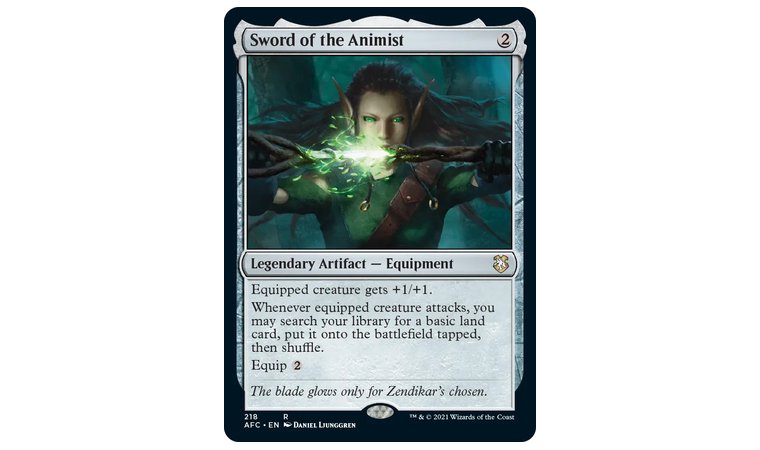
If Feast and Famine isn’t your jam, Sword of the Animist will probably do it for you.
Like most powerful equipment cards, Animist’s strength lies in its simplicity. For two mana (cast and equip), this sword gives the equipped creature +1/+1. More importantly, it causes you to put a tapped land from your deck into play, and triggers on attack, not dealing damage. Both these respective properties come together to make an early game threat that requires your opponent to counterplay lest you ramp too quickly.
Animist’s effect also means that simply playing aggressively – even attacking with weenies – grants you a slow but steady source of increased mana income per turn, allowing you to play more cards or get your big pieces on the field faster.
More mana income is good, but there’s always the risk of overdoing it. If your deck already has ways to ramp, Sword of the Animist might be overkill.
As with other trigger cards, Animist works best with cards that can fight more. However, because its ability activates on attack, this sword won’t work on double strike – you’ll need something like Aurelia, the Warleader to create a new combat phase to milk Animist for all it’s worth.
My Verdict: Sword of the Animist provides a lot of early game pressure with its ramp ability, and the ease of activating said ability demands immediate action from your opponent.
What do players say?
10. Sunforger [Premier Searcher]
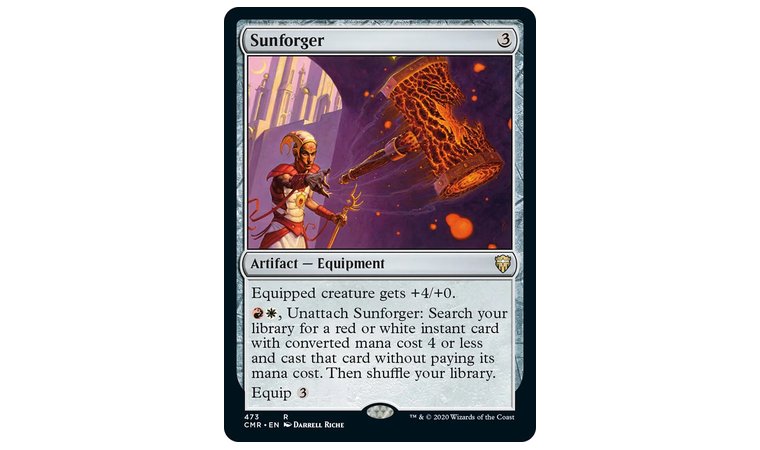
| Our Score | 8
☆
★
☆
★
☆
★
☆
★
☆
★
☆
★
☆
★
☆
★
☆
★
☆
★
|
| Set | Multiple, most recent reprint is in Final Fantasy Commander |
| Card Type | Artifact – Equipment |
| Mana Cost | 3 |
| Equip Cost | 3 |
| Effects | – On equipped creature: +4/+0 – RW, Unattach this Equipment: Search your library for a red or white instant card with mana value 4 or less and cast that card without paying its mana cost. Then shuffle. |
A third hammer? Yes, please.
Unlike the other hammers on this list, Sunforger doesn’t rely on combat ability, though it does have some of that via a very meaty +4/+0. But it’s the second ability that really puts Sunforger on this list.
See, Sunforger’s second ability allows you to pay RW and detach it (which makes it even slower on top of its three mana casting and equip costs), and in return, you can cast a 4- red or white instant from your deck for free. This means that Sunforger doesn’t just bulk up your guys but also serves as a rapid response to, well, just about anything your opponent can throw out.
Despite its power, Sunforger isn’t an auto-include. Take your deck out for a spin with and without this card to see if you’re too slow to get any mileage out of it.
It’s this ability that makes Sunforger such a force to be reckoned with. Once this equipment hits the field, your opponent now has to contend with your entire deck when it comes to possible interruptions – even if you’re just bluffing.
Lastly, because it is itself an equipment, Sunforger can be searched by Stoneforge Mystic. Searching a searcher, how about that?
My Verdict: While it won’t fit in every deck, Sunforger is a neat little piece of equipment that ensures you always have the card you need.
What do players say?
11. Sword of the Meek [Strong Recursive Artifact]
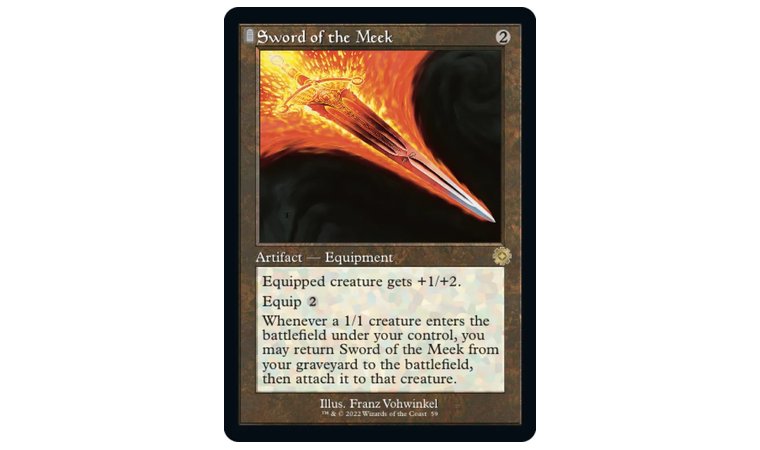
| Our Score | 7
☆
★
☆
★
☆
★
☆
★
☆
★
☆
★
☆
★
☆
★
☆
★
☆
★
|
| Set | Multiple, most recent reprint is in Mystery Booster 2 |
| Card Type | Artifact – Equipment |
| Mana Cost | 2 |
| Equip Cost | 2 |
| Effects | – +1/+2 – Whenever a 1/1 creature you control enters, you may return this card from your graveyard to the battlefield, then attach it to that creature. |
Unassuming it may be, but Sword of the Meek was once half of an engine (the other half being Thopter Foundry) that allowed you to convert X mana into X 1/1 flying artifacts and X life.
The entire reason to play Sword of the Meek is pretty much just its recycle effect. Keep an eye on this sword whenever new cards that generate 1/1s are released.
The combo worked thanks to Meek’s inherent recycle effect. At the end of your opponent’s turn, you’d use Foundry to sacrifice Meek to summon a 1/1 Thopter token and gain 1 life. Because the token is 1/1, Meek would activate to reattach itself to the new Thopter.
This cycle could be repeated at the end of an opponent’s turn so long as you had enough mana to pay for it, effectively creating a near-infinite source of 1/1 fliers and a ton of healing.
Outside of this combo, Sword of the Meek doesn’t see much play as it’s a one-trick pony. Still, it’s a neat little piece of history…and I’m sure it’s just biding its time until the next stupidly awesome combo.
What do players say?
12. Kaldra Compleat [Massive Living Weapon]
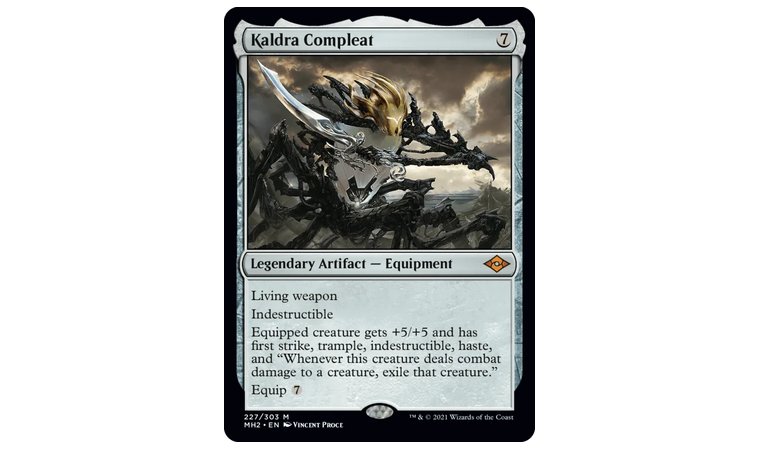
| Our Score | 7
☆
★
☆
★
☆
★
☆
★
☆
★
☆
★
☆
★
☆
★
☆
★
☆
★
|
| Set | Multiple, most recent reprint is in Commander Masters. |
| Card Type | Legendary Artifact – Equipment |
| Mana Cost | 7 |
| Equip Cost | 7 |
| Effects | – Living weapon – Indestructible – On equipped creature: +5/+5, first strike, trample, indestructible, haste, exiles creatures it deals combat damage to. |
Every entry on this list so far has been a (relatively) cheap equipment card, so it’s time to turn to something big: Kaldra Compleat.
This Phyrexian monstrosity grants its equipper a buffet of buffs: 5/5, first strike, trample, haste, indestructible, and exiles creatures it deals damage to. This doesn’t come without a cost though, as Kaldra Compleat has a whopping 7 mana cost (both cast and equip), which is especially huge compared to the standard one to three mana that most equipment cards have.
Luckily, this equipment card comes with a built-in user. Living weapon means that Kaldra Compleat will spawn a 0/0 Black Phyrexian Germ token on play and equip itself to that token – and because of haste, that token will be ready to fight as soon as Compleat hits the board. Suddenly that giant mana cost doesn’t seem too unreasonable, huh?
As with many equipment decks, Stoneforge Mystic is an amazing card for cheating out big plays like Kaldra Compleat.
Still, the entire point of equipment decks is to win with their assortment of cheap, powerful equipment cards – and this card is far from cheap. While it can serve as an interesting plan B option for when things go sideways, there’s no shortage of excellent equipment that make Kaldra Compleat pale in comparison.
My Verdict: Kaldra Compleat is powerful, but is held back both by its high cost and the efficiency of other equipment cards.
What do players say?
13. Colossus Hammer [Incredible Power Boost]
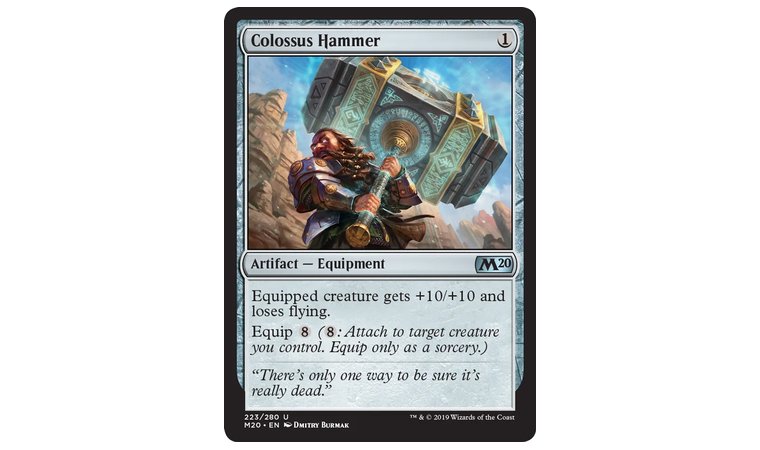
| Our Score | 7
☆
★
☆
★
☆
★
☆
★
☆
★
☆
★
☆
★
☆
★
☆
★
☆
★
|
| Set | Multiple, most recent reprint is in Final Fantasy Commander |
| Card Type | Artifact – Equipment |
| Mana Cost | 1 |
| Equip Cost | 8 |
| Effects | – On equipped creature: +10/+10, loses flying |
When all you have is a hammer, everything looks like a nail. And when your hammer is Colossus Hammer, it doesn’t matter how big their monsters are – they’ll be smashed all the same.
Hammer is a really simple card. Its casting cost of 1 contrasts with its utterly titanic 8 mana cost, but putting it on gives the equipped creature +10/+10 and removes flying. Sure, it’s a one note strategy, but going full bonk on your opponent is both hilarious and surprisingly effective.
Cards which let you equip for free, such as Puresteel Paladin and Sigarda’s Aid are perfect partners for this card.
This isn’t a subtle weapon, and even the latest strategies involving it revolve around setting it up as a surprise bonk. Still, none can deny just how many games a Hammer ambush can win, making it a great card to build a deck around.
My Verdict: Colossus Hammer may be a one-trick pony, but it’s a very good trick that can catch a lot of foes off-guard.
What do players say?
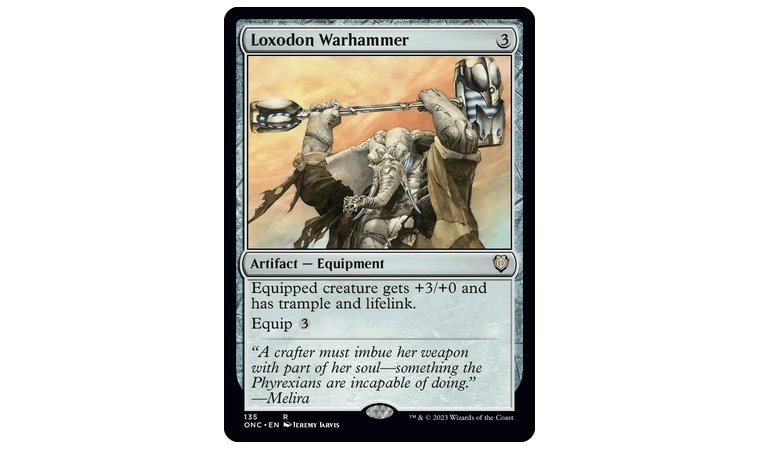
14. Loxodon Warhammer [Respectable All-Rounder]
| Our Score | 7
☆
★
☆
★
☆
★
☆
★
☆
★
☆
★
☆
★
☆
★
☆
★
☆
★
|
| Set | Multiple, most recent reprint is in Phyrexia: All Will Be One Commander |
| Card Type | Artifact – Equipment |
| Mana Cost | 3 |
| Equip Cost | 3 |
| Effects | – On equipped creature: +3/+0, trample, lifelink |
Hammer time isn’t over yet. While the previous hammer is a big tool meant for big swings, Loxodon Warhammer is a more moderate but still effective piece of gear.
No muss, no fuss – just an all-around great aggro tool. Warhammer gives a hefty +3/0, as well as trample and lifelink. Three extra power is nothing to sniff at, while trample ensures that at least some damage goes through.
As with Colossus Hammer, Loxodon Warhammer is best when paired with cards that circumvent its pricey equip cost.
While Warhammer is best used on the offense, it does have some applications for recovering from an aggressive foe. Lifelink, unlike trample, works even when you’re blocking, so you can use it to not only send your opponent’s creature packing with its +3/+0, but also recoup some lost life or create a buffer.
My Verdict: Loxodon Warhammer is an all-around solid card that can work as both attacker and defender.
What do players say?
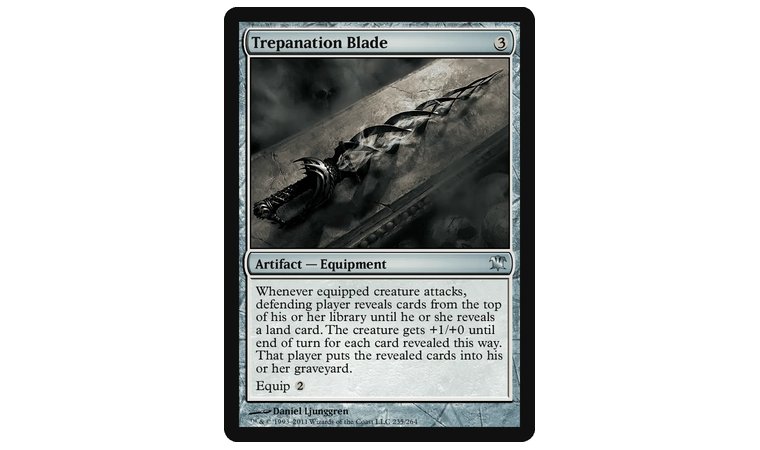
15. Trepanation Blade [Fun Casual Gambling Card]
| Our Score | 6
☆
★
☆
★
☆
★
☆
★
☆
★
☆
★
☆
★
☆
★
☆
★
☆
★
|
| Set | Multiple, most recent reprint is in The List (PLST) |
| Card Type | Artifact – Equipment |
| Mana Cost | 3 |
| Equip Cost | 2 |
| Effects | – Whenever equipped creature attacks, defending player reveals cards from the top of their library until they reveal a land card. The creature gets +1/+0 until end of turn for each card revealed this way. That player puts the revealed cards into their graveyard. |
Hear me out: I know it’s a situational card, but I like it. And while it’s…alright, it’s pretty terrible, no other card hits the dopamine spikes for casual Magic like this one. Especially if it blows up in your face.
Trepanation Blade is a wonky piece of gear. It gives no inherent bonuses and is pricey to field. When you do get the effect off, it’s a gamble: it’ll mill cards from your opponent until they reveal a land, and the equipped creature gains +1/+0 per card revealed. Oh, and this doesn’t count for mill purposes as those are tied to a keyword.
Gambling on an attack boost is pretty terrible, and considering land ratios (especially for ramp decks), you’ll be lucky to get anything higher than +2/+0. God help you if the cards you milled have flashback or if your opponent plays any form of graveyard recovery.
If you really want to make Trepanation Blade work, try to weave exile into the deck. Good luck.
On top of that, in every great trading card game – whether that’s Pokémon, Yu-Gi-Oh! or even One Piece, Digimon, Star Wars: Unlimited or anything else in between – thinning your opponent’s deck is rarely helpful to you. At best you’ll deprive them of a few key resources, at worst (and more often than not), you’ll make their deck more consistent by trimming the fat.
All in all, milling your opponent out isn’t a particularly great strategy, and let’s face it: there are much better cards you’d want to play than Trepanation Blade. Still, few things can match the feeling of highrolling a +3 or +4 power from this, even if it rarely happens. Let’s go gambling! …aw, dangit.
My Verdict: Trepanation Blade is a funny card for casual magic and is hilarious when it actually works – but please don’t use it in serious matches.
What do players say?
FAQs
What is the best equipment card in Magic?
The best equipment card in Magic is a toss-up. As with virtually every card game like Yu-Gi-Oh!, Pokémon, Disney Lorcana, and more, there’s no single best equipment card in Magic, especially in a vacuum. The best equipment MTG has to offer depends on your deck’s needs and win condition.
What are equipment cards in MTG?
Equipment cards in MTG are artifacts that you place on the field. Once they’ve been cast, you can pay the equip cost of an equipment to attach it to a creature you control.
What is the best protection equipment?
The best protection equipment is debatable. However, both Lightning Greaves and Swiftfoot Boots are good places to start if you’re running a Voltron or equipment deck.
Who is the best equipment Commander?
The best equipment Commander is, like other questions of best card, a matter of personal preference. There’s no one singular best Commander for equipment, as each one offers something different. That said, I personally like Nahiri, Forged in Fury for her ability to circumvent commander tax and potentially play a lot of free cards.
What is a good number of equipment to have in a commander deck?
The number of equipment cards you should include in your EDH deck depends on if you have cards to weather the first few turns as well as cards with awesome search abilities that let you tutor the equipment you need, when you need it. If I had to venture a guess, I’d say most decks should run no more than 20 – but that’s a ballpark figure.
Can you put equipment on your opponent’s creatures?
No, you can’t put equipment on your opponent’s creatures. Unlike other games, “gift” cards can’t be given to your opponent in Magic, as the equip keyword dictates you can only target creatures you control.
What happens if an equipment becomes a creature?
If an equipment becomes a creature, it’s subject to the same rules governing creatures. Equipment that can become creatures have the reconfigure ability, which lets you pay a mana cost to switch between modes.