


What Is SaaS Marketing? How It Works and How To Start in 2026

Eneba Hub contains affiliate links, which means we may earn a small commission if you make a purchase through them—at no extra cost to you. Learn more


Recent update
Explore Udemy for SaaS Marketing with Dekker: SaaS Startup Lead Generation, a structured introduction to positioning, demand generation, and lead nurturing.
What is SaaS marketing? It is the work of attracting, converting, and keeping subscribers for SaaS, or software as a service, which people pay for through an ongoing subscription. The buying journey runs longer than a one-time sale, and retention matters as much as the first signup. This guide shows how the subscription funnel works, which tools and channels fit a first campaign, and what it costs.
So what is SaaS marketing going to cost you in time and money? Basic automation tools run about $15–$30 a month for a small team, and an enterprise deal can take 6–18 months to close. A low-cost email platform gives you an easy place to start.

Below, you will find the funnel, the tools, the costs, a step-by-step plan, and one course worth a look.
Jump to:
What Is SaaS Marketing? Key Facts at a Glance
The short answer to “What is SaaS marketing?” fits in this table, with the detail following below.
|
Startup cost |
$15–$30 a month for basic automation tools. Most SaaS companies budget about 10% of revenue for marketing overall. |
|---|---|
|
Launch time |
Weeks to a first lead. Enterprise deals take 6–18 months to close. |
|
Day-to-day responsibilities |
Content production, campaign management, and metrics tracking |
|
Main risks |
Churn above the healthy 5–7% range and rising customer acquisition cost |
|
Beginner suitability |
Medium – needs marketing fundamentals plus SaaS metrics like MRR and churn |
The funnel explains why the work continues after someone becomes a paying customer.
How a SaaS Marketing Funnel Actually Works
How does SaaS marketing work? It takes the marketing team, the sales team, the product team, and the buyer’s stakeholder group, and each one handles a different part of the journey.
- Marketing team attracts suitable prospects and explains the product’s value through content, campaigns, and customer emails.
- Sales team qualifies leads, answers purchasing questions, and supports deals that need a conversation.
- Product team shapes the trial, onboarding, and in-product experience that help customers reach a first win.
- Buyer and stakeholders judge the software’s fit, cost, and setup effort. SaaS deals often involve several decision-makers.
B2B SaaS marketing adds a layer of complexity because the buyer is another business. The person who uses the software often differs from the person who approves the budget, so your content has to speak to both.
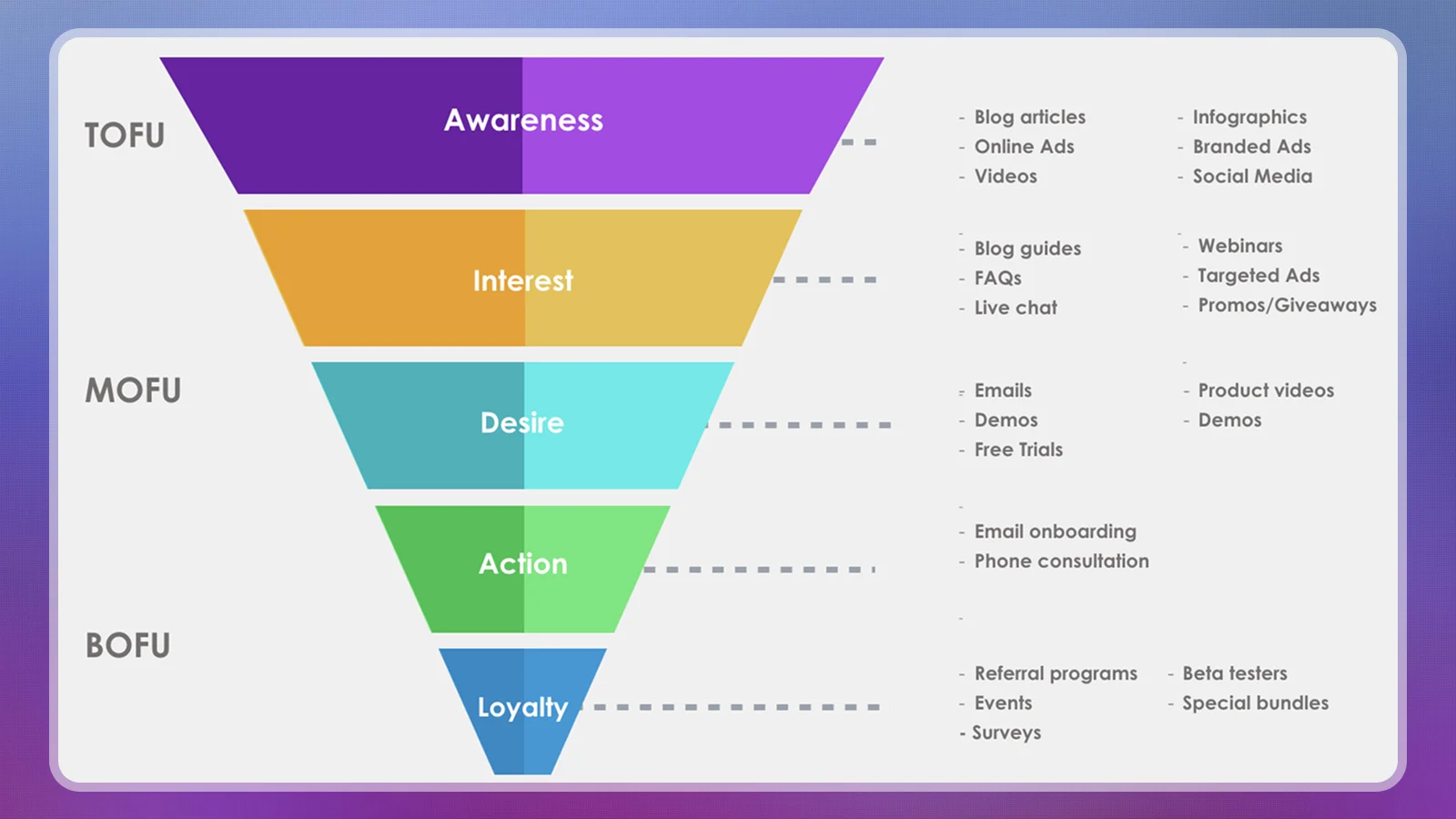
What is SaaS marketing at this stage? It is helping buyers evaluate the product without a meeting. SaaS buyers spend 27% of their buying-process time researching online before they talk to sales, so your website carries much of the early conversation. The funnel gives that conversation a sequence.
- Awareness means publishing material about the problem your product solves, such as tutorials and comparison guides. Someone searching “What is SaaS marketing?” wants an explanation before a sales pitch, and your prospects feel the same way.
- Interest grows when you explain possible solutions through product pages, tutorials, and demos. Show the work a buyer could finish with your software, and skip the list of disconnected features.
- Desire builds when you tie the product to a specific workflow and back the claim with evidence, such as a case study. B2B SaaS marketing content should also help your internal champion explain the purchase to colleagues.
- Action gives the buyer a clear next step, like a demo request, a free trial, or a subscription. Match the step to your sales model and the buyer’s readiness.
- Loyalty comes from onboarding, useful product habits, and renewal support, so customers keep finding value.
What is SaaS marketing after the purchase? It is everything that helps customers keep using and renewing the software. Buyers rarely move through the stages in a straight line. Someone may revisit pricing or ask colleagues for input after starting a trial.
What is SaaS marketing for a small team? Mostly the work of finding the unanswered question at each stage. A generic newsletter cannot fill in for a missing product demo or unclear onboarding instructions.
Marketing Automation and Monetization Tools Worth Knowing
SaaS marketing leans on two kinds of tools:
- Campaign tools get your message out.
- Monetization and analytics tools show whether the message worked.
Sending more emails does not explain cancellations, and a revenue dashboard does not write an onboarding message. So, what is SaaS marketing without both? It’s a campaign you cannot measure.
Each tool category below has a named example.
- Marketing automation: Moosend manages email campaigns and automated follow-ups.
- Subscription analytics: ChartMogul tracks recurring revenue and churn, which is the rate at which customers cancel their subscriptions.
- Billing and monetization: Stripe Billing, Chargebee, Schematic, and Paddle handle charging customers, managing subscriptions, and controlling access to paid features.
Pick a tool category only when you have a specific task for it. A growing software stack can look like progress while it adds more logins and more data to keep in sync. A small B2B SaaS marketing team gets more value from a few connected systems that share the same customer data.
The table compares the analytics and billing tools:
|
Tool |
Best for |
Free trial |
Price |
|---|---|---|---|
 |
Subscription billing and tax collection |
None listed |
Pay-as-you-go at 0.7% of billing volume, or $620/month for up to $100K in monthly billing volume |
 |
Subscription lifecycle management |
Yes |
Free for the first $250K in cumulative billing, then 0.75%; Performance plan at $7,188/year |
 |
Recurring-revenue analysis and churn tracking |
14 days, no credit card |
Free plan; Starter from $57/month and Pro from $99/month, billed yearly; Enterprise from $19,900/year |
 |
Pricing and entitlement management |
None listed |
Free plan; Growth at $400/month; custom pricing available |
 |
Merchant-of-record billing arrangements |
None listed |
5% + 50 cents per checkout transaction; custom pricing available |
Prices come from each vendor’s pricing page, except Chargebee, whose figures come from Schematic‘s July 2026 comparison. A merchant of record is the company that legally sells to your customer and handles sales tax on your behalf. Entitlements are the features or usage limits included in a plan.
The right tools for B2B SaaS marketing teams depend on the stage. Start with email automation, add analytics once you have paying subscribers, and choose a billing tool when you are ready to charge.
Pricing also shapes your message. Many B2B SaaS companies use hybrid pricing, which mixes a subscription fee with usage-based charges. A usage-based offer needs a clear explanation of what raises the bill, and a feature-based plan needs a clear list of what each tier includes. That is why pricing tools belong in any discussion of what is SaaS marketing.
What SaaS Marketing Really Costs To Get Off the Ground
A first SaaS marketing setup starts at about $15–$30 a month for basic automation tools. Content, advertising, and your own time cost extra.
The question “What is SaaS marketing?” has a budget answer too. It includes labor, content production, and distribution. A low software bill can still come with a heavy workload, especially when the founder writes the content and runs the campaigns.
Split your budget into these cost lines.
- Basic automation covers essential email marketing, lead management, and CRM functions for $15–$30 a month.
- Overall marketing budget averages about 10% of revenue for a SaaS company. High-growth companies often spend 40% or more. A new business should set its budget by the cash it has and the work it can sustain.
- Billing and analytics costs depend on the plan, transaction activity, or billing volume. The tools table above runs from free tiers to several hundred dollars a month, before enterprise plans.
- Content and distribution includes writing, design, product demos, and any paid ads.
- Learning is easier to budget than it looks. Many beginners offset the learning curve with a SaaS marketing course instead of hiring right away.
Match your spend to the work you can sustain. B2B SaaS marketing is hard to judge when a team buys traffic but has no capacity to follow up or support onboarding.
The cost beginners underestimate is the wait for SEO content to pay off. Search content can become one of your strongest channels for B2B SaaS companies, but the return takes months to show up.
What is SaaS marketing if the results take months to appear? It is a long game that calls for patience. Set a review date for every campaign so that patience does not turn into funding something that is not working.
Pros and Cons of SaaS Marketing
SaaS marketing gives you steady customer relationships and measurable subscription results, and it comes with ongoing work. B2B SaaS marketing suits teams that are ready to connect acquisition with product adoption.
| Pros | Cons |
|---|---|
| ✅ High-ROI channel – SEO delivers a 702% ROI for B2B SaaS companies. ✅ Strong content payoff – 88% of B2B SaaS marketers report positive results from data-driven content. ✅ Reliable lead source – Case studies are effective at boosting sales for 47% of SaaS companies. ✅ Wide channel adoption – Email marketing has 84% adoption among SaaS marketers. ✅ Scalable automation – Tools handle repetitive lead-nurturing tasks at scale. | ❌ Long sales cycles – Enterprise SaaS deals can take 6 to 18 months to close. ❌ Over-automation risk – 62% of consumers lose loyalty to brands that feel unpersonalized. |
The advantages depend on execution. A tutorial needs a clear audience, and an automated sequence needs a useful reason for every message.
For a solo marketer, long sales cycles are the con that matters most. Feedback arrives slowly while you still have to keep publishing, so start with a manageable customer journey before you add channels.
So what is SaaS marketing, once you weigh the trade-off? It is a set of recurring relationships. They give you more chances to learn, improve onboarding, and support renewals, and they ask for steady work in return.
Step-by-Step: How To Get Started With SaaS Marketing
Expect a few weeks to set up a first campaign and a few more to reach a first qualified lead. Your timeline depends on your existing website, content, and product access.
The working answer to “What is SaaS marketing?” is a connected campaign you can inspect. Before you publish, decide what makes a lead qualified and who responds when one arrives.
A SaaS marketing course can give you structure before you begin. It should not delay conversations with prospective customers, though. Follow the five steps below, then improve the plan with evidence from your campaign.
Step 1: Define Your Ideal Customer and Positioning
Build a specific buyer persona before you write anything. A target market that is too broad is one of the most common mistakes in B2B SaaS marketing, so pick the customer group with a problem your software can solve. Write an ideal customer profile, or ICP, that describes the organization, its workflow, and its reason to buy. Name both the user and the budget owner.
What is SaaS marketing to that customer? Say it in a positioning statement that covers who the product serves, the task it helps complete, and why your approach fits. A scheduling tool for esports organizers, for example, should talk about tournament coordination and skip generic productivity claims.
Step 2: Build a Content and SEO Foundation
Create a product page and educational content around your customer’s actual task. A blog is a main source of organic traffic and leads for many SaaS companies. Zapier, for example, has built a large share of its traffic through blog content that answers practical questions.
Search engine optimization, or SEO, helps search engines understand your content and match it to relevant searches. Focus on useful pages and clear product explanations over publishing volume.
What is SaaS marketing if buyers never see the product? Show the software itself with an accurate screenshot or short demo, so they can connect your promise to the workflow.
Step 3: Set Up Email and Lead-Nurturing Automation
Build a follow-up sequence around what the prospect did. Someone who requests a demo needs a different reply than someone who joins your newsletter. Write each message to answer one question, and stop acquisition emails once the customer has moved past them.
Email marketing has 84% adoption among SaaS marketers, which makes it one of the most reliable channels for consistent leads. The email answer to “What is SaaS marketing?” is relevant communication that helps someone take the next useful step.
Step 4: Launch Paid and Social Channels
Choose channels where your buyers already look for information or compare solutions. Send each ad to a landing page that repeats the same promise, and give visitors an action that fits their readiness. Skip the generic homepage.
Many buyers now purchase through social media platforms, so paid social works well alongside organic content. If your budget is small, start with one paid channel and test a specific message before you add more. Specific examples, clear product limits, and a fitting call to action discourage poor-fit clicks. Then review the conversations those clicks produce to decide whether to expand.”
Step 5: Track MRR, Churn, and CAC To Iterate
Track monthly recurring revenue (MRR), churn, and customer acquisition cost (CAC) together. MRR is your subscription revenue on a monthly basis, so a $40,000 two-year subscription equals roughly $1,666 in MRR. Churn is the share of customers who cancel, and CAC is what you spend to win each new customer. Use the same definitions and reporting periods every time.
A healthy annual churn is around 5%–7%. Benchmarks vary by segment, so look at your own customers and cancellation reasons before you treat that range as a diagnosis. The measurement side of what is SaaS marketing comes down to retained customers.
Once you have paying subscribers and billing data, ChartMogul can show recurring revenue and churn next to your campaign records. Until then, track qualified inquiries, trial activity, and customer feedback to find one problem to fix.
Close each review with an action and an owner. A dashboard earns its place when someone changes a message, fixes an onboarding problem, or investigates a recurring cancellation reason.
Deepen Your SaaS Marketing Knowledge
This guide gives you the overview, and a SaaS marketing course shortens the trial and error. The learning side of “What is SaaS marketing?” should end in a usable campaign plan. If you are new to marketing overall, start with How To Learn Digital Marketing.
The best-fit pick is SaaS Marketing with Dekker: SaaS Startup Lead Generation on Udemy. This SaaS marketing course holds a 4.2-out-of-5 rating from 1,026 ratings, has 40,517 students, and runs 22.5 hours of on-demand video on positioning, demand generation, and lead nurturing.
Here is the course at a glance, for readers who want a guided SaaS marketing course before building a campaign.
The table summarizes the commitment if you are comparing a SaaS marketing course with independent study.
|
Course |
Provider |
What It Covers |
Duration and Price |
|---|---|---|---|
 |
Coursera (STARWEAVER) |
Growth strategy, lead capture, email nurturing, onboarding, retention analytics, and marketing automation |
9 hours; free to enroll, certificate extra |
|
|
Coursera (Simplilearn) |
Account-based marketing, content marketing, B2B channels, and measuring lead generation |
About 4 hours; free to enroll, certificate extra |
 |
Teachable (Ryan Kulp) |
Target audience, paid and organic acquisition, analytics, partnerships, and conversion optimization |
8+ weeks, self-paced; $1,750 (one-time) or four installments of $500 each |
Prices vary widely across these platforms, so check each checkout page before you enroll. Udemy lists new-learner pricing from $14.99. The two Coursera courses are free to enroll in, with a fee only if you want the certificate.
The Teachable course costs $1,750 as a one-time payment, or four payments of $500 on its payment plan, and you can work through it at your own pace. A SaaS marketing course pays off when its syllabus closes a specific gap, so do one exercise after each relevant lesson, such as rewriting your positioning or drafting an onboarding message.
Try answering “What is SaaS marketing?” with your own product’s customer journey. If your answer stays abstract, pair the lessons with more hands-on practice.
Core Channels for B2B SaaS Marketing
The five core channels are content and SEO, email automation, paid social and search ads, case studies and thought leadership, and product-led growth. B2B SaaS marketing works best when each channel has a clear job in the same customer journey.
So, what is SaaS marketing across channels? It is a coordinated system. Pick one main acquisition route, then support the evaluation and onboarding steps it creates. Each channel below handles a different customer need.
- Content marketing and SEO answers problems buyers already research and shows where your software fits. A significant number of B2B SaaS marketers see positive results from data-driven content. That is a good reason to publish useful material, though your own returns will vary.
- Email automation continues the conversation after a signup, download, or product action. In B2B SaaS marketing, keep educational messages separate from sales follow-up and customer onboarding.
- Paid social and search ads test specific messages against clear audiences or search intent. Judge them by the quality of the opportunities they create as well as the cost per visit.
- Case studies and thought leadership help buyers judge credibility and practical fit. Many SaaS companies say case studies are effective at boosting sales, and a story from a similar customer carries more weight than an unrelated success claim.
- Product-led growth lets the product drive signups and upgrades through a free trial, a free plan, or an easy self-service start. B2B SaaS marketing still has to explain the use case and help users reach value.
Pick channels you can maintain before you add more. A SaaS marketing course can go deeper on any single channel, but your buyer and product should choose the channel.
What is SaaS marketing for an esports event-management product? Search content might cover scheduling conflicts while a demo shows how organizers handle changes. That gives the content and the product separate jobs.
B2B SaaS marketing also needs channel-specific standards. A case study should describe a comparable customer, and an onboarding email should help the reader finish an immediate task. For the wider basics, read What Is B2B Marketing?
What is SaaS marketing when the pieces work together? Each channel hands the buyer a relevant next step, and each trial comes with useful onboarding. The next section covers where beginners lose leads.
Where New SaaS Marketers Lose Leads
The most common reason beginners stall is an undefined target market. It weakens your positioning, content, and lead qualification all at once, so make the buyer specific enough that the campaign can address a recognizable task.
The diagnostic answer to “What is SaaS marketing?” shows where a customer stops moving forward. A campaign might attract attention and still fail to explain the product, or it might generate trials that never reach a useful result.
- Target market too broad. Fix this by building specific buyer personas before you produce content. In B2B SaaS marketing, a daily user and a budget owner often need different material.
- Content that only promotes the product. Solve the audience’s actual problems first, then ask for the sale. Someone searching “What is SaaS marketing?” needs an explanation before a pitch, and your buyer needs help understanding their own problem too.
- Tracking vanity metrics. Measure CAC, churn, and lifetime value (LTV), and treat likes and followers as secondary. LTV estimates what a customer is worth over the whole relationship, and the result depends on the method you use.
- Changing several campaign variables at once. Test one element at a time, such as a subject line, a call to action, or a button color. An A/B test compares two versions to see which performs better.
- Reinventing the wheel. Many marketers rebuild a campaign from scratch when a proven template would work. Reuse your best templates and playbooks, and build something new only when nothing fits.
What is SaaS marketing aiming for if the team only counts leads? A better fix may be clearer onboarding, sharper qualification, or a product explanation that prevents poor-fit signups.
A SaaS marketing course can help you organize these decisions. The core habit stays the same. Document the problem, change one element, and review how customers behave afterward. For more guides like this, browse Eneba Hub Learning.
Final Verdict on SaaS Marketing
SaaS marketing is worth pursuing when you have a useful product, a defined customer, and capacity for continued follow-up. Founders and marketers who can connect education with onboarding have a clearer starting point than teams focused only on generating more visits.
A startup still testing product-market fit, meaning proof that customers want the product, should put customer conversations and product learning first. A SaaS marketing course is a good alternative to learning by trial and error when structure is what you lack. It will not settle unclear demand on its own.
The best answer to “What is SaaS marketing?” is a customer journey you can explain and improve. Start with a focused audience and a manageable campaign, then expand when the evidence supports the decision.
For readers who want guided instruction before building that campaign, this is the best-fit learning option:
FAQs
SaaS marketing uses content, SEO, email, and paid campaigns to attract, convert, and retain software subscribers. It covers recurring customer relationships, including onboarding and renewal. That is the short answer to what is SaaS marketing.
Basic automation tools cost about $15–$30 a month, and the average SaaS company spends roughly 10% of revenue on marketing. Content, ads, and labor add to that.
Enterprise deals take 6–18 months to close, and SEO content builds value over months. Track early signals like qualified leads and trial signups along the way.
Yes, when the product meets a clear need and the team can sustain acquisition and retention work. Judge the investment by qualified demand, product adoption, and retained customers.
No. Prior SaaS experience is optional, but knowing MRR and churn speeds up learning. A SaaS marketing course or a small practice campaign can build those basics before you manage a larger budget.
For B2B SaaS marketing, start with a content and SEO plan, an email tool like Moosend, and a subscription analytics platform like ChartMogul. That combination is the practical answer to what is SaaS marketing for a first campaign.