

MOUSE: P.I. for Hire Review: Cheese Louise!



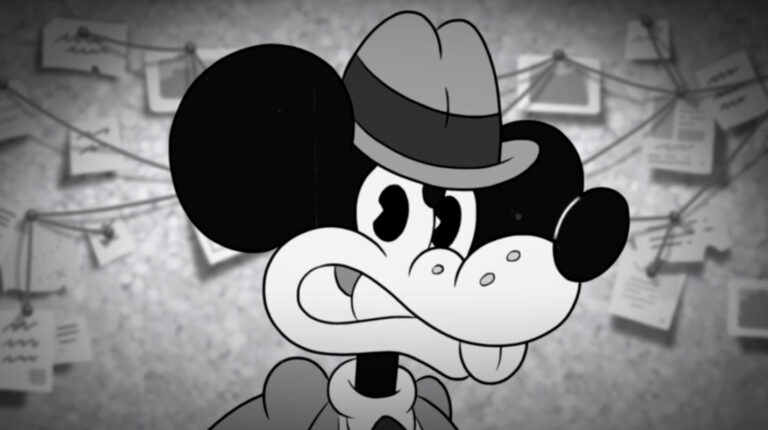
Why I oughta…! MOUSE: P.I. for Hire is a cartoon noir FPS stuffed with so many cheese puns it’ll make you lactose intolerant. Developed by Fumi Games and published by PlaySide, it’s out now on all major platforms (I played it on PC). It’s got moxie, but is that enough to warrant hiring this rodent gumshoe? Join me as I grab my trench coat and fedora and follow Jack Pepper as he tries to crack his latest case.

Jump to:
Forget it, Jack, It’s Mouseburg
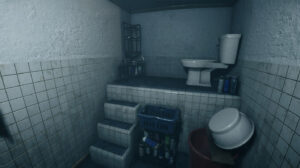
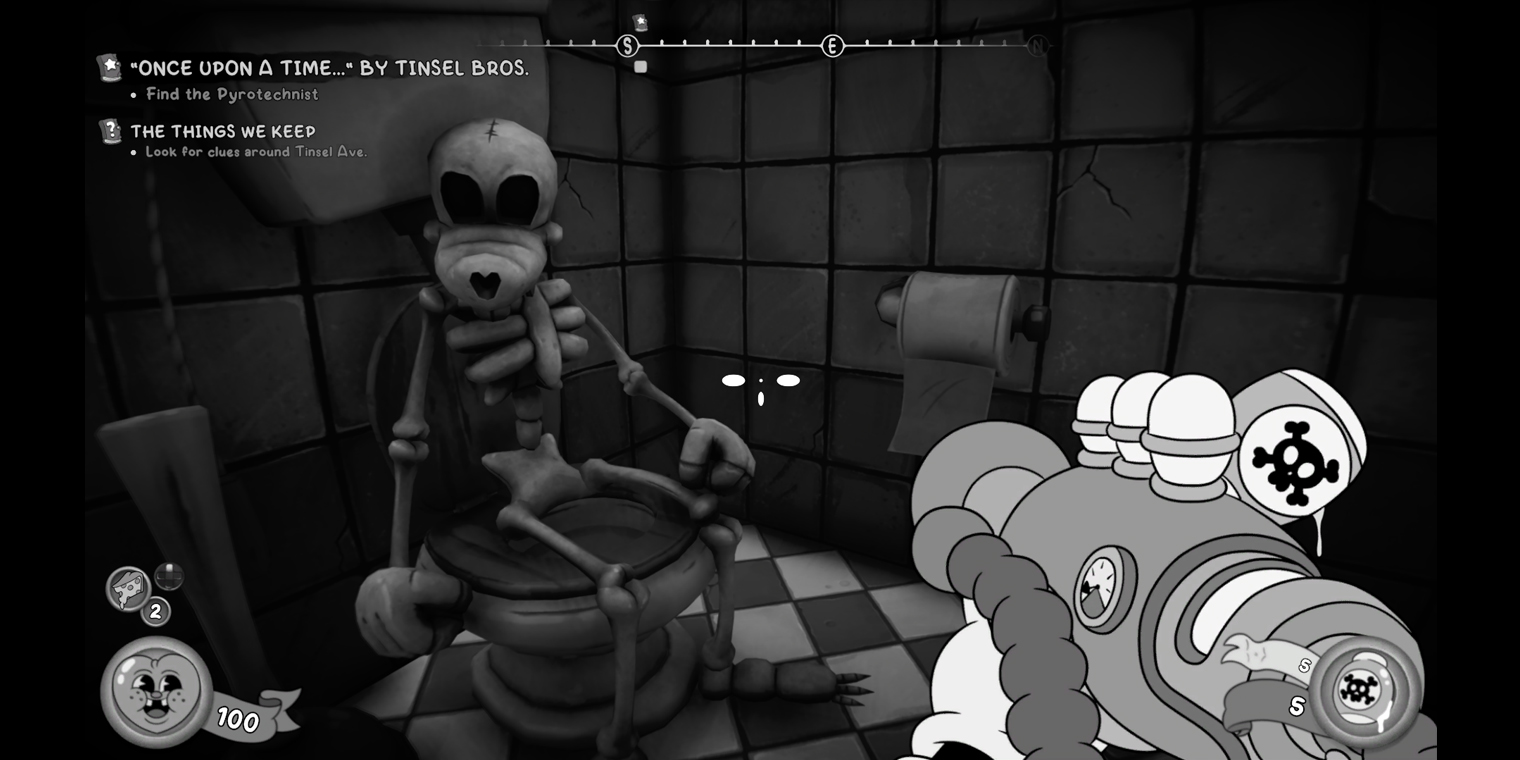
It was the skeleton that did it. There I was, exploring one of Mouseburg’s rundown tenements, when I came across the remains of an anthropomorphic mouse who’d apparently died on the toilet. Judging by how many times I came across the exact same scene later on and elsewhere in my travels, there must have been some distant mass toilet-death epidemic in-world.
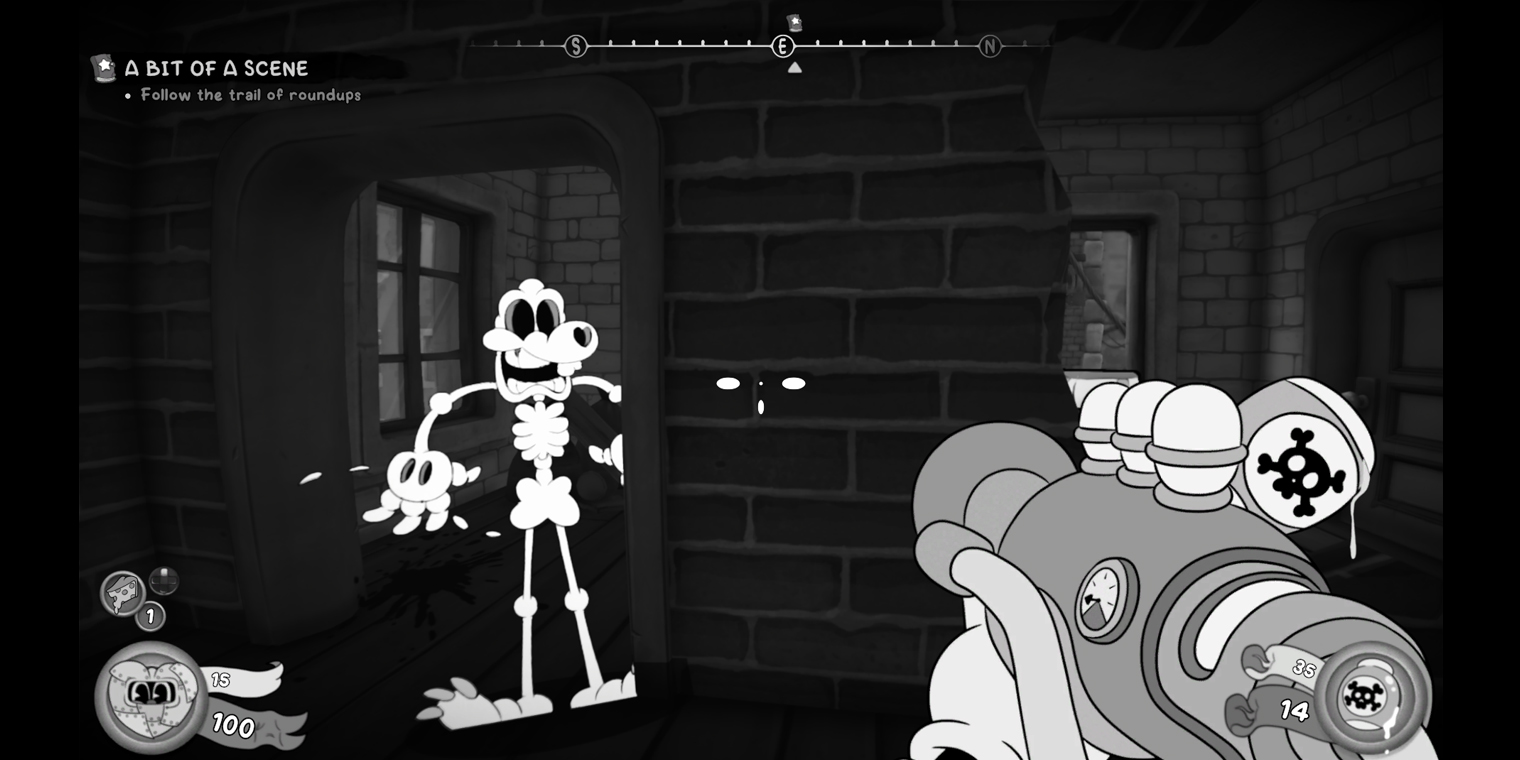
But this isn’t what bothered me; it was the skeleton itself. Rendered in the painterly monochrome 3D of the world, it made me question why the enemies I killed as Jack Pepper left 2D animated skeletons behind. Was it the method of death? Was melting goons down with the awesome Devarnisher (which shoots turpentine and acts like acid) the reason the equally 2D enemies left 2D bones behind? Or, and this is why it bothered me, was I giving more thought to the game world than the developers?
MOUSE: P.I. for Hire puts you in the animated (gum)shoes of Jack Pepper (gruffly voiced by Troy Baker), a war veteran turned private detective who finds himself investigating the disappearance of his old war buddy Steve Bandel. Bandel had been working as a stage magician, and a good one from all accounts. Trouble is, he managed to vanish mid-act and now no one knows where he went. Jack sets off to find him and quickly uncovers a troubling conspiracy involving the shrew community of Mouseburg. Turns out, they’re being made to disappear too and the reason why isn’t related to magic.
Although MOUSE’s story is serviceable it does the idea of detective fiction a disservice; while the game is filled with mobsters, corrupt politicians, and classy dames with hidden agendas, it rarely actually feels like a noir. This in and of itself isn’t necessarily a bad thing, but it highlights the biggest problem with MOUSE – it’s content to tick all the right boxes and leave it at that.
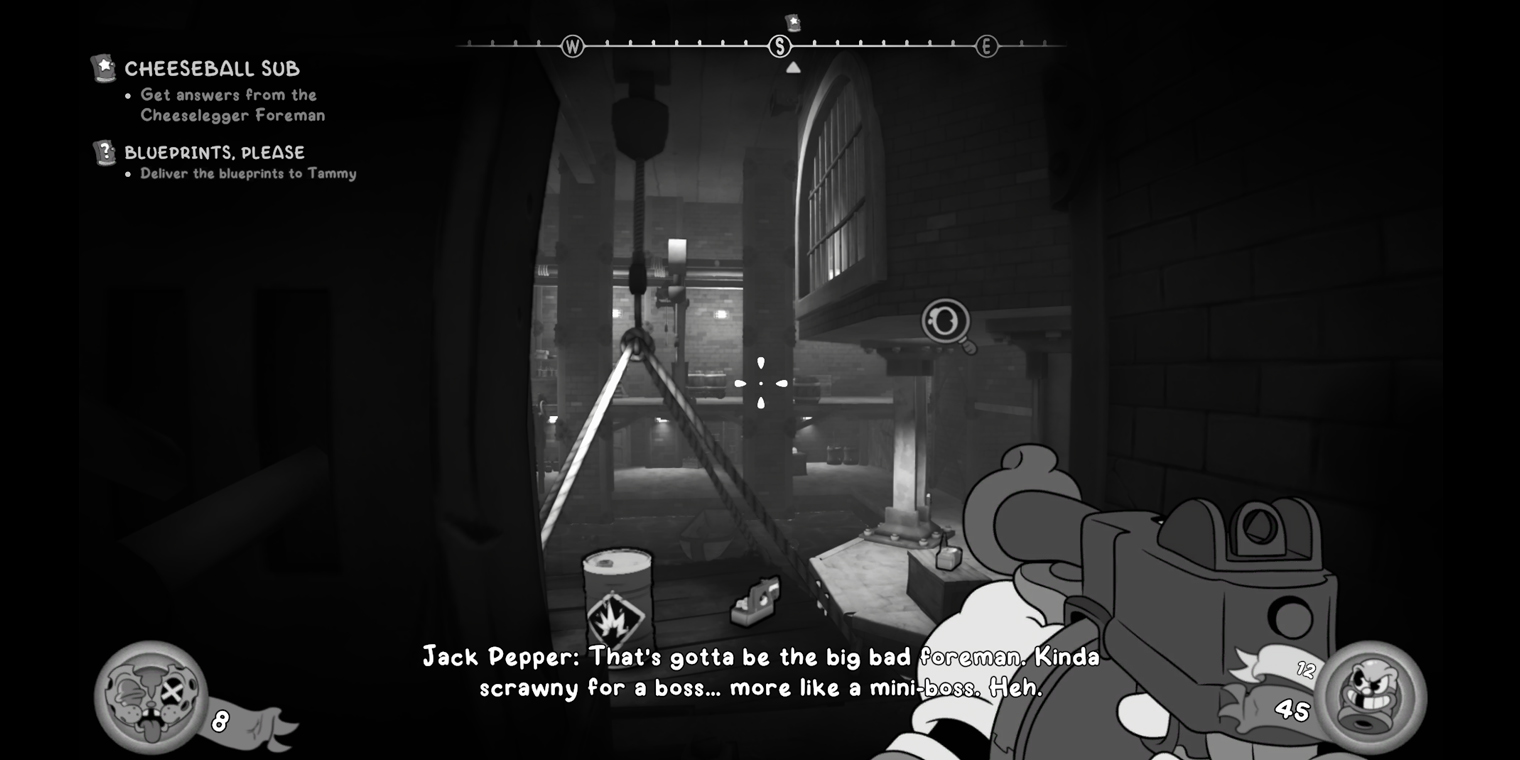
Chiefly, it uses a lot of the tropes and lingo of pulp fiction but mixes them with a contemporary meta-angle where Jack comments on everything with the equivalent of a knowing wink. This gives the impression that the game itself knows it’s all a bit silly, so why take anything seriously? Elliott Gould’s louche version of Philip Marlowe in The Long Goodbye is an excellent precedent of a noir story that subverts expectations, so it’s possible, but MOUSE is content to rely on its admittedly brilliant visual hook: it’s like a noir, but with cartoon rodents!
Un-brie-lievable
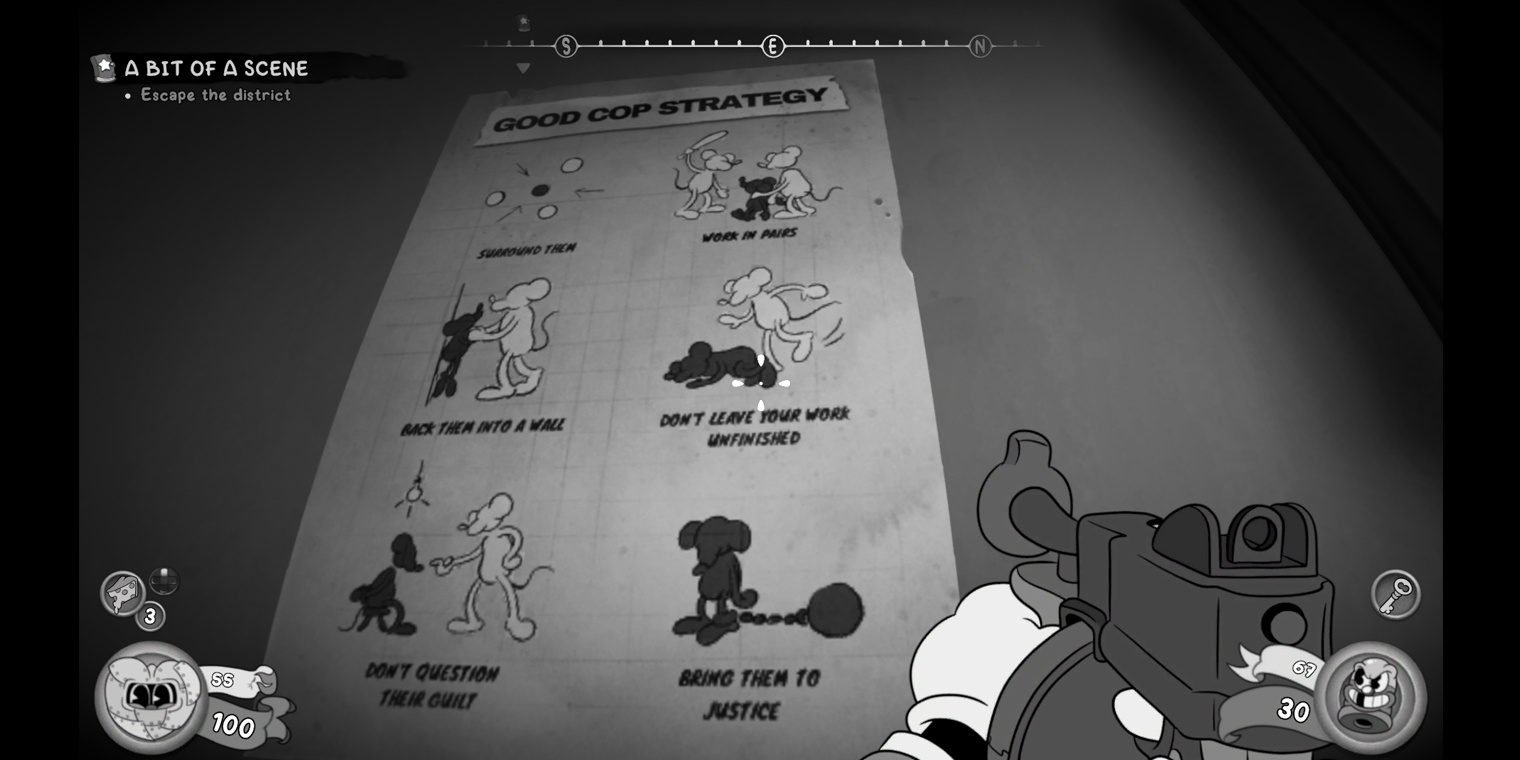
MOUSE isn’t subtle, at any point. The game is set in 1934 and presents shrews as a minority being targeted by the Big Mouse Party, which favors “big, strong mice.” The war that Jack fought in is referred to as the Quite Big Affair. Shadowy bad guys are called “ze scientists” and, just in case you’re not sure what real-world things are being referenced, the shrews’ native language bears an uncanny similarity to Polish.
A lack of tact isn’t a bad thing, necessarily, nor is basing a first-person shooter on real world events (if it was, then how are we supposed to judge many modern FPS titles?). It’s just disappointing that Fumi Games hit on the novel idea of using the bouncy “rubber house” animation of the 1930s in an FPS setting and then didn’t take the idea as far as it could go, or keep things coherent.
Cuphead is the obvious touchstone here, even though it’s a bullet hell/schmup. Everything in Cuphead makes sense, because the whole thing (the characters, the world) is presented as being animated. Why do the characters in MOUSE live in a 3D world, with 3D food and clothes, but only some objects have the same bouncy animation style? Why are all animals shown to be 2D cartoons that leave 3D corpses – except for the ones I gun down, melt, or explode?
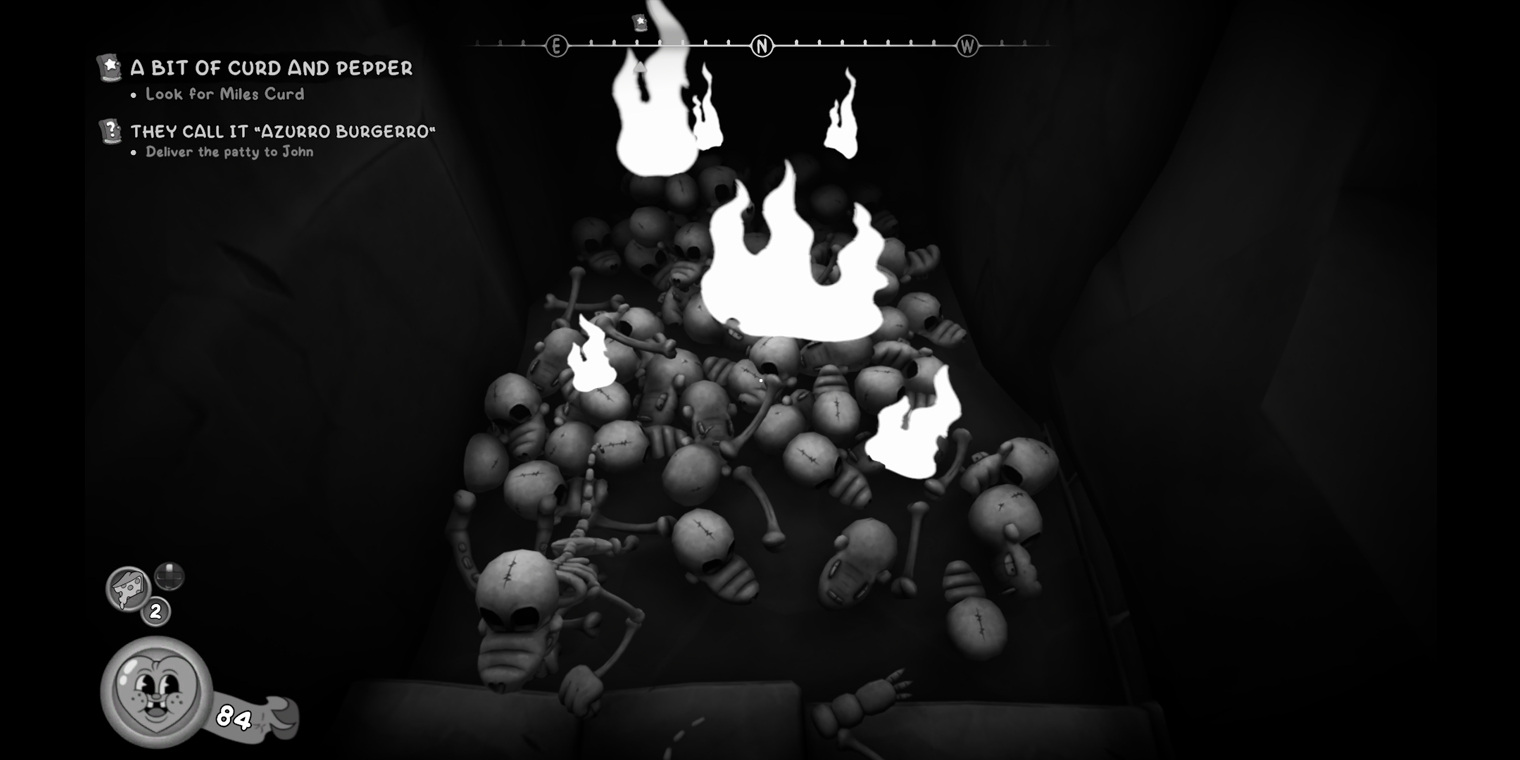
And why are there so many skeletons everywhere? At one point, I found a fire pit made from bones. Is it a literal manifestation of the idea that the city was built on the bodies of laborers? I suspect it might be, given the amount of posters everywhere promoting the idea of hard work and being a cog in a machine.
Obviously, this really bothered me and I couldn’t stop thinking about it. It also didn’t help that character sprites are made in such a way that they always rotate to face the player (this is a design trick that uses something known as a “billboard,” where a 2D sprite is assigned to an invisible 3D model, and you’ll find it in contemporary games like Octopath Traveller and Ruffy and the Riverside).
It’s really disconcerting to murder a ton of goons and then have their corpses constantly turn to face you as you move past them. Or walk past normal pedestrians and have them also turn on the spot, even if this means they’re no longer technically moving in the right direction.
A Wise Guy, Huh?
The good news is the actual shooting is solid, and Jack moves at a fair old clip. And that’s before he gets access to additional moves, like spring-heeled shoes for a double jump, and the ability to use his tail as a helicopter and grappling hook. Most enemy fights happen in self-contained arenas, just as you’d find in old-school shooters like Quake and modern reinterpretations like the newer DOOM games, leading to hectic firefights.
Enemy types are visually varied from typical thugs to cultists, and even vengeful ghost brides(!) and robots, and I like that enemies can be literally flattened with environmental things like anvils and pianos. What I didn’t like is that getting baddies lined up for a fatal crushing often took more work than simply blasting them, given their propensity to just charge towards me.
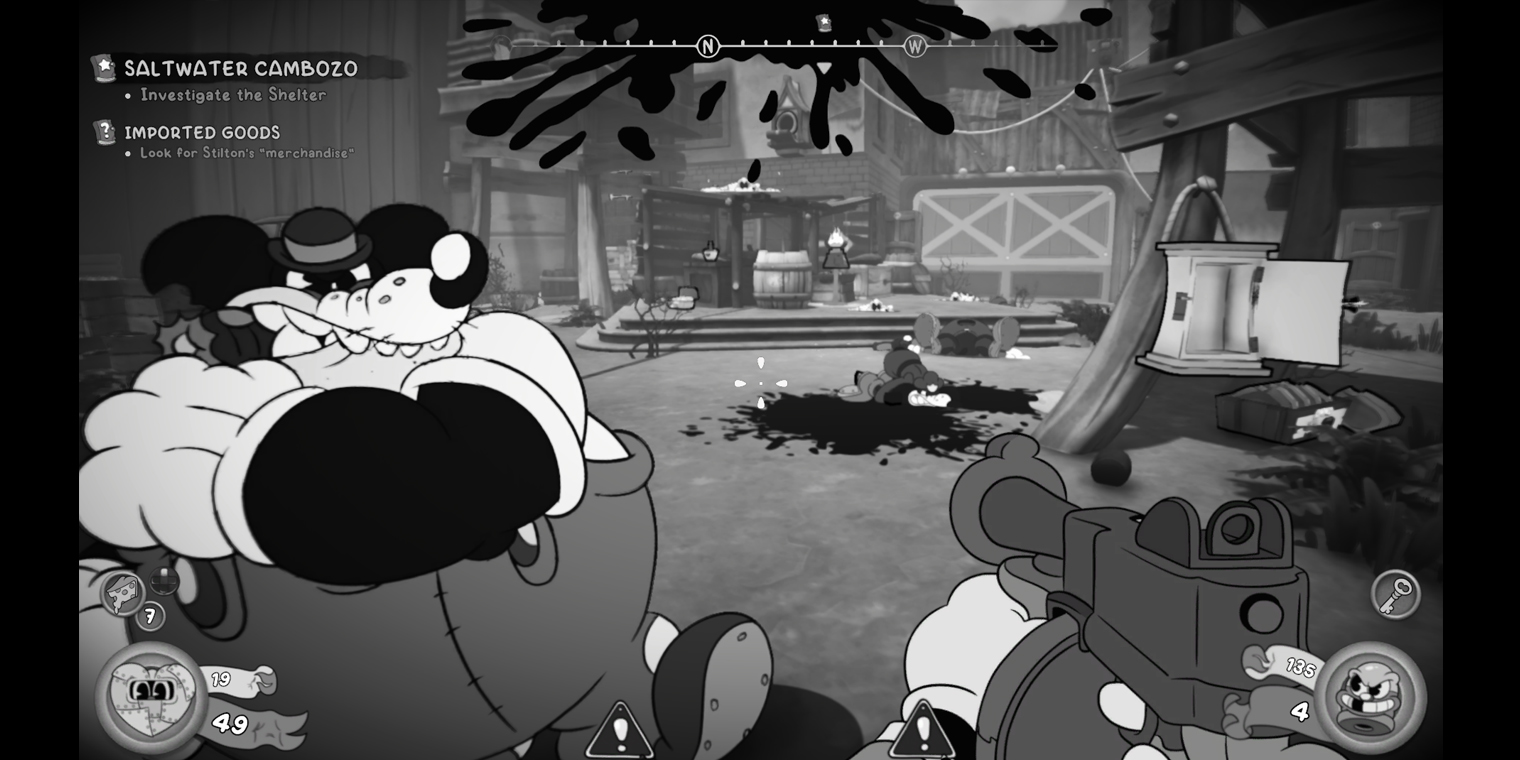
Even so, I can’t say it made battles any less exciting, thanks to the steady stream of new environments and arcade-style pickups (including literal finger guns that unfortunately don’t make a ‘pew pew’ noise). Plus, I never got bored of seeing enemies burst into flames and run around in a fiery panic before collapsing into cartoon ash or bones.
Actual guns all look cool in action, but some (like the double-barreled shotgun) lack heft in terms of not quite sounding like they should or having the impact on baddies I expected (the first shotgun tends to stun enemies, for some reason). Plus, once I got the Devarnisher early on, I only really used other weapons because my ammo for that ran out; it can one-shot most normal enemies and has the best death animation attached to its attacks. Mind you, the amusingly named Loose Cannon (a literal cannon you can hold) was a lot of fun to blast baddies with, as was a late-game freeze ray.
You Feta Believe It!
Jack has his mitts for melee combat, and can give enemies (and destructible crate/barrels) a good kick. Sometimes the latter will open up new avenues or reveal hidden blueprints and special schematics, which in turn can be used to upgrade or unlock weapons back in the small central hub. I did like the extra flavor this hub gives the game, as Jack can chat with his friends there to get a bit more background info (like how he put the father of Tammy, who upgrades your guns, in jail).
Keep in mind that you don’t get to revisit levels (at least, not in the state you first found them), so make sure to poke around before completing a main objective. I mentioned how Jack can use his tail, but one of the neatest quirks is this is also his lockpick. Safes, and some doors, need to be unlocked via a relatively easy minigame that occasionally adds a timer or set number of moves to keep things interesting.
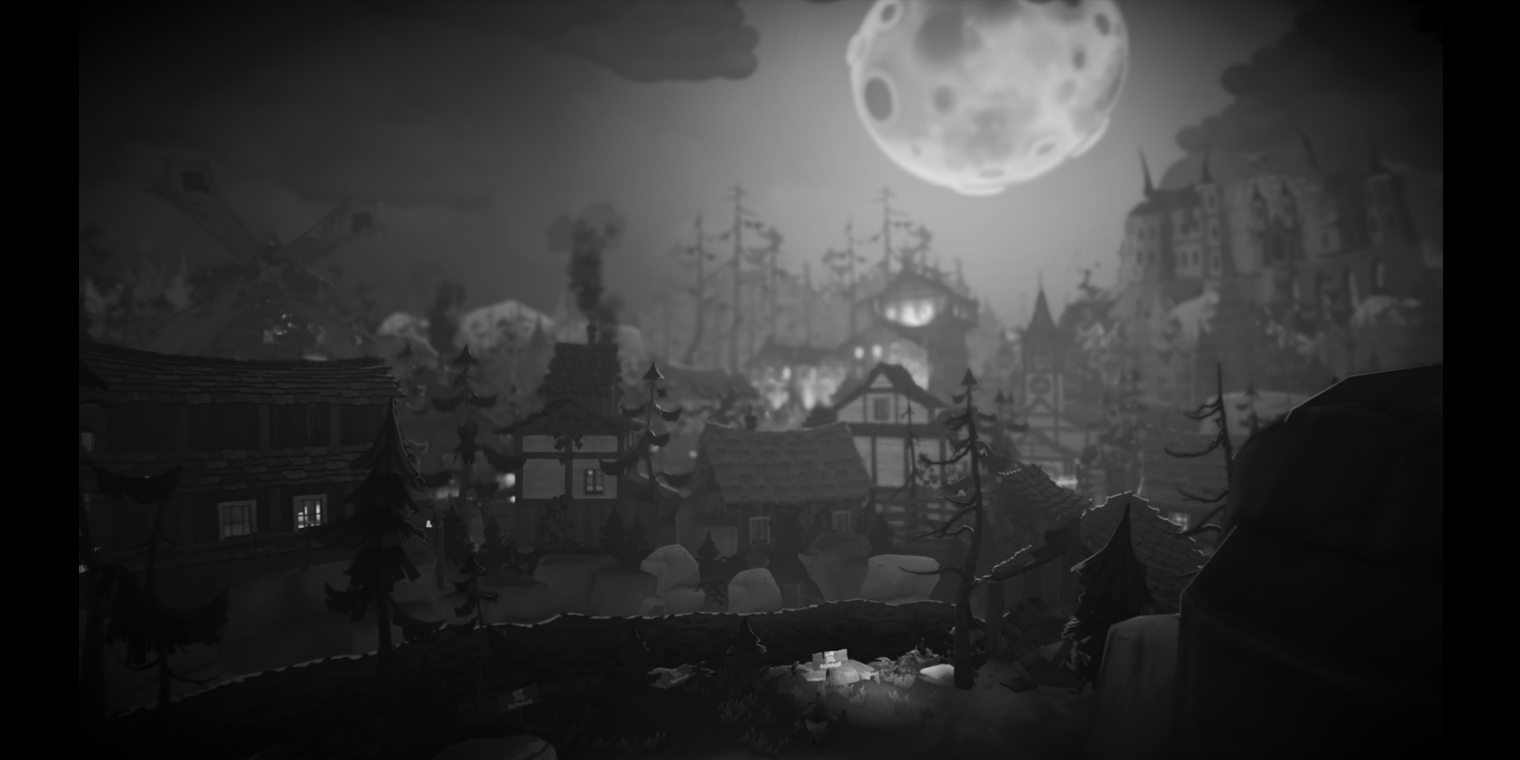
MOUSE: P.I. for Hire is largely linear, but every so often you’ll get the chance to tackle missions in whatever order you want. This is done via a charming overworld you drive around, with each area of the map being visually distinctive. I was worried that the overall aesthetic would cause the game to become one big gray blur, but Fumi manages to invest enough character into each setting that this never becomes an issue, whether it’s an underground lab or mansion.
There were a few quirks that annoyed me, like how some water is deadly and some isn’t, but both types look the same, or how invisible walls would pop up to force me to fight in an artificially contained area before opening up afterwards (there’s a gator fight that’s especially bad for this). You might even expect this sort of game design from an FPS, so take these issues with a pinch of salt.
Some Gouda Stuff and Some Stuff That’s Not so Grate
Most of the issues I did find were to do with MOUSE’s collision of genres. Read any 1930s detective stories or watch films from that time period, and they might have shootouts, but they’re short-lived and narratively contained as opposed to regular onslaughts of action. By definition, detective fiction favors actual detective work, and Jack Pepper talks the talk, but that’s the limit of what he (and the game) offers players. Any investigation involves coming across obvious clue pickups and then pinning them to his office’s Crime Wall, with any leads automatically resolving.
None of this is terrible by any stretch of the imagination, and I’m not falling into the “I’m mad at the game for not being what I think it should be” review trap; rather, I can see that Fumi understands the language of 1930s animation, detective fiction and first-person shooters, but only on a surface level.
In other words, across the roughly 12 hour play time I couldn’t shake the feeling Fumi Studio was busy ticking-off boxes as to what players expect from all these aspects, without adding anything new. Even the jazz score is serviceable, lacking the pizzazz or bombast of the likes of Duke Ellington or Benny Goodman.
I don’t rate games in my reviews as I believe this is largely an unnecessary metric, unless the game in question is objectively amazing or terrible. Having said that, if I did, then consider MOUSE: P.I. for Hire to be the very definition of a 7/10 title. It’s perfectly balanced and does everything you’d expect from this type of game, no more and no less.