


Best Game Development Courses in 2026: 6 Picks for Beginners

Eneba Hub contains affiliate links, which means we may earn a small commission if you make a purchase through them—at no extra cost to you. Learn more


START BUILDING WITH UNITY
Getting Started with Unity and Basic 2D/3D Game Development on Coursera is the leading recommendation for beginners who want guided engine practice across both 2D and 3D game development.
The best game development courses include Getting Started with Unity and Basic 2D/3D Game Development for engine practice, Diploma in Basic Game Development for a short introduction, and Certificate in Game Design for formal study. Udemy lists its Unity introduction at approximately 1 hour of video, while Coursera recommends one week at 10 hours of study for its Unity course.
Choosing between game development courses depends on what you want to build. Someone interested in a small 2D platformer needs a different learning path from someone planning a 3D adventure game or pursuing a career in game design.
Starting with the right engine and a manageable project prevents you from spending weeks learning tools you may never use.
This guide compares six options covering Unity, Unreal Engine, and Godot, alongside broader game design education. Each entry explains its learning requirements, course commitment, practical value, and certificate options so you can choose a path that fits your budget and experience.
Jump to:
What Is Game Development?
Game development is the process of designing, programming, building, and testing interactive games. It combines several disciplines, including software development, visual design, animation, sound production, level design, and storytelling.
A game engine brings many of these elements together. It provides tools for creating environments, managing objects, implementing physics, and programming interactions without requiring developers to build every underlying system from scratch.
For example, creating a collectible in a platformer requires more than placing an object on the screen. You need to configure its appearance, detect when the player touches it, trigger an event, and update the player’s score. A useful game development course teaches you how those systems connect.
There are also different ways to approach the discipline:
- Game programming: Writing scripts and implementing movement, physics, artificial intelligence, and gameplay mechanics.
- Game design: Planning levels, rules, player progression, difficulty, and interactive experiences.
- Game art and animation: Creating characters, environments, visual effects, and animations.
- Game production: Coordinating development tasks, testing builds, and managing the project from concept to release.
The best game development courses depend on which of these areas you want to explore. Engine-focused instruction is a practical starting point for aspiring developers, while broader game development programs can introduce design principles and structured project work.
How These Game Development Courses Were Chosen
These game development courses are compared on documented scope and practical fit based on the details each provider gives prospective students. The criteria also distinguish short online game dev courses from longer game development programs:
- Coverage: The engine, design topics, and practical tasks described.
- Provider: The platform or institution offering the learning path.
- Price: Free access, course fees, subscription offers, and assessment charges.
- Practice: Opportunities to connect lessons with playable work.
- Certificate: The completion credential or formal program award.
- Time: The provider’s stated study commitment or video length.
The best game development courses fit a specific goal, so the labels describe different uses instead of a universal ranking.
The Best Game Development Courses, Compared
The best game development courses give beginners a manageable starting point and a clear reason to continue. These six different learning paths suit different budgets, engines, and study preferences.
Online game dev courses work best when you apply a lesson in the editor before moving on. Longer game development programs require the same habit, with more attention to assessment deadlines and sustained project work.
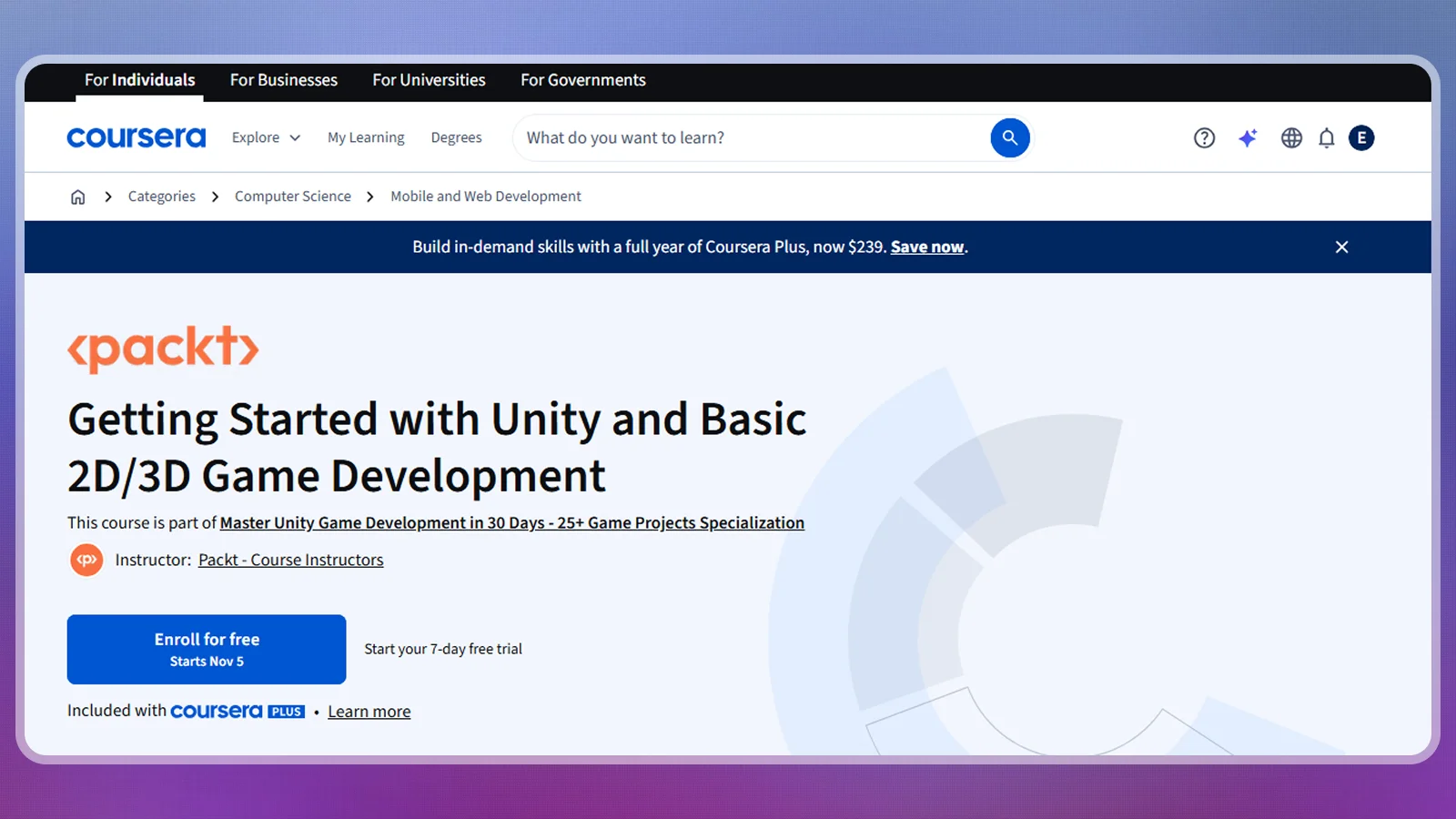
1. Best Overall: Getting Started with Unity and Basic 2D/3D Game Development (Coursera)
|
Best for |
Beginner engine practice |
|---|---|
|
Effort |
Medium |
|
Price |
Coursera Plus or individual enrollment pricing; check checkout |
|
Time to complete |
1 week at 10 hours/week; approximately 11 hours of video |
|
Main learning outcome |
Build foundational 2D and 3D game mechanics |
|
Certificate |
Shareable completion certificate |
This is the strongest overall choice among the best game development courses for beginners who have not yet decided whether they prefer 2D or 3D development.
Coursera’s curriculum introduces the Unity editor, scripting, player movement, gameplay mechanics, and interface development. Its practical exercises give learners opportunities to apply the tools rather than simply watch demonstrations.
What makes this course particularly useful is its coverage of different game formats. A beginner can explore 2D mechanics before moving into a 3D environment, gaining a clearer understanding of how the same engine handles different types of projects.
What you need: A computer capable of running Unity, a stable internet connection, and enough time to follow the demonstrations inside the editor. Basic programming experience can help, but the course is intended for beginners.
To get the most from it, complete each exercise in your own project rather than copying the instructor’s work without modification. Change a movement speed, adjust a collision rule, or create another collectible. Those small experiments show whether you understand the underlying mechanics.
The provider lists a one-week study commitment at 10 hours per week and approximately 11 hours of video. Remember that this is the advertised learning schedule, not a guarantee of proficiency. You will need additional practice to become comfortable building independently.
The course also offers a shareable completion certificate, which can document your learning. A playable project is still the more useful demonstration of your practical ability when applying for development opportunities.
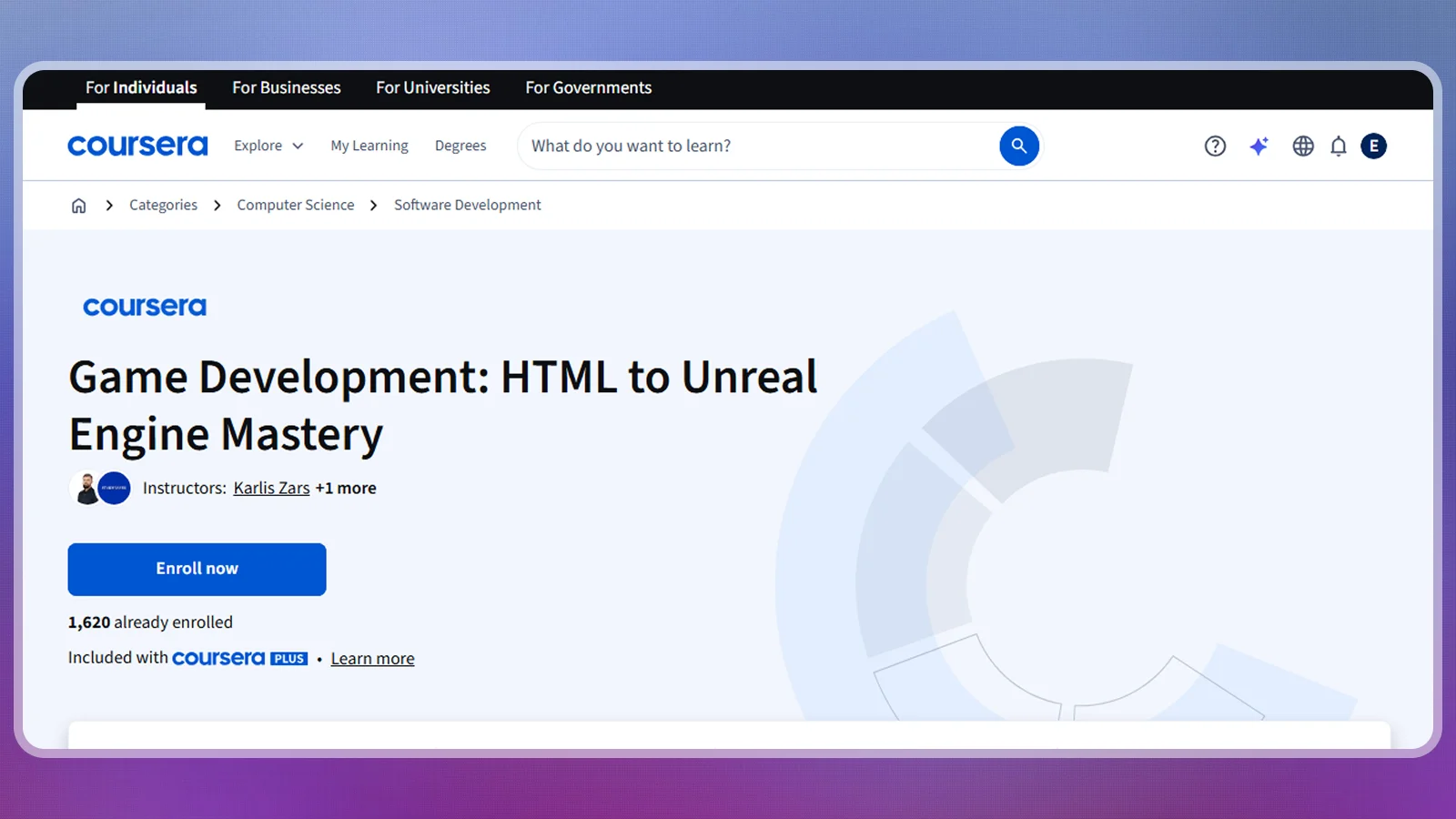
2. Best for Beginners: Game Development: HTML to Unreal Engine Mastery (Coursera)
|
Best for |
Short beginner introduction |
|---|---|
|
Effort |
Low |
|
Price |
Individual enrollment or eligible Coursera Plus access |
|
Time to complete |
2 hours |
|
Main learning outcome |
Understand basic game concepts and explore Unreal Engine |
|
Certificate |
Shareable completion certificate |
This game development course is ideal for beginners who want an initial introduction before committing to a longer engine-specific curriculum.
The Coursera course introduces foundational game design concepts, HTML5 game development, and basic work inside Unreal Engine. It gives learners an initial look at how different development environments handle graphics, sound, and gameplay.
What you need: A computer, internet access, and an interest in exploring game development tools. You do not need to arrive with advanced programming knowledge for this introductory course.
To get the most from it, use the two-hour course as an orientation rather than a complete learning path. Pay attention to the differences between browser-based game development and working inside a dedicated engine. Then choose which environment you want to explore further.
The provider lists a two-hour completion estimate, alongside 13 videos, four readings, and two assignments. Its published rating is 4.5/5 from 12 reviews, although the relatively small review sample offers limited evidence about overall learner satisfaction.
The short commitment makes this a convenient starting point, but it will not provide enough practice to develop advanced Unreal Engine skills. Continue with dedicated Blueprints, C++, and project-based training if you decide to pursue that engine.
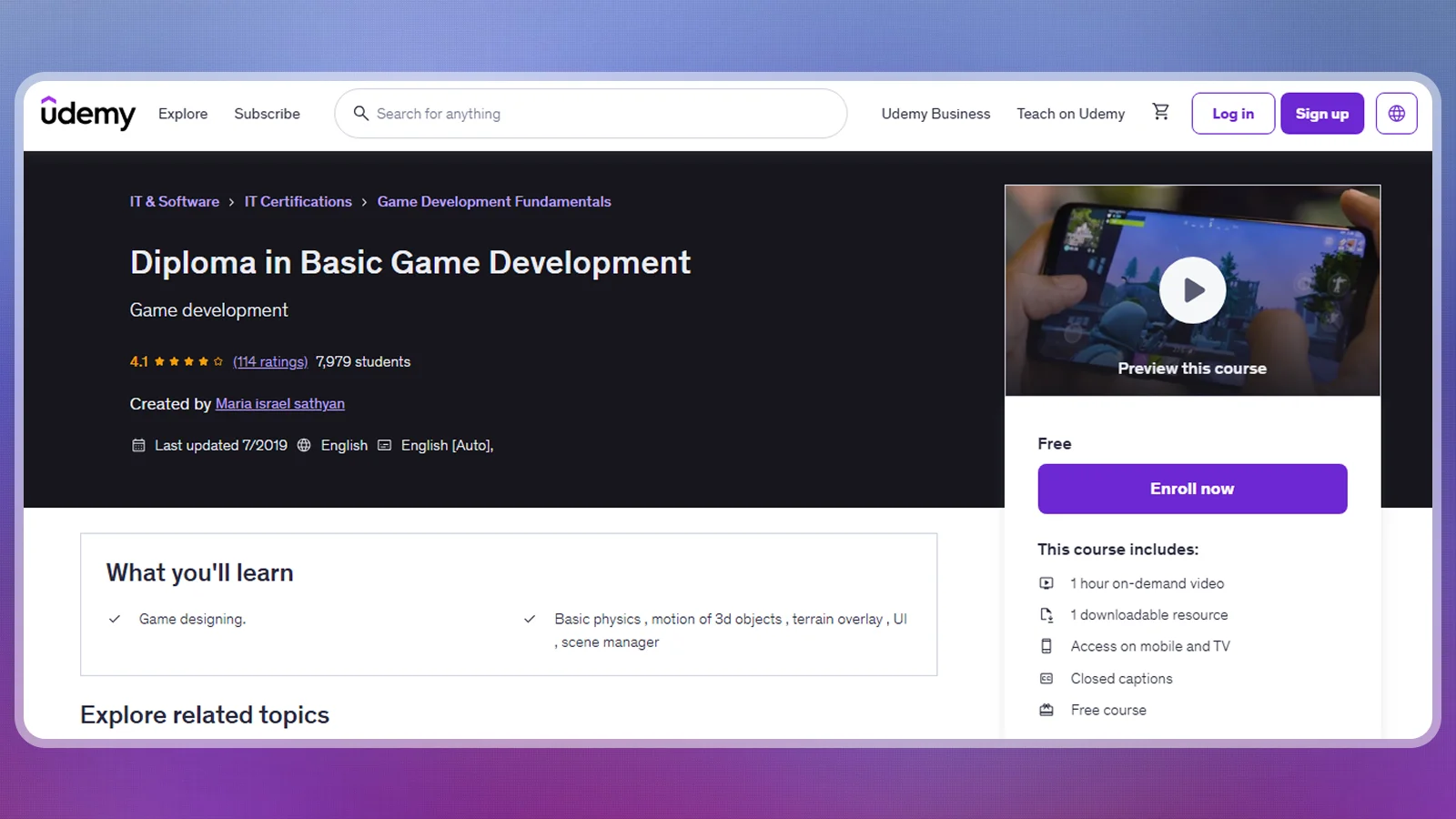
3. Best For Unity Editor Basics: Diploma in Basic Game Development (Udemy)
|
Best for |
Learning Unity editor fundamentals |
|---|---|
|
Effort |
Low |
|
Price |
Check current enrollment price |
|
Time to complete |
Approximately 1 hour of video |
|
Main learning outcome |
Understand basic Unity navigation and scene setup |
|
Certificate |
Not listed by the provider |
Diploma in Basic Game Development is a short introduction for learners who want to explore the Unity editor without committing to a longer course.
Its lessons cover editor navigation, terrain setup, basic physics, object movement, and interface integration. These are useful concepts for understanding how a game scene is assembled and how different components interact.
What you need: A computer that can run the required Unity version and enough time to follow the demonstrations. The course is introductory, so it does not require an advanced programming background.
To get the most from it, recreate the demonstrated scene and experiment with its objects. Try changing terrain settings, moving an object, or adjusting its physics behavior. The aim is to become comfortable navigating the editor rather than simply finishing the videos.
The provider listing in the original draft records approximately one hour of video and a rating of 4.1/5 from 114 reviews. It also identifies July 2019 as its last update, so check the software requirements carefully before enrolling.
That older update is the main limitation. Unity has changed substantially since 2019, and some interface instructions may not match the current editor. Treat this as an introduction to foundational concepts rather than a complete course for modern Unity development.
4. Best For 2D Game Development: Godot 4 2D Game Dev (GameDev.tv)
|
Best for |
Building 2D games with Godot |
|---|---|
|
Effort |
Medium |
|
Price |
$149 list price; promotional pricing may apply |
|
Time to complete |
17.5 hours |
|
Main learning outcome |
Build three playable 2D game projects |
|
Certificate |
Not listed by the provider |
If you already know that you want to create 2D games, Godot 4 2D Game Dev is one of the more practical game development courses to consider.
GameDev.tv organizes its curriculum around three playable projects: a physics-based game, a space shooter, and a platformer. Along the way, learners work with GDScript, nodes, scenes, signals, movement, combat, and enemy behavior.
What you need: A computer capable of running Godot 4, enough storage for project files, and a willingness to experiment with scripting. Previous programming experience can help, but the course is positioned for beginners.
To get the most from it, complete the three projects in sequence. Once a game works, modify an existing mechanic. For example, change an enemy’s movement pattern or add another interaction to the platformer. These modifications help turn guided exercises into independent development skills.
The provider lists 17.5 hours of content and 138 lectures. Its three-project approach provides a longer practical learning path than the introductory courses above.
The listed price in the original comparison is $149, although promotional offers can reduce the enrollment cost. Check the current checkout amount before purchasing rather than treating a temporary discount as the standard price.
Its main advantage is the focused Godot curriculum. However, learners planning to specialize in 3D games or another engine will need a different course.
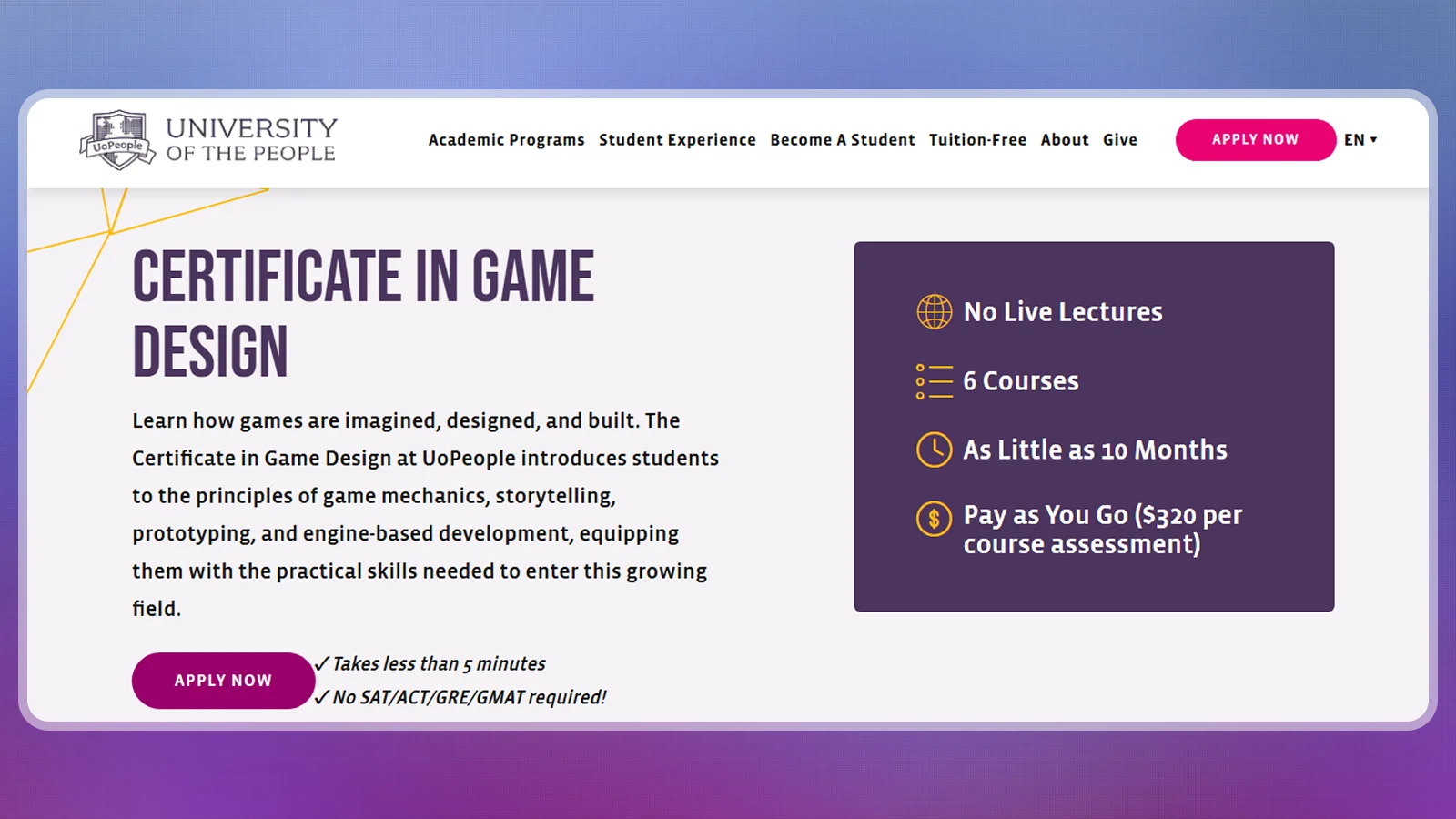
5. Best Formal Certificate: Certificate in Game Design (UoPeople)
|
Best for |
Formal game design education |
|---|---|
|
Effort |
High |
|
Price |
$1,980 total |
|
Time to complete |
As little as 10 months |
|
Main learning outcome |
Understand game design, prototyping, narrative, and production |
|
Certificate |
Certificate in Game Design |
The University of the People (UoPeople) offers a more structured alternative to short game development courses. Its Certificate in Game Design is designed for learners who want to study the principles behind interactive experiences alongside practical development.
The six-course curriculum includes game design, games and society, narrative and storytelling, game prototyping, game engines, and a final capstone project.
That final project is particularly valuable because it connects the different subjects through a playable game. Instead of completing unrelated exercises, learners have an opportunity to bring their design and development knowledge together.
What you need: A reliable study schedule, access to a computer, and the ability to complete coursework and assessments over an extended period. Review the university’s admission requirements and current program terms before applying.
To get the most from the program, treat the capstone as a portfolio project. Keep design notes, document your decisions, and retain playable builds as the game develops. This makes the work more useful when explaining your abilities to potential employers or collaborators.
UoPeople lists six courses, completion in as little as 10 months, and a total program cost of $1,980. Its published fee structure includes a $60 application fee and $320 in assessment fees for each course.
This is a substantially larger commitment than a single online course. However, the structured curriculum and formal certificate make it more appropriate for someone who wants a broader educational experience.
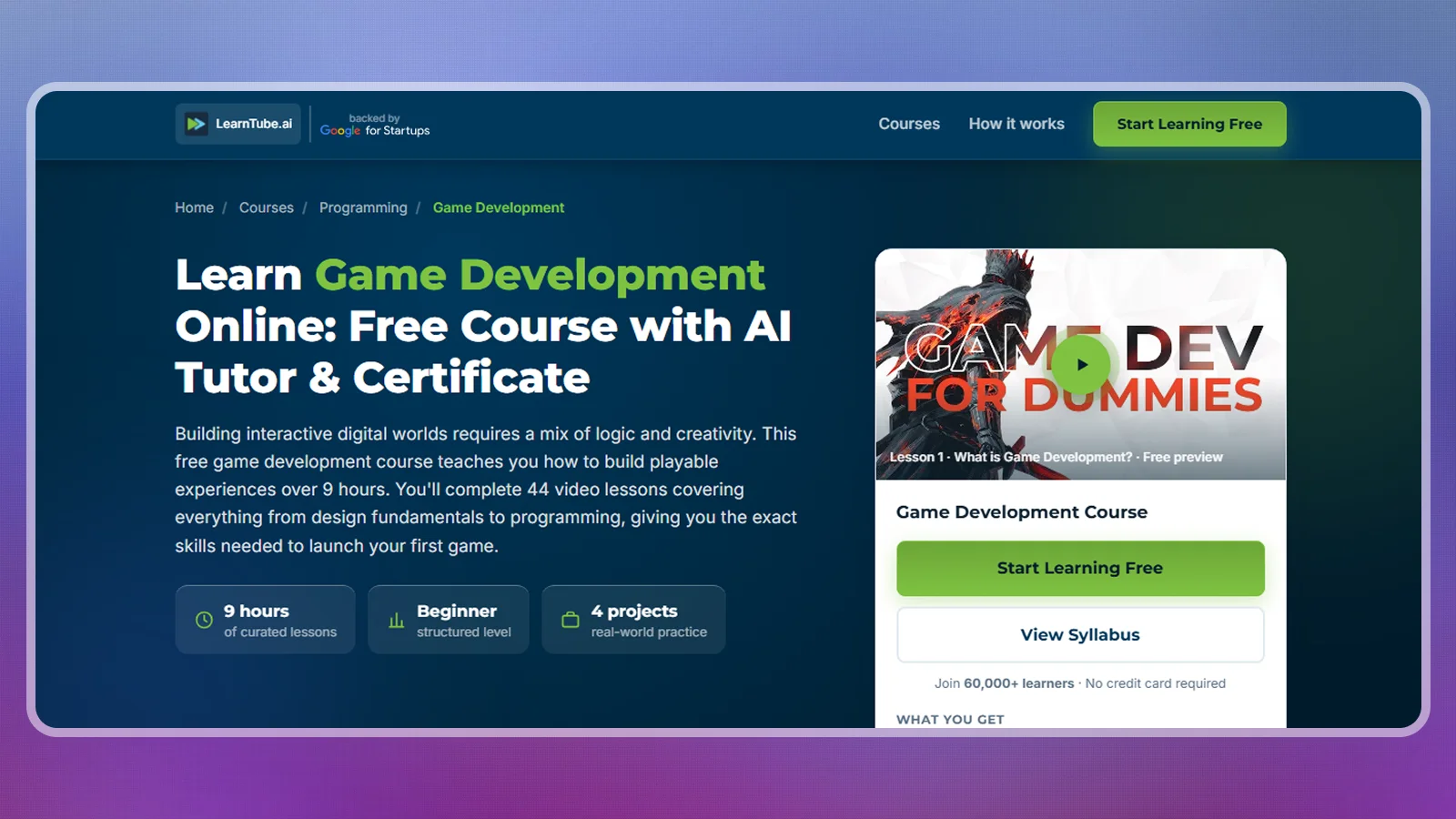
6. Best Free Option: Learn Game Development Online (LearnTube.ai)
|
Best for |
Free AI-guided learning |
|---|---|
|
Effort |
Low–Medium |
|
Price |
Free lessons, quizzes, and AI tutor |
|
Time to complete |
Approximately 9 hours |
|
Main learning outcome |
Understand game development fundamentals |
|
Certificate |
Optional paid certificate |
LearnTube.ai is a useful option for beginners who want an organized introduction without an initial course payment.
Its curriculum covers game development fundamentals, design, engine selection, programming, assets, and testing. The platform also includes an AI tutor that can help explain unfamiliar concepts while learners progress through the material.
What you need: A computer, internet access, and a willingness to apply the lessons using a game engine. The free learning path is suitable for exploring concepts before choosing a more specialized course.
To get the most from it, use the AI tutor to clarify specific concepts rather than relying on it to create an entire project for you. If a lesson introduces player movement, for example, try implementing that mechanic in your own engine and compare the results.
The provider lists 44 video lessons, six modules, four practical projects, and approximately nine hours of content. Lessons, quizzes, and AI tutor access are advertised as free, while the completion certificate is an optional paid upgrade.
The broader curriculum makes it useful for exploring different areas of game production. However, it is an introductory resource, not a substitute for specialized Unity, Unreal Engine, or Godot training.
Beyond dedicated game development courses, beginners can also use official learning resources:
- Unity Learn: Free learning pathways covering Unity fundamentals, C#, 2D development, and 3D projects.
- Unreal Engine Developer Community: Training materials covering Unreal Engine, Blueprints, and programming.
- Godot Documentation: Official tutorials that explain how to create a first 2D or 3D game.
- Your own practice project: Build a small playable prototype and modify its mechanics as you learn.
These resources are particularly useful when you want to reinforce lessons without paying for another course.
How These Game Development Courses Compare
The best game development courses differ in their teaching approach, project depth, price, and study commitment. This comparison makes it easier to narrow down the options before reading the detailed course descriptions:
|
Course |
Provider |
Best for |
Price |
Time |
Certificate |
|---|---|---|---|---|---|
|
Getting Started with Unity and Basic 2D/3D Game Development |
 |
Best overall |
$239/year promotional Coursera Plus offer |
1 week |
Yes |
|
Game Development: HTML to Unreal Engine Mastery |
|
Short introduction |
$239/year promotional Coursera Plus offer |
2 hours |
Yes |
|
Diploma in Basic Game Development |
 |
Unity editor basics |
Free |
Approximately 1 hour |
Not listed |
|
Godot 4 2D Game Dev |
 |
2D game development |
$149.00 list price |
17.5 hours |
Not listed |
|
Certificate in Game Design |
 |
Formal study |
$1,980 total |
As little as 10 months |
Yes |
|
Learn Game Development Online |
 |
AI-guided learning |
Free learning |
Approximately 9 hours |
Optional paid |
The order starts with the overall engine pick, moves through beginner, free, budget, and certificate options, and ends with AI-guided learning.
Factors to Consider When Choosing a Game Development Course
Your intended project, budget, and existing experience should determine which of the best game development courses you choose. Before enrolling, consider these factors:
- Your preferred game engine: Choose Unity for a broad introduction to 2D and 3D development, Unreal Engine for its visual scripting and 3D ecosystem, or Godot for a focused, lightweight development environment.
- Programming experience: Beginners should look for lessons that explain basic scripting concepts. If you already know C# or another programming language, you may be ready for more advanced engine-specific instruction.
- Course freshness: Check the last update date and supported engine version. Older tutorials can still explain fundamentals, but outdated interfaces and workflows can slow down learning.
- Practical projects: Look for courses that require you to build something. A playable project demonstrates more than simply completing a sequence of videos.
- Budget: Compare the individual enrollment price with subscriptions and formal program fees. Also check whether certificates and assessments cost extra.
- Available study time: A two-hour introduction is easier to fit into a busy schedule than a six-course academic program. However, shorter lessons do not necessarily mean faster skill development.
- Certificate requirements: Decide whether you need a completion record or a formal academic credential. For development jobs, practical skills and portfolio projects remain important.
- Teaching support: Consider whether you learn better through videos, written documentation, quizzes, instructor feedback, or AI-assisted explanations.
A good course should address a specific skill gap. Avoid paying for broad instruction when you already know which engine and development discipline you want to pursue.
How To Get Started With Game Development

Once you have selected one of the best game development courses, the next step is turning its lessons into practical experience. Follow this process to build a foundation without getting overwhelmed.
- Choose one engine. Start with Unity, Unreal Engine, or Godot. Pick the tool that matches the type of game you want to create rather than trying to learn all three simultaneously.
- Complete an introductory course. Learn how to navigate the editor, create a scene, import assets, and implement basic interactions.
- Build a small project. Start with something manageable, such as a platformer, a simple puzzle, or a basic arcade game. Avoid beginning with a large multiplayer project.
- Experiment with mechanics. Change movement speed, add collectibles, adjust enemy behavior, or introduce another level. These modifications help you understand the systems rather than simply reproduce tutorials.
- Build a portfolio. Save playable versions of your projects, screenshots, and short explanations of your development decisions. A portfolio gives others something concrete to evaluate.
You can also use free documentation and community resources when you encounter problems. Learning to read error messages, debug scripts, and search for specific solutions is an important part of becoming an independent developer.
The best game development courses give you a starting structure, but consistent project work is what turns that knowledge into practical ability.
So, Are Game Development Courses Worth It?
Yes, for beginners who want structured engine learning and guided practice. Game development courses can organize unfamiliar tools into a sequence, so you spend less time deciding which disconnected tutorial to watch next.
The best game development courses connect explanations with tasks you can repeat and adapt. A completion certificate records study, but none of these courses guarantees a job or income. Career value depends on the skills and project work you develop, along with hiring conditions. Judge a game development course by the work it helps you produce.
Free online game dev courses are a reasonable first test of your interest. Pay when you can name the benefit you need, like focused Godot instruction or a formal design certificate. Longer game development programs suit sustained study, while a short introduction can help you choose a direction with less commitment.
Final Verdict
After comparing all six options, the right choice depends on your experience, preferred engine, and learning goals.
|
Your situation |
Where to start |
|---|---|
|
New to game development and unsure about 2D or 3D |
Getting Started with Unity and Basic 2D/3D Game Development |
|
Want a short introduction to game development |
Game Development: HTML to Unreal Engine Mastery |
|
Want to explore Unity editor fundamentals |
Diploma in Basic Game Development |
|
Already interested in making 2D games |
Godot 4 2D Game Dev |
|
Want structured academic game design study |
Certificate in Game Design |
|
Want free lessons with AI assistance |
Learn Game Development Online |
For most beginners, Getting Started with Unity and Basic 2D/3D Game Development is the strongest overall starting point because it introduces two major game formats and includes practical exercises. If you are not ready to pay for instruction, Learn Game Development Online offers a free way to explore the fundamentals.
Meanwhile, Godot 4 2D Game Dev is the better choice for learners who already have a clear interest in 2D projects. Those seeking a broader academic experience should consider UoPeople’s certificate, provided the cost and longer commitment fit their plans.
The best game development courses are not necessarily the longest or most expensive. Choose instruction that helps you build something, understand how it works, and eventually create a game without following every step of a tutorial.
FAQs
The best game development courses include Coursera’s Unity introduction for engine practice, Udemy’s short editor course, and UoPeople’s certificate for formal study.
Yes. Game development courses provide structured lessons and guided practice. Choose one with practical projects so you can demonstrate your skills through a playable portfolio.
Yes. LearnTube.ai offers free lessons and quizzes, while Unity Learn, Epic’s Developer Community, and Godot’s documentation provide additional free resources.
Coursera lists two hours for its Unreal introduction and one week at 10 hours per week for its Unity course. Independent practice takes additional time.
Some do. Both Coursera courses offer shareable completion certificates, UoPeople provides a formal Certificate in Game Design, and LearnTube.ai offers an optional paid certificate.
Choose Unity for its 2D and 3D learning path or Godot for focused 2D projects. The best game development courses match the engine you want to use.