

How to Beat QWOP: Simple Strategies to Master a Notorious Running Game

QWOP has a reputation for turning confident players into clumsy, back‑flipping sprinters. It’s a browser‑based running game created by Bennett Foddy where you control an athlete with just four keys. Each key moves a single part of the runner’s legs. There are no power‑ups or shortcuts, just you, a runner, and a 100‑meter track. When I first tried to beat QWOP, I went two meters before face‑planting. If you’ve ever been in that position, don’t worry. This guide focuses on showing you how to beat QWOP without frustration. Once you know what each key does, develop a rhythm, and commit to practice, you’ll watch your runner glide past the finish line.
Jump to:
How to Beat QWOP – Understanding Controls and Basic Movement
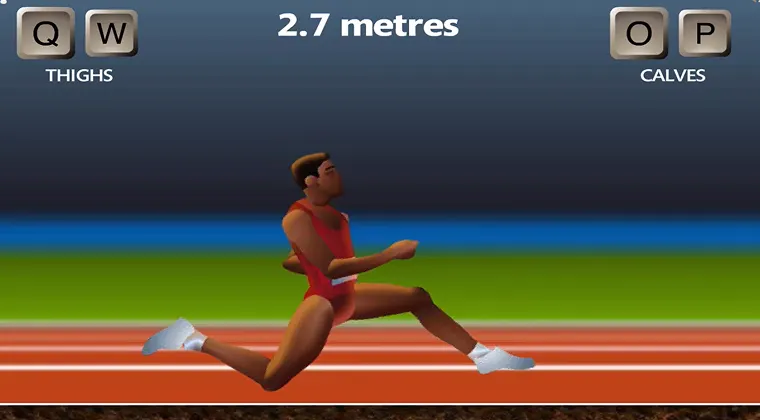
The first step in learning how to beat QWOP is understanding how the four keys work. Each key controls one muscle group. Pressing Q drives the runner’s right thigh forward and pulls the left thigh backward. Pressing W does the opposite by moving the left thigh forward while the right thigh swings back. The O key moves the left calf, pushing the foot downward and bending the right knee. The P key mirrors this action for the right calf. It helps to think of each pair, Q/W for thighs and O/P for calves, as operating two pistons. When one piston pushes forward, the other retracts.
With that in mind, start by getting a feel for how the runner responds. Your avatar begins standing upright. Tap O briefly to lean your torso forward. This subtle tilt shifts your center of gravity ahead of your hips, which helps avoid falling backward. From there, alternate the thigh and calf pairs: press W and O together to move your left thigh and right calf, then press Q and P together to move your right thigh and left calf.
This imitates the natural motion of taking a step as one leg swings forward while the other begins to push off. Don’t spam the keys. Hold each combination just long enough to see the front foot rise and approach the ground. A good benchmark is when the raised foot is about six inches above the track. Release the keys as the foot descends so the back leg can extend.
During my early practice runs, I found it tempting to mash keys when I felt off balance. That instinct usually led to a tumble. Instead, watch the runner’s front foot and let gravity do part of the work. Pressing O or P too long will overextend the knee and send your athlete flipping. If you treat the keys as muscles, pushing and releasing in short bursts, you’ll begin to feel the rhythm. Physics‑based games reward patience.
Our news post on Bennett Foddy’s upcoming Baby Steps walking simulator reminds readers that deliberately placing each footstep can be both calming and challenging. That same idea applies here; walking with purpose beats frantic tapping.
Mastering the QWOP Rhythm and Key Combinations
Once you understand the basic movements, the key to beating QWOP lies in rhythm. Two common techniques help build consistency. The first is the WO/QP cadence. Press W and O simultaneously to push your left thigh forward while extending your right calf, then press Q and P to swing your right thigh forward while extending your left calf.
Alternate these combinations with a steady tempo. Think of each press as a drum beat: WO, QP, WO, QP. Timing matters more than speed. Watch the knees; start moving the trailing leg forward just before the lead foot hits the ground. If you wait until the front foot is flat, you’ll lose momentum and risk stumbling.
The second method is often called the knee‑hop or scoot strategy. It’s slower but easier for beginners. Hold W until one foot is out in front and the rear knee points toward the ground. Tap Q once to pull the trailing leg up. Then tap W repeatedly to inch forward. This creates a hopping motion where you slide across the track on one knee while the other foot drags behind.
Because only two keys are involved, it reduces the chance of losing balance. Keep your taps rhythmic; longer presses will tip you over. When I first beat the game, I combined these approaches, using the knee‑hop to build momentum at the start and transitioning to the WO/QP cadence once I felt comfortable. Gamition’s tips recommend pushing the hurdle at the halfway point using the same knee‑hop method rather than attempting a jump.
There’s also a speed‑run trick known as the Scoot of Shame. Hold down W and P and repeatedly tap Q. This causes the runner to shuffle forward with minimal risk of falling because the upper body leans forward while the legs remain mostly bent. The technique is slower but reliable. I’ve used it after stumbling to regain control and continue without restarting.
Experiment with all three methods until you find a rhythm that suits your reflexes. Our roundup of the hardest video games explains that conquering challenging titles often comes down to learning the systems and staying persistent. QWOP is no different. A consistent cadence, not lightning‑fast tapping, is what moves your athlete down the track.
Overcoming Hurdles and Avoiding Common Mistakes
At 50 meters, QWOP presents a hurdle that trips many players. You have two options: clear it or push it. Clearing the hurdle requires a clean leap. Before reaching the obstacle, build some speed using the WO/QP cadence. When the front foot is about to hit the ground just before the hurdle, hold W and O slightly longer than usual, then quickly tap Q and P together. This extends both legs and can vault your runner over the hurdle. Practice this jump in isolation because mistiming the keys causes spectacular falls.
If jumping feels risky, push the hurdle along. Gamition’s guide suggests continuing with the knee‑hop strategy and letting the hurdle slide along as you press forward. It slows you down but greatly reduces the chance of disqualification. I’ve used this approach in many runs, focusing on keeping my athlete leaning forward to avoid the obstacle catching under my feet. Regardless of the method, avoid pressing opposing keys simultaneously. Holding Q and W together cancels thigh movements and stops forward momentum. Likewise, pressing O and P together locks the calves and causes you to topple.
Another common error is leaning too far back at the start. Always tap O or P lightly at the beginning of each stride to maintain a forward lean. If you fall, press E to instantly reset your runner without returning to the menu. I discovered this quick‑recover key after several frustrating resets.
Using it, you can salvage a run after an almost inevitable stumble. For more games that feature unpredictable physics and reward experimentation, check out our list of PS5 sandbox games, where titles like Goat Simulator 3 let you embrace chaos in an open world.
When approaching the final meters, stay calm. Anxiety often leads to spamming keys and undoing twenty minutes of careful progress. Keep watching the knees, maintain your rhythm, and resist the urge to rush. Remember that momentum builds gradually. If you feel yourself tipping backward, a quick press of O tilts the torso forward without upsetting your stride.
Practice makes these adjustments feel intuitive.
Practice Strategies, Mindset, and Next Steps
Beating QWOP is less about raw dexterity and more about patience and muscle memory. Set realistic goals. Your first objective might be reaching five meters consistently. Once that feels easy, aim for ten, then twenty. Celebrate small improvements because they reinforce your growing control over each key. During my practice sessions, I also watched replays of successful runs to observe how the avatar’s limbs moved in relation to the key presses. Mimicking that motion helped me internalize the correct timing.
It’s important to choose a technique that aligns with your learning style. Some players prefer the knee‑hop because it provides immediate stability; others enjoy the more natural gait of the WO/QP cadence. Switching between techniques mid‑run can help you recover from mistakes. Also, practice on a full keyboard rather than a laptop’s shallow keys. The deeper travel offers better tactile feedback, which makes it easier to time releases.
Maintaining a positive mindset is crucial because QWOP is intentionally difficult. The ragdoll physics engine punishes overcorrection, and progress often comes in inches. Remind yourself that even elite speedrunners took countless attempts to perfect their runs. The Guinness World Record for fastest QWOP time was once 51 seconds. As of June 2024, a Japanese player known as kurodo1916 lowered that record to 45.53 seconds. Those times reflect hundreds of hours of practice. Your goal might simply be to finish. That’s an achievement worth celebrating.
When you feel burnt out, step away and play something else. A physics‑heavy game like Getting Over It with Bennett Foddy challenges you to control a hammer‑wielding climber. It shares QWOP’s emphasis on patience and precise input and can refresh your focus when you return. Taking breaks keeps frustration at bay and helps your brain process the muscle memory you’re building.
Beating QWOP teaches transferable skills: breaking down complex tasks, practicing deliberately, and staying calm under pressure. Those skills translate to other games and real‑world situations. When you finally cross the 100‑meter line, the satisfaction comes not just from winning but from mastering your own impatience. That’s what kept me coming back, even after dozens of spills.
Practice, Patience, and Persistence
QWOP’s simple premise hides a demanding challenge. You control a runner’s thighs and calves with four keys, each affecting balance and momentum. To learn how to beat QWOP, start by leaning forward with a quick tap of O, then alternate W/O and Q/P combinations to simulate walking.
Practice the WO/QP cadence for smooth strides, and use the knee‑hop or Scoot of Shame methods for stability. Keep your eyes on the front foot and time your presses so the trailing leg begins to swing forward just before the lead foot hits the ground. Avoid pressing opposing keys together, lean forward to prevent falling backward, and use the E key to recover quickly from missteps. The hurdle at 50 meters can be jumped with a well‑timed leap or pushed along using the knee‑hop. Above all, embrace practice and patience. Each meter teaches you a little more about rhythm and control.
If you’re looking for a game that continues this quirky, physics‑based challenge, consider picking up Getting Over It with Bennett Foddy. Our marketplace offers a Getting Over It with Bennett Foddy Steam key that lets you tackle another inventive test of patience and control. Just like QWOP, it rewards calm focus and deliberate movement. And if you’d prefer something lighter after beating QWOP, browse our store for digital game keys and gift cards. I’ve found that mixing challenging games with relaxing titles keeps gaming fun and prevents burnout.
FAQs
How do I control the QWOP keys correctly?
To control the QWOP keys correctly, focus on how each key moves a specific part of the runner’s legs. Q drives the right thigh forward and the left thigh back, W does the opposite, O moves the left calf downward while bending the right knee, and P mirrors that motion for the right calf. Practice pressing the appropriate pair of keys together, WO for moving the left leg forward and QP for the right, to simulate natural stepping without overextending and falling.
What is the easiest way to beat QWOP?
The easiest way to beat QWOP is to use the knee‑hop or Scoot of Shame technique. Hold W until one leg stretches forward and the rear knee points down, then tap Q to bring the trailing knee up and tap W repeatedly to slide forward. This method sacrifices speed for stability, allowing you to progress steadily with minimal risk of tipping over.
How do you get past the hurdle in QWOP?
To get past the hurdle in QWOP, keep using the same knee‑hop motion and push the obstacle along instead of jumping over it. Pushing the hurdle slows you down but reduces the chance of falling, making it a safer option for most players. If you prefer to jump, build speed with the WO/QP cadence and then extend both legs at the last moment to vault over the hurdle.
Why is QWOP so hard?
The reason why QWOP is so hard is that the game uses ragdoll physics and separates leg movement into four independent keys. You must coordinate thighs and calves while balancing your torso, and any slight mistiming sends the runner sprawling. Unlike typical games where a single button makes your character run, QWOP forces you to think about muscle groups and adjust constantly to gravity and momentum.
What do the Q, W, O, and P keys do in QWOP?
The Q, W, O, and P keys in QWOP control the runner’s thighs and calves. Q moves the right thigh forward and the left thigh backward, W moves the left thigh forward and the right thigh backward, O pushes the left calf down while bending the right knee, and P does the same for the right calf. Understanding these actions helps you plan which keys to press together for each stride.