


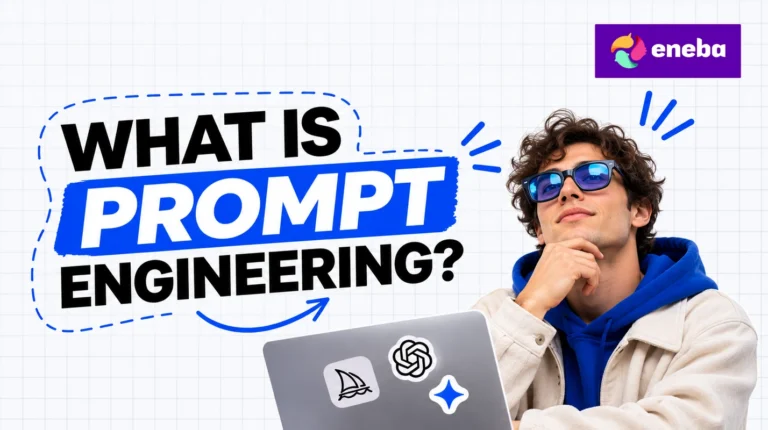
What Is Prompt Engineering? How It Works and How To Start in 2026

Eneba Hub contains affiliate links, which means we may earn a small commission if you make a purchase through them—at no extra cost to you. Learn more


START WITH STRUCTURE
Try Coursera for a beginner prompting course, then practice by comparing AI outputs against a clear task checklist.
What is prompt engineering? It’s the practice of designing, testing, and refining instructions for an AI model so its responses better match your task. This guide shows you how to write clearer prompts, compare results, and choose beginner courses without starting with code. You can start with free learning resources, while a prompt engineering course can help you follow a more structured learning path.
You don’t need to spend months studying before you can start experimenting with AI prompts. A short course can introduce techniques, but repeated practice is a stronger investment than chasing a prompt engineering certification before you can evaluate an answer.
You’ll learn how prompt engineering works, explore different techniques, and discover useful tools and learning resources along the way.
Jump to:
What Is Prompt Engineering? Key Facts at a Glance
The practical answer to “What is prompt engineering?” is instruction design plus output checking. Here’s a quick overview of what beginners should know before getting started:
|
Startup cost |
Free learning options; professional tools include Braintrust Pro at $249/month |
|---|---|
|
Launch time |
Start with a practice task; the listed courses include 3-hour and 5.5-hour options |
|
Day-to-day responsibilities |
Write instructions, compare responses, refine prompts, and check accuracy |
|
Main risks |
Ambiguous instructions and plausible but inaccurate AI answers |
|
Beginner suitability |
High – natural-language practice does not require coding |
The different prompt engineering techniques we’ll explore next can help you write more effective instructions. Once you’ve practiced the basics, a prompt engineering book can help you explore more advanced concepts.
How Prompt Engineers Shape AI Outputs
Prompt engineers guide AI responses by writing clear instructions and testing how well the results match their goals. Google Cloud defines the practice around designing and optimizing prompts to guide AI toward desired responses.
Here’s how each part of the process works:
- Prompt writer: the person who defines the task and decides what a successful response looks like.
- AI model: a large language model, or LLM, that generates a response from the instructions and information it receives.
- Testing platform: an optional system for comparing prompt versions and evaluating outputs in a production workflow.
These roles show that the answer to “What is prompt engineering?” involves understanding how AI responds to instructions and evaluating the results.
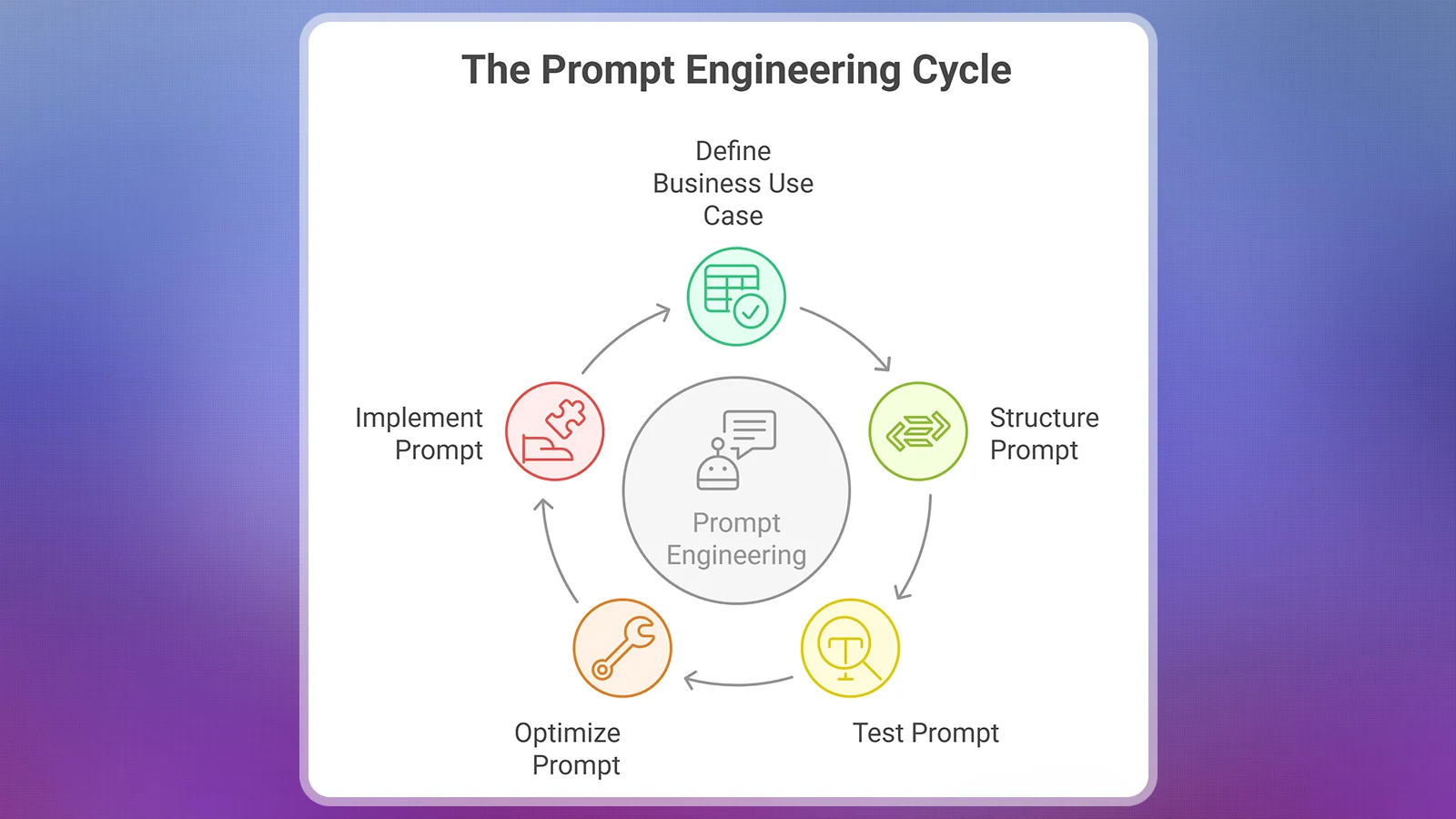
Here’s a simple process you can follow to improve your prompts:
- Draft an instruction: state the task and intended audience.
- Add context or examples: supply the source material or sample output the task needs.
- Test the response: compare it with your requirements and known facts.
- Refine failures: change unclear wording or missing constraints.
- Deploy and monitor: use the prompt in its intended workflow and review failures.
Revisit your prompts whenever your requirements change or you switch to a different AI model.
Prompt Engineering Types: Direct Instructions, Examples, and Reasoning
Different prompt engineering techniques help you guide AI responses based on the task you’re working on. Google Cloud describes zero-shot prompting as an instruction without examples, few-shot prompting as guidance through example input-output pairs, and chain-of-thought prompting as breaking a reasoning task into intermediate steps.
In practice, understanding “What is prompt engineering?” means knowing which technique works best for the problem you’re trying to solve. Examples help demonstrate a format; decomposing a task helps expose missing reasoning. Always check the accuracy of AI-generated responses, regardless of the technique you use.
Prompt Engineering Tools Worth Trying
You can start practicing with a simple AI chat interface. As your projects grow, dedicated testing tools can help you compare results more consistently. The answer to “What is prompt engineering?” doesn’t change when you add software: you still need clear criteria for judging outputs.
Here are some useful tools to explore based on your needs:
- Playground: OpenAI Playground supports experiments with model instructions.
- Evaluation and versioning: Braintrust and PromptHub help organize testing and prompt revisions.
- Command-line testing: Promptfoo suits people comfortable running tests through a terminal.
Start with the tools that match your current needs before investing in paid platforms.
Braintrust lists its Pro plan at $249/month and reports PromptHub plans from $12/month. TrueFoundry describes Promptfoo as free and open-source.
Here’s how these prompt engineering tools compare:
|
Tool |
Best for |
Price |
|---|---|---|
 |
Comparing outputs and evaluating prompt changes |
Pro: $249/month |
 |
Prompt versioning and team collaboration |
From $12/month |
 |
Command-line prompt testing |
Free and open-source |
 |
Experimenting with prompt structures |
Paid API access |
You can experiment with different prompt engineering types without needing expensive software. Focus on writing effective prompts and checking their results before exploring more advanced tools.
What Prompt Engineering Skills and Tools Cost
You can start learning prompt engineering for free, although advanced tools like Braintrust Pro can cost $249 per month. Fortunately, you don’t need a paid subscription to build your skills as a beginner.
Here’s where you might encounter costs as you learn:
- Learning materials: free guides and free-to-enroll courses can introduce the workflow.
- Paid instruction: Udemy advertises new-learner courses from $14.99; this is an introductory offer, not a universal course price.
- Evaluation software: consider a professional platform when repeated testing becomes difficult to manage manually.
- Versioning software: pay for collaboration features when a shared workflow needs them.
- Model access: API usage or a subscription can create recurring costs beyond a prompt engineering course.
One expense worth keeping an eye on is AI model access, especially if you start using paid APIs regularly. A prompt engineering book is optional, and a prompt engineering certification deserves a separate decision.
Start with free resources and invest in paid tools only when you have a clear reason to use them.
Pros and Cons of Prompt Engineering
Prompt engineering is relatively easy to get started with, but getting reliable results takes practice and careful review. The useful answer to “What is prompt engineering?” includes both the control clearer instructions provide and the limits that remain.
Here’s a closer look at the benefits and challenges of prompt engineering:
| Pros | Cons |
|---|---|
| ✅ Accessible entry – natural-language practice needs no coding ✅ Low-cost learning – free guides and free-to-enroll courses are available ✅ Transferable techniques – useful across writing, support, and coding tasks ✅ Visible feedback – compare an output directly with your requirements ✅ Structured learning – a prompt engineering course can organize practice | ❌ Ongoing maintenance – changed models or tasks can require revised prompts ❌ Human review – clear instructions can still produce inaccurate answers |
One of the biggest advantages is that you can quickly see how changes to your prompts affect AI responses. A revised instruction either improves the result against your criteria or it doesn’t.
A prompt engineering certification can support your skills, but practical examples are often more useful when you want to demonstrate your abilities. Keep examples of your tests and revisions, particularly when you want to show how you handled failures.
Step-by-Step: How To Get Started With Prompt Engineering
Start with a simple task you can evaluate yourself, then improve your prompt based on the results. You’ll get a better understanding of “What is prompt engineering?” once you see how small changes to your instructions affect AI responses.
Step 1: Pick a Model and Interface to Practice On
Pick an AI platform that fits your budget and is easy to use. OpenAI Playground is an option for experiments, but it uses paid API access; don’t treat it as a free chat service.
Pick a familiar task, like drafting dialogue for a game character from a short character sheet. Write down the intended audience and the output requirements before prompting. Stick with the same task as you experiment so you can clearly see how each prompt change affects the result.
Step 2: Write a Direct, Zero-Shot Prompt First
Write a direct instruction without sample answers. For example: “Write a greeting for a cautious village merchant. Use only the character notes supplied below. Return dialogue without stage directions.”
Save the response and note what failed. Perhaps the merchant invents a quest or mentions information absent from the notes. This first attempt gives you a starting point for understanding “What is prompt engineering?” through practice. You now have a specific reason to revise the instruction.
Step 3: Add Context, Examples, and Constraints
Add the missing character information, a sample line, and explicit boundaries. Tell the model which facts it may use and what to do when information is absent.
Compare the revised response with your baseline. Different prompt engineering types become useful when you need to give the AI clearer examples or instructions. If you’re explaining “What is prompt engineering?” to a colleague, this comparison is more informative than a polished response shown without its original prompt.
Step 4: Break a Reasoning Task Into Checkable Parts
Choose a reasoning task with an answer you can verify, like checking a quest sequence for contradictions. Ask for the conclusion and a concise explanation of the constraints used.
Review the stated dependencies against your design notes. Even if an AI response sounds convincing, you should still check its accuracy against your own notes. The answer to “What is prompt engineering?” includes deciding what evidence to request and what you must check independently. Keep the model’s explanation separate from your own verification.
Step 5: Test, Critique, and Refine
Test the prompt with incomplete notes and conflicting instructions. Ask the model to critique its draft against your checklist before revising it.
Self-critique is a technique for reducing errors. Review the AI’s feedback carefully, since it can miss errors in its own responses.. Keep a record of failures and revisions so your answer to “What is prompt engineering?” includes repeatability, rather than a successful isolated attempt.
Step 6: Take a Structured Course to Fill the Gaps
Choose a prompt engineering course after identifying where your practice stalled. Compare its syllabus with that gap: examples, evaluation, or task decomposition.
A prompt engineering book can reinforce terminology, while a prompt engineering certification may document completion. Practical projects are still essential for developing your skills. Finish by saving the task, prompt revisions, and your assessment of the outputs. That record gives you something concrete to revisit after the lessons.
Courses, Certifications, and a Prompt Engineering Book To Go Deeper
Start with a prompt engineering course that matches the skills you want to develop. A good course should explain “What is prompt engineering?” before introducing techniques you can practice through real exercises.
ChatGPT Prompt Engineering: 70,000+ Prompts | Generative AI on Udemy is the hands-on pick for practicing prompt structures. You can also use free guides or a prompt engineering book to reinforce what you’ve learned.
Before enrolling, check what each course covers and the type of certificate you’ll receive upon completion.
|
Course |
Provider |
What It Covers |
|---|---|---|
|
Prompting for Generative AI |
 |
Creative prompting for images, video, and vector design in Adobe Firefly |
|
ChatGPT Prompt Engineering: 70,000+ Prompts | Generative AI |
 |
Standard, zero-shot, few-shot, and chain-of-thought techniques |
|
Prompt Engineering for Beginners: From Zero to Expert |
|
Beginner fundamentals |
|
Certificate Course in Prompt Engineering and Generative AI |
|
Introductory prompting and generative AI overview; completion certificate, not a vendor credential |
|
ChatGPT and AI Prompt Engineering Mastery |
|
Applied prompting practice |
If you’re considering a paid prompt engineering certification, check who issues it and how your skills will be assessed.
Free guides are a good starting point when you need to review the basics of prompt engineering. Buy a prompt engineering book for its explanations and exercises, not a promise of permanent prompts.
6 Ways To Apply Prompt Engineering Skills
Prompt engineering can help you handle everyday tasks more efficiently, especially when you need consistent AI responses. The answer to “What is prompt engineering?” becomes more useful when attached to work with clear acceptance criteria.
Here are six practical ways to put your prompt engineering skills to use:
- Content and copywriting: use AI to draft emails based on a clear brief. Review the results for accuracy and provide examples to help the model match your preferred writing style.
- Customer support: use prompts to categorize customer requests and draft replies based on company policies. Make sure the AI knows when to refer a question to a human agent.
- Coding assistance: ask AI to help write or improve code, then test the results carefully before adding them to your project.
- Game design prototyping: experiment with character dialogue or alternative quest ideas based on your design notes. Check that the results fit your game’s story and established rules.
- Research and summarization: use AI to summarize documents and identify important information. Ask for supporting passages so you can verify the results against the original material.
- Internal workflows: use prompts to extract important details from messages before generating replies. Keep each step separate so you can identify errors more easily.
Choose prompt engineering techniques based on the task you’re working on and the results you want to improve. A prompt engineering course becomes more valuable when you bring a specific application to its exercises.
Mistakes That Sink Prompt Engineering Results
Unclear instructions are one of the most common reasons AI responses miss the mark. The answer to “What is prompt engineering?” includes reducing those assumptions and catching failures before outputs enter your work.
Here are some common mistakes to watch out for and how to fix them:
- Vague requests: replace “make this better” with the audience, purpose, and acceptance criteria. Be clear about which information the AI should use.
- Overloaded prompts: break complicated requests into smaller tasks. For example, ask the AI to identify important facts before using them to draft a response
- Untested first drafts: try incomplete and contradictory inputs before reuse. Test it with incomplete information or conflicting instructions to see how reliably it performs.
- Uncritical self-review: use model critique to find potential defects, then verify them yourself. Always review important information yourself before accepting the results.
- Voice instructions without examples: give the AI a sample of your preferred writing style instead of relying on vague descriptions like “sound professional.” Explain which aspects of the example it should follow.
Even with a prompt engineering certification, regular practice is essential for improving your results. Keep failure notes beside each prompt version so revisions respond to observed problems.
To understand “What is prompt engineering?” In practice, it helps to see how prompts are tested and improved over time. That makes your workflow easier to explain, repeat, and maintain.
Final Verdict on Prompt Engineering
Prompt engineering is a valuable skill if you regularly use AI and want more control over the responses you receive. A small evaluated project is a better starting point than a large software subscription or a prompt engineering certification.
Coursera is a good starting point if you prefer structured lessons, especially if you’re interested in creative applications of AI. If you only use AI for occasional informal questions, a free guide and deliberate practice may be sufficient. A paid prompt engineering course makes more sense once you can name the gap it should address.
Ultimately, the answer to “What is prompt engineering?” comes down to writing effective instructions and knowing how to evaluate the results. Start there before paying for credentials.
FAQs
Designing and improving instructions for AI is the simplest answer to “What is prompt engineering?” You describe the task, supply useful context, test the response, and revise instructions when the result misses your requirements.
Free learning options are available. Professional tools can reach $249/month for Braintrust Pro, but that is an optional tool price, not a beginner learning requirement.
Income and the time needed to find paid work vary. Earning depends on applying prompting to useful work, demonstrating quality, and finding clients or an employer who needs that work.
Yes, if you regularly use AI and can evaluate its answers. Learning prompt engineering types helps you choose between direct instructions, examples, and structured reasoning. Occasional users may only need a free guide.
No, natural-language prompting does not require coding. Programming becomes useful when you connect models to applications or automate testing. Start with a task whose output you can judge yourself.
Try Udemy‘s ChatGPT Prompt Engineering: 70,000+ Prompts | Generative AI as a prompt engineering course. Prioritize exercises before a prompt engineering certification; a completion certificate is not a vendor credential.
Yes, start with Google Cloud‘s free guide before buying a prompt engineering book. It explains the core techniques behind “What is prompt engineering?”