

Former Alan Wake Artist Working on New Game For Old System



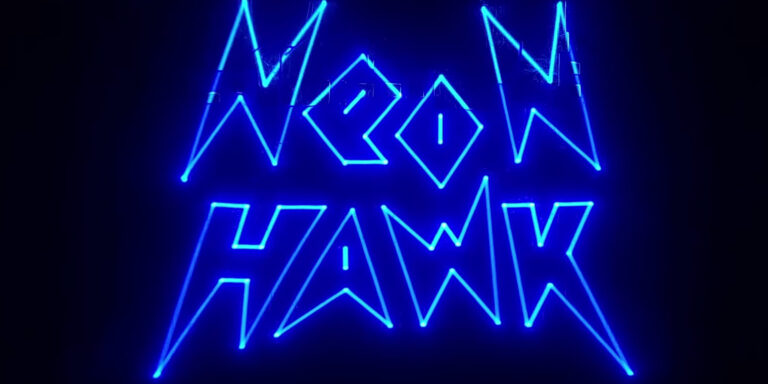
Mikko Huovinen is a name that might not catch the average gamer’s eye, but he’s played an important part behind the scenes in the development of numerous Remedy games, including Alan Wake, Max Payne 2, and Quantum Break. He’s currently hard at work on space-based shoot ‘em up Neon Hawk, for the 1980’s Vectrex console.
Huovinen has worked as a 3D modeler, and crafted characters and levels for multiple well-received games by Remedy. His work on Neon Hawk takes a different approach as it uses vector graphics (created by mathematical equations); other 1980s home game consoles used raster graphics (basically, pixel art).

Jump to:
Vec… What?
The Vectrex was first released in 1982. There are plenty of video game consoles that have been lost to history or faded from the public’s mind, and the Vectrex is one such machine. Despite being the first (and only) games console to make it to market with vector graphics, as well as boasting a wealth of other technological innovations, it was removed from sale in the US by the end of 1984.
The idea behind the Vectrex took shape in 1981 when Mike Purvis and John Ross at Western Technologies/Smith Engineering (the former helped create components for the Sega Genesis) decided to try building an arcade cabinet style games console. These used vector graphics, and so the plan was to replicate this but on a much smaller scale.
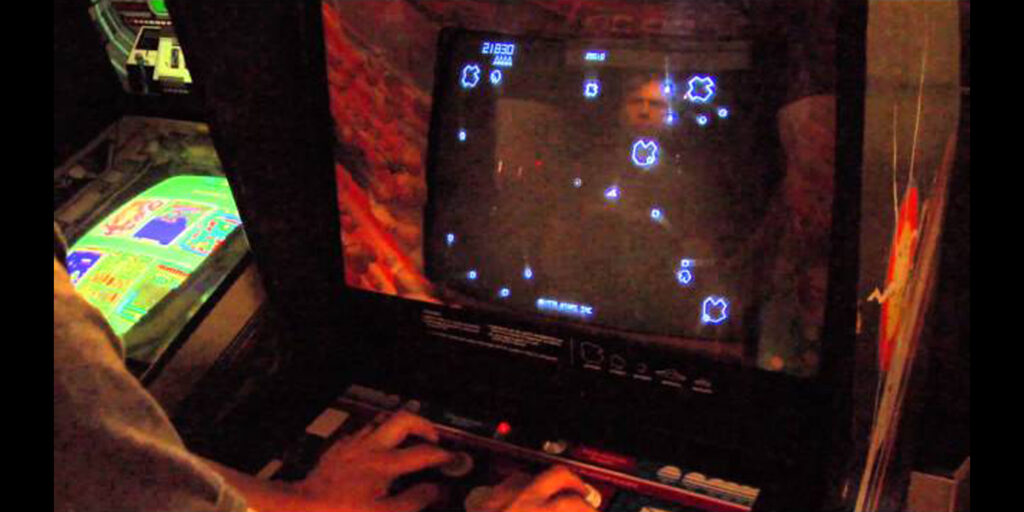
Vector graphics are based on mathematical equations run by a computer, meaning they can be scaled up and down without any loss in quality. Other games systems, even ones mass-produced today, tend to work on raster graphics, which builds images out of pixels and as such can look really nice, but isn’t easily scalable in terms of quality.
Ahead of Its Time
The general consensus between Vectrex fans is that it was an excellent machine but it came out at the wrong time, and the Video Game Crash of 1983 helped sink it. Part of the reason the latter happened was down to a vast range of clone games on the market, which the Vectrex wasn’t immune from releasing: as a machine based on arcades, quite a few of its titles were similar to popular games like Asteroids and Space Invaders.
It did draw praise at the time for its design, however: the 9” CRT screen featured a carry handle for portability and meant that the console was self-contained. The controller was modeled after arcade cabinets, too, and had a joystick with four face buttons that could be easily stored under the monitor.
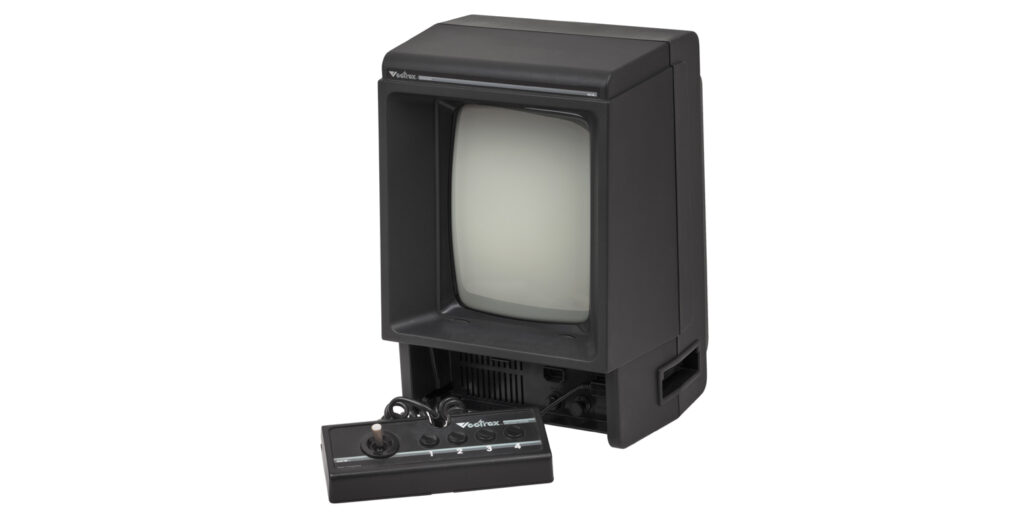
Inside, the Vectrex boasted a 16-bit Motorola 68A09 CPU which was faster and more advanced than the 6502 8-bit microprocessor used in Commodore, Atari and Apple computers around the same time. Audio was possible thanks to a General Instrument AY-3-8910 sound device that allowed for three tone generator channels and wave shaping for dynamic music (compared to the Atari 2600, for example, which only had two channels for audio).
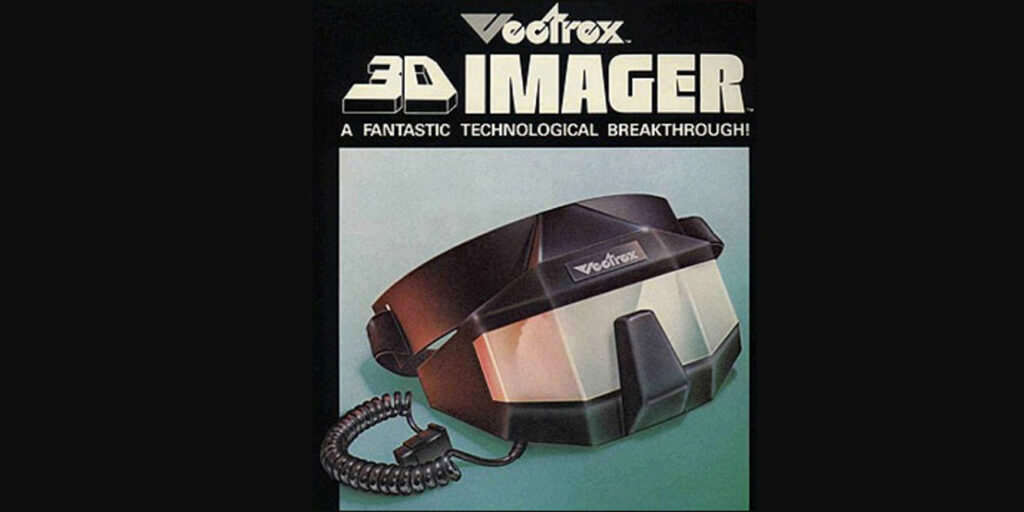
Cartridges could be placed in the side of the base, and even though it wasn’t around for long, it still got two peripherals: a lightpen that could interact with the screen, and 3D Imager Googles. This created a kind of optical illusion wherein a game would appear in 3D space, rather than true 3D as it’s known today. Even so, this made the Vectrex the first 3D mass market device, beating both Sega’s 3-D Goggles (1994) and Nintendo’s Virtual Boy (1995).
During its short lifetime, it was sold by Milton Bradley and then Hasbro. In Japan, noted video game company Bandai marketed it as the Vectrex Kousokusen.
Homebrew Games
The Vectrex screen is in black and white, but color was provided for games via screen overlays – just as arcade cabinets used. This technological limitation still applies today even for developers, like Huovinen, making homebrew games. However, it’s considered an acceptable quirk given that the system’s graphics retain a very appealing neon glow that many modern titles often seek to emulate (such as the Geometry Wars series).
Over 30 games were released for the Vectrex during its initial release period. However, a vibrant homebrew scene started in the mid-90s and is still going strong. Neon Hawk has been in active development for over a year already, and new games are still coming out.
One of the latest is Vyrzon, a space shooter, which was released in February 2025. Old games are still occasionally resurfacing too, including a long lost shoot ‘em up called Crush of Lucifer that was discovered in 2020.