


Best Graphic Design Courses in 2026: 7 Picks for Beginners

Eneba Hub contains affiliate links, which means we may earn a small commission if you make a purchase through them—at no extra cost to you. Learn more


COURSE QUICK LOOK
Start with the Graphic Design Specialization on Coursera for a broad foundation in typography, image-making, and branding. Free enrollment and paid certificate access are separate considerations.
The best graphic design courses include Graphic Design Specialization for a broad foundation, Fundamentals of Graphic Design, Typography & Color Theory for beginners, and Graphic Design Projects For Beginners for affordable practice. Coursera lists its specialization at 2 months at 10 hours a week, a useful benchmark for structured study.
These graphic design courses suit first-time learners, career changers, and people preparing a graphic design portfolio. Listed graphic design course commitments include short video courses and a certificate program lasting 9 months or less. Prices include a $19.99 one-time course and a $2,700 paid-in-full certificate program, while free enrollment requires a closer look at access terms.
Compare the seven best graphic design courses below by learning goal, price, workload, certificate, and portfolio practice.
Jump to:
Best Graphic Design Courses at a Glance
The best graphic design courses serve different goals, so match the learning focus to your next project before comparing credentials. This table separates broad foundations, practical introductions, and specialist study. Individual course profiles cover the available price, time, certificate, and prerequisite details.
|
Course |
Provider |
Best for |
Learning Focus |
|---|---|---|---|
|
Graphic Design Specialization |
 |
Best Overall |
Typography, image-making, and branding |
|
Fundamentals of Graphic Design, Typography & Color Theory |
 |
Best for Beginners |
Design principles, typography, and color |
|
Graphic Design Projects For Beginners |
|
Best Budget Pick |
Canva-based marketing projects |
|
Graphic Design 101: How to Master Visual Communication |
|
Best Short Introduction |
Visual communication and layout |
|
Graphic Design Professional Certificate |
 |
Best Certificate |
Software skills and instructor critique |
|
Graphic Design |
|
Best for Presentation Design |
Presentation-focused visual communication |
|
Digital Design Masterclass For Graphic Designers |
|
Best for Digital Design Skills |
Icons, thumbnails, and digital layouts |
The list moves from best overall through introductory graphic design courses to more focused options.
Why Learn Graphic Design?
Graphic design is communication through images and typography. Learning it helps you arrange information so an audience can understand a message, recognize a brand, or take an action. The best graphic design courses can connect those decisions to practical work, including marketing materials, publication layouts, or a game’s promotional artwork.
Sessions College reports a $62,960 median annual wage for graphic designers as of May 2025. It attributes the figure to the U.S. Bureau of Labor Statistics. That occupation-wide figure gives career context, while your graphic design portfolio shows the work you can actually do.
The best graphic design courses teach composition, color relationships, typography, and image-making together. Software instruction becomes more useful when you can explain why a layout works. A polished esports poster, for example, needs readable event details as much as an attractive background.
How These Graphic Design Courses Were Chosen
The best graphic design courses here cover different starting points and learning goals, from introductory principles to career-focused study. These criteria help distinguish a useful graphic design course from an appealing course title:
- Coverage: Principles, typography, color, branding, or a clearly defined specialty.
- Teaching context: University instruction, professional teaching, or a focused project format.
- Provider feedback: Ratings paired with their review counts, without cross-platform rankings.
- Cost clarity: One-time prices, enrollment language, and certificate access.
- Practice: Exercises that can develop into a graphic design portfolio.
- Credential scope: The certificate offered and the learning it represents.
- Prerequisites: Software familiarity and the intended starting level.
Together, these factors favor a manageable learning path through the best graphic design courses over a longer course catalog.
7 Best Graphic Design Courses for Different Learning Goals
The best graphic design courses below earn their labels through curriculum fit and practical trade-offs. Choose a foundational graphic design course if you are starting from scratch, or a specialist option if you already have work to improve.
1. Best Overall: Graphic Design Specialization (Coursera)
Graphic Design Specialization is one of the best graphic design courses for connecting visual fundamentals with a branding capstone. Beginners can develop the final identity project for a graphic design portfolio.
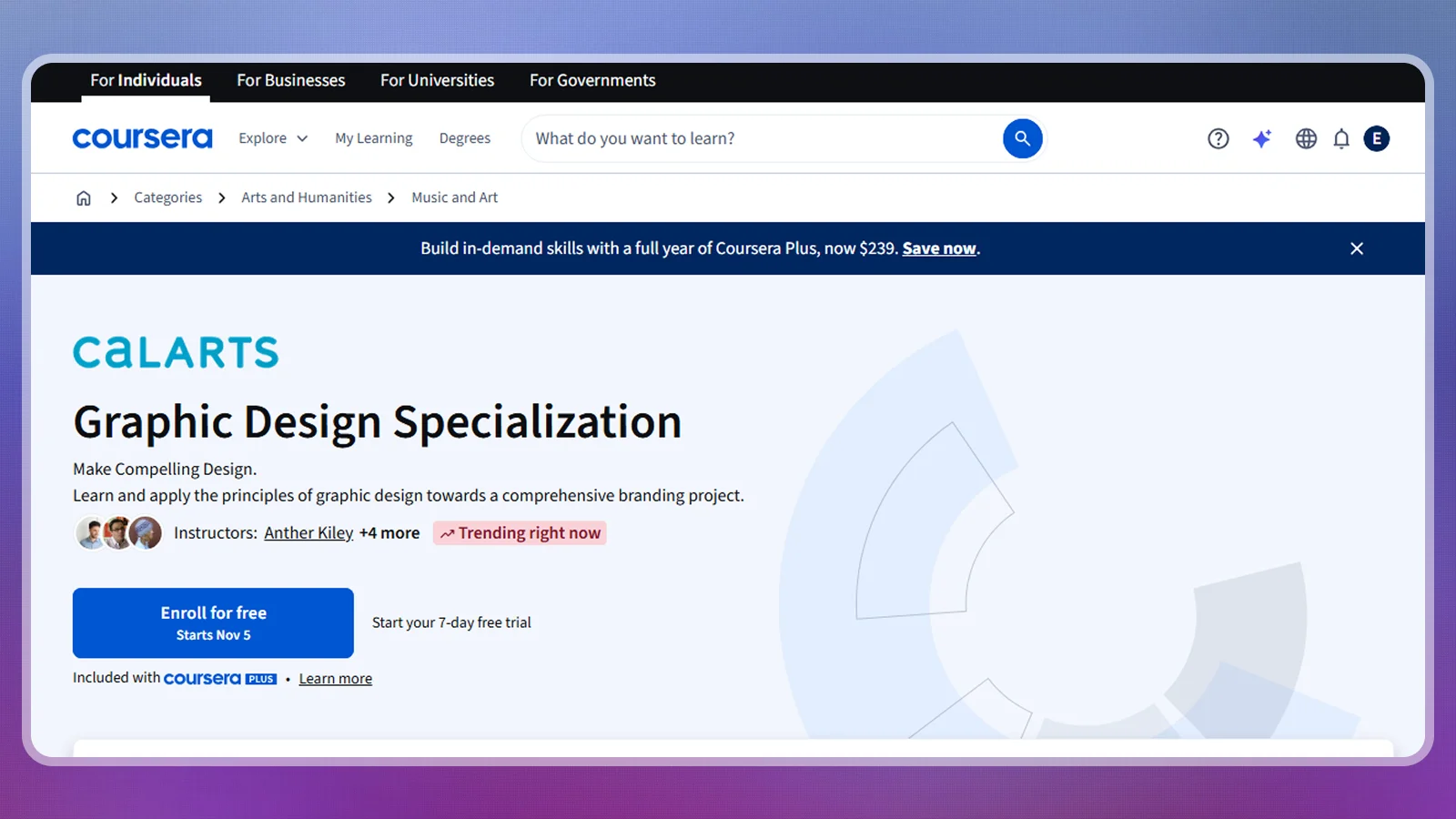
Developed by the California Institute of the Arts, the graphic design course program covers typography, image-making, design history, and branding through Coursera. Its capstone, Brand New Brand, brings those subjects together in a finished identity project.
Coursera lists the commitment as 2 months at 10 hours a week. Its 4.7 rating comes from 21,973 reviews of courses in the program, so treat that feedback as program-level context.
The provider’s key graphic design course details are collected here:
| Provider | Coursera |
| Price | Free to enroll |
| Difficulty | Beginner |
| Time | 2 months at 10 hours a week |
| Certificate | Shareable certificate, subject to enrollment option |
| Rating | 4.7 from 21,973 reviews of courses in the program |
Free enrollment describes the starting offer. Read the access terms for your chosen enrollment option before committing to assessed work or a certificate. The shareable course completion certificate is distinct from an exam-based vendor certification.
These are the main strengths and limitations of this graphic design course:
| Pros | Cons |
|---|---|
| ✅ Connected curriculum – links fundamentals with branding. ✅ University teaching – developed by California Institute of the Arts. ✅ Capstone practice – brings skills into a finished identity project. ✅ Beginner level – offers a foundational starting point. | ❌ Weekly commitment – sustained study suits a regular schedule. ❌ Access distinction – free enrollment requires attention to certificate terms. |
This is the default recommendation for beginners who can commit to the full study schedule and want a connected branding project. Keep early drafts alongside the final identity so you can explain your decisions.
2. Best for Beginners: Fundamentals of Graphic Design, Typography and Color Theory (Udemy)
Fundamentals of Graphic Design, Typography & Color Theory is the beginner pick for learning the vocabulary behind visual decisions. As one of the best graphic design courses, it focuses on principles before a larger branding assignment.
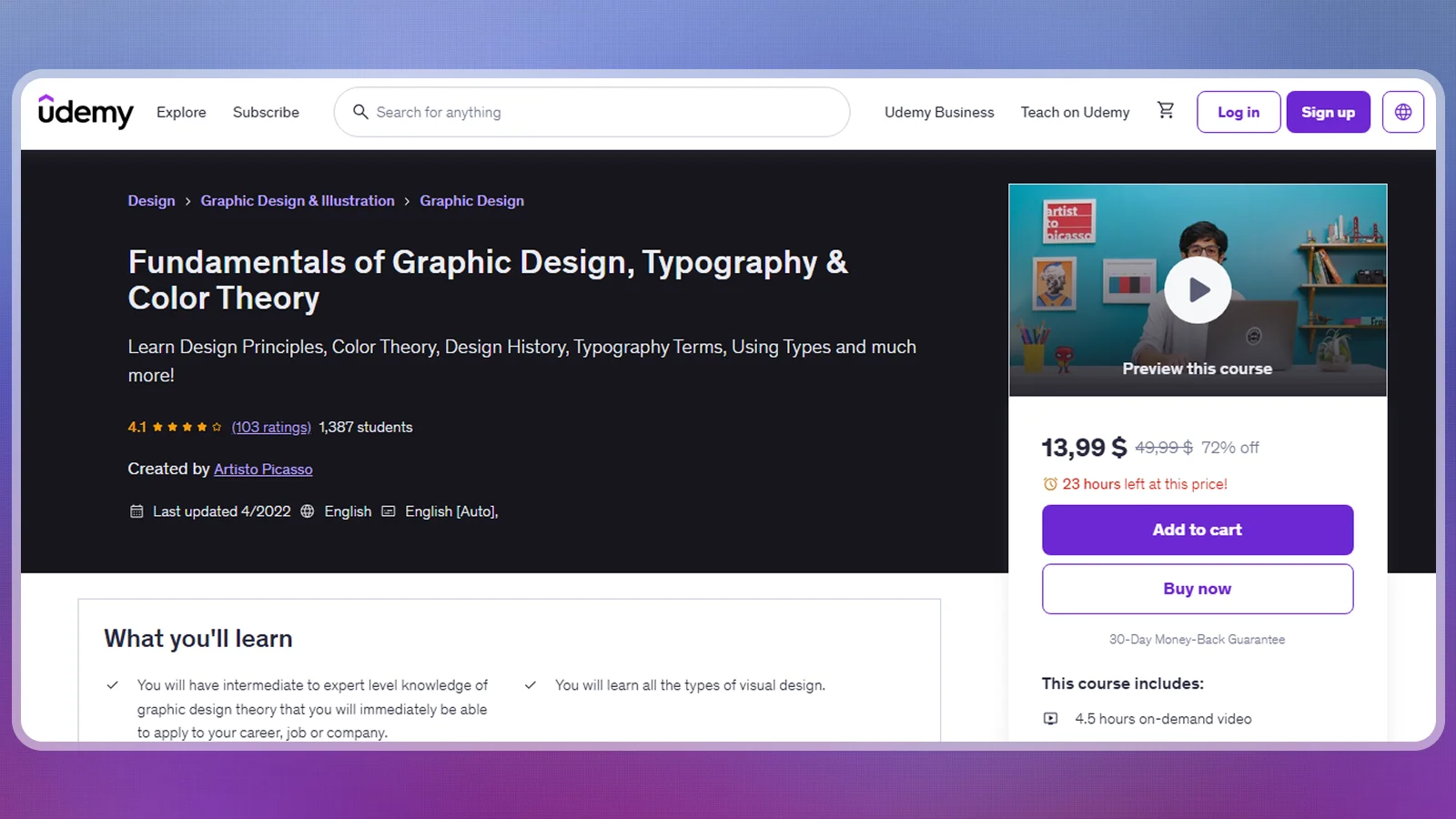
The Udemy course covers design principles, color theory, design history, and typography through on-demand video. Its conceptual focus suits learners who can recognize an appealing design but struggle to explain its layout or type choices.
Udemy lists 4.5 hours of video and a $54.99 original price. That is the price basis used here, since temporary sale prices change.
The course’s published details provide this comparison:
| Provider | Udemy |
| Price | $54.99 list price, one-time purchase |
| Difficulty | Beginner |
| Time | 4.5 hours of on-demand video |
| Certificate | Certificate of completion |
| Rating | 4.1 from 103 ratings |
The beginner recommendation follows the subject coverage. A learner seeking the best graphic design courses centered on software demonstrations should compare the project-focused options as well.
These trade-offs help place the course:
| Pros | Cons |
|---|---|
| ✅ Principles first – explains foundational design decisions. ✅ Typography coverage – introduces how type communicates. ✅ Color focus – connects color choices with composition. ✅ On-demand format – allows lessons to fit around other commitments. | ❌ Theory emphasis – practical software work needs separate attention. ❌ Limited video scope – a compact introduction leaves room for further study. |
Turn each graphic design course topic into a small exercise for your graphic design portfolio. For example, redesign a fictional game-night flyer after the typography lesson, then explain how the revised hierarchy helps readers find the event details.
3. Best Budget Pick: Graphic Design Projects For Beginners (Udemy)
Graphic Design Projects For Beginners is perfect for learners looking for the best graphic design courses on a budget but still want practical assignments. This course has a lower listed original price than the fundamentals course above.
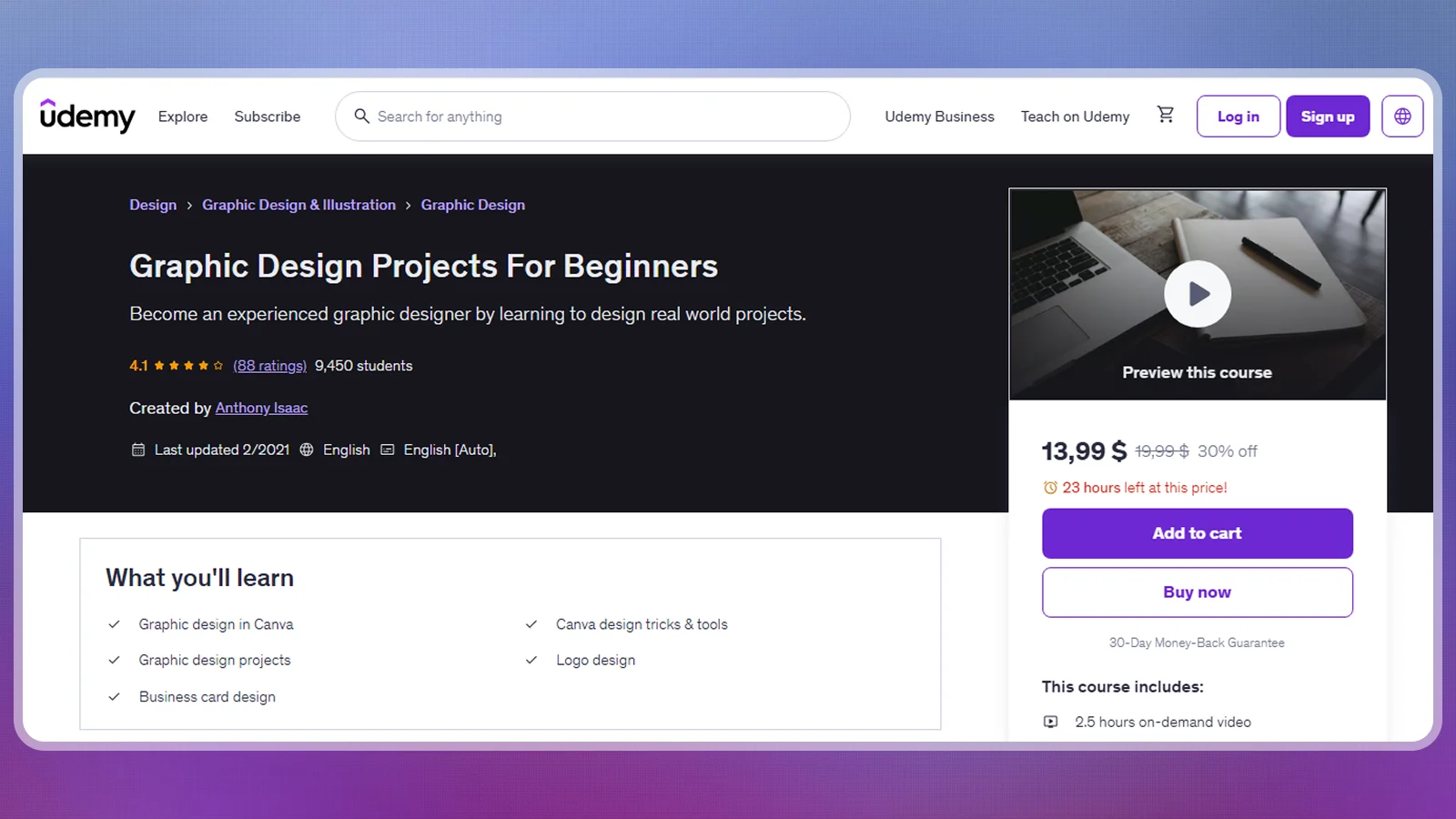
This Udemy graphic design course uses Canva for projects including social graphics, posters, logos, and business cards. Its format suits learners who prefer creating a visible result while learning how layout decisions work.
Udemy lists a $19.99 original price and 2.5 hours of on-demand video. Allow additional practice time for rebuilding the examples with your own text and images.
These are the main course facts:
| Provider | Udemy |
| Price | $19.99 list price, one-time purchase |
| Difficulty | Beginner |
| Time | 2.5 hours of on-demand video |
| Certificate | Certificate of completion |
| Rating | 4.1 from 88 ratings |
Use this graphic design course for affordable Canva practice, then adapt the demonstrated layouts to your own briefs. A graphic design portfolio becomes more informative when the work answers your own brief.
The practical advantages come with clear limits:
| Pros | Cons |
|---|---|
| ✅ Project format – connects lessons to visible outputs. ✅ Useful formats – includes common marketing materials. ✅ Accessible workflow – centers on Canva projects. ✅ One-time purchase – offers a defined course purchase. | ❌ Tool-specific approach – practice centers on Canva. ❌ Short introduction – broader design study remains useful. |
A gaming creator could adapt the graphic design course exercises into a fictional tournament poster and matching channel graphics. Keep the audience and visual identity consistent across the pieces.
4. Best Short Introduction: Graphic Design 101: How to Master Visual Communication (Coursera)
Graphic Design 101: How to Master Visual Communication suits beginners who want a compact introduction before choosing longer graphic design courses. Its short format makes it a useful starting point for exploring layout.
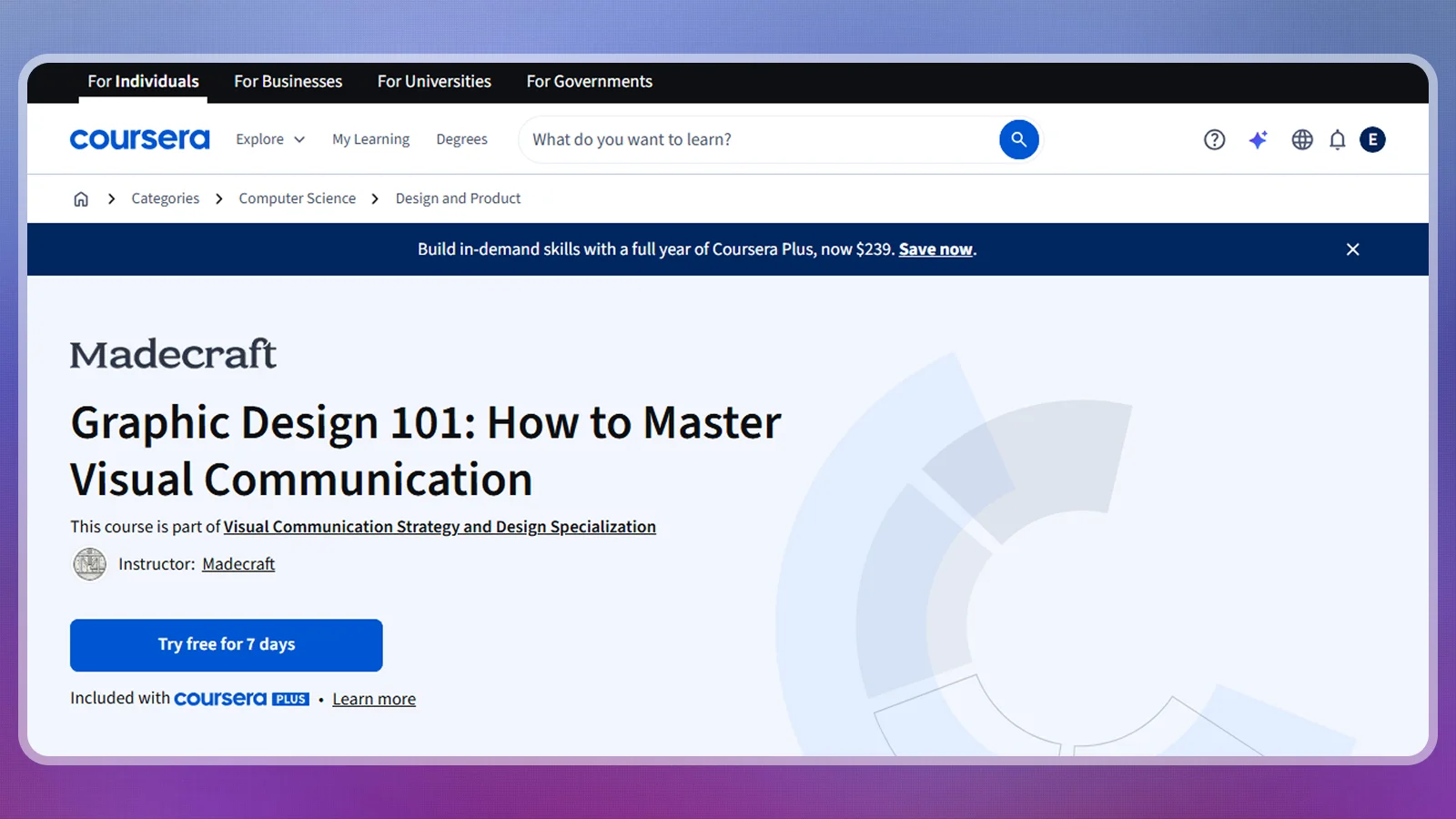
Available through Coursera, this graphic design course introduces contrast, repetition, alignment, and proximity. These principles explain how a composition separates information, creates consistency, and groups related content.
Coursera lists 6 hours to complete the course and identifies it as beginner-level. The course also covers color and typography, with a layout project that brings the ideas together.
Here is the course’s factual overview:
| Provider | Coursera |
| Price | Not listed |
| Difficulty | Beginner |
| Time | 6 hours to complete |
| Certificate | Shareable certificate |
| Rating | Not listed |
Choose an enrollment option based on the access it includes. A platform subscription promotion and an individual graphic design course price serve different purchasing decisions.
These are the course’s useful features and limits:
| Pros | Cons |
|---|---|
| ✅ Beginner level – provides an introductory entry point. ✅ Layout principles – explains relationships between visual elements. ✅ Typography and color – connects key visual decisions. ✅ Applied project – turns principles into a complete layout. | ❌ Narrower scope – offers less breadth than the specialization. ❌ Access decision – certificate access depends on the enrollment terms. |
Use the final graphic design course assignment as a draft for your graphic design portfolio. Revise the layout after a break, and record which changes improve the reading order.
5. Best Certificate: Graphic Design Professional Certificate (Sessions College)
Graphic Design Professional Certificate is the certificate-focused choice for learners seeking the best graphic design courses with a more substantial program and instructor critique. It fits a different commitment level from the short graphic design courses above.
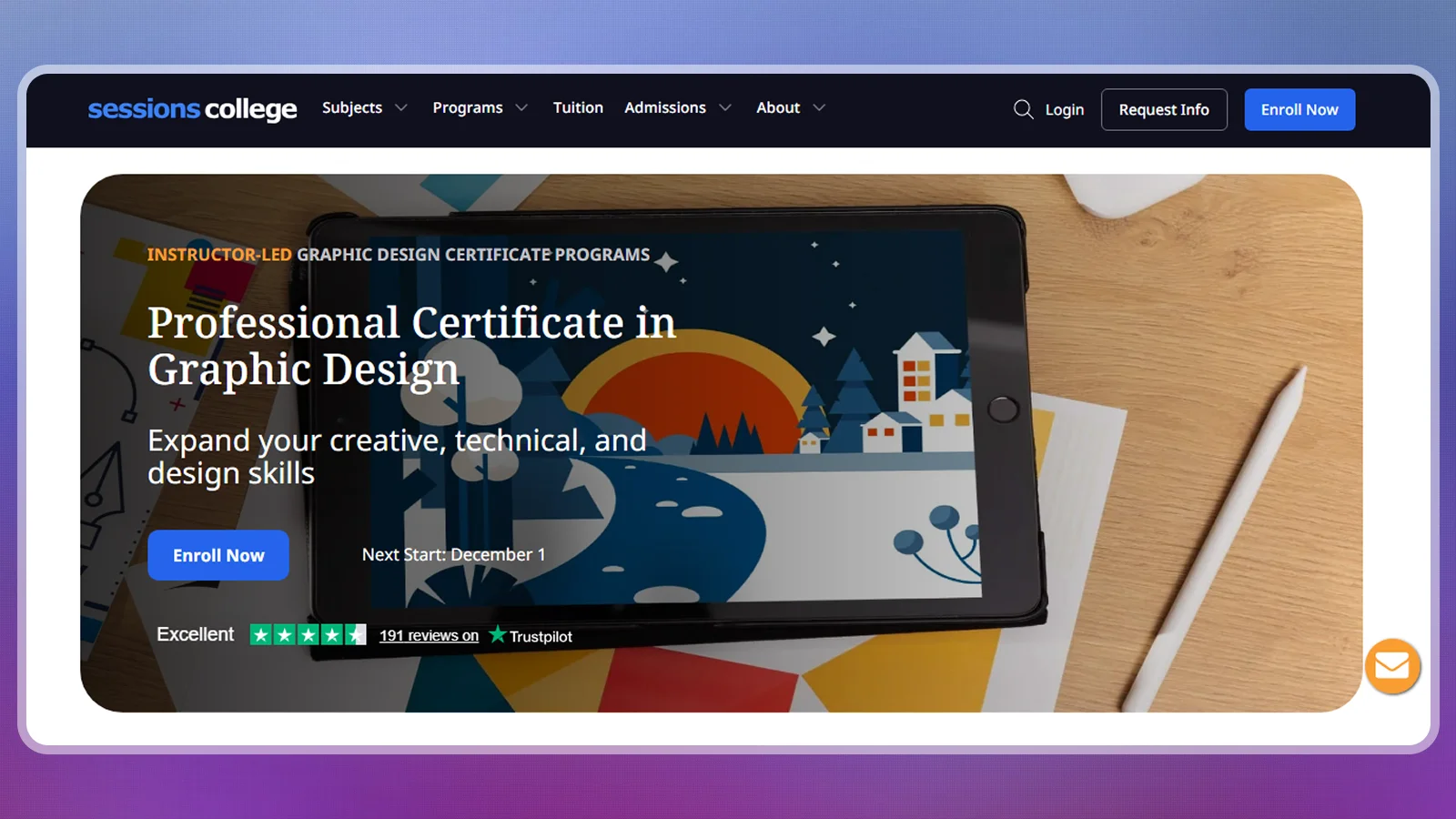
The Sessions College program covers Adobe Photoshop, Illustrator, and InDesign, alongside projects like logos, posters, and publication layouts. Mentoring and critique let graphic design students revise their work with instructional guidance.
Sessions College lists a $2,750 tuition, which offers a $50 discount when paid in full, and a self-paced completion period of 9 months or less. The larger commitment makes feedback quality and curriculum fit central purchasing considerations.
Program facts for this graphic design course are summarized below:
| Provider | Sessions College |
| Price | $2,700 paid in full |
| Difficulty | Beginner |
| Time | 9 months or less, self-paced |
| Certificate | Professional Certificate documenting program completion, distinct from exam-based software vendor certification |
| Rating | 4.5 from 191 ratings |
The Sessions College Professional Certificate is a program-completion credential, distinct from an exam-based software vendor certification. A graphic design portfolio should remain part of the goal even when the certificate motivates enrollment. Save the revisions that show how critique improved your work.
The program offers these advantages and trade-offs:
| Pros | Cons |
|---|---|
| ✅ Instructor critique – provides guidance for revision. ✅ Software breadth – covers major Adobe design applications. ✅ Varied projects – includes identity and publication work. ✅ Self-paced study – allows flexibility within the program period. | ❌ Larger investment – costs substantially more than the short courses. ❌ Longer commitment – suits sustained study rather than a quick introduction. |
Choose this graphic design course when guided development is worth the additional cost to you. A short introductory course is a better first purchase if you are still exploring the subject.
6. Best for Presentation Design: Graphic Design (Coursera)
Graphic Design is a focused alternative for beginners interested in presentation-oriented visual communication. This graphic design course suits someone whose immediate goal is improving how information appears on a page or slide.
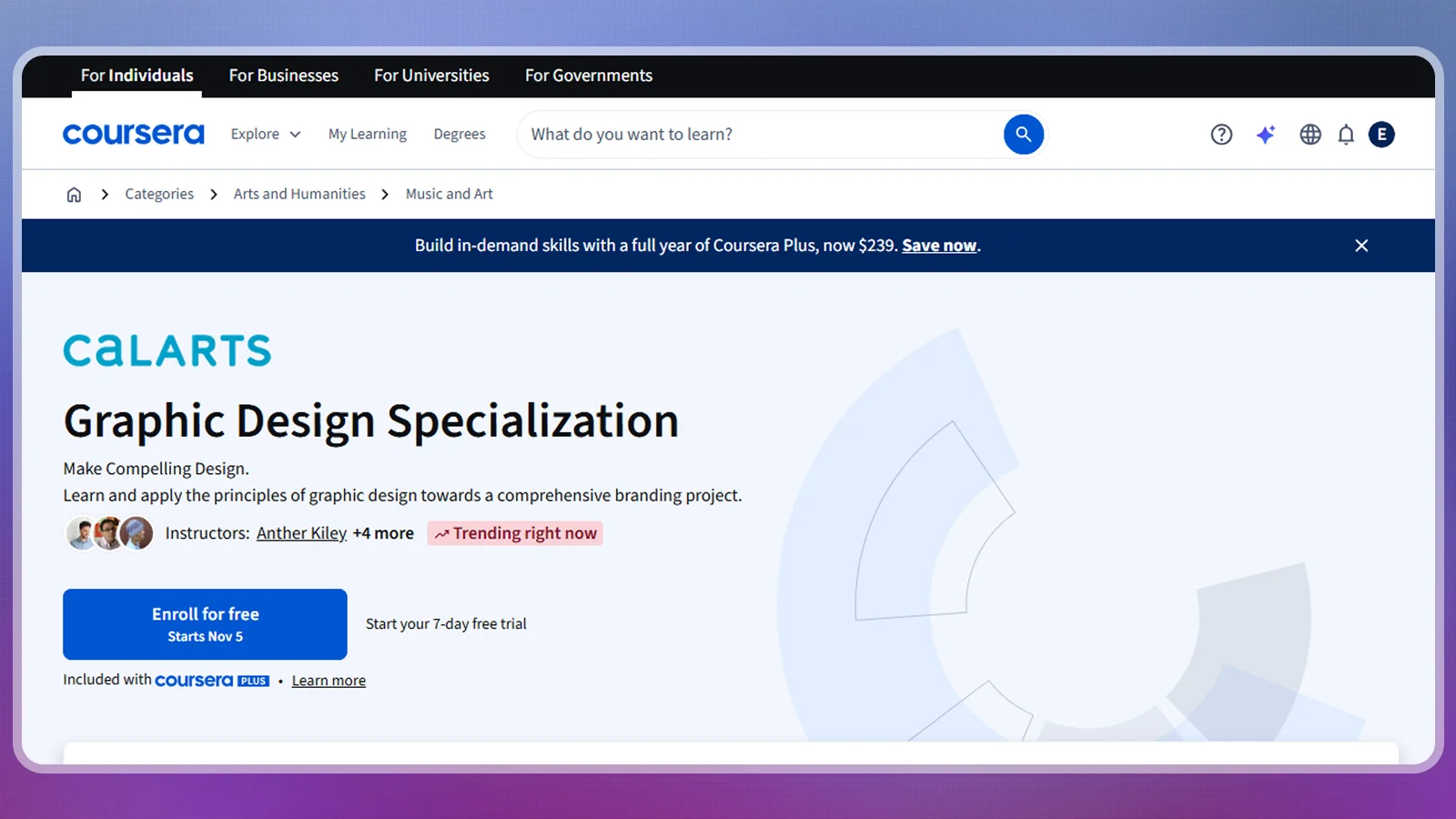
This graphic design course is available through Coursera and carries a beginner-level designation. Its presentation-design focus gives it a narrower role than a program built around a complete brand identity.
Coursera lists a commitment of 3 weeks at 10 hours a week. Its 4.8 rating comes from 3,376 reviews, which should be read within this provider’s own review context.
The available course details are:
| Provider | Coursera |
| Price | Not listed |
| Difficulty | Beginner |
| Time | 3 weeks at 10 hours a week |
| Certificate | Shareable certificate |
| Rating | 4.8 from 3,376 reviews |
Choose this graphic design course if you need to improve your presentation skills. A useful personal exercise is redesigning a fictional game pitch with clearer hierarchy and consistent visual treatment.
Its positioning brings these strengths and limits:
| Pros | Cons |
|---|---|
| ✅ Beginner designation – offers a foundational starting level. ✅ Focused application – suits presentation-oriented learning. ✅ Published study schedule – helps with workload planning. ✅ Shareable certificate – provides a completion credential. | ❌ Narrower application – a branding goal may suit the specialization better. ❌ Weekly workload – requires room for regular study. |
Your graphic design portfolio should show the communication problem from the graphic design course alongside the revised presentation. Explain how the sequence and emphasis help the intended audience understand the message.
7. Best for Digital Design Skills: Digital Design Masterclass For Graphic Designers (Udemy)
Digital Design Masterclass For Graphic Designers is one of the best graphic design courses for specialist learners who already know their way around design software. This graphic design course broadens digital output beyond an introductory poster or logo.
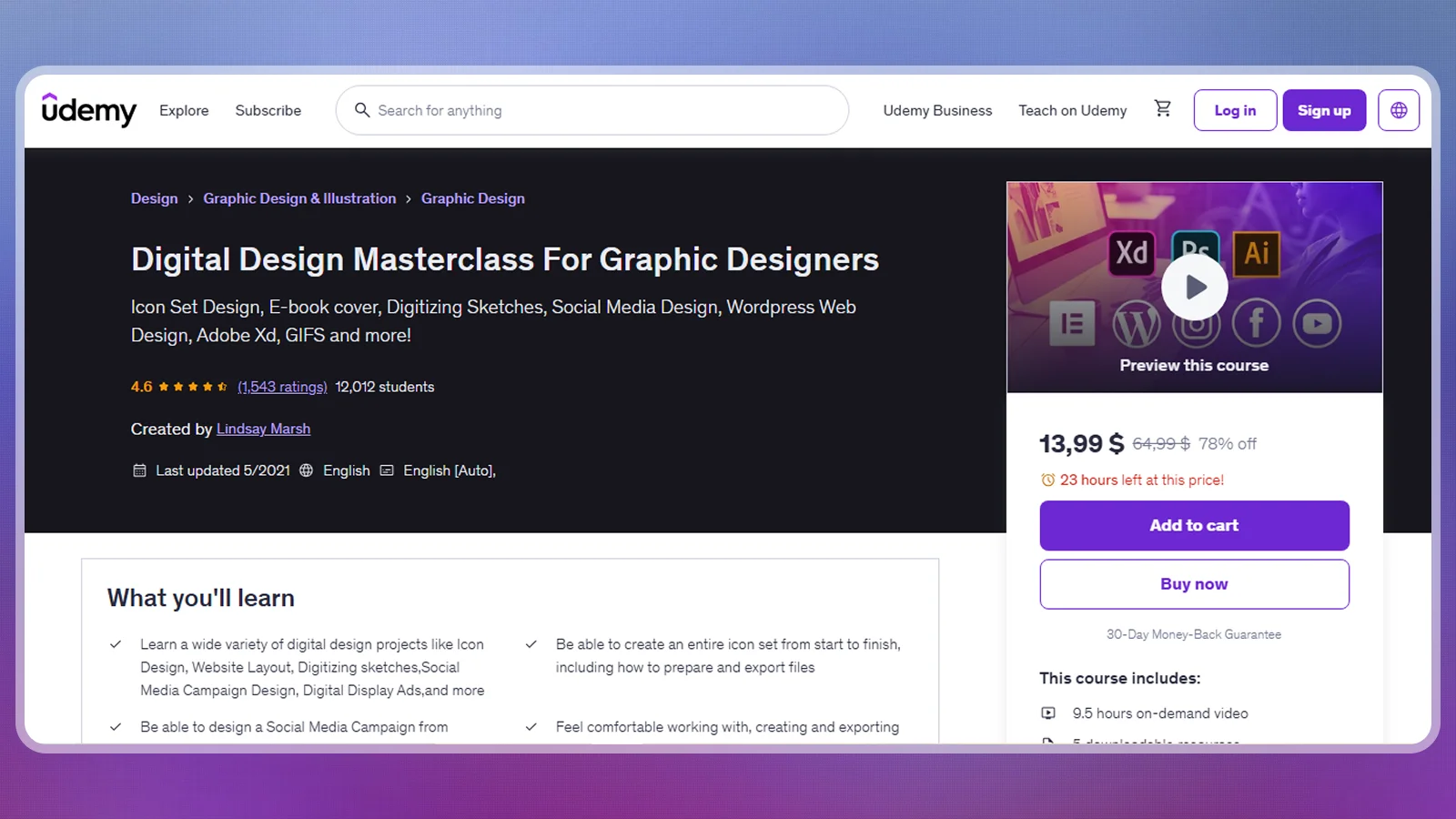
The Udemy course covers thumbnail design, e-book covers, icon sets, social campaigns, and web layouts. Its tool coverage includes Adobe XD and WordPress, so compare those workflows with the applications you plan to use.
Udemy lists a 4.6 rating from 1,543 ratings. The course description calls for prior familiarity with Adobe Photoshop and Illustrator, even though its intended audience includes beginner-level designers.
These are the main course facts:
| Provider | Udemy |
| Price | $109.99 list price, one-time purchase |
| Difficulty | Beginner designers with familiarity with Photoshop and Illustrator |
| Time | 9.5 hours of on-demand video |
| Certificate | Certificate of completion |
| Rating | 4.6 from 1,543 ratings |
This makes it a follow-on graphic design course for someone who can already complete basic software tasks. Total beginners should start with foundational instruction.
Key trade-offs for this graphic design course are:
| Pros | Cons |
|---|---|
| ✅ Digital formats – includes icons, thumbnails, and covers. ✅ Campaign practice – connects individual assets with a wider visual system. ✅ Layout breadth – extends study into web-oriented work. ✅ Skill expansion – suits learners adding to existing software knowledge. | ❌ Software prerequisites – assumes Photoshop and Illustrator familiarity. ❌ Multiple workflows – requires attention to the tools used in each project. |
Build a graphic design portfolio around a connected set of assets. A fictional game’s announcement campaign offers a practical theme for testing consistency across different screen sizes and formats. If you also want to write the campaign’s headlines and calls to action, explore copywriting courses as a complementary learning path.
Free Graphic Design Courses and Resources
Start with accessible lessons and a small practice brief before making a large purchase. The best graphic design courses earn their cost through useful structure, practice, or feedback, while free material can help you decide what you need.
These resources offer ways to explore the subject:
- Free enrollment: Coursera advertises free enrollment for Graphic Design Specialization. Read the selected enrollment option’s terms to understand the lesson, assessment, and certificate access.
- Course exploration: Udemy course previews help you assess the teaching style before buying. Use a preview to judge the pace and clarity of an explanation.
- Video fundamentals: YouTube offers a free Graphic Design Basics series for introductory study. Apply a principle to your own layout after each lesson.
Free graphic design courses and resources work best with a defined assignment. Give yourself an audience, message, and format, then revise the result after studying a relevant principle.
Paid graphic design courses can be more useful when they solve a specific learning problem. Graphic Design Specialization adds a connected branding pathway, while Sessions College adds instructor critique. Pay for the structure or guidance you need.
How To Choose the Best Graphic Design Courses
Choose based on the work you want to create and the guidance you need. The best graphic design courses for a certificate-focused career changer can differ from those for a creator who needs better channel graphics.
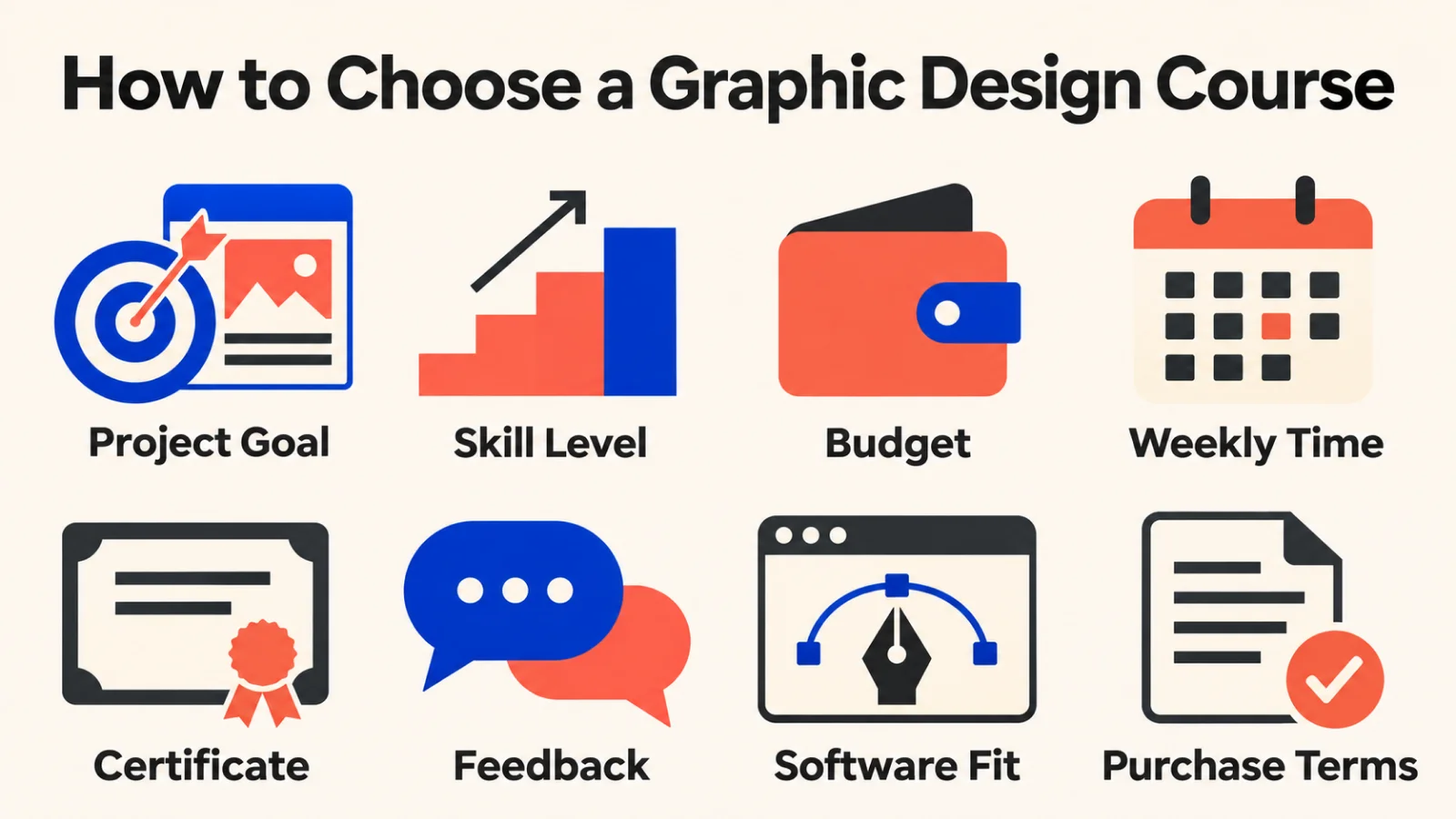
Use these factors to narrow your shortlist for the best graphic design courses:
- Current level: Start with design principles if typography and composition are unfamiliar. Choose the digital masterclass after you’re familiar with the required software.
- Project goal: Match the graphic design course assignments to your intended output. Branding, presentation design, and social graphics call for different practice.
- Budget and billing: Compare a one-time purchase with the full terms of an enrollment or subscription offer. Include any software you choose to use.
- Weekly availability: Match the advertised workload to your calendar. Video duration and the time needed to revise an assignment are different commitments.
- Certificate purpose: Decide who needs to see the credential and why. A completion certificate documents study, while a graphic design portfolio shows applied work.
- Feedback: Choose guided critique if you struggle to diagnose weaknesses in your layouts. Self-paced video suits learners comfortable reviewing their own drafts.
- Software fit: Compare the applications taught with the work you plan to do. Tool-specific instruction is most useful when you can follow along.
- Purchase terms: Read the refund and access conditions attached to your chosen offer. Keep those terms with your purchase records.
The best graphic design courses are those you can turn into finished, revised work. A longer syllabus has little value if it prevents you from completing a useful project.
Are Graphic Design Courses Worth It?
Yes, for learners who need a structured path and purposeful practice, the best graphic design courses can be worth the cost. A suitable course reduces the work of deciding what to study next and connects separate skills through assignments.
Judge a course’s value by its assignments and feedback. For career-focused study, choose projects that let you show the skills required for the roles you want.
The best graphic design courses help you make better decisions and explain them clearly. If you want to become a graphic designer, connect your studies with a portfolio of original projects. Include your brief, selected revisions, and finished work so readers can follow your design decisions.
Start with free lessons or previews if you are still exploring the subject. Pay when you can name the benefit you need, like a coherent curriculum, relevant projects, or instructor critique. Course completion alone cannot guarantee a job.
Final Verdict
Graphic Design Specialization is the best overall foundation for a beginner who wants connected study and a branding project. Fundamentals of Graphic Design, Typography & Color Theory is the better compact theory introduction. At the same time, Graphic Design Projects For Beginners suits a budget-conscious learner who wants to start making things.
Begin with free resources or graphic design course previews if you are still exploring design. Choose Sessions College when instructor critique and a certificate program justify a larger commitment. The best graphic design courses are the ones that help you finish and improve work for a graphic design portfolio, so make that outcome central to your purchase.
FAQs
The best graphic design courses include Graphic Design Specialization for breadth and Fundamentals of Graphic Design, Typography & Color Theory for a compact start. Coursera lists its specialization at 2 months, at 10 hours a week.
Yes, the best graphic design courses can be worthwhile when they provide relevant practice, structure, or feedback. Choose one that helps you create and revise a graphic design portfolio. Completing a course cannot guarantee employment.
Yes, free tutorials can teach core principles, and Coursera advertises free enrollment for Graphic Design Specialization. Read the access terms before assuming assessments or a certificate are included.
Coursera lists Graphic Design Specialization at 2 months at 10 hours a week and Graphic Design 101 at 6 hours. These are study estimates, so allow additional time for practice and revision.
Yes, several courses offer completion certificates, subject to enrollment terms. Sessions College‘s Professional Certificate also documents program completion, distinct from an exam-based software vendor certification.
Udemy lists Graphic Design Projects For Beginners at a $19.99 original price and the fundamentals course at $54.99. Sessions College lists $2,700 paid in full. Coursera access depends on the enrollment option.
Include finished projects, their intended audiences, and explanations of your design decisions. Show selected revisions alongside branding, layouts, or a coordinated digital campaign. Relevant practice is a key reason to compare the best graphic design courses.