


Best JavaScript Courses in 2026: 7 Picks for Beginners

Eneba Hub contains affiliate links, which means we may earn a small commission if you make a purchase through them—at no extra cost to you. Learn more


COURSE QUICK LOOK
Start with The Complete JavaScript Course on Udemy for a broad video-led path. Codecademy suits beginners who prefer interactive exercises, while freeCodeCamp offers a free curriculum.
The best JavaScript courses include The Complete JavaScript Course for broad coverage, Learn JavaScript for beginners, JavaScript Algorithms and Data Structures for free study, and JavaScript Course + Certificate for an exam-backed credential. Choose a JavaScript course by its learning format, practice opportunities, and certificate requirements. Free options sit next to paid certificate tracks, so you can compare format, practice, and credentials in one place. Udemy lists 71 hours of video for the overall pick, so it suits a sustained study commitment.
These seven JavaScript courses suit first-time coders, developers adding another language, and learners seeking a credential. The options include free study, a $95 course-and-exam package, and specializations advertised through a $239 annual subscription offer. Listed study commitments include a shorter interactive introduction and a longer certificate track. Listed study commitments run from about 15 hours for the interactive introduction to 80 hours for the certificate track.
The comparison separates beginner foundations from algorithm practice and wider web-development study.
Jump to:
Best JavaScript Courses at a Glance
The best JavaScript courses serve different goals, so match the course to the task you want to complete. This comparison emphasizes fit. The individual course cards include prices, durations, and credentials where the provider lists them, with gaps marked explicitly. The table lists the price, time, and certificate for each of these online JavaScript courses, with gaps marked as not listed.
|
Course |
Provider |
Best for |
Price |
Time |
Certificate |
|---|---|---|---|---|---|
|
The Complete JavaScript Course 2025: From Zero to Expert! |
 |
Broad video-led study |
Not listed by the provider |
71 hours of video |
Not listed by the provider |
|
Learn JavaScript |
 |
Interactive beginner practice |
Free; certificate needs Plus or Pro |
15 hours |
Certificate of completion with Plus or Pro |
|
JavaScript Algorithms and Data Structures |
 |
Free structured learning |
Free |
Not listed by the provider |
Free certification |
|
JavaScript Course + Certificate |
 |
Course and exam package |
$95 one-time |
80 hours |
Exam and certificate included |
|
Modern JavaScript From The Beginning 2.0 |
|
Modern language syntax |
Not listed by the provider |
40 hours |
Not listed by the provider |
|
Data Structures & Algorithms in JavaScript Specialization |
 |
Algorithm-focused study |
Included with Coursera Plus |
About 4 weeks at 10 hours a week |
Shareable certificate |
|
Web Development with HTML5, CSS, and JavaScript Specialization |
|
Broader web foundations |
Included with Coursera Plus |
4 weeks at 10 hours a week |
Shareable certificate |
The order moves from the strongest general-purpose JavaScript course to beginner, free, certificate, and specialty choices.
What Is JavaScript?
JavaScript is a programming language used to make websites respond to users. It handles behavior like updating a score, validating a form, or changing what appears after a button press. JavaScript courses teach the rules behind those interactions.
HTML gives a page its structure, and CSS controls its appearance. JavaScript functions organize reusable actions, while a JavaScript for loop repeats an instruction across a collection. The DOM, or Document Object Model, lets code read and change page elements.
JavaScript also runs outside the browser through tools like Node.js. For a first project, though, a browser-based quiz or simple score tracker is a useful target. Good JavaScript courses connect variables, conditions, loops, and asynchronous code to something you can run and debug. If you want to build games with it, see our guide on how to become a game developer.
How These Courses Were Chosen
The best JavaScript courses here cover distinct learning needs, from a first coding session to algorithm practice. The comparison uses these course-selection criteria:
- Coverage: A JavaScript course should connect fundamentals, JavaScript functions, and the JavaScript for loop to practical tasks.
- Teaching: Instructor identity and the provider’s stated format help explain the learning experience.
- Ratings: Scores appear with their review counts, without treating different platforms’ ratings as equivalent.
- Cost: Published prices retain their billing basis, including promotional subscription wording.
- Practice: Exercises, projects, and challenges help turn explanations into usable skills.
- Credentials: Certificate wording follows the provider’s description.
- Recency: The update date a provider shows, read alongside the syllabus.
A course’s title or update claim alone does little to settle its fit. The syllabus and practice format carry more weight. That same check is how to choose a JavaScript course for your own goal.
The 7 Best JavaScript Courses, Compared
These seven JavaScript courses cover broad study, interactive beginner practice, free learning, certificates, modern syntax, algorithms, and wider web development. Start with the entry that matches your current level, then compare how it asks you to practice.
The best JavaScript courses make the next task clear. A beginner needs understandable exercises, while an experienced programmer may need a focused gap filled. Keep that distinction in mind as you compare the options.
1. Best Overall: The Complete JavaScript Course 2025: From Zero to Expert! (Udemy)
This JavaScript course earns the overall pick through its breadth. It gives learners room to move from basic language rules into browser interaction and more advanced programming concepts without immediately switching to another course.
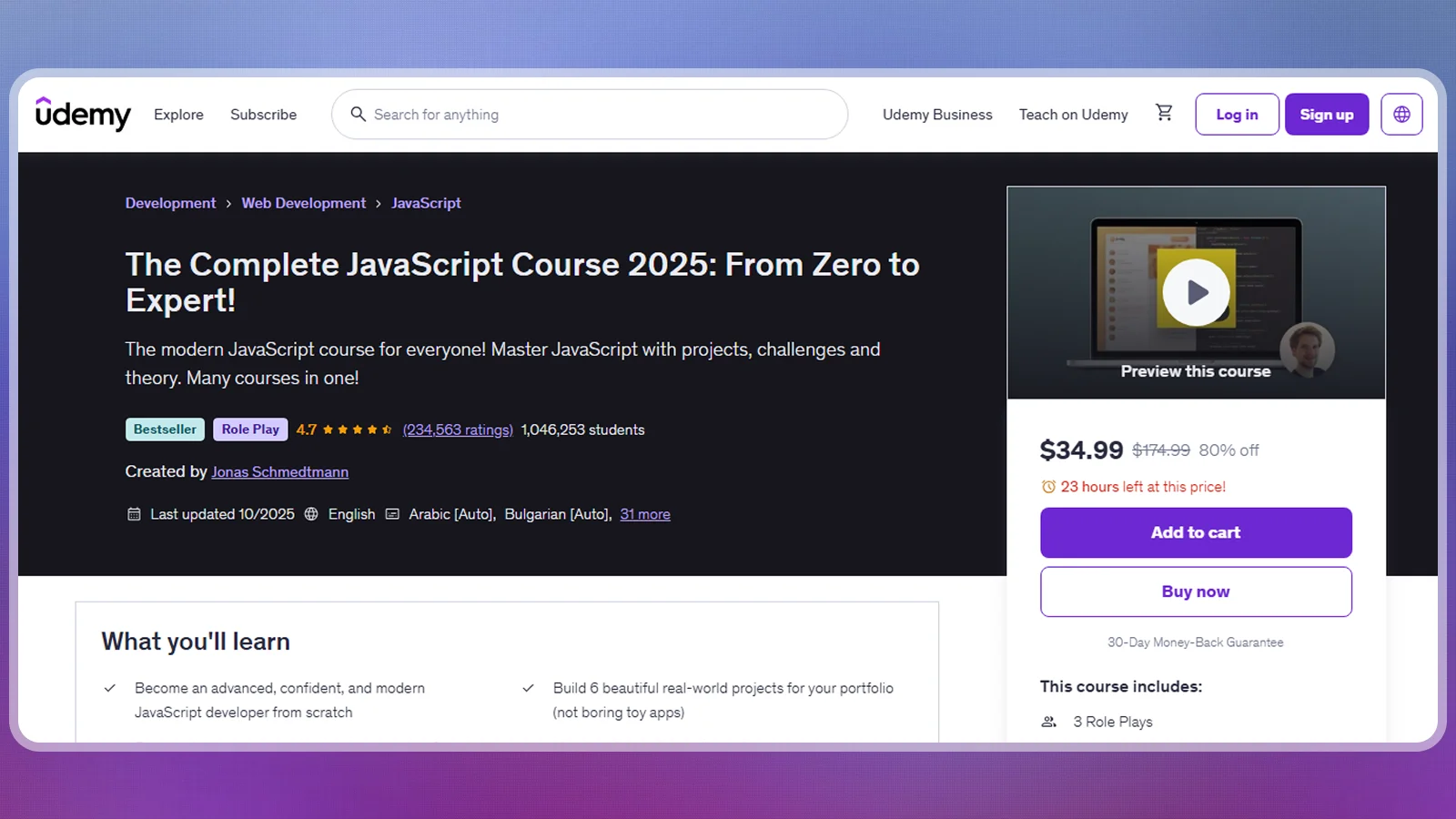
Jonas Schmedtmann’s course on Udemy covers fundamentals, ES6+, DOM manipulation, object-oriented programming, asynchronous code, and modern tooling. The Udemy page lists a 4.7 rating from 234,528 ratings. The rating reflects a large pool of learner feedback, but the syllabus is the more useful guide to the topics you need. Udemy prices change often during sales, so check the current price on the course page.
The long format suits learners who want a substantial reference as they progress. Use its JavaScript functions lessons to build reusable game actions, then apply a JavaScript for loop to a list of scores or inventory items. Those are suggested practice tasks, separate from the provider’s course projects.
The facts below separate the course’s stated details from fields without a published value.
| Provider | Udemy |
| Price | Not listed by the provider |
| Difficulty | Not listed by the provider |
| Time | 71 hours of on-demand video |
| Certificate | Not listed by the provider |
| Rating | 4.7 from 234,528 ratings |
The video runtime describes the content library. Your working schedule also needs room for exercises, debugging, and rebuilding examples on your own.
These strengths and limitations shape its fit as a JavaScript course.
| Pros | Cons |
|---|---|
| ✅ Breadth – Fundamentals through advanced concepts ✅ Browser work – DOM manipulation included ✅ Programming depth – Object-oriented and asynchronous code ✅ Guidance – Goal-based learning pathways | ❌ Commitment – A substantial video library ❌ Format – Video study needs separate coding time |
Choose this JavaScript course if you want a broad path and can maintain a regular practice habit. A shorter interactive introduction is easier to fit around a crowded schedule.
2. Best for Beginners: Learn JavaScript (Codecademy)
This JavaScript course suits beginners who want to type code as they learn. Its interactive format makes it easier to connect an explanation to a result before moving to the next topic.
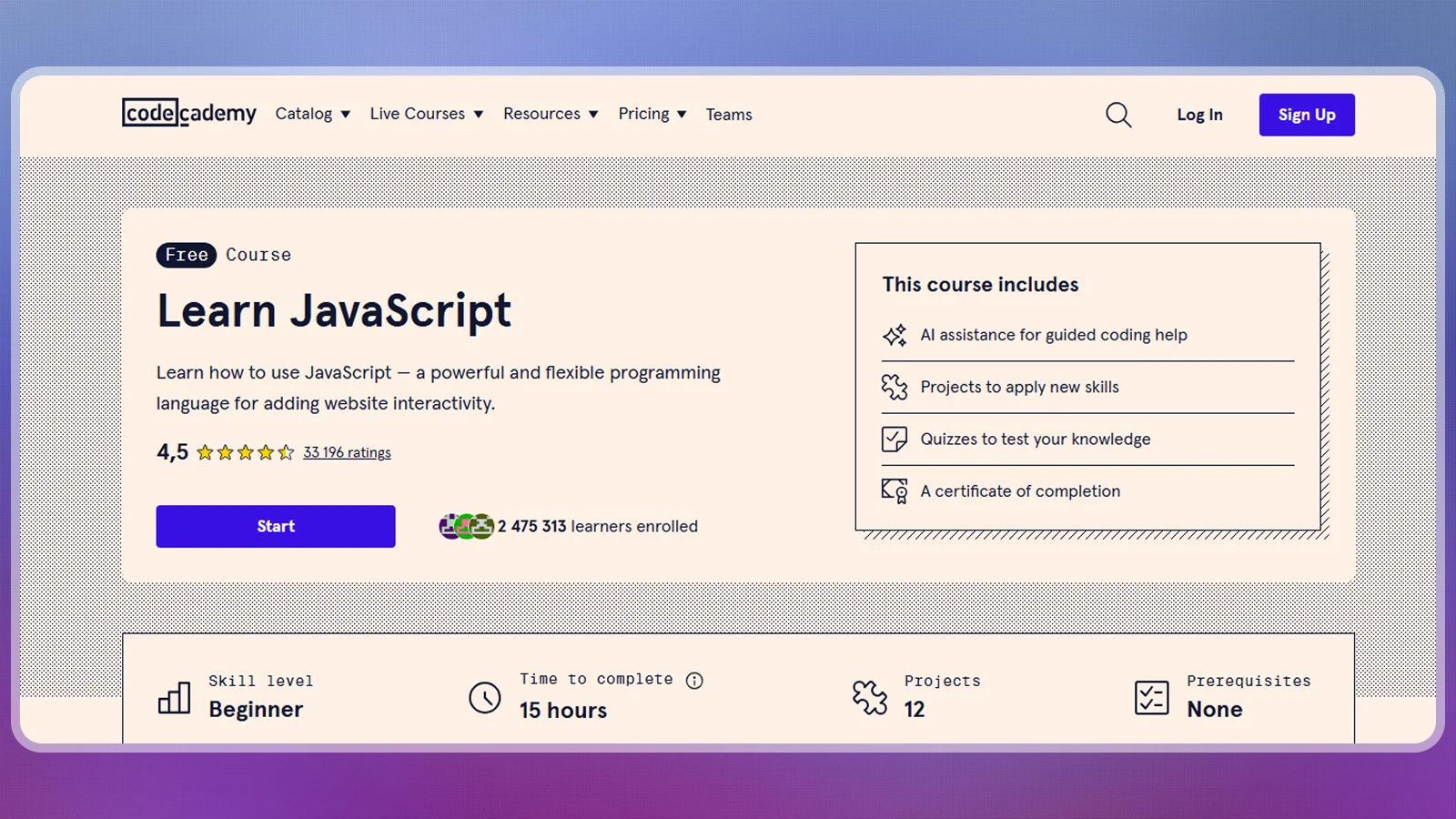
Learn JavaScript on Codecademy covers data types, conditionals, scope, arrays, and loops. Its JavaScript functions coverage includes arrow functions, a compact function-writing syntax. The course also introduces the JavaScript for loop and while loops.
According to Codecademy, the course takes 15 hours and has a 4.48 rating from 33,191 ratings. The shorter listed commitment makes it an approachable starting point among these JavaScript courses. It offers a certificate of completion. The course itself is free, and the certificate of completion requires a Plus or Pro plan.
Use each exercise as a prompt for a small change. Alter a condition, return a different value, or pass another argument into a function. That habit reveals how the code works beyond the supplied answer.
Here are the provider details for this JavaScript course.
| Provider | Codecademy |
| Price | Free course; certificate needs a Plus or Pro plan |
| Difficulty | Beginner |
| Time | 15 hours |
| Certificate | Certificate of completion with Plus or Pro |
| Rating | 4.48 from 33,191 ratings |
The interactive format is its strongest reason to choose it. Learners seeking extensive application architecture should continue into a broader JavaScript course afterward.
The trade-offs are straightforward.
| Pros | Cons |
|---|---|
| ✅ Interaction – Code alongside explanations ✅ Foundations – Core language topics covered ✅ Function practice – Arrow functions included ✅ Learning help – AI learning assistant included | ❌ Depth – Larger applications need further study ❌ Certificate access – Requires a Plus or Pro plan |
Pick this JavaScript course if starting feels harder than finding information. Frequent small exercises give you a clear action to take during each study session.
3. Best Free Option: JavaScript Algorithms and Data Structures (freeCodeCamp)
This JavaScript course is the strongest free starting route on the list. It combines a structured curriculum with interactive work and certification challenges, so a limited budget can still accommodate organized practice.
JavaScript Algorithms and Data Structures from freeCodeCamp covers basic JavaScript, ES6, regular expressions, basic data structures, object-oriented programming, and functional programming.
The range gives this JavaScript course room to grow with a learner. Start by tracing a JavaScript for loop through an array, then write JavaScript functions that transform the values. Later challenges ask you to combine ideas instead of recognizing isolated syntax.
A useful practice extension is a browser-game score processor. Read a collection of scores, filter entries, and calculate a result through reusable functions. Keep the interface simple while you concentrate on the logic.
The course facts reflect its free curriculum and challenge-based credential route. freeCodeCamp‘s updated certification asks you to build certification projects and pass an exam, and the certification is free.
| Provider | freeCodeCamp |
| Price | Free |
| Difficulty | Not listed by the provider |
| Time | Not listed by the provider |
| Certificate | Free certification with projects and an exam |
| Rating | Not listed by the provider |
The free format makes this JavaScript course useful for testing your interest before paying for another learning path.
Its benefits come with a need for consistent work on your own.
| Pros | Cons |
|---|---|
| ✅ Access – Free curriculum ✅ Practice – Interactive learning ✅ Coverage – Basics through programming concepts ✅ Challenges – A certification route | ❌ Study style – Requires persistence on your own ❌ Format – Less suited to video-first learners |
Choose this JavaScript course if budget is your main constraint and you are comfortable working through written instructions. Use a separate project to apply each new concept beyond the exercises.
4. Best Certificate: JavaScript Course + Certificate (W3Schools)
This JavaScript course is the clearest choice for readers who want a course and exam in the same purchase. The published package price makes its credential route easier to compare with subscription-based learning.
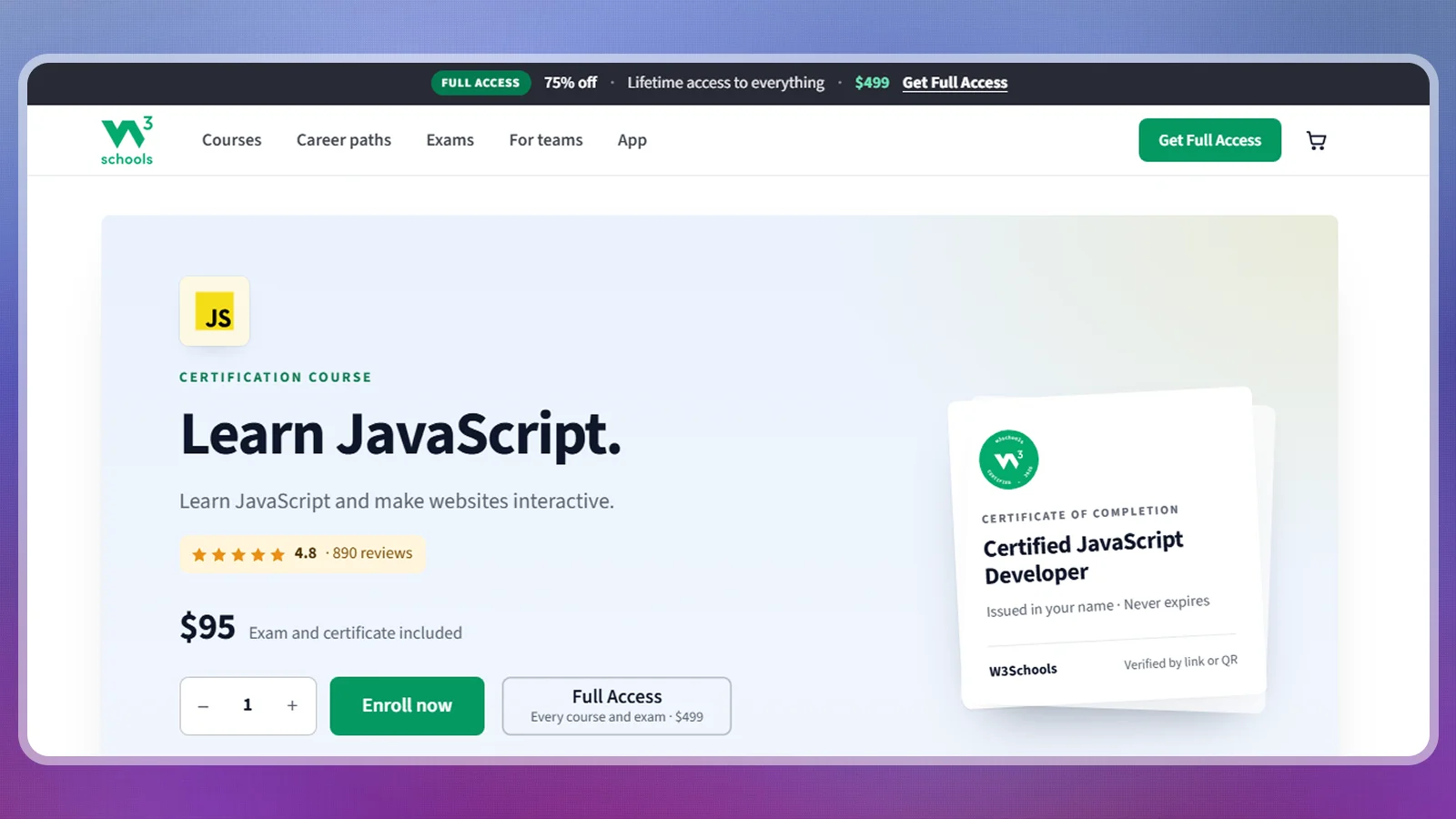
JavaScript Course + Certificate from W3Schools covers variables, data types, operators, objects, events, conditions, and loops. Its JavaScript functions material belongs alongside those building blocks, so the certificate has a defined learning path behind it.
The W3Schools page lists $95 with the exam and certificate included, an 80-hour course length, and a 4.8 rating from 888 reviews. The package also includes a one-year W3Schools Hero subscription, which the page values at $120, and three exam attempts. Your score sets the certification level, with Intermediate at 40%, Advanced at 75%, and Professional at 90%. Those details make the package suitable for a learner who wants a stated study commitment and a specific credential goal.
Use the JavaScript for loop lessons to process repeated data, then connect the result to a page event. A small game-statistics page would give you a practical way to combine calculations with user interaction.
The package details are summarized here.
| Provider | W3Schools |
| Price | $95, exam and certificate included |
| Difficulty | Beginner |
| Time | 80 hours |
| Certificate | Exam and certificate included |
| Rating | 4.8 from 888 reviews |
The credential is the reason to favor this JavaScript course over a free curriculum. Keep a working project alongside the exam preparation so you can show how you apply the material.
These are its main strengths and limitations.
| Pros | Cons |
|---|---|
| ✅ Price clarity – Published package cost ✅ Exam included – Assessment in the purchase ✅ Core coverage – Language and browser foundations ✅ Study scope – Substantial listed course length | ❌ Paid route – Certificate package costs money ❌ Commitment – A longer study path |
Choose this JavaScript course if an assessed credential is part of your goal. A free route remains the better first move if you mainly want to explore the language.
5. Best for Modern Syntax: Modern JavaScript From The Beginning 2.0 (Udemy)
This JavaScript course suits learners who want a path centered on modern language syntax. Its coverage of ES6 and later features makes modern syntax the reason to choose it.
Brad Traversy’s Modern JavaScript From The Beginning 2.0 on Udemy covers modern JavaScript syntax, including ES6, ES7, and ES8+ features. That focus helps learners connect familiar programming ideas to the forms they will encounter in contemporary JavaScript code. Udemy shows 40 hours of content and 132,102 ratings for the course.
Approach this JavaScript course with a translation exercise. Write a small operation using syntax you already understand, then rewrite it using a newer feature and explain what changed. JavaScript functions provide a useful place to compare function declarations with arrow syntax.
A JavaScript for loop remains useful even as the language gains other ways to process collections. Practice reading both direct iteration and function-based approaches, then choose the version that makes your intent easiest to follow.
The facts card keeps the course’s provider separate from unspecified purchase and credential details.
| Provider | Udemy |
| Price | Not listed by the provider |
| Difficulty | Not listed by the provider |
| Time | 40 hours |
| Certificate | Not listed by the provider |
| Rating | 132,102 ratings; average not listed in the research |
Choose this JavaScript course for its modern-language focus, with your existing skill level and preferred teaching style as the deciding factors.
The syllabus focus has these practical trade-offs.
| Pros | Cons |
|---|---|
| ✅ Modern syntax – ES6 and later features ✅ Language focus – JavaScript-centered study ✅ Named instructor – Taught by Brad Traversy ✅ Progression – A beginning-to-modern-syntax approach | ❌ Overlap – Familiar material for experienced learners ❌ Specialization – Broader web skills need separate study |
This JavaScript course is most useful when language syntax is the gap you need to close. Build a small working feature after each topic to keep that study practical.
6. Best for Algorithms: Data Structures and Algorithms in JavaScript Specialization (Coursera)
This JavaScript course bundle suits programmers who already understand the basics and want to practice solving structured problems. Its intermediate level makes it a follow-on choice after an introductory course.
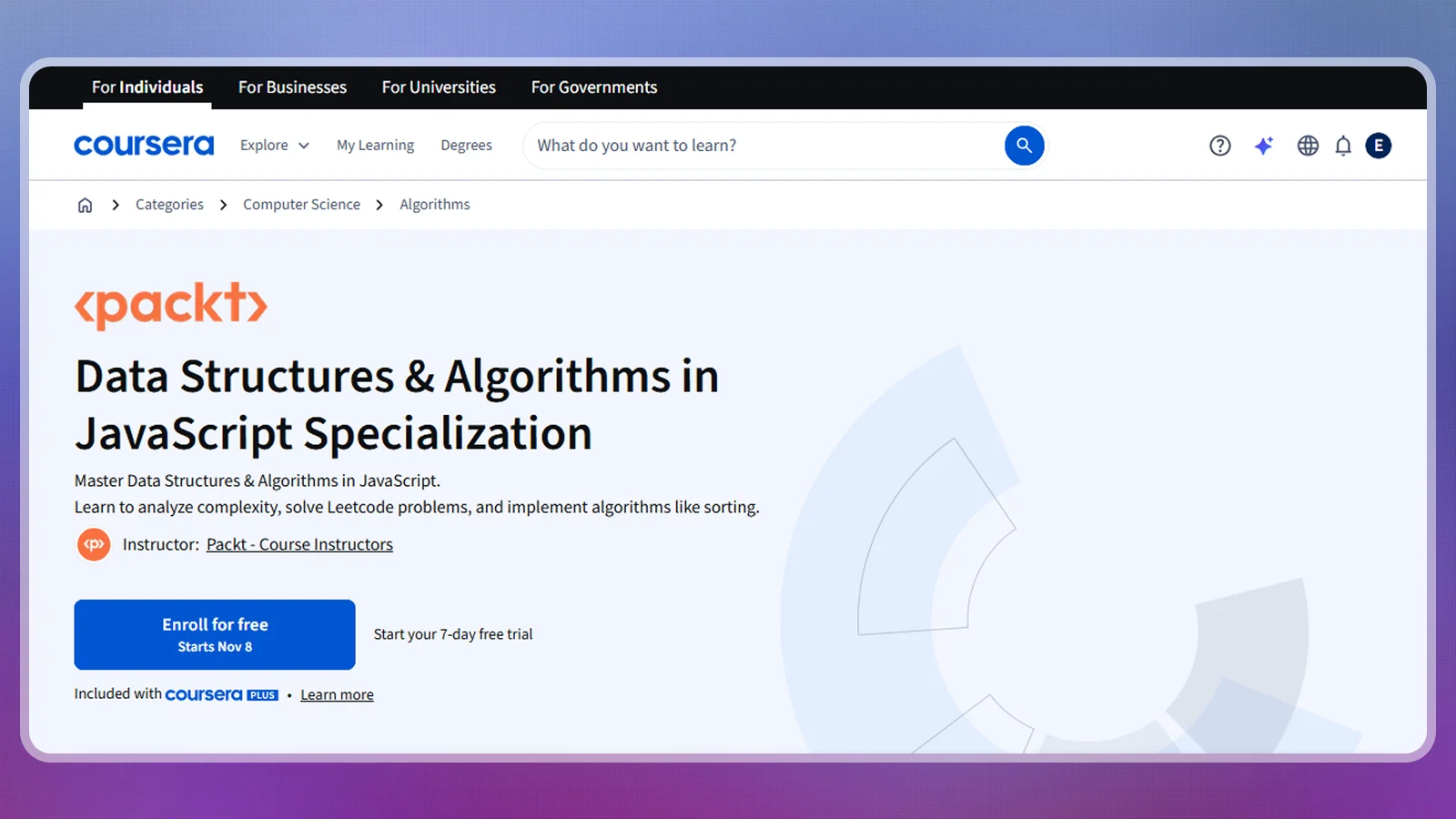
Data Structures & Algorithms in JavaScript Specialization on Coursera is taught by Packt course instructors. It covers arrays, sorting, linked lists, hash tables, stacks, queues, sliding-window techniques, and interview-style problems.
The Coursera page lists four weeks to complete and 28 hours of video content. It also advertises a $239 annual Coursera Plus offer. The Coursera page lists a three-course series that takes about four weeks at 10 hours a week, and its FAQ gives 28 hours of video content. The specialization is included with Coursera Plus, which Coursera advertises at $239 for a year. That is a subscription offer, so compare it as a bundle purchase.
JavaScript functions become building blocks for algorithms here. You should already be comfortable tracing a JavaScript for loop and explaining how an array changes before choosing this JavaScript course.
The provider details show its intermediate focus.
| Provider | Coursera |
| Price | Included with Coursera Plus ($239/year advertised offer) |
| Difficulty | Intermediate |
| Time | About 4 weeks at 10 hours a week, 28 hours of video |
| Certificate | Shareable certificate |
| Rating | Not listed by the provider |
Its value comes from concentrated problem-solving practice. Use written explanations and small test cases alongside your solutions so you can explain why an approach works.
These are the main reasons to choose or skip this JavaScript course.
| Pros | Cons |
|---|---|
| ✅ Focus – Data structures and algorithms ✅ Problem variety – Sorting and collection-based techniques ✅ Progression – Intermediate-level study ✅ Credential – Shareable certificate | ❌ Prerequisites – Assumes language foundations ❌ Billing – Advertised price covers an annual subscription |
Choose this JavaScript course after you can write and debug small programs on your own. Beginners will get more from the introductory options first.
7. Best for Web Foundations: Web Development with HTML5, CSS, and JavaScript Specialization (Coursera)
This JavaScript course bundle is the better fit for beginners who also need HTML and CSS. Its strength is the connection between page structure, visual presentation, and interactive behavior.
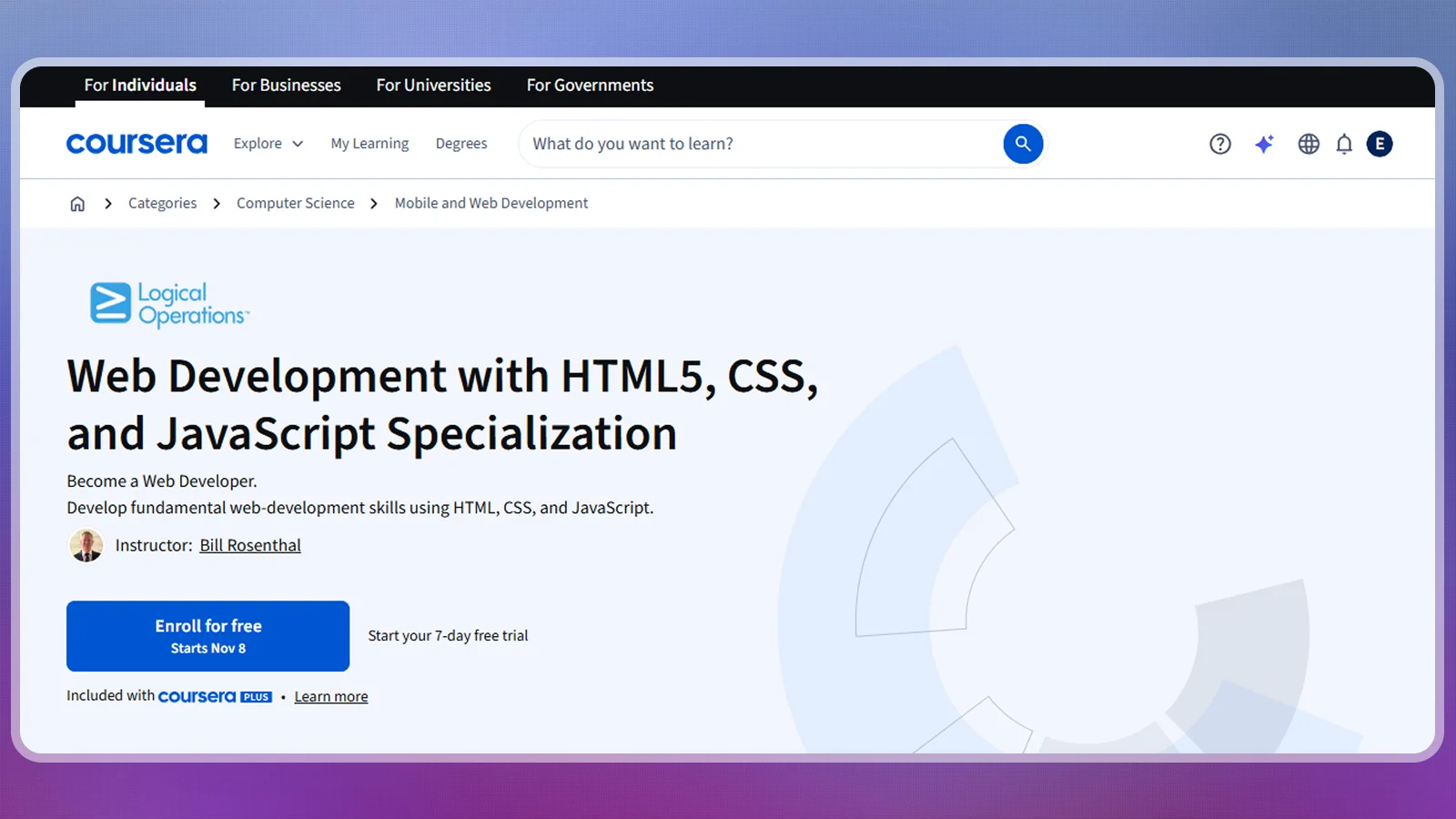
Web Development with HTML5, CSS, and JavaScript Specialization on Coursera combines web foundations with JavaScript browser work. The JavaScript material includes manipulating DOM objects, processing collections, attaching event listeners, and integrating third-party libraries.
The bundle connects JavaScript functions and the JavaScript for loop to page content and user actions. That browser-focused coverage suits learners who need to connect language syntax to interface behavior.
According to Coursera, the specialization is beginner level, takes four weeks to complete at 10 hours a week across four courses, and offers a shareable certificate. The page advertises a $239 annual Coursera Plus offer. Bill Rosenthal teaches it for Logical Operations.
The facts below describe the bundle’s stated scope.
| Provider | Coursera |
| Price | Advertised Coursera Plus annual offer: $239 |
| Difficulty | Beginner |
| Time | 4 weeks to complete at 10 hours a week |
| Certificate | Shareable certificate |
| Rating | Not listed by the provider |
Treat this JavaScript course bundle as a web-foundations route. A game leaderboard page is a useful practice target because it combines HTML content, CSS styling, and JavaScript interaction.
Its broader scope creates a different balance from a language-only course.
| Pros | Cons |
|---|---|
| ✅ Foundations – HTML, CSS, and JavaScript together ✅ Browser practice – DOM objects and events ✅ Beginner level – An accessible starting route ✅ Credential – Shareable certificate | ❌ Breadth – Study time covers multiple subjects ❌ Billing – Advertised price covers an annual subscription |
Choose this bundle if you want to understand how a webpage works as a whole. A dedicated JavaScript course is more direct if HTML and CSS are already familiar.
Free JavaScript Courses and Resources
Free JavaScript courses provide enough material to begin practicing before you buy anything. The best JavaScript courses earn their price through a learning experience that suits you, while free resources let you build the foundations first. For a step-by-step plan before you pick a course, see our guide on how to learn JavaScript.
These routes cover different ways to study:
- Interactive curriculum: freeCodeCamp offers structured JavaScript lessons and certification challenges. Work through the exercises, then reuse the concepts in a small project.
- Written explanations: The Modern JavaScript Tutorial from javascript.info covers fundamentals, error handling, promises, asynchronous code, and the DOM. It is useful when you want a written explanation beside your code.
- Project-oriented study: The Odin Project‘s Full Stack JavaScript path connects language foundations with more advanced projects. It suits learners who want their study organized around building.
- Beginner course: Introduction to JavaScript from Sololearn is a free course for learners with no coding experience.
Use free resources to practice JavaScript functions and trace a JavaScript for loop without copying the answer. Then decide which parts of a paid JavaScript course would improve your learning.
Codecademy adds an interactive guided format, while W3Schools packages study with an exam and certificate. The Complete JavaScript Course offers a broad video-led sequence. Paying makes sense when one of those formats solves a specific difficulty in your current routine.
What To Look for in a JavaScript Course
Your next practical goal should decide which JavaScript course you choose. The best JavaScript courses for a first browser interaction differ from those for algorithm preparation or a certificate. That goal is the starting point for how to choose a JavaScript course.
Use these factors to compare the remaining choices:
- Current level: Begin with language foundations if you cannot yet explain a condition, loop, or function. Intermediate JavaScript courses assume that knowledge is usable.
- Budget and billing: Compare free study, a course-and-exam purchase, and an annual subscription separately. The same headline price can represent a different purchase.
- Available study time: Distinguish video runtime from the work needed to complete exercises. A JavaScript course fits your schedule only when you can also code.
- Credential needs: Decide who will use the certificate and for what purpose. Keep projects beside the credential so your work shows the skill. W3Schools, for example, sets the certification level by exam score.
- Hands-on practice: Look for tasks that require changing inputs, reading errors, and building features. JavaScript functions should become tools you can use without a prompt.
- Teaching fit: Compare the instructor’s explanations with your preferred format. Some learners progress through video, while others need interactive or written exercises.
- Access terms: Read the purchase, subscription, and refund terms before enrolling. Choose access that matches how you plan to study. W3Schools lists a 14-day money-back guarantee if you haven’t used an exam attempt.
A useful test is to describe the project you want to finish after the JavaScript course. If the syllabus connects directly to it, the choice has a purpose.
Practice JavaScript Functions and the JavaScript for Loop
A suitable JavaScript course should help you explain both concepts in your own words. JavaScript functions package an operation for reuse, while a JavaScript for loop repeats work under a stated condition.
Try a score-processing task after a lesson. Write a function that accepts a score collection, loop through it, and return a useful result. Then change the input and predict the output before running the code.
That small test is more useful than counting completed videos. The best JavaScript courses give you a route to that kind of independent work, and your practice turns the route into a skill.

Are JavaScript Courses Worth It?
Yes, JavaScript courses are worth it for learners who need structure, guided practice, or a credential. A clear sequence helps you connect JavaScript functions, loops, and browser interaction instead of collecting disconnected explanations.
The best JavaScript courses also reduce the number of learning decisions you make during a study session. You can focus on the next exercise, test your understanding, and return to an explanation when the code behaves differently from your prediction.
A JavaScript course still needs to lead into work on your own. Build a small project, make changes without a tutorial, and practice finding errors. A certificate can record completed study, but project work shows how you apply it. No course can guarantee a job offer, and the BLS outlook for web developers describes the work and how people enter the role.
Start with a free JavaScript course if you are still exploring the subject. Pay when a particular format, organized syllabus, or exam package gives you a clear reason to continue.
Final Verdict
The Complete JavaScript Course is the strongest broad video-led choice, while Learn JavaScript is easier to approach through interactive beginner exercises. freeCodeCamp is the best starting route on a limited budget. A paid budget winner is harder to justify without comparable published course prices.
Choose W3Schools if the exam-and-certificate package is your priority. Learners who already know the language should consider the algorithm specialization, while those missing HTML and CSS will benefit from the web-foundations bundle.
The best JavaScript courses match your next task and the way you learn. Pick a focused route, keep writing code, and move to another course when you can name the gap it will fill.
FAQs
Learn JavaScript on Codecademy is the beginner pick among these best JavaScript courses because it pairs explanations with interactive exercises. For a broader video-led path, Udemy lists 71 hours for The Complete JavaScript Course.
Yes, JavaScript courses are useful when you need a structured syllabus, guided exercises, or a certificate. Their value depends on applying the lessons through coding practice and projects on your own.
Yes, freeCodeCamp offers a free JavaScript curriculum with interactive lessons and certification challenges. Written resources like The Modern JavaScript Tutorial can help you revisit concepts as you practice.
Learning time depends on your starting point, practice schedule, and goal. Listed course commitments cover lessons or guided study, while building and debugging your own projects takes further practice. Listed lengths range from 15 hours for Learn JavaScript on Codecademy to 80 hours for the W3Schools course, plus time for your own projects.
Yes, some do. Codecademy lists a completion certificate with Plus or Pro, W3Schools includes an exam and certificate, and both Coursera specializations offer shareable certificates. freeCodeCamp offers a free certification. The Udemy listings show none.
JavaScript functions package reusable operations, while a JavaScript for loop repeats instructions under a stated condition. Both are foundations taught by the best JavaScript courses.