


How Do I Become a Game Developer? Tools and Steps for 2026

Eneba Hub contains affiliate links, which means we may earn a small commission if you make a purchase through them—at no extra cost to you. Learn more


START WITH A PROJECT
Try Coursera for a beginner game-development specialization with a structured learning path.
How do I become a game developer? Start by learning programming fundamentals and getting comfortable with a game engine. Building playable projects is essential for developing your skills and preparing for professional work. With a median annual salary of around $115,000 in the US, game development can also be a rewarding career for those passionate about creating games.
You can begin today with Godot, a free game engine that’s great for beginners. Try creating a simple scene where you can control a character, then gradually experiment with more advanced features. There’s no need to invest in expensive courses before you’ve explored the basics.
This guide covers the qualifications and tools you’ll need, alongside salary expectations and a practical roadmap to become a game developer. You’ll also discover recommended courses to help you build your skills and prepare for opportunities in the gaming industry.
Jump to:
What Is a Game Developer?
A game developer brings video games to life through programming and technical problem-solving. They create the systems that make games work, from character movement to how players interact with the world. Some work at major game studios, while others join smaller indie teams or develop their own projects.
If you want to become a game developer, you’ll need to understand how gameplay ideas turn into working features. Even something as simple as making a character jump involves writing code and testing how it behaves. It’s a creative career that combines technical skills with hands-on experimentation.
What Does a Game Developer Do?
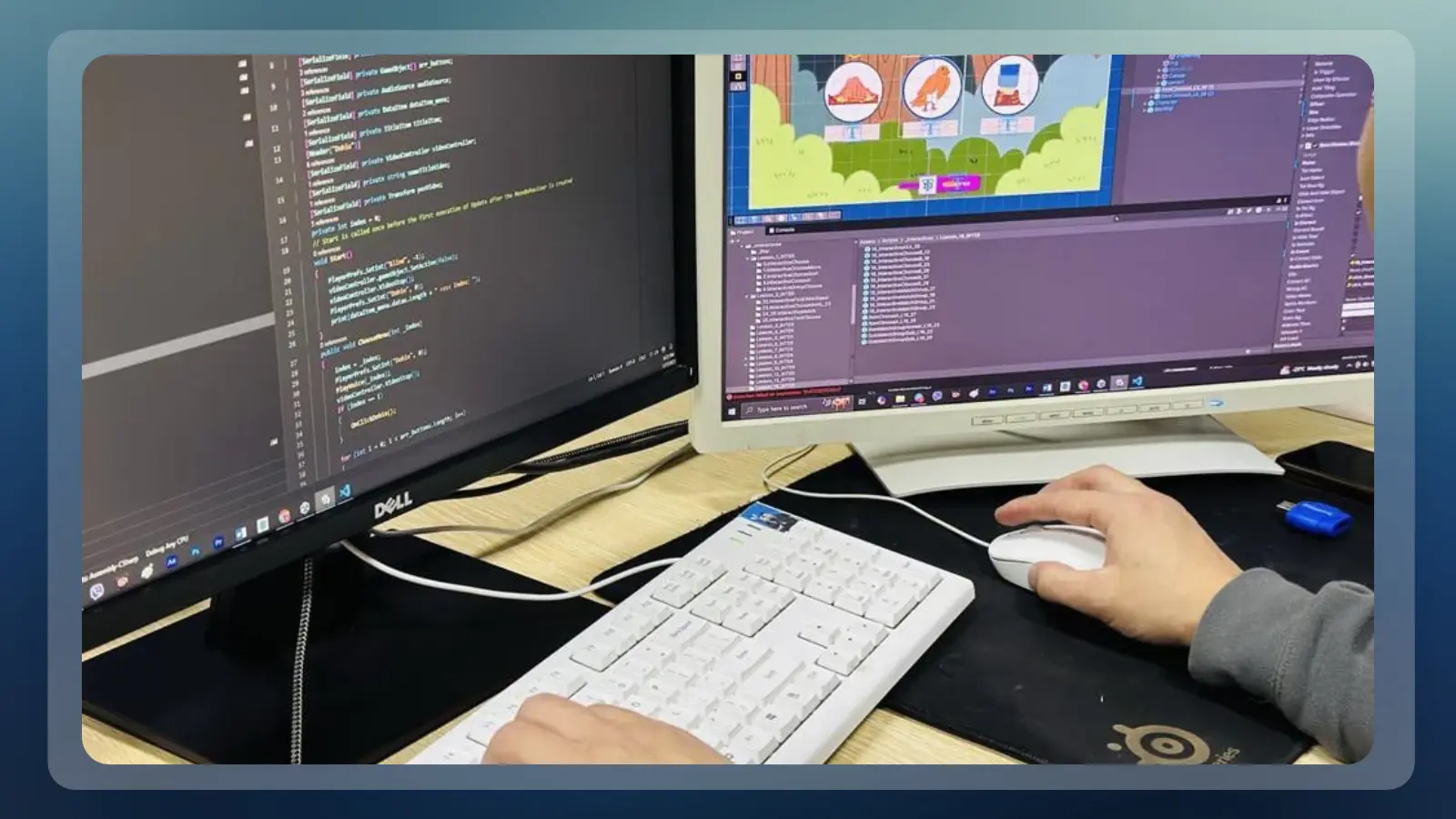
A game developer turns creative ideas into features that players can actually interact with. Their work involves writing code and testing gameplay to make sure everything runs as intended. The daily responsibilities vary depending on the studio and project, but most developers handle tasks like these:
- Writing gameplay code: Creating the systems behind character movement and combat. Developers often use C# in Unity, while Unreal Engine supports C++ and visual scripting for gameplay features.
- Building prototypes: Creating early versions of gameplay ideas to see how well they work. Simple test environments can help developers identify problems before the team invests time in finished artwork.
- Integrating art and audio: Adding animations and sound effects to the game, then making sure they respond correctly to player actions. This often involves working closely with artists and sound designers.
- Debugging and optimizing: Finding and fixing issues that affect gameplay or performance. Developers also improve how efficiently a game runs, especially when complex features cause slowdowns.
- Reviewing player behavior: Using playtesting feedback to understand how people interact with the game. These insights help developers improve controls and adjust difficulty where needed.
A significant part of game development involves testing your work and making improvements based on feedback. Even a simple feature can take several attempts to get right. If you enjoy solving technical challenges and seeing your ideas become playable, this process can be one of the most rewarding parts of the job.
Roles in Game Development
The main technical tracks are gameplay programming, engine/tools programming, and technical art. They share problem-solving skills but require different portfolio evidence.
Use the work you want to demonstrate as the first filter:
|
Role |
What You’d Do |
How Much Code |
First Portfolio Piece |
|---|---|---|---|
|
Gameplay programmer |
Build movement, combat, and interface logic |
High: gameplay scripting |
A small platformer or top-down shooter |
|
Engine/tools programmer |
Create systems and editors for other developers |
Very high: underlying systems |
A save/load system or level editor |
|
Technical artist |
Connect art production with engine requirements |
Moderate: scripts and shaders |
A character animation or shader demonstration |
Gameplay programming is a great starting point for beginners because you can see your code come to life as you build a game. It also helps you develop practical skills that can support your journey toward becoming a game developer.
Before exploring career opportunities, take some time to understand the different roles and their salary expectations. If you’re ready to build your skills, the Game Design and Development with Unity Specialization is a useful starting point for structured, hands-on learning.
Pros and Cons of Becoming a Game Developer
Becoming a game developer can be a rewarding career if you enjoy creative problem-solving and turning ideas into playable experiences. However, the job also comes with technical challenges and plenty of revisions. Here’s a closer look at the advantages and drawbacks before you decide to pursue this career.
| Pros | Cons |
|---|---|
| ✅ See your ideas come to life – turn your code into gameplay features that players can experience firsthand. ✅ Build a strong portfolio – completed games give you practical projects to show potential employers. ✅ Accessible learning tools – free engines like Godot make it easier to start without a large investment. ✅ Transferable technical skills – programming and debugging experience can be useful in other software development roles. ✅ Different career paths – explore gameplay programming or technical art based on your interests. | ❌ Demanding deadlines – some studios have intense production schedules, especially near major releases. ❌ Frequent technical challenges – fixing bugs and revising features can take up a large part of your workday. |
Game development can be a great fit if you enjoy learning new technologies and working through technical challenges. Start with a small project to see how much you enjoy the process before investing in expensive courses or committing to a longer education path.
Game Developer Qualifications
You don’t need a specific game developer degree to get started, although some employers do require one. What really matters is having the skills to build a working game and explain how you built it. If you’re wondering how to become a game developer without formal education, there are several ways to build those skills.
Here’s what you should focus on:
- Education: A degree in computer science or game development can give you a solid foundation. Look for programs where you get to write actual code and work on game projects with other students. These experiences can help you get comfortable with the kind of work you’ll encounter at a studio.
- Alternative paths: You can learn plenty on your own through online courses and tutorials. Platforms like Coursera and Udemy have beginner-friendly lessons that let you practice at your own pace. Just make sure you’re building your own projects alongside the tutorials.
- Portfolio or experience: Your portfolio is where you get to show off what you’ve built. Include a few playable games and explain which features you worked on. If you ran into a tricky bug or solved a technical problem, share how you handled it. Employers appreciate seeing your thought process.
- Certifications: Certificates can be a nice addition to your resume, especially if they show you’ve learned a relevant skill. Some professional certifications involve separate exams, while online course certificates usually confirm completion. Neither automatically qualifies you for a job, so keep your focus on practical experience.
- Soft skills: You’ll spend plenty of time working with other developers, so getting comfortable with teamwork is important. Learn to explain problems clearly and take feedback without getting discouraged. Being able to work through bugs with teammates is a useful skill in any game studio.
Your portfolio is one of the strongest ways to prove your skills. Start with small games you can actually finish, then work toward more ambitious projects as your confidence grows. You don’t need a massive game to impress someone. A polished project with well-written code can already say a lot about your abilities.
The Engines and Tools Game Developers Rely On
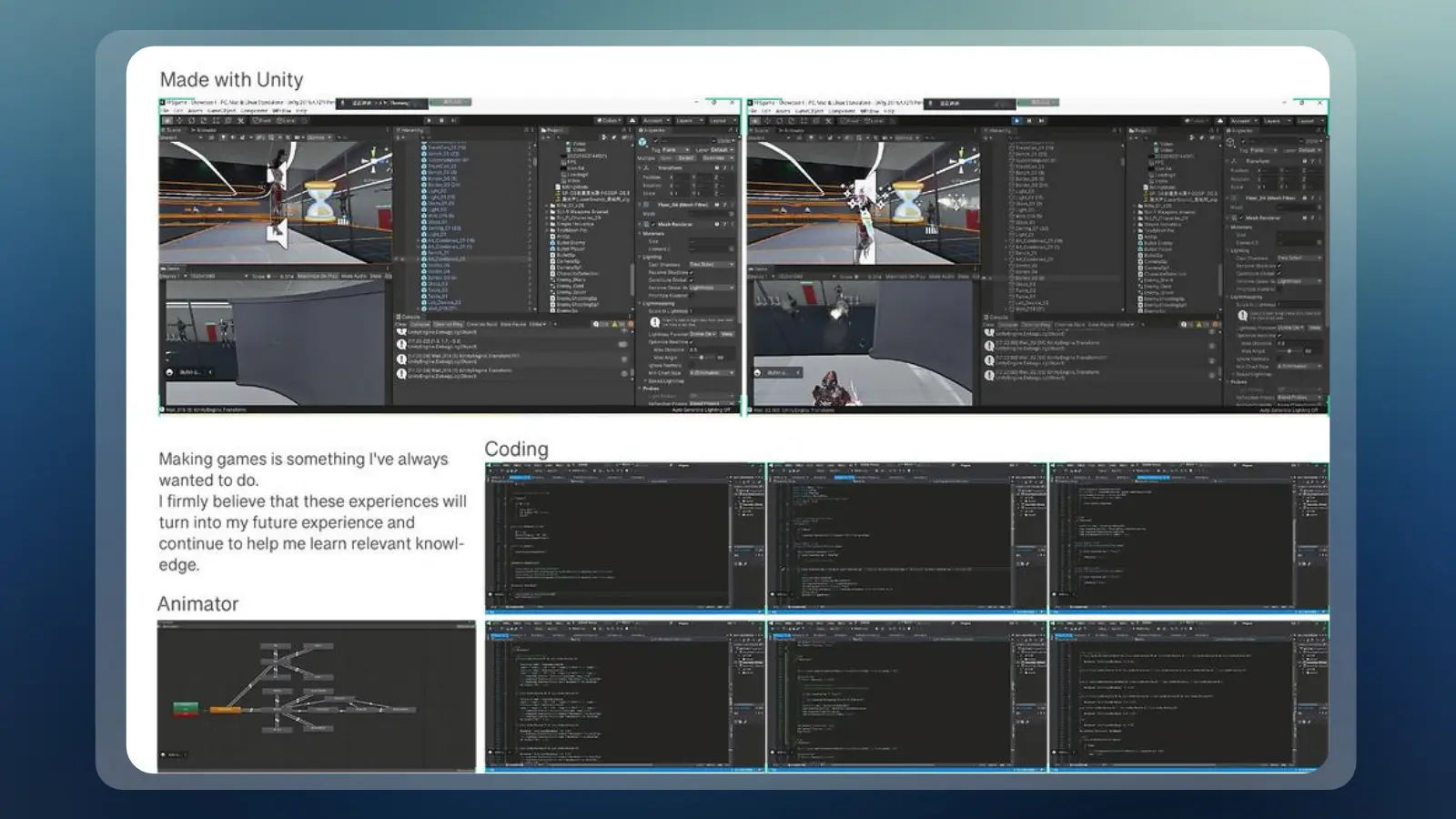
Choosing the right game engine is an important step when you’re learning how to become a game developer. Start with one tool that matches the type of game you want to create, then get comfortable with its features before exploring more advanced software.
Here are six popular options worth considering:
|
Tool |
Best for |
Programming Approach |
Price |
|---|---|---|---|
 |
Beginner-friendly 2D and 3D game development |
GDScript, C# |
Free, open-source |
 |
Beginners who want to create 2D games without traditional coding |
Visual event system; optional JavaScript |
Limited free edition; paid subscription |
 |
Cross-platform 2D and 3D development |
C# scripting; visual scripting |
Free Personal plan for eligible users; paid Pro plans |
 |
High-quality 3D games and advanced visual effects |
C++ and Blueprint visual scripting |
Free to start; 5% royalty on eligible game revenue above $1 million |
 |
2D games and indie development |
GML Code and GML Visual |
Free for non-commercial use; $99.99 one-time Professional license for commercial use |
 |
Complete beginners learning programming through simple games |
Block-based visual programming |
Free |
You don’t need to learn every engine to become a game developer. Godot is a great starting point if you want free software, while Unity is worth exploring if you’re interested in the recommended courses later in this guide. Focus on completing your first playable project before adding another engine to your workflow.
Game Developer Salary and Career Progression
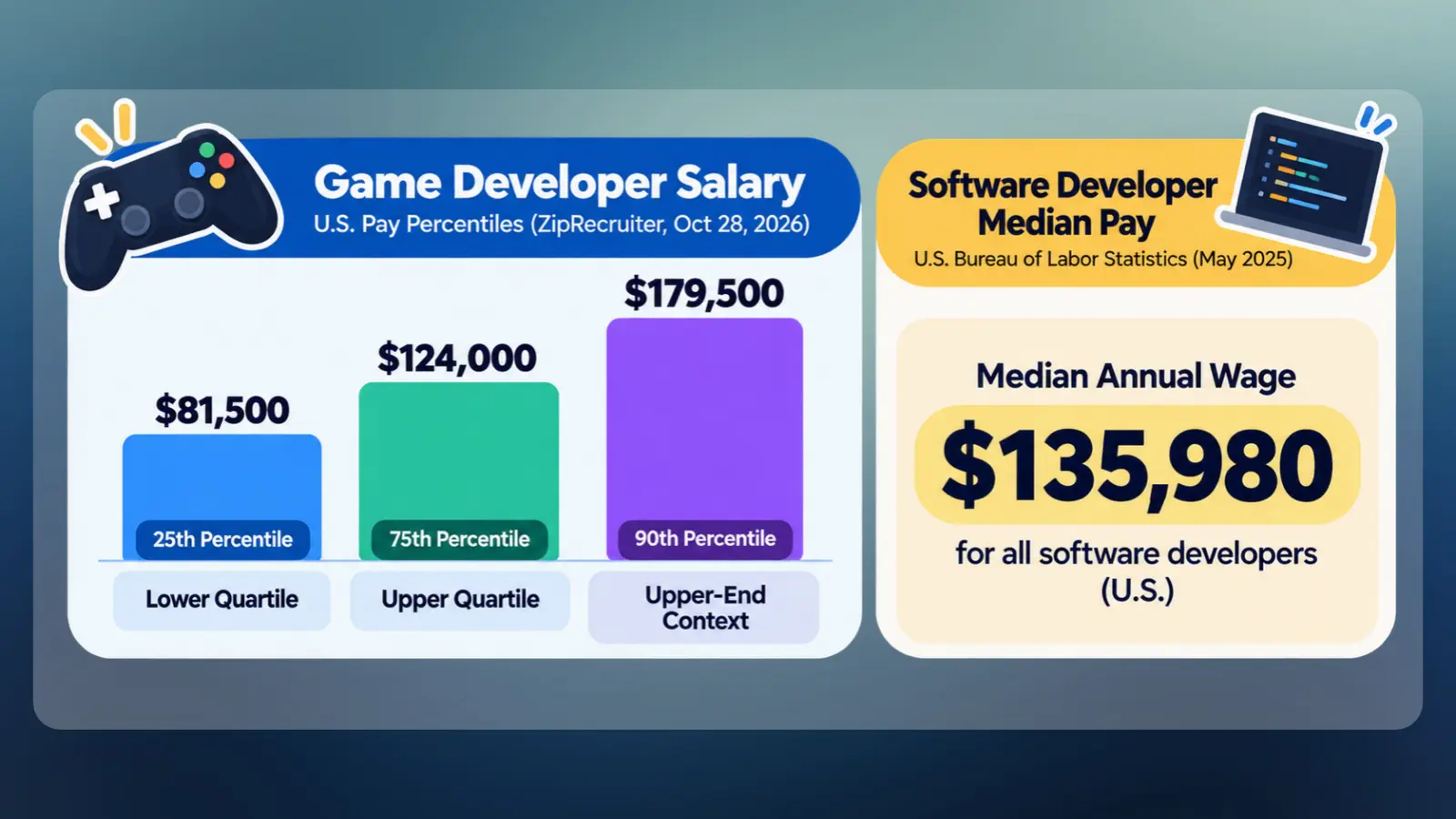
Game development can be a rewarding career with plenty of room to grow as you gain experience. In the US, the median game developer salary is around $115,000 per year, although your actual earnings depend on your skills and the studio you work for.
Here’s a closer look at the reported annual salary range:
- Lower earners (25th percentile): Around $81,500 per year.
- Median salary: Approximately $115,000 per year.
- Higher earners (75th percentile): Around $124,000 per year.
- Top earners (90th percentile): Around $179,500 per year.
As you build experience, you can move into senior development positions and take responsibility for larger gameplay systems. Some developers eventually become technical leads who guide other programmers, while others focus on specialized areas such as graphics programming or game engine development.
Building a strong portfolio and gaining experience with completed games can help you pursue better-paying opportunities over time. When exploring game developer jobs, consider the responsibilities and working conditions alongside the salary to find a role that fits your career goals.
How Do I Become a Game Developer? A Step-by-Step Guide
Becoming a game developer starts with learning the basics and putting your skills into practice. You don’t need to build an ambitious game right away. Focus on small projects that help you understand how games work, then gradually develop the skills needed to create more complex experiences.
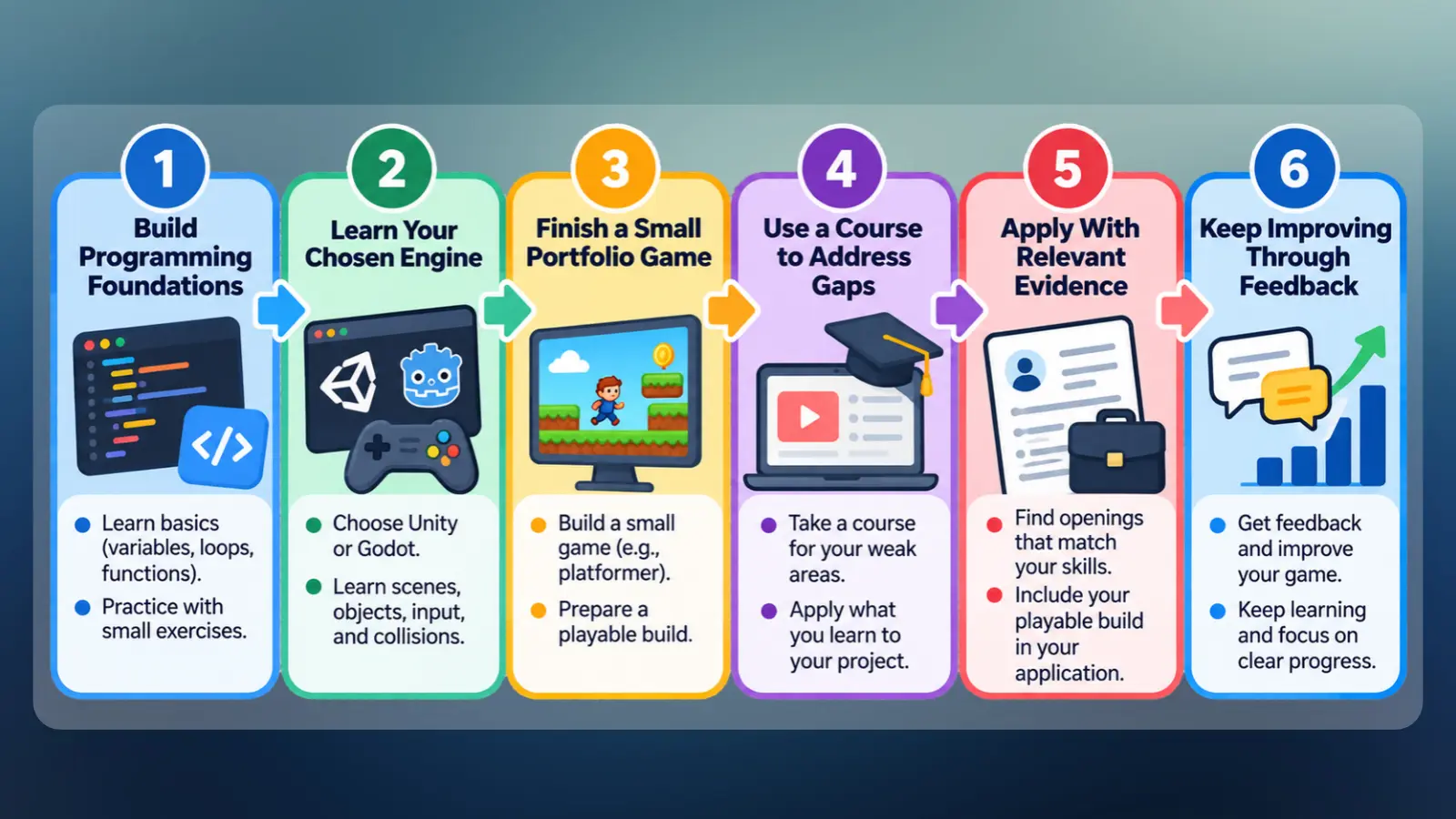
Step 1: Build Programming Foundations
Start with basic programming concepts like variables and loops before jumping into complicated game mechanics. Practice writing simple code that controls how a game behaves, such as tracking a character’s health or calculating damage.
Try explaining what your code does in your own words before moving on to the next exercise. This helps you understand the logic behind each feature instead of relying entirely on tutorials. A strong programming foundation will make it easier to work with game engines later.
Step 2: Learn Your Chosen Engine
Pick a game engine like Unity or Godot and spend time getting comfortable with its features. Learn how to create scenes and handle player input, then experiment with basic interactions.
Follow beginner tutorials to understand the workflow, but challenge yourself to build something independently afterward. You could change how a character moves or introduce a new gameplay mechanic. These small experiments will help you develop confidence with the engine.
Step 3: Finish a Small Portfolio Game
Once you’re comfortable with the basics, start working on a small game you can actually finish. A simple platformer or top-down shooter is a good choice because it lets you practice essential gameplay systems without taking on an overwhelming project.
Give your game a clear objective and make sure players can complete it. Ask someone to test it and pay attention to any confusing controls or technical issues. Once it’s polished, add the finished project to your portfolio with a short explanation of what you built.
Step 4: Use a Course to Address Gaps
Online courses can help when you run into concepts that are difficult to understand on your own. Look for lessons that address your current challenges rather than starting another course that covers everything you’ve already learned.
If you’re working with Unity, the C# Programming for Unity Game Development Specialization course can help strengthen your scripting skills. Apply what you learn directly to your existing projects so you can see how the concepts work in practice.
Step 5: Apply With Relevant Evidence
Once you’ve completed a few projects, start exploring entry-level game developer positions that match your skills. Read each job description carefully and pay attention to the programming languages or engines employers expect you to know.
Include playable projects in your portfolio and explain which features you developed yourself. If you’ve worked with a team, make your contribution clear. It’s also worth researching game developer salary expectations so you can approach job applications with realistic goals.
Step 6: Keep Improving Through Feedback
Your progress doesn’t stop after completing your first game. Share your projects with other developers and ask for feedback on how they play. Use those suggestions to improve your code and fix issues you may have missed.
As you gain experience, you can experiment with more advanced game systems or explore a specialization that interests you. Keep track of your progress and update your portfolio with your strongest work. Consistent practice and completed projects will help you continue developing your skills over time.
Recommended Courses
A structured course can make learning game development easier, especially when you’re unsure where to start. Choose a course that matches your current skills and the type of game you want to create. Some focus on programming fundamentals, while others help you get comfortable with game engines through practical projects.
For example, the Game Design and Development with Unity Specialization takes around two months at ten hours of study per week. Meanwhile, the Unity Game Development Master Class includes approximately 19 hours of video lessons. Keep in mind that you’ll need extra practice time to apply what you’ve learned.
These options connect with tools introduced above:
|
Course |
Provider |
What It Covers |
Study Format |
|---|---|---|---|
|
Game Design and Development with Unity Specialization |
 |
Unity game design and development |
Guided specialization |
|
Unity Game Development Master Class |
 |
Beginner Unity game development |
Self-paced video course |
|
C# Programming for Unity Game Development Specialization |
|
C# programming for Unity |
Programming specialization |
|
Game Design: Art and Concepts Specialization |
|
Design theory and conceptual development |
Design specialization |
|
Introduction to Basic Game Development using Scratch |
|
Visual programming foundations |
Guided project |
Courses can give you a solid foundation, but hands-on practice is what helps you improve. Apply what you’ve learned to your own games and build projects that demonstrate your skills.
Alternate Careers in Game Development
If game development doesn’t quite suit your interests, there are other tech careers worth considering. Your programming skills can also open doors to roles outside the gaming industry.
- General software developer: Builds software for different industries. A good fit if you enjoy programming but want to work on other types of applications.
- Software QA analyst or tester: Tests software and identifies bugs before release. The US median annual salary is around $104,300.
- Computer programmer: Writes and maintains code for software applications. This path focuses more on technical tasks and may involve less creative input.
Game development skills can give you a useful foundation for these careers, although each role may require additional training or experience.
Final Verdict on Becoming a Game Developer
Game development can be a rewarding career if you enjoy creative problem-solving and building playable experiences. Start with a beginner-friendly engine and complete small projects before moving on to more advanced work. Online courses can help you develop your skills along the way.
The career may feel challenging if you prefer creative work without technical troubleshooting or need immediate income. Other software careers could be worth exploring if you enjoy programming but aren’t particularly interested in games.
If you ask, “How do I become a game developer?”, focus on learning the fundamentals and building a portfolio of finished games. Keep improving through feedback, and use structured courses to strengthen the skills you need for professional opportunities.
FAQs
To become a game developer, start by learning programming fundamentals and getting comfortable with a game engine like Unity or Godot. Build small, playable projects to practice your skills, then create a portfolio that shows potential employers what you can do.
A game developer in the US earns a median salary of around $115,000 per year, although actual pay varies by experience and employer. Senior developers may earn more, especially when they take on leadership roles or work on larger projects.
Learning game development can take several months to a few years, depending on your experience and learning path. Short courses can help you understand the basics, but building a strong portfolio and becoming ready for professional work usually takes additional practice.
No, you don’t necessarily need a degree to become a game developer. Some employers prefer candidates with computer science or game development degrees, while others consider self-taught developers with strong programming skills and completed projects.
The most important game developer skills include programming and debugging, along with familiarity with a game engine. You’ll also need problem-solving abilities and good communication skills, especially when working with other developers on larger projects.
Game development can be a rewarding career in 2026 if you enjoy programming and creative problem-solving. The industry provides opportunities to work on different types of games, although competition for jobs and demanding production schedules are worth considering.