


Best Courses for Trading in 2026: 6 Picks for Beginners

Eneba Hub contains affiliate links, which means we may earn a small commission if you make a purchase through them—at no extra cost to you. Learn more



COURSE SHORTLIST
Start with Learn Options Trading Strategies on Coursera for a structured options pathway. Complete beginners can start with the free Traders' Academy beginner path from Interactive Brokers instead.
The best courses for trading include Learn Options Trading Strategies for structured options study, the Traders’ Academy beginner path for complete beginners, and a free Udemy technical analysis course for chart study. Coursera lists the options for 2 weeks at 10 hours a week. Before enrolling, consider which market you want to trade and how much you’re comfortable spending on a course.
These trading courses suit beginners and early-intermediate learners, from those after online classes for stock trading to those studying options and currency markets. The selection runs from free introductions to a $333 certificate program. The best courses for trading can help you build essential knowledge before moving on to more specialized topics, especially when it comes to understanding trade execution and potential losses.
Jump to:
Best Courses for Trading at a Glance
The best courses for trading cover different subjects and skill levels, so it’s worth choosing one that aligns with your learning goals. These online trading lessons range from a first introduction to focused options study and an exam-assessed certificate.
|
Course |
Provider |
Best for |
|---|---|---|
|
Learn Options Trading Strategies |
 |
Best overall |
|
Free Trading and Technical Analysis Course: Forex and Stocks |
 |
Best free option |
|
Master Trading with Indicators and Chart Patterns |
|
Best for technical analysis |
|
Derivatives Trading and Risk Management Specialization |
|
Best for options and forex |
|
Stock Trading Professional Certificate |
 |
Best certificate |
|
Traders’ Academy Beginner Path |
 |
Best for beginners |
The trading courses run from the structured overall pick through free, specialty, certificate, and beginner alternatives.
What Trading Actually Involves
Trading involves buying and selling financial assets with the aim of profiting from changes in their market prices. Stocks represent ownership in companies, options are contracts with defined rights, and currency trading, the focus of forex trading training courses, involves exchanging one currency against another.
Understanding the risks of each trade is an essential part of learning how financial markets work. A useful trading course explains order types, borrowing, and risk controls alongside charts. Leverage means using borrowed exposure, which can increase both gains and losses.
Online courses on share trading should explain how orders reach the market and how transaction costs affect a trade, and forex trading training courses should cover currency pairs and the risks of leverage. These lessons become more valuable when you understand the reasoning behind each trading decision and can apply it to practical examples.
People explore trading for personal interest or potential careers in finance, although it’s important to recognize the risk of significant financial losses. This article is general information, not financial advice.
How These Trading Courses Were Chosen
These trading courses were selected based on their educational value and suitability for different experience levels, with particular attention to the topics they cover. The best courses for trading explain what you will study and make the commitment understandable.
Each course was evaluated using the following criteria:
- Content: Foundations, chart reading, and risk management appropriate to the subject.
- Provider and instructor: A named education provider and a clear teaching focus.
- Ratings: Provider-published scores with their review counts and scope.
- Cost: Published prices and free options.
- Practice: Opportunities to apply online trading lessons.
- Credentials: Stated certificates and assessment requirements.
- Fit: A manageable format for learning to trade.
Online courses on share trading and forex trading training courses are evaluated based on their intended audience and learning objectives, since ratings across different platforms aren’t always directly comparable.
The Best Courses for Trading, Compared
The best courses for trading help learners develop practical skills that match their current experience and trading interests. Beginners looking for online classes for stock trading should start with general mechanics, then choose a specialty trading course once they understand its vocabulary and risks.
1. Best Overall: Learn Options Trading Strategies (Coursera)
Learn Options Trading Strategies offers a coherent options pathway that connects contract basics with more complex strategies. This course is best suited to learners who already have an interest in options trading and want to explore more advanced strategies.
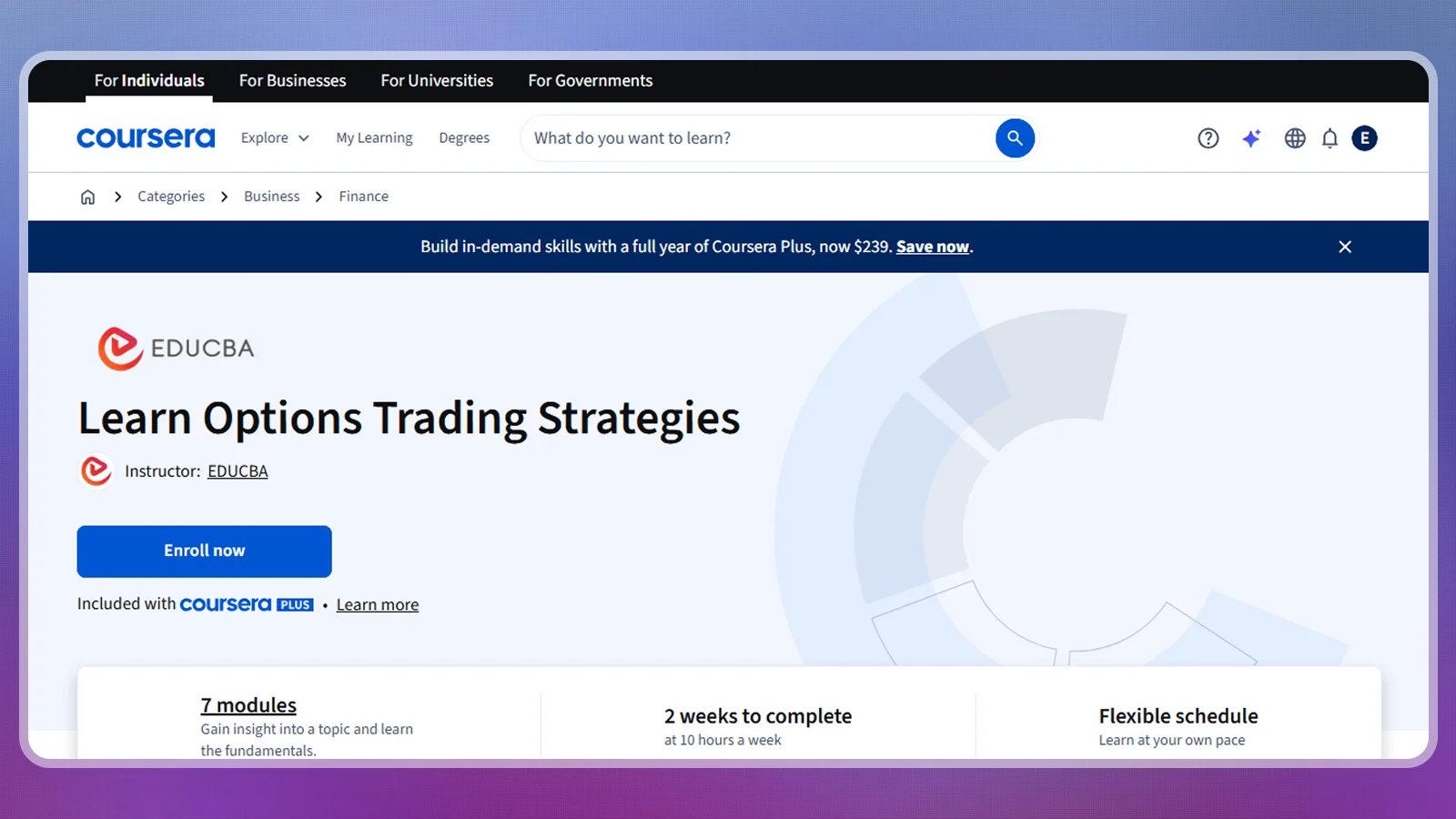
Available through Coursera, this trading course covers payoff structures, hedging, and speculation. Hedging involves using financial positions to help reduce the risk of losses elsewhere in a portfolio. The syllabus progresses to strategies like straddles and strangles, which combine options contracts.
According to Coursera, the course contains 7 modules. Learners who complete the course can earn a shareable certificate to document their studies. The NYIF selection below instead requires an exam for its certificates, so choose between them based on your assessment needs.
Here’s what to expect in terms of course duration and requirements:
| Provider | Coursera |
| Price | Included with Coursera Plus |
| Difficulty | Not listed by the provider |
| Time | 2 weeks at 10 hours a week |
| Certificate | Shareable certificate |
| Rating | Not listed by the provider |
The structure is its main advantage, with a clear trade-off in subject breadth:
| Pros | Cons |
|---|---|
| ✅ Connected syllabus – contracts lead into strategy construction ✅ Risk applications – includes hedging and payoff structures ✅ Multi-leg strategies – covers spreads, straddles, butterflies, and condors ✅ Regular assessments – 28 assignments across 7 modules ✅ Recently updated – the page lists a June 2026 update | ❌ Narrow starting point – concentrates on options ❌ No reviews yet – the page shows no rating |
If you’re completely new to financial markets, consider learning the basics of stock trading before exploring options strategies. Options strategies also address a different need from forex trading training courses focused on currency-market fundamentals.
These online trading lessons work best when you sketch each strategy’s possible outcomes before moving on. These diagrams can help you understand potential gains and losses before applying a strategy in simulated trades.
2. Best Free Option: Free Trading and Technical Analysis Course: Forex and Stocks (Udemy)
Free Trading and Technical Analysis Course: Forex and Stocks suits readers who want chart-focused instruction across different markets. Its emphasis is useful for sampling technical analysis before committing to a longer trading course.
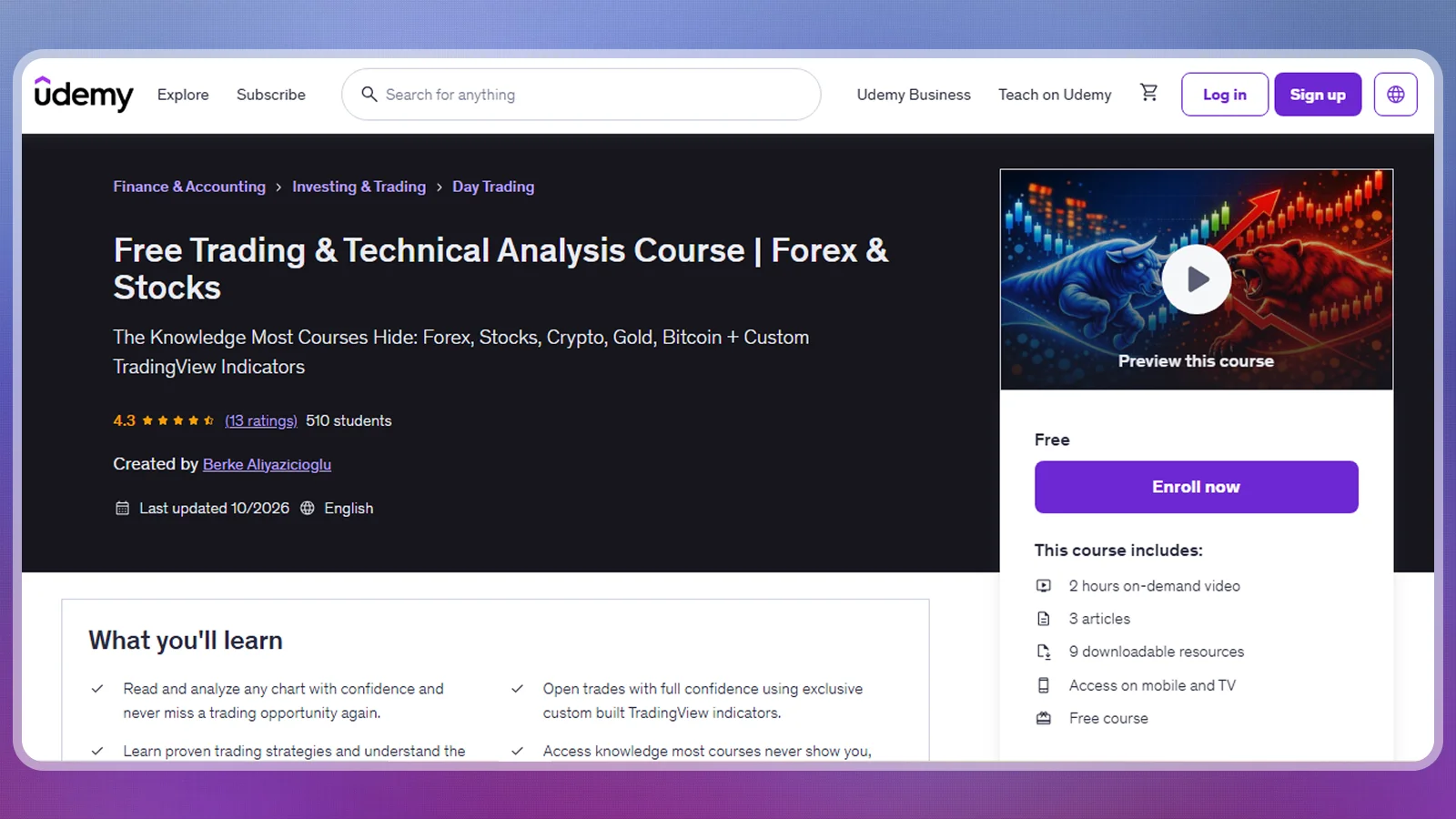
This Udemy trading course introduces chart reading, terminology, and custom TradingView indicators. It’s a practical starting point for exploring technical analysis before enrolling in a more comprehensive trading course. Examples cover forex, stocks, and crypto.
Udemy lists 1 hour 57 minutes across 23 lectures, with a rating of 4.3 from 13 ratings. Since the rating comes from a small number of reviews, it’s worth checking the syllabus carefully before deciding if the course suits your needs.
Here’s a quick overview of what the course includes:
| Provider | Udemy |
| Price | Free |
| Difficulty | No prior trading experience needed |
| Time | 1 hour 57 minutes, 23 lectures |
| Certificate | Not listed by the provider |
| Rating | 4.3 from 13 ratings |
The course introduces several markets, although its short duration limits how deeply it can explore each topic.
| Pros | Cons |
|---|---|
| ✅ Multiple markets – examples include forex and stocks ✅ Chart focus – introduces indicators and terminology ✅ Core tools – covers candlesticks, support and resistance, Fibonacci, and RSI ✅ Extra material – 3 articles and 9 downloadable resources ✅ Custom indicators – the instructor’s own TradingView indicators | ❌ Broad scope – several markets share a short format |
This free trading course can help you learn the language of charts, but pattern recognition needs repeated practice. Take time to understand what each indicator measures before experimenting with it in practice.
A stock trading course may then help connect chart examples with stock-specific mechanics, while deeper forex study calls for forex trading training courses with more currency-risk coverage. Keep notes on your chart observations and explain the reasoning behind each interpretation to develop a more consistent approach.
3. Best for Technical Analysis: Master Trading with Indicators and Chart Patterns (Coursera)
Master Trading with Indicators and Chart Patterns is the focused choice for readers who already understand basic trade mechanics. This trading course takes a closer look at technical indicators and how traders interpret chart patterns.
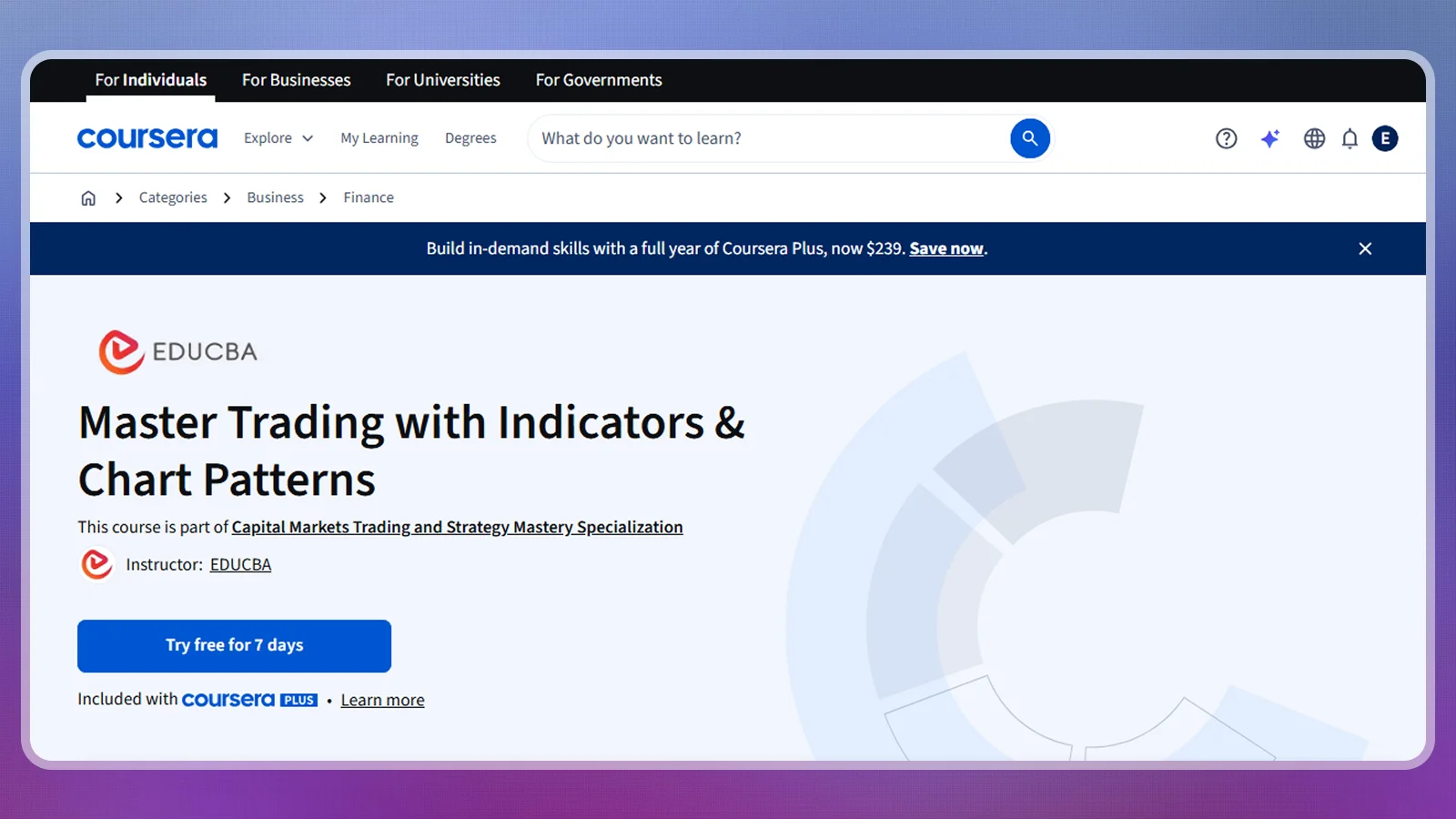
The Coursera trading course syllabus covers moving averages, candlestick analysis, and breakout patterns. It also introduces MACD, a momentum indicator, and ATR, a measure of price volatility. These indicators can help you understand market behavior, although you’ll still need to evaluate what their signals mean in context.
Coursera lists a completion estimate of 1 week and a shareable certificate. Keep in mind that free enrollment may not include access to the certificate.
Here’s a breakdown of the course’s key details:
| Provider | Coursera |
| Price | Free to enroll |
| Difficulty | Not listed by the provider |
| Time | 1 week at 10 hours a week |
| Certificate | Shareable certificate |
| Rating | 5.0 from 11 reviews |
The specialized curriculum has clear advantages, although some prior trading knowledge can help:
| Pros | Cons |
|---|---|
| ✅ Indicator detail – covers momentum and volatility tools ✅ Pattern study – includes candlesticks and breakouts ✅ Risk planning – covers stop-loss placement and volatility-based risk management ✅ Graded practice – 19 assignments across 5 modules ✅ Short commitment – about a week at 10 hours a week | ❌ Prior knowledge helps – assumes basic trading familiarity |
Online trading lessons about indicators become more useful when you can explain why a signal might fail. Practice with charts that show unclear or conflicting signals to better understand the limitations of technical analysis.
Beginners can explore free technical analysis lessons before deciding if a more specialized course is worth the investment. Similar chart tools may appear in online courses on share trading and in forex trading training courses, but market mechanics still differ, so connect each chart to the instrument you actually intend to trade.
4. Best for Options and Forex: Derivatives Trading and Risk Management Specialization (Coursera)
Derivatives Trading and Risk Management Specialization offers a broader sequence covering related contract markets. This specialization is a good fit for learners who prefer a structured program that explores several related financial markets.
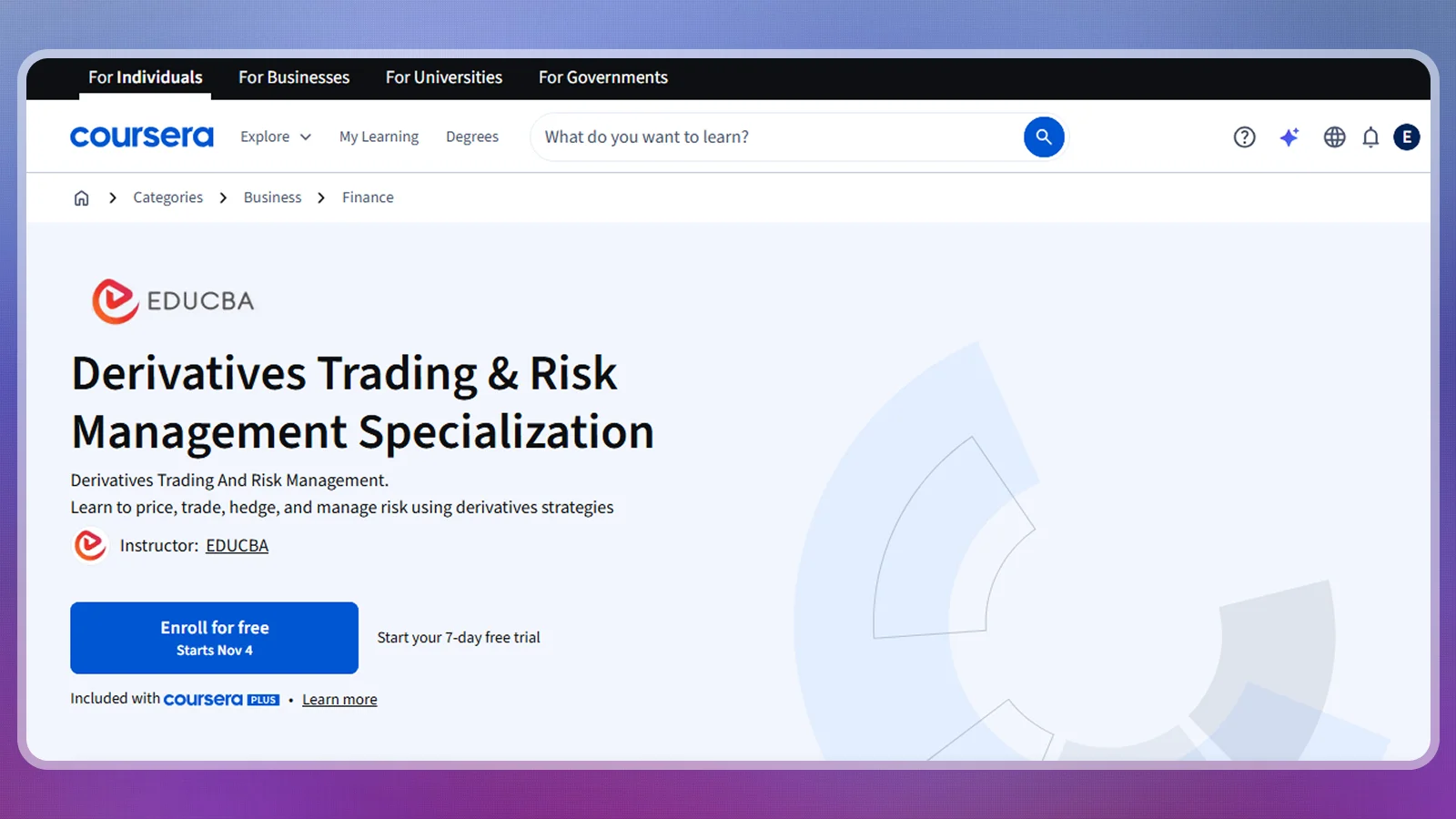
The Coursera specialization covers futures, options, swaps, and currency risk. Derivatives are financial contracts whose value is linked to an underlying asset or market benchmark. The sequence includes Futures and Options Trading for Beginners and Currency Derivatives and Forex Risk Management.
Coursera lists 6 courses over 2 months at 10 hours a week and labels the program beginner level. The program currently has a provider-listed rating of 4.7 based on 12 reviews.
Here’s what to expect before enrolling in the specialization:
| Provider | Coursera |
| Price | Free to enroll |
| Difficulty | Beginner |
| Time | 2 months at 10 hours a week |
| Certificate | Shareable certificate |
| Rating | 4.7 from 12 reviews |
The program covers several related subjects, but completing the full sequence requires a longer study commitment.
| Pros | Cons |
|---|---|
| ✅ Connected subjects – links options and currency derivatives ✅ Risk emphasis – includes hedging and currency risk ✅ Pricing concepts – covers option Greeks and Black-Scholes ✅ Applied projects – practical projects on real market scenarios ✅ Beginner level – the page labels the program beginner | ❌ Larger commitment – requires sustained study across a series |
The currency-risk lessons make this sequence a better fit for studying hedging than forex trading training courses focused on chart setups alone. Its focus on risk management makes it particularly relevant for learners interested in how currency exposure affects financial positions.
A free trading course can help you learn the vocabulary before enrolling, and a stock trading course is a simpler alternative if you only want cash-stock mechanics. Consider this specialization if you want to develop a broader understanding of derivatives and can commit to the full program.
5. Best Certificate: Stock Trading Professional Certificate (edX)
Stock Trading Professional Certificate gives credential-focused learners a defined assessment target. This program is particularly suitable for learners who want to demonstrate their knowledge through a formal assessment and recognized course credentials.
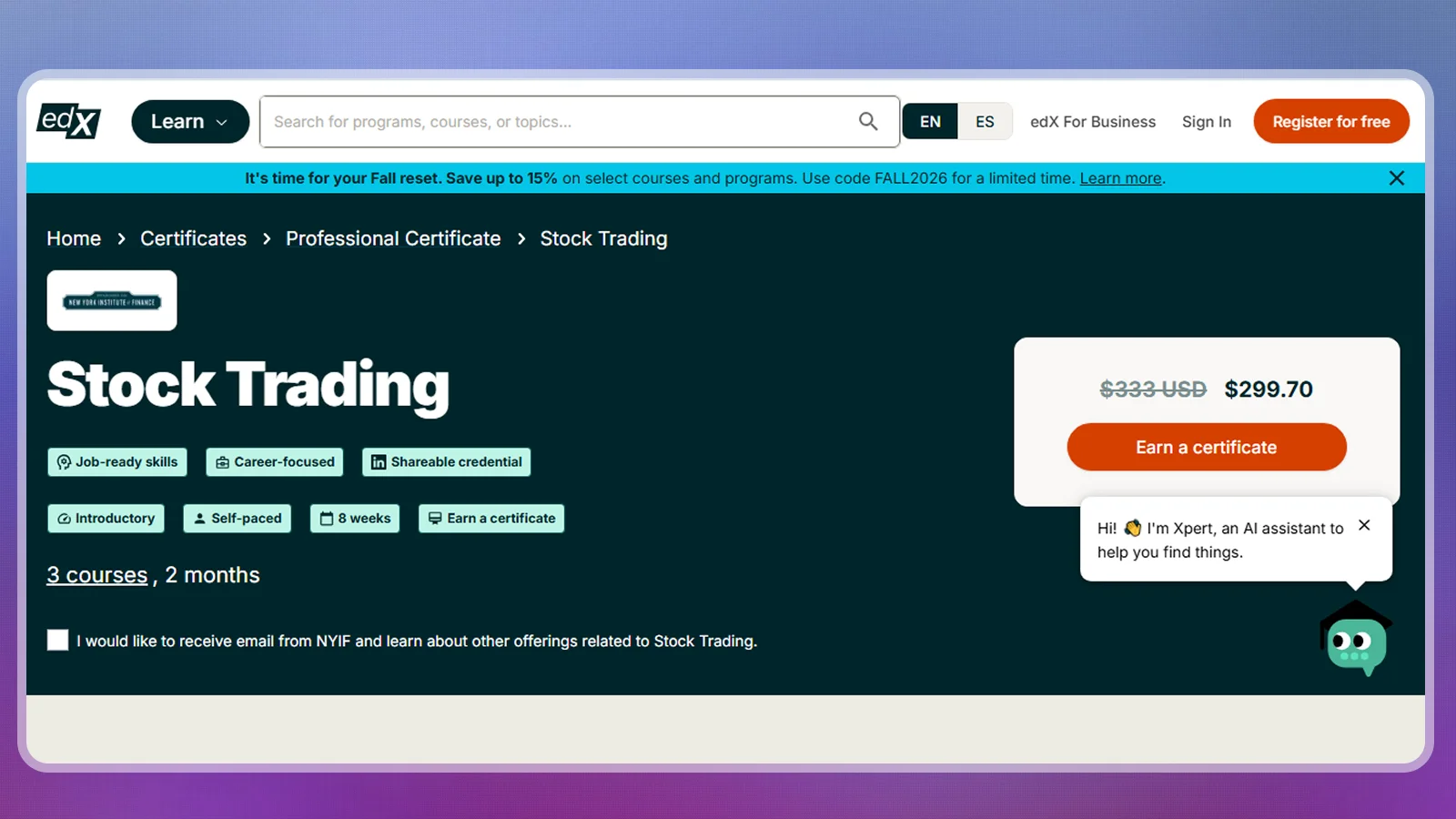
The online classes for stock trading offered by NYIF through edX cover introductory stock trading, technical analysis, and day-trading skills. The program features instruction from Peter Tuchman and David Green, who bring professional trading experience to the lessons.
edX lists an original price of $333 and a discounted price of $299.70. To pass the assessment, learners must score at least 70% on a 20-question exam within 60 minutes, with only one attempt allowed.
Here are the program’s main details and certification requirements:
| Provider | edX |
| Price | $333 list price, $299.70 discounted |
| Difficulty | Introductory |
| Time | 8 weeks, self-paced |
| Certificate | Exam-assessed program certificates: NYIF Certificate of Mastery and edX Professional Certificate |
| Rating | Not listed by the provider |
The formal assessment gives learners a clear target, although the single exam attempt is worth considering:
| Pros | Cons |
|---|---|
| ✅ Defined assessment – published passing requirement ✅ Named credentials – certificates from NYIF and edX ✅ Wall Street instructors – Peter Tuchman and David Green teach it ✅ Free preview – the first module of the first course is free ✅ Practical modules – covers bracket orders, swing trading, and options | ❌ Restricted attempt – the exam allows a single try |
A stock trading course should still be judged on what you learn, even when it offers a certificate. Before enrolling, consider how the curriculum supports your learning goals and the skills you want to develop.
Free online courses on share trading are the more economical route if your only goal is understanding a brokerage account. This program is worth considering if earning an assessed certificate is important to you. Learners interested in currency markets may find forex trading training courses more relevant.
6. Best for Beginners: Traders’ Academy Beginner Path (Interactive Brokers)
The recommended beginner path within Traders’ Academy starts from zero: it needs no trading experience or login, and it connects foundational lessons with platform education. Beginners can follow the recommended learning path to build their knowledge gradually before exploring more advanced courses.
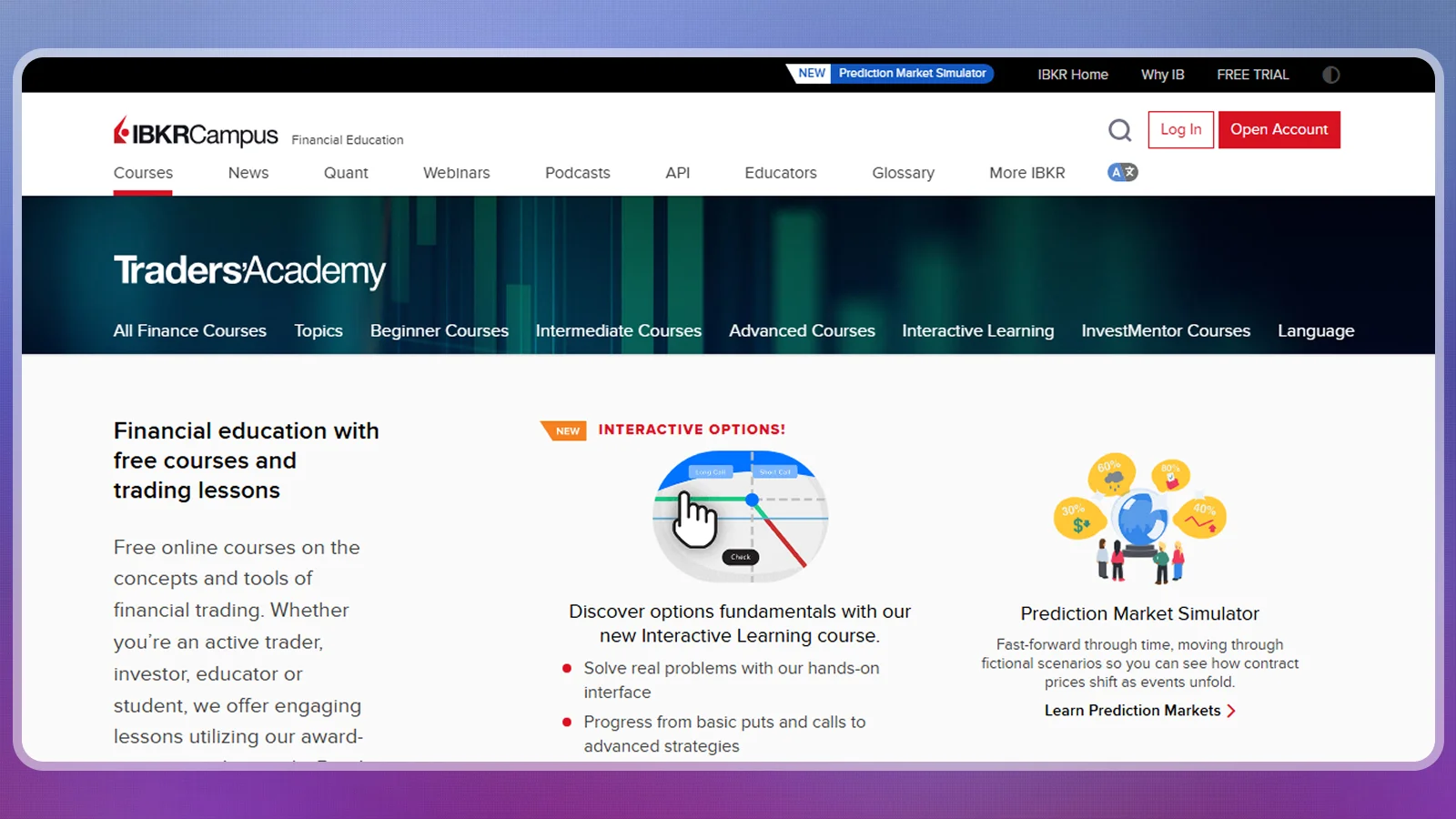
Run by Interactive Brokers, the pathway includes Intro to Stocks, IBKR Paper Trading Account, and platform introductions. The curriculum also introduces exchange-traded funds (ETFs), which allow investors to buy shares in a fund that holds a collection of assets.
Interactive Brokers estimates about 3 hours for the recommended beginner path. Paper trading lets beginners practice placing orders with simulated money before considering real trades.
Here’s what beginners can expect from the learning path:
| Provider | Interactive Brokers |
| Price | Free |
| Difficulty | Beginner |
| Time | Beginner path about 3 hours |
| Certificate | None; Interactive Brokers doesn’t issue certificates |
| Rating | Not listed by the provider |
The practical platform lessons are useful, although much of the instruction focuses specifically on Interactive Brokers:
| Pros | Cons |
|---|---|
| ✅ Connected foundation – combines stock and platform lessons ✅ Practice education – includes paper-trading instruction ✅ No login needed – most lessons open without an account ✅ Notes and quizzes – each lesson has both to reinforce it ✅ Next steps mapped – a recommended options sequence follows the basics | ❌ Broker-specific content – platform lessons focus on Interactive Brokers ❌ No certificate – Interactive Brokers doesn’t issue one |
A stock trading course should explain both the instrument and the order interface. The beginner path introduces trading concepts alongside practical platform exercises, which can help newcomers understand how orders work.
Starting with free lessons can help you identify which trading topics interest you before investing in paid online courses on share trading. Its online trading lessons are most useful when you repeat the operations yourself, and simulation helps you separate interface mistakes from conceptual gaps, although simulated results still differ from live trading.
Free Trading Courses and Resources
Free online courses on share trading can help you build foundational knowledge before investing in more advanced lessons. The best courses for trading are useful when they solve a specific gap, and free resources help reveal that gap before you commit.
Start with these accessible trading courses:
- A free preview: the NYIF certificate on edX opens the first module of Intro to Stock Trading for free.
- Chart vocabulary: Free Trading and Technical Analysis Course: Forex and Stocks on Udemy provides online trading lessons across several markets.
- A connected pathway: Interactive Brokers provides the Traders’ Academy beginner sequence and paper-trading education.
Free trading resources give you the opportunity to explore different markets before deciding which area you want to study further. Paid online courses on share trading may follow naturally from the stock lessons, while forex trading training courses become relevant if currency risk is your focus.
Paid trading courses may be worth considering if you want a more structured learning path or a formal assessment of your knowledge. Among online classes for stock trading, the NYIF program adds a graded exam, while the Coursera specialization connects derivatives subjects. Either structure helps only if you use it consistently.
How To Choose the Right Trading Course
Start by identifying the trading skills you want to develop or the qualifications you hope to earn. The best courses for trading fit a concrete purpose, so decide between understanding a first trade, studying a specialty, and completing an assessed program before comparing brands.
Consider these factors when comparing trading courses:
- Current level: Start with online classes for stock trading that cover order mechanics if terms like margin and leverage are unfamiliar.
- Market: Online classes for stock trading suit stock-focused goals, and forex trading training courses should address currency pairs and their risks.
- Billing: Read the enrollment terms for access, renewal, and certificate charges.
- Study format: Choose self-paced online trading lessons for flexible replay, or graded assignments if you want deadlines.
- Practice: Look for exercises you can repeat and explain on your own.
- Certificate: Match the credential to a stated personal or work-related need.
- Instructor fit: Use previews to judge explanations and subject coverage.
- Refund terms: Read cancellation conditions before paying.
If you’re still exploring your interests, a free trading course is a practical place to begin. Study becomes easier to organize once you can name the exact task you want to perform. A focused trading course is worth more than a broad syllabus you never finish.

Are Trading Courses Worth It?
Yes, trading courses can be worthwhile if you want structured lessons and opportunities to develop practical market knowledge. The best courses for trading organize a subject into a sequence you can follow and give you a clear reason to keep studying.
Online trading lessons become more valuable when you take time to practice each concept and understand how it applies to real market situations. Online classes for stock trading should help you understand stock mechanics, while forex courses need a clear currency-risk focus.
The reviewed options range from free introductions to assessed study, so pay only when the syllabus or assessment meets a need the free lessons leave unanswered. Trading takes judgment and practice, and a certificate cannot guarantee profitable decisions. Compare trading courses by their teaching and terms. Be cautious of courses that emphasize impressive profit screenshots instead of explaining the skills and risks involved.
Final Verdict on the Best Courses for Trading
For structured options study, Learn Options Trading Strategies stands out, while Traders’ Academy provides a free introduction for complete beginners. Readers exploring charts can use the free technical-analysis trading course. Readers who want online classes for stock trading with an assessed credential have a clearer reason to consider Stock Trading Professional Certificate.
None of these picks offers scheduled classroom teaching, so readers who want in-person rather than online classes for stock trading should look elsewhere. The best courses for trading match a specific learning need. Start with a course that matches your current knowledge, then consider more advanced training once you’ve identified the skills you want to develop.
FAQs
Among the best courses for trading, the free Traders’ Academy beginner path from Interactive Brokers suits complete beginners: it takes about 3 hours and includes paper trading. Learn Options Trading Strategies is the stronger structured choice once options are your chosen subject.
Yes, trading courses can be worthwhile for structure, focused practice, and assessment. Choose a course that addresses a specific knowledge gap, and try free online courses on share trading first if your learning goal is still unclear.
Yes, Udemy has introductory lessons, and Interactive Brokers offers online courses on share trading through the free Traders’ Academy beginner path. Free lessons can teach foundations and platform use before you decide to pay for deeper study.
It depends on your starting knowledge, market, and practice routine. A course’s viewing time is only part of the commitment. Allow time to repeat exercises, study mistakes, and explain trade risks on your own.
Yes, some do. Coursera lists shareable completion certificates for the options, chart-pattern, and derivatives selections. Among online classes for stock trading, the NYIF program awards certificates subject to its exam requirements.
No, a trading course cannot guarantee profitability. It can teach mechanics and risk concepts, but live decisions involve uncertainty, costs, and possible losses. Judge education by its teaching quality, not income claims.
Free online courses on share trading teach the foundations without a course fee. Paid options may add an assessed credential, a longer sequence, or graded projects. Your learning goal determines which are the best courses for trading.