

How Does Minecraft Make Money? Breaking Down the Billions

Minecraft is a financial phenomenon that continues to rack up billions more than a decade after launch. With over 300 million copies sold worldwide and a player base that refuses to quit, I’ve always been curious about how does Minecraft make money.
The thing is, Minecraft doesn’t just rely on one-time purchases like most games from its era. The game has evolved into a multi-billion-dollar empire through game sales, microtransactions, subscription services, and licensing deals that extend far beyond the digital realm.
Understanding how Minecraft generates revenue reveals why it’s remained relevant for so long. In this breakdown, I’ll walk you through exactly how Minecraft makes its money, backed by real figures and insights into yearly earnings that showcase just how massive Mojang’s creation has become.
Jump to:
How Does Minecraft Make Money: Minecraft’s Monetization Channels
The genius of Minecraft‘s business model lies in its diversity. While many games burn bright for a year or two before fading into obscurity, Minecraft built something sustainable by tapping into multiple revenue streams that keep generating income long after that initial purchase.
Understanding these monetization channels matters because they reveal why Minecraft can afford to keep pumping out free updates while competitors struggle to stay relevant.
For parents, it explains those recurring charges. For gamers, it shows how a single purchase can evolve into ongoing spending. And for industry analysts, it demonstrates a blueprint for long-term profitability.
Let’s break down each revenue stream and see how they stack up.
Game Sales
The foundation of Minecraft‘s fortune starts with the game itself. When you purchase Minecraft, you’re choosing between different editions that cater to various platforms and play styles.
The Java Edition typically runs $29.99, while the Bedrock Edition sits around $26.99 to $29.99 depending on your platform. The combined bundle offering both editions usually goes for $39.99, though sales can drop it to $24.99.
What makes Minecraft unique is its cross-platform presence. As of 2023, Minecraft became the first video game to surpass 300 million copies sold across all platforms. To put that in perspective, its closest competitor, Grand Theft Auto V, sits at around 205 million units.
The game’s pricing strategy remains smart. Occasional discounts and bundle deals with consoles drive additional sales without devaluing the base product. Microsoft‘s decision to maintain separate pricing for Java and Bedrock editions (before bundling them) also maximized revenue from dedicated players who wanted both versions.
In-Game Purchases
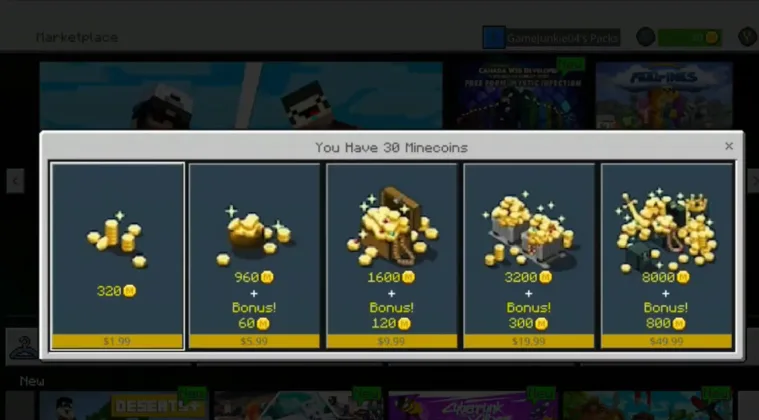
Here’s where Minecraft really prints money. The Marketplace ecosystem built into Bedrock Edition generates serious cash through Minecoins, the in-game currency that players use to purchase skins, texture packs, and entire worlds created by both Mojang and community creators.
These microtransactions might seem small individually – a skin pack here, a texture pack there – but they add up fast. In 2024, Minecraft‘s mobile version alone pulled in $98 million from in-app purchases. The peak came during 2021 when mobile IAP revenue hit $158 million, fueled by pandemic-era gaming booms.
The brilliance here is that in-game purchases allow Minecraft to continue earning even after the initial sale. Players who bought the game years ago still return to grab new content, creating a recurring revenue stream that keeps growing. Content creators on the Marketplace have collectively earned over $500 million, with Mojang taking a cut from each transaction.
Subscriptions
Minecraft Realms represents the subscription pillar of the monetization strategy. This service lets players host private, always-online servers without dealing with technical setup. For $3.99 monthly, you get a server supporting 2-3 players. The Realms Plus tier at $7.99 monthly bumps that to 10 players and throws in access to over 150 rotating Marketplace items.
The subscription model creates predictable, recurring revenue that financial analysts love. While exact subscriber numbers aren’t public, the service has proven popular enough that Mojang continues expanding its features. The 30-day free trial helps convert hesitant players, and the automatic renewal keeps subscriptions active until users manually cancel.
What makes Realms particularly profitable is its low barrier to entry. Players who might struggle with traditional server hosting find the simplicity worth the monthly fee, especially when playing with friends across different platforms. Minecraft’s cross-platform functionality makes Realms even more valuable for groups on mixed devices.
Merchandise and Licensing
Beyond the digital realm, Minecraft has transformed into a merchandising empire. Walk into any toy store and you’ll find Minecraft action figures, LEGO sets, plushies, clothing, and collectibles. Physical merchandise extends the brand’s reach and captures revenue from players who want to express their fandom offline.
Licensing deals amplify this further. Minecraft books regularly hit bestseller lists. Spin-off games like Minecraft Dungeons and Minecraft Legends generate additional sales. The upcoming Minecraft movie will likely drive another revenue surge when it hits theaters.
These revenue streams prove that Minecraft‘s profitability extends far beyond game sales. The brand itself has become valuable enough to license across multiple industries, from education to entertainment.
Summary of Revenue Streams
Minecraft‘s financial success stems from this diversified approach to monetization. Game sales provide the foundation, microtransactions create ongoing revenue, subscriptions deliver predictable income, and merchandising expands the brand’s reach.
This multi-channel strategy explains why Minecraft continues thriving while competitors fade. Understanding these revenue streams gives you the complete picture of how a single game transformed into a multi-billion dollar franchise.
How Much Does Minecraft Cost?
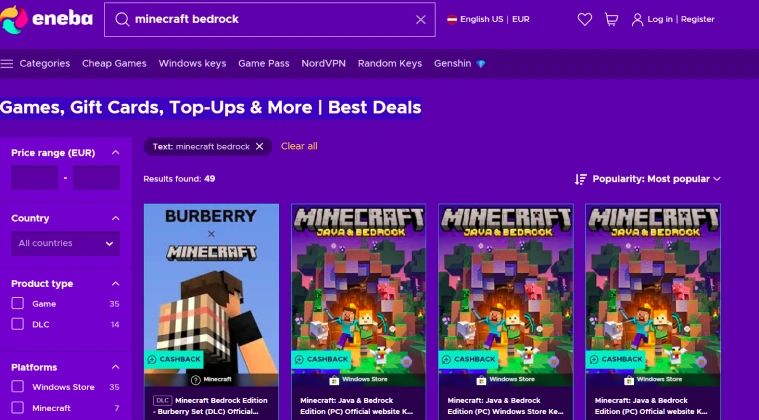
So, how much is the game Minecraft exactly? The answer depends on which edition and platform you choose. The Java Edition for PC costs $29.99, while Bedrock Edition ranges from $26.99 to $29.99 depending on whether you’re grabbing it for console, mobile, or PC.
The smartest purchase is the combined bundle at $39.99 (often on sale for $24.99), which gives you both Java and Bedrock editions. This lets you access extensive modding on Java while enjoying cross-platform multiplayer on Bedrock. Console versions (Xbox, PlayStation, Nintendo Switch) typically sit around $29.99.
Beyond the initial purchase, optional spending includes Marketplace purchases (individual items range from $1-$10) and Realms subscriptions ($3.99 or $7.99 monthly). If you’re looking for the best hardware to run the game smoothly, check out our guide on the best laptop for Minecraft.
Total Sales and Copies Sold
The numbers behind Minecraft sales are staggering. How many Minecraft copies have been sold? As of October 2023, the game crossed 300 million copies sold across all platforms, which makes it the best-selling video game in history.
Breaking down Minecraft total sales by platform reveals the Bedrock Edition‘s dominance. Mobile versions (Minecraft: Pocket Edition) have sold over 130 million copies alone. The Java Edition, despite being PC-exclusive, has moved approximately 35 million units. Console sales across Xbox, PlayStation, and Nintendo Switch account for the remaining distribution.
Major milestones highlight the game’s sustained success. It hit 100 million copies in 2016, doubled that to 200 million by 2020, and reached the historic 300 million mark in 2023. These represent consistent year-over-year growth averaging around 23 million copies annually.
The Chinese free-to-play edition adds another dimension, with over 700 million registered players, though these don’t count toward paid copies sold. Regional distribution shows strongest sales in North America, Europe, and Asia, with mobile versions particularly dominant in developing markets where console gaming remains expensive.
Yearly and Total Revenue
How much money does Minecraft make a year? In 2024, the game generated $220 million in revenue, with mobile accounting for $115 million of that total. While this represents a dip from the 2018 peak of $500 million, it’s still remarkable profitability for a game over a decade old.
How much money has Minecraft made in total? Conservative estimates put lifetime revenue at $10-12 billion across all monetization channels. Game sales alone account for roughly $4.2 billion. Mobile in-app purchases have generated over $1 billion since launch. Merchandise and licensing deals add billions more.
Year-over-year trends reveal interesting patterns. Revenue spiked during the pandemic, with 2021 hitting $380 million as homebound players flocked to online gaming. The 2024 decline to $220 million reflects market normalization post-pandemic rather than declining interest – player counts actually remain strong at over 200 million monthly active users.
Factors affecting yearly revenue include major updates that drive re-engagement, marketing campaigns, and broader gaming industry trends. The upcoming Minecraft movie could trigger another revenue surge similar to what other franchises experienced with media adaptations.
Why Minecraft Continues to Generate Revenue
The secret to Minecraft‘s sustained profitability lies in constant evolution without paywalls. Regular free updates add new blocks, mobs, and mechanics that keep longtime players engaged while attracting new ones. The Marketplace monetizes this engagement without forcing purchases.
Community-created content fuels ongoing spending. Players repeatedly return to grab new skins, texture packs, and adventure maps. The Education Edition has opened institutional revenue streams, with schools purchasing licenses for classroom use.
Most impressively, Minecraft maintains this revenue without aggressive monetization tactics. There are no loot boxes, no pay-to-win mechanics, and no content locked behind paywalls. This player-friendly approach builds loyalty that translates into sustainable long-term spending. If you’re curious about earning in-game currency yourself, you might explore strategies for how do you make money in Minecraft beyond just playing.
Minecraft’s Impact on the Gaming Industry
Minecraft‘s financial success has reshaped how the industry thinks about game longevity. Before Minecraft, most games expected a 1-2 year lifecycle. Mojang proved that games could generate billions over decades with the right approach.
The indie developer-to-Microsoft acquisition story inspired countless studios. Markus “Notch” Persson’s solo project became a $2.5 billion acquisition in 2014, demonstrating that small teams could compete with AAA studios. This influenced the entire indie game movement and showed how creative, accessible gameplay could triumph over graphics and production values.
Educational gaming benefited enormously. The Education Edition legitimized gaming in classrooms, showing administrators that games could teach programming, collaboration, and problem-solving. This opened doors for other educational games to gain institutional acceptance.
Understanding Minecraft‘s financial model helps gamers appreciate why certain monetization choices were made, helps analysts predict industry trends, and helps enthusiasts recognize what makes a game not just popular but sustainably profitable.
The Enduring Financial Power of Minecraft
Minecraft‘s monetization strategy demonstrates how games can achieve lasting profitability through diversified revenue streams, player-friendly monetization, and constant evolution.
Game sales provide the foundation at over 300 million copies. In-game purchases generate ongoing revenue exceeding $1 billion from mobile alone. Subscriptions create predictable income. Merchandise and licensing extend the brand beyond gaming.
The game’s financial success – generating billions annually over a decade after launch – proves that respecting your player base pays dividends. No predatory tactics, no pay-to-win mechanics, just quality content and optional purchases.
Minecraft‘s impact reaches beyond its own success. It proved indie games could achieve AAA profitability, legitimized educational gaming, and established a blueprint for sustainable game monetization that the industry continues studying.
If you’re looking for similar experiences, explore our list of games like Minecraft that capture that creative sandbox spirit.
FAQs
Minecraft has generated an estimated $10-12 billion in total revenue since 2009, with approximately $4.2 billion from game sales alone. This includes in-game purchases, merchandise, licensing, and subscriptions across all platforms.
In 2024, Minecraft generated $220 million in revenue. The game’s highest-earning year was 2018 with $500 million. Annual revenue fluctuates based on updates, market trends, and major releases, but consistently remains profitable.
Absolutely. Mobile in-app purchases alone have generated over $1 billion lifetime, with 2024 bringing in $98 million. The Marketplace ecosystem generates substantial recurring revenue while maintaining a player-friendly approach without forced monetization.
Over 300 million copies have been sold across all platforms as of October 2023, which makes Minecraft the best-selling video game in history. Mobile versions account for 130+ million, with console and PC sales distributing the rest.
Markus “Notch” Persson, Minecraft‘s creator, sold Mojang to Microsoft for $2.5 billion in 2014. As the majority owner, he reportedly received around $1.8 billion from the sale. Current leadership under Microsoft operates differently as corporate executives.
Marketplace creators have collectively earned over $500 million. Individual earnings vary wildly – top creators make six figures annually, while hobbyists earn modest supplemental income. Mojang takes a percentage, but creators keep over 50% of revenue after platform fees.