“History Will Be Lost Forever” – An Interview With Frank Gasking From Games That Weren’t



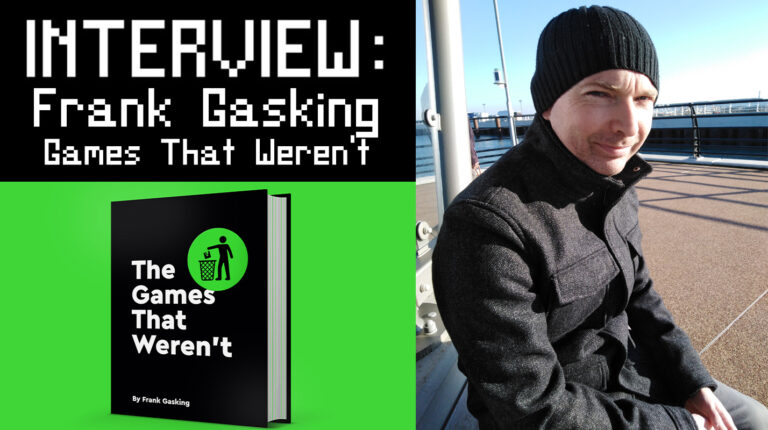
Frank Gasking is the author and games preservationist behind the Games That Weren’t (GTW) book and website, which is a long-running project to find and catalogue lost, cancelled, and unreleased video games. His primary focus is on retro hardware such as the Commodore 64, but GTW also highlights titles from other platforms, including the NES, Amiga, GameBoy, and Playstation.
GTW started in the mid-nineties, after Gaskin read an article in Zzap!64 magazine about Commodore games that were announced but never released. He started to dig into these games, and others, and when he was in his mid-teens was invited to write an article for the magazine following up on his research.
Gasking spoke with Eneba via video call about GTW, growing up as video game technology and the industry has changed, and what the future might look like for game preservation and availability. The interview has been edited for brevity.
What is it about Commodore games specifically that speak to you, that grabbed and continued to grab you?
I think for me personally, it’s because the Commodore, like the 64 in particular, was the very first proper home computer that I ever saw. And it’s hard to explain. You get that sensation where you know you’re experiencing something extremely special.
Like, the pixels pop out the screen, they’re very vibrant, almost luminous and you’re controlling it. And that was my experience playing something like Buck Rogers, I think, or Tapper, one of those two games.
So I was completely mesmerized by this machine. And I thought I have to get my own computer, but I didn’t get a 64 straight away. We couldn’t afford it. We didn’t have a lot of money. So my mum very kindly went out and got this Atari 2600 bundle with a load of games. And that was still amazing, even though the games were quite old and it was archaic hardware, it was a fantastic machine.
But I always had a soft spot for the 64. Every time I went around my sister’s, I was desperate to play this machine. And over time, eventually my mum got one off the catalogue. And I remember it turned up with no plug. It had no plug in it and I was only about seven years old. My mum had just come off working nights, so she was fast asleep and I had to sit staring at this box, not able to do anything, poring over the games for hours until she finally woke up and put a plug on it for me.
I think it’s a combination of things with the 64; you not only got the really lovely graphics but you had that sound chip as well. That’s how I discovered songs. Rather than listening to Queen songs, like It’s a Kind of Magic, I heard the 64 version done for the Highlander game first. And that always stuck with me as well, and I didn’t really want that to end.
What have you found to be the main reasons games back in the day were never finished, or finished but not published?
There’s so many sorts of reasons for the cancellations. That’s one of the quite cool things about doing the archive for so long is that you discover all these different stories.
Sometimes there’ll be a game that’s complete and it’s all finished and it’s about to go to mastering, and literally the company has been in financial trouble and they’ll collapse just before it can get there. An example of that is Daffy Duck on Commodore 64. It was reviewed in the magazines, it’s just about to go to mastering and just disappeared.
Sometimes you don’t know the reasons, they get finished and reviewed but then they just disappear and there’s no reason given for it, the company’s still going and then you kind of try and sort of read between the lines.
It might be that the game was released on another platform earlier and the sales weren’t very good and it sort of bombed, so that had an impact on deciding to release the game.
An example would be Sensible Soccer on the NES that we found recently, that was practically finished. But the people that were set to publish that game, they suddenly decided the NES was on its way out and they didn’t think they were going to make any money from it. So they just focused on the Game Boy edition instead.
Usually the game is complete and not released. If you find something that’s complete that you can release, then you feel a little bit sad for the person who spent all that time and effort, especially if it’s really good.
With the work you do with GTW, you get a lot of help and resources from people who were actually involved in the games. But, have you come across anyone who isn’t supportive of your GTW efforts, and if so, did you give any decent reasons why?
Thankfully we haven’t. I mean, sometimes we’ve had some people saying, “Are you kind of sharing these games? It’s morally wrong.” But that’s very rare. Most of the time people say that if we didn’t save a lot of this software, then it would be very likely lost for good. In some cases, some of the things that we found are on the last remaining disk in existence of that game. If we leave it too much longer, then that disk is going to deteriorate; this will be gone forever, potentially.
We haven’t really had anyone kick back from what we’re doing because we are doing something positive. We’re not really causing anyone any harm. We’re just trying to preserve history. So, you know, we’re not profiteering off anyone’s work or anything like that.
I always ask games preservationists what their Holy Grail is, but I’ve seen on your site you’ve found a few! Do you still have any titles that you’re dying to find…?
There’s a couple. I don’t know if it’s weird having multiple Holy Grails, but the reason for that is that when I started doing the articles, there were a couple of base games that I remembered specifically, which to me were the big ones.
The main one, It’s like an isometric Cluedo game called Murder!, by U.S. Gold. And that is an example of a game that was completely finished. It was reviewed by all the magazines, but they just didn’t release it for whatever strange reason. And we think that’s because the Amiga and the PC and the ST versions that were released earlier didn’t sell that well. So they decided to just can the 64 one, which is bizarre.
And the other one I’d say would be Batman Returns by Konami. That was a late Commodore game that didn’t get finished. I remember reading the diaries back in the day, seeing all the levels coming together and I’d say they’re the two main ones that are left.
Have you ever come across a lost game that made you think, “This really should stay lost?”
On a personal level, no, because that’s the strange thing. I’m a very passionate person. I love anything that’s on the list. I mean, I’ve had criticism for this as well. I’ll post something on the site and say, oh, we found it. Oh, look at this amazing game with lovely graphics and that. And then someone will turn around and say “That doesn’t look lovely at all.”
But I’m someone who’s fairly subjective, and I’m an artist as well, and I see beauty in all sorts of different things. And I’m the same with unreleased games. I’m kind of, even if we find a very early prototype and there’s not much to it, I’m still very excited that we found it.
On the other hand, there are moments where you spend so long searching for something that you build it up in your mind as something being much greater than it really is. And there’s definitely been cases of that.
And I’d say Daffy Duck was definitely one of those. Because Daffy Duck was one that had really good reviews, and we built up a picture in our minds that it was going to be this amazing action game.
But the reality was, when we got the game, it was great. It was good. But some things didn’t quite live up to how we picture them. So for instance, the little laser gun that was shown in the screenshots – you couldn’t actually use it. It was just like a red herring, it did nothing in the game, you couldn’t shoot anything.
I don’t think there’s anything where I’ve actually found it and thought “I wish I didn’t find it.” But, there will be others that probably wish that we didn’t find it. Maybe the authors of their game themselves. Some of them might wish that their stuff remained buried.
You’ve been involved with the Commodore scene for a long time, not just through GTW, but also with various magazines linked to it. Zzap!64 is one that relaunched a couple of years ago, and its new editor is Chris Simpson, aka Peri Fractic. What are your thoughts on his taking over Commodore to bring it back?
It’s certainly a really interesting development. I was still very much a part of the 64 scene long after many had moved on. And I remember in particular back then the excitement around Escom’s takeover, and there were all these promises of reviving the brand, and talk of releasing the 64 in certain parts of the world, that kind of thing.
(Escom was a German company that bought Commodore and Amiga, but went bankrupt in 1996.)
It’s like many of the takeovers and plans that followed over the years: it sort of ultimately came to nothing. So because of those past experiences I’ve tended to stay out of such discussions because I always remain fairly skeptical. I don’t know Christian personally, never really sort of crossed paths with him, but the main thing is that I hope his intentions are genuinely motivated by passion, rather than ego or attention, because I know that can happen sometimes.
But that said, it’s encouraging to see that he’s got the right sort of people involved. I think having them involved is promising because that means that he’s got people overseeing what he’s doing and keeping an eye on everything. I’ve been skeptical of these kinds of things before and I’ve been happily proven wrong.
With news that Compute!’s Gazette Magazine is also coming back (after 35 years), do you think that there’s a renewed interest in retro games? If you had your way, which old video game magazine would you love to see return?
If there was a possibility of bringing a magazine back, I would love to see Commodore Format make a comeback. The thing is, it’s never going to be quite the same.
I think what you want ultimately is those original writers that you grew up with writing for the magazine and you’re not necessarily going to get that. With Zapp’s case, they’re lucky to have a couple of the original people that worked on the original magazine so you’ve got that mix of new and old.
You know, when you sometimes get a sequel to a film like 30 years on from the original, you’re kind of happy it’s happened, but then you’re still a bit disappointed. It never lives quite up to the expectation you have.
It’s a real tough one because you do want to see it back. But then would you prefer to see something completely new to make new memories or something positive? I don’t know.
Following on from this, nostalgia is often cited as playing a pivotal role in game preservation. Do you think younger generations lack the understanding of why and how game preservation is important, since they haven’t grown up with physical media the way we have?
A lot of modern day gamers don’t really know what it’s like to have a physical copy. So they don’t have that attachment like we do.
I guess it’s the same as if you didn’t grow up with vinyl music. If you only grew up with an iPod and you just had MP3s, you’ve got no attachment at all to physical music. You just think that you’ll just move your files around and it will go from hard drive to hard drive. There’s no attachment at all.
And I think that’s going to be the same for newer generations with games. Unless you maybe reintroduce more physical media and bring that back, then people might understand it more and they might have more of a connection to it.
There’s also the recent Stop Killing Games aspect, of games being delisted and disappearing for good.
Yeah, that’s the kind of sad and scary thing at the moment, is that you’ll see people not realizing that when you buy a digital copy on a platform like Steam, if anything happens to Steam or if it just disappears and goes bankrupt, whatever, then you can’t access that game anymore. And that’s the issue.
And from a preservation point of view, how then are you going to preserve it? Because at the moment, we’re in a situation that even if they turn the servers off, that means it blocks you from playing the single player mode of the game. If you’ve still got part of the code on the hard drive, there’s maybe a way that you could save some of that or preserve some of it, hack it together and get it going.
Once it goes and gets streamed, so you’re only getting the data streamed down to your TV, then there’s nothing to preserve there unless you get physical access to the servers where the games are on. So it’s going to make preservation incredibly hard, almost, well, practically impossible.
Regarding the impermanence of video games, I know that you make titles available to download on the GTW site, but do you also make physical backup copies – is this even possible for some of the games?
No, I just make the digital backup and I make several copies of that. So we’ve got it preserved and then we put that on the website where we can or we give copies of those back to the original authors if we’re not allowed to release it, that kind of thing.
What formats do you typically have to work with?
The main sort of media I’ve been preserving from are five and a quarter inch floppy disks and three and a half inch ones. Which are surprisingly robust; the five and a quarter inch disks, even though they’re completely bendable, are more reliable than the three and a half inch ones. Sometimes I do cassette tapes as well.
But if we’re backing up from tapes, especially ZX Spectrum, it’s always a bit of a challenge trying to get some of that hardware working on modern day platforms.
How do you explain the idea of game preservation to someone who doesn’t really understand its importance? What can they do to help?
Game preservation is about trying to save our history to do with games in general. If we don’t save a lot of this material that we’re doing right now, then much of this history will be lost forever. But it’s not just the actual games itself, it’s the stories behind them as well. It’s a race against time.
If we don’t save any of this history, then there’s no context to the new games that are coming out. There’s no kind of background to them or no connection. If we don’t capture the stories of the people that made those original games as well as the actual physical games themselves, then we don’t learn about what their process was and what issues they had, what challenges they encountered back then. I think that’s really important.
And in terms of people helping, from a Games That Weren’t point of view, it’s a case of: if you know anything about any of the games that we’re looking for, just even simple bits of information like a magazine clipping or a credit, something like that can go a long way.
It can actually lead to something quite big to make a recovery, to get in touch with a person who, if you don’t reach them in time, they might go and bin all of their disks. So the race against time element is a really key point.
There’s been instances over the years where we’ve just got hold of someone and they’ve got rid of their stuff or someone’s passed away a couple of years before. If we don’t do this, then we’re going to lose so much history. And we see that in the films industry and the music industry.
There’s a lot of material that has been lost because we didn’t think to preserve things or keep hold of it. We didn’t see a value in it and it’s only now we start to see the value in those things. So, there’s an opportunity with gaming and I think we need to grasp it while we can.