


Best Python Courses in 2026: 6 Picks for Beginners

Eneba Hub contains affiliate links, which means we may earn a small commission if you make a purchase through them—at no extra cost to you. Learn more


CHOOSE YOUR GOAL
Explore The Complete Python Developer Certification Course on Udemy for exam-focused study.
The best Python courses pair a clear goal with the appropriate practice. It’s best to choose the course that matches your current level and goals, which means that your top choice will depend on whether you’re a student, a self-taught hobbyist, or someone who codes for a living.
A Python online course can introduce the basics, while a Python certification course can organize preparation around an external exam. Our list covers six Python courses and their teaching focus, from free study materials, exam-based courses, to even subscription-based learning.
We also distinguish the differences between a course certificate from certification for Python programming.
Jump to:
Best Python Courses at a Glance
These best Python courses cover different starting goals, from introductory coding to data science and exam preparation. Use the provider and best-for labels to narrow your choice, then compare the detailed facts below.
|
Course |
Provider |
Best for |
|---|---|---|
|
The Complete Python Developer Certification Course |
 |
Best overall |
|
Python for the Absolute Beginner |
 |
Best for beginners |
|
Python Course for Beginners With Certification: Mastering the Essentials |
 |
Best free certificate |
|
Google’s Python Class |
 |
Best free option |
|
Learn Python for Total Beginners |
|
Best budget pick |
|
Expressway to Data Science: Python Programming Specialization |
|
Best for data science |
What Python Is Used for and Why Beginners Learn It
Python is a high-level programming language used for automation, web applications, data science, and games. Its readable syntax makes it a useful first coding language.
Python courses help beginners connect instructions to visible results. You could organize text files, summarize a game-session log, or build a text-based inventory system. These projects make an introduction to Python concrete without requiring a large application.
What an Introduction to Python Course Should Cover
An introduction to Python should cover setup, variables, data types, and control flow, which means the rules that decide which instructions run. Lists and dictionaries should lead into functions, file handling, and error handling.
Good Python courses connect these topics through exercises. A Python online course should give you chances to change inputs, predict outputs, and repair mistakes before moving ahead.
How These Python Courses Were Chosen
These Python courses are matched to goals, access, and practice, with separate labels for beginner study and certification for Python programming. The comparison uses these criteria:
- Coverage: A coherent introduction to Python and a clear route into later topics.
- Teaching: A stated audience and an understandable learning format.
- Cost: Free access and paid billing presented separately.
- Practice: Exercises beyond watching a Python for loop explanation.
- Credentials: A clear distinction between a completion award and a Python certification course.
- Updates: Documented additions to teaching material.
The 6 Best Python Courses, Reviewed
The strongest Python course for you depends on what you want to do after the lessons. Exam preparation, first-time coding, and data analysis need different paths.
A Python certification course can help organize exam study. Other Python courses focus on teaching skills or awarding a completion certificate, which should be considered separately from external certification for Python programming.
1. Udemy‘s Complete Python Developer [Best Overall]
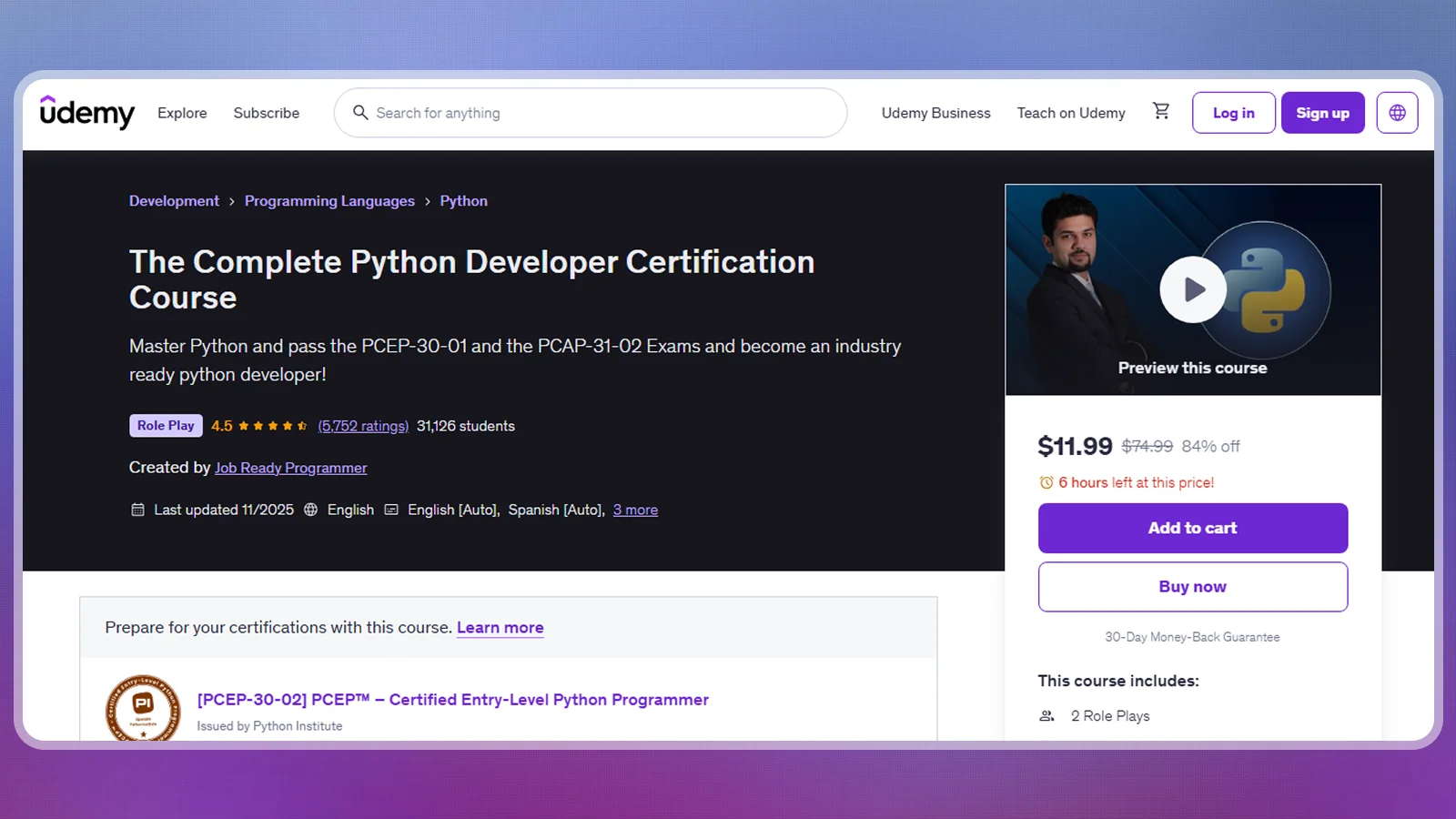
This Python course wins our overall pick for its broad syllabus and explicit exam target. It makes the most sense for learners who want fundamentals connected to certification for Python programming.
Udemy prepares you for PCEP-30-01 and PCAP-31-02. You’ll study data types, collections, functions, modules, packages, and object-oriented programming. The Udemy page records 32 new coding exercises added in July 2025.
Use this Python online course as a structured study route. After an introduction to Python, practice explaining a Python for loop and writing functions before treating exam preparation as revision.
| Pros | Cons |
|---|---|
| ✅ Exam focus: names PCEP and PCAP preparation ✅ Broad foundations: covers collections through object-oriented programming ✅ Coding practice: includes added exercises ✅ Reusable skills: teaches functions, modules, and packages | ❌ Budget uncertainty: no published price in the course details ❌ Planning gap: no listed completion time |
Choose it when an exam provides useful direction for your Python course. A first-time programmer who wants a gentler introduction to Python should consider the next pick.
2. Coursera‘s Python for the Absolute Beginner [Best for Beginners]
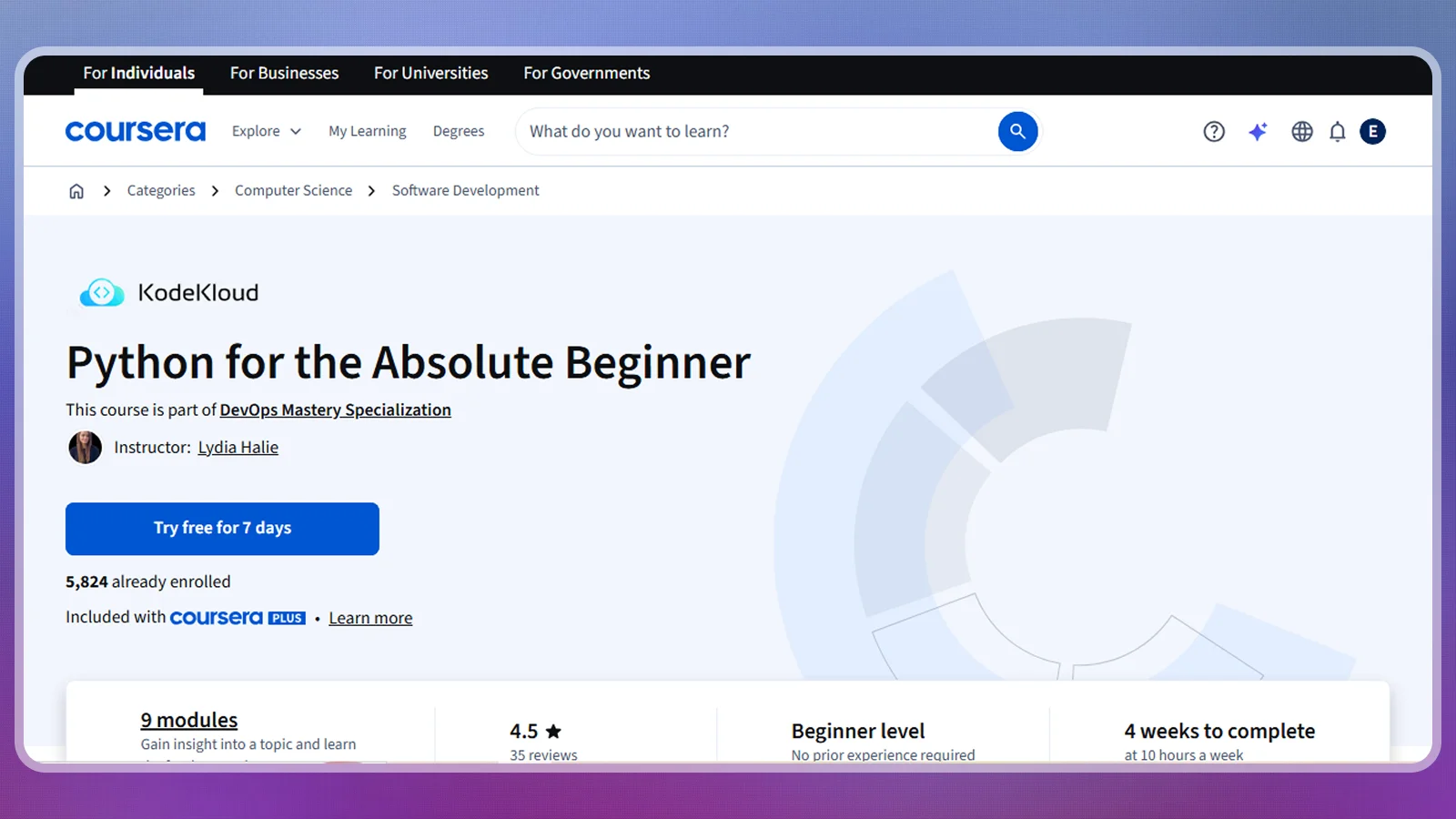
Coursera‘s Python course is our choice for someone starting without programming experience. Its beginner focus and stated weekly workload make it easier to plan a study routine.
You’ll be introduced to Python through data types, operators, decisions, iteration, collections, functions, and exceptions. According to Coursera, the course takes 4 weeks at 10 hours a week. There’s also an annual subscription option for ˆCoursera Plus at $239 annually.
Coursera‘s shareable certificate records completion of the beginner course covering decisions, iteration, functions, and exceptions. For external certification for Python programming, choose a course that names the exam it prepares you for.
| Pros | Cons |
|---|---|
| ✅ Beginner audience: suitable for first-time programmers ✅ Clear progression: develops fundamentals before later topics ✅ Study schedule: states a weekly workload ✅ Completion award: offers a shareable certificate | ❌ Subscription decision: the advertised offer covers annual platform access ❌ Small review pool: limited feedback compared with longer-running listings |
3. Scaler [Best Free Certificate]
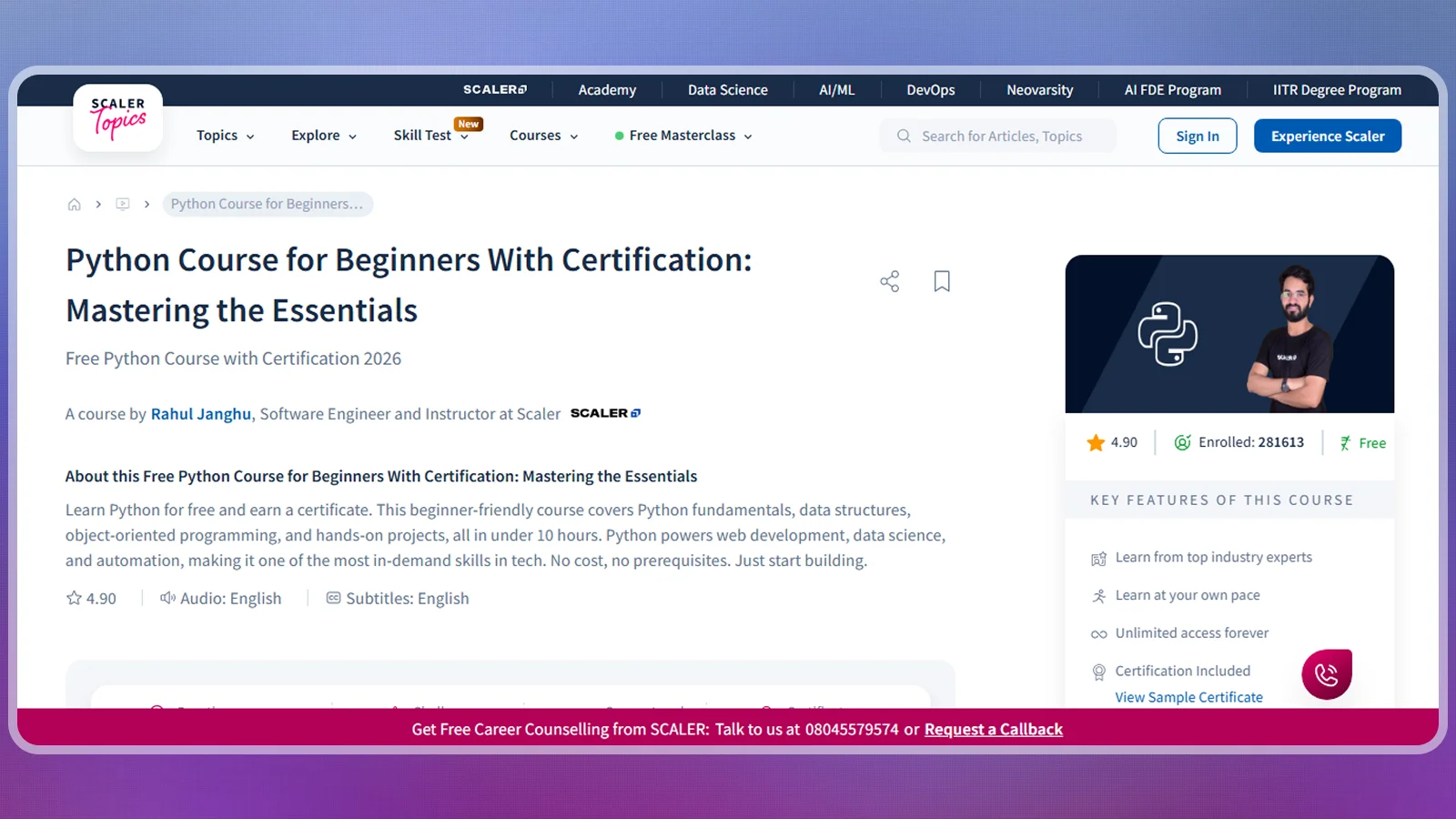
This Python course combines free access with a named completion award, making it a useful starting point for learners who want a structured introduction to Python without a subscription.
Rahul Janghu teaches the Scaler course, which covers setup, control flow, collections, functions, object-oriented programming, as well as file and error handling. Scaler lists under 10 hours of content across 16 modules, 131 lessons, and 10 coding challenges.
The challenges give you places to apply a Python for loop instead of only watching an explanation. Although the title resembles a Python certification course, the stated award is Scaler‘s Certificate of Excellence.
| Pros | Cons |
|---|---|
| ✅ Free access: no-cost learning route ✅ Named award: provides a Certificate of Excellence ✅ Built-in practice: includes coding challenges ✅ Broad introduction: covers fundamentals and later programming concepts | ❌ Rating scope: the displayed instructor score is separate from a course rating ❌ Fast content span: broad coverage calls for extra practice |
Choose this Python online course when cost and a completion record are your priorities.
4. Google [Best Free Option]
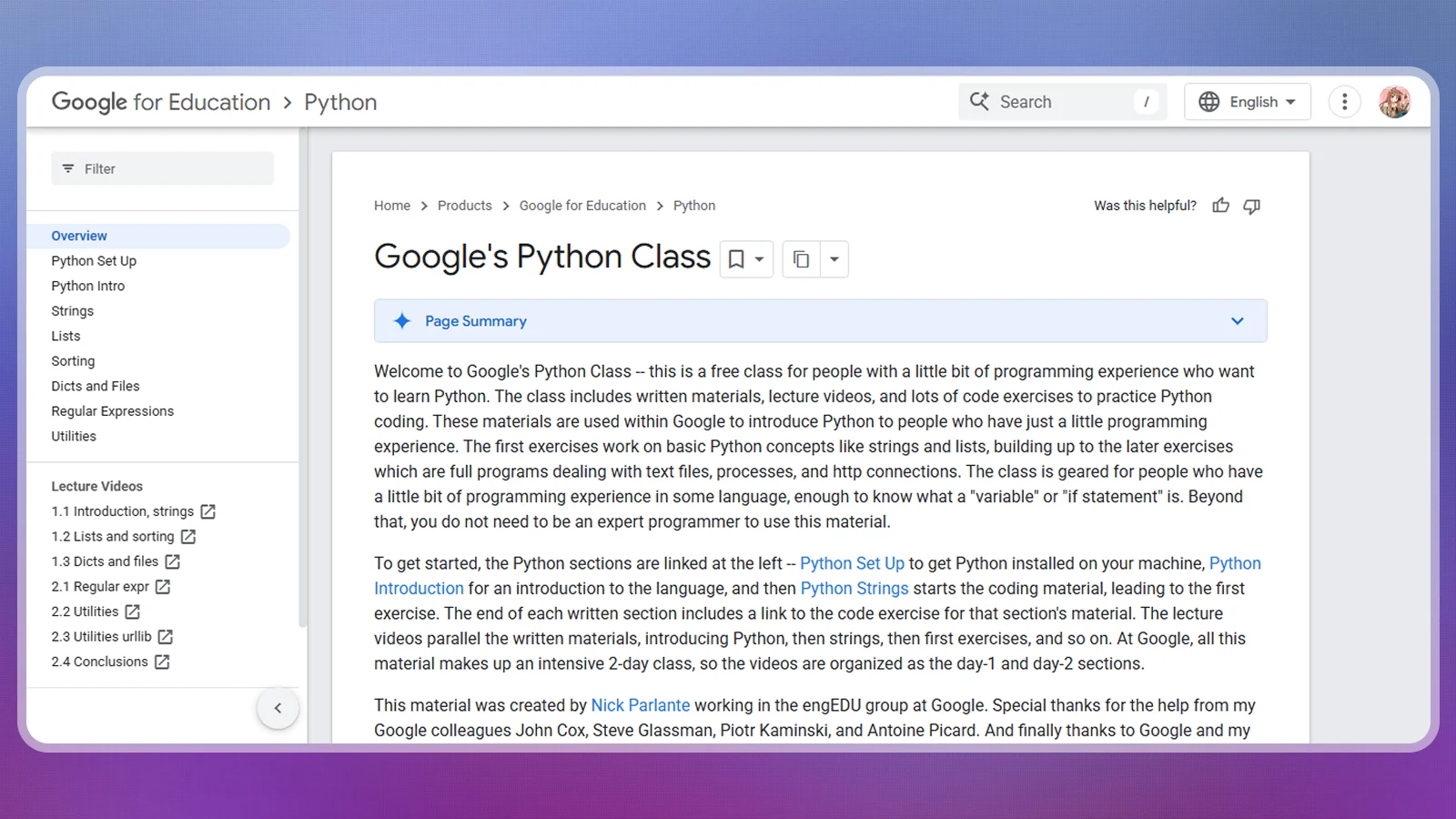
Google‘s Python course is the strongest option for someone who already understands basic programming. Its combination of written material, videos, and exercises suits learners who like working through examples on their own.
The intended audience already has some programming experience, so complete beginners should start with a more gradual introduction to Python.
Lessons in this Python course cover strings, lists, files, processes, and HTTP connections, which are the system of requests and responses commonly used to communicate with websites.
| Pros | Cons |
|---|---|
| ✅ Free study: no course purchase required ✅ Official material: published by Google ✅ Format choice: combines written lessons and videos ✅ Practical scope: includes files and HTTP exercises | ❌ Prior knowledge: assumes some programming experience ❌ Credential gap: no completion certificate listed |
Choose this class once you can follow basic programming logic and want practice with files and HTTP connections.
5. Udemy‘s Python for Total Beginners [Best Budget Pick]
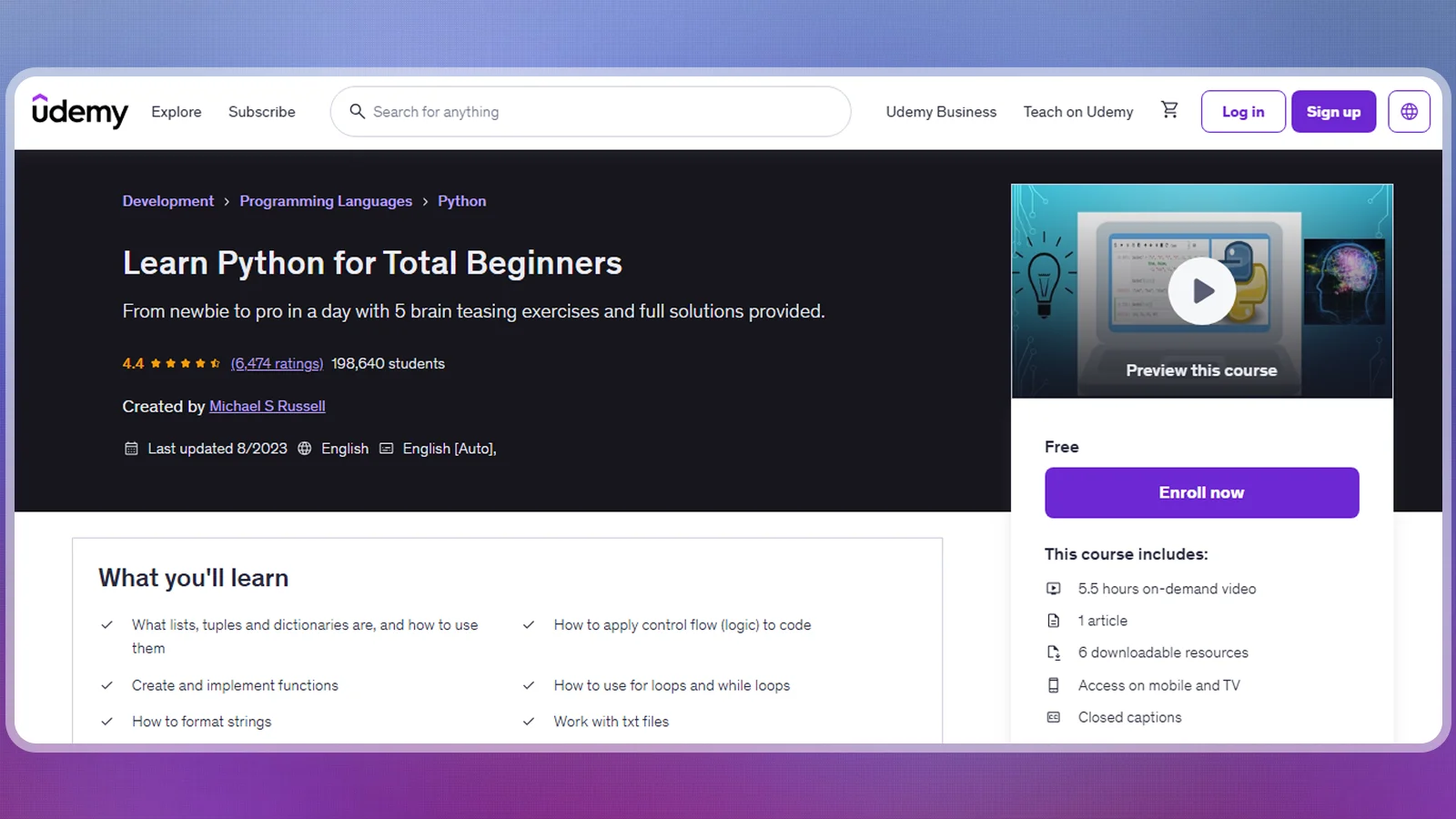
This free Python course is a practical budget pick for learners who prefer on-demand video. It offers an accessible way to try programming.Udemy‘s beginner course introduces Python through Anaconda and Jupyter Notebook, a tool that lets you run code in separate sections alongside notes. It covers variables, collections, control flow, loops, functions, and text files.
Udemy lists 5.5 hours of on-demand video and free access, making this Python online course suitable for trying the teaching format without a purchase. Readers pursuing certification for Python programming should choose a Python certification course with named exam coverage after learning the foundations.
| Pros | Cons |
|---|---|
| ✅ Free enrollment: listed as a free course ✅ Video format: offers on-demand lessons ✅ Notebook workflow: introduces Jupyter Notebook ✅ Core coverage: includes loops, functions, and text files | ❌ No listed award: no completion certificate ❌ Exam scope: no named certification target |
Among free Python courses, this is a sensible way to find out if video-led study works for you.
6. Coursera‘s Expressway to Data Science [Best for Data Science]
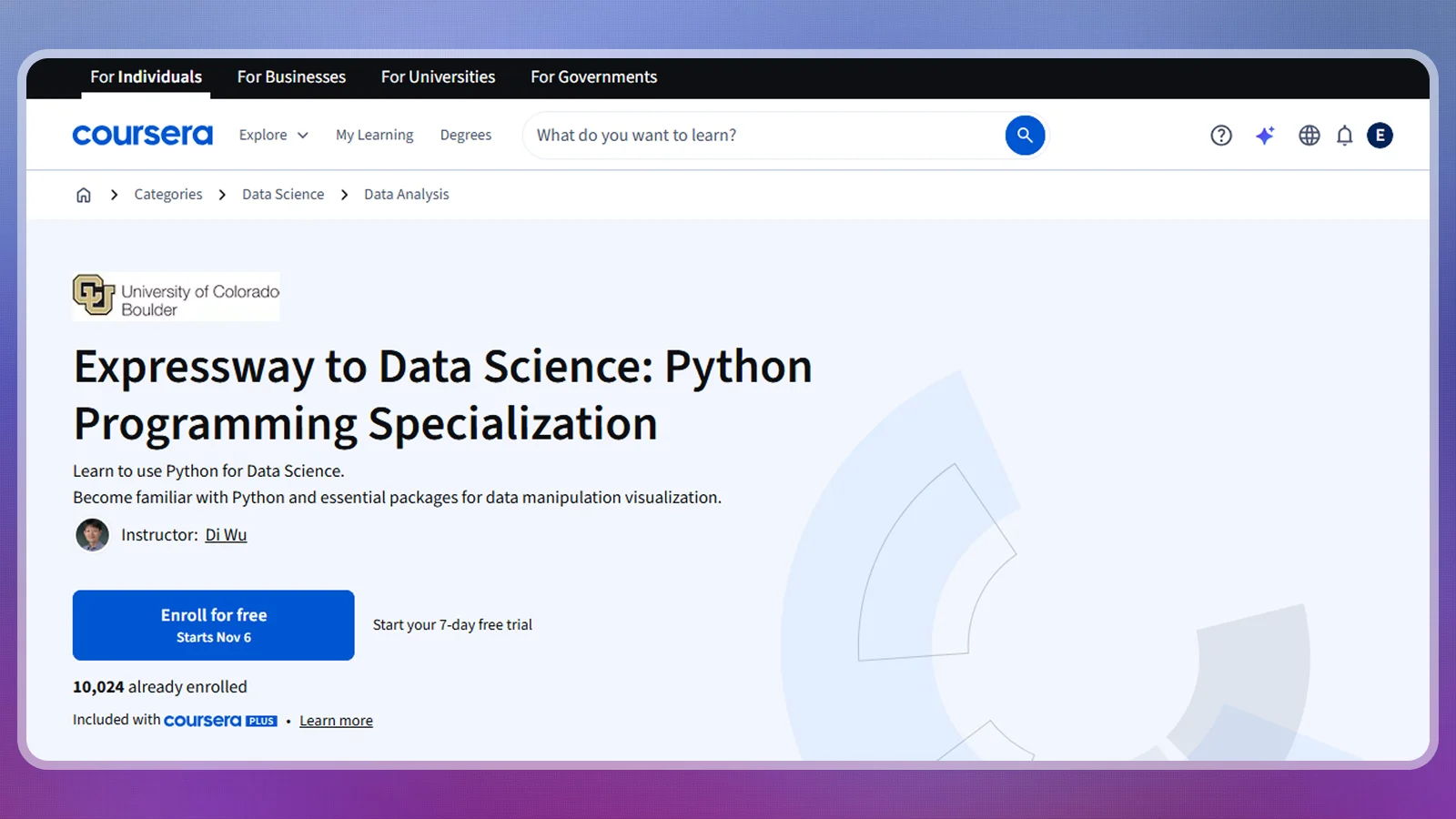
This Python course sequence makes the most sense when your goal is working with data, because it connects programming foundations to packages used for analysis and visualization.
Coursera presents fundamentals, functions, and data science packages as a connected path. The tools include Pandas, NumPy, Matplotlib, and Seaborn, which help organize, calculate, and visualize data. Start with the introduction to Python material before focusing on specific packages.
Choose this Python online course sequence to practice analysis and visualization with Pandas, NumPy, Matplotlib, and Seaborn.
| Pros | Cons |
|---|---|
| ✅ Clear direction: connects Python with data science ✅ Useful packages: includes analysis and visualization tools ✅ Foundation sequence: develops fundamentals and functions ✅ Completion award: offers a shareable certificate | ❌ Subscription cost: requires Coursera Preimum at $239 annually ❌ Specialized direction: less focused on general application building |
Pick this path when working with datasets is the reason you want to learn.
Free Python Courses and Resources
You can start with free lessons and practical exercises before paying for Python courses. Choose a resource that matches your experience, then complete its exercises before switching.
These free routes serve different needs:
- Official practice: Google’s Python Class combines written material, videos, and exercises for people with some programming knowledge.
- Completion award: Python Course for Beginners: Mastering the Essentials offers an introduction to Python with a named certificate.
- Video-first study: Learn Python for Total Beginners provides a free Python online course for learners who prefer watching and repeating examples.
- Catalog browsing: Codecademy lists Learn Python 2 as free. Keep its older language version in mind when choosing a starting resource.
Free Python courses are enough to begin writing code. Paid structure becomes useful when a specific Python certification course matches your exam goal.
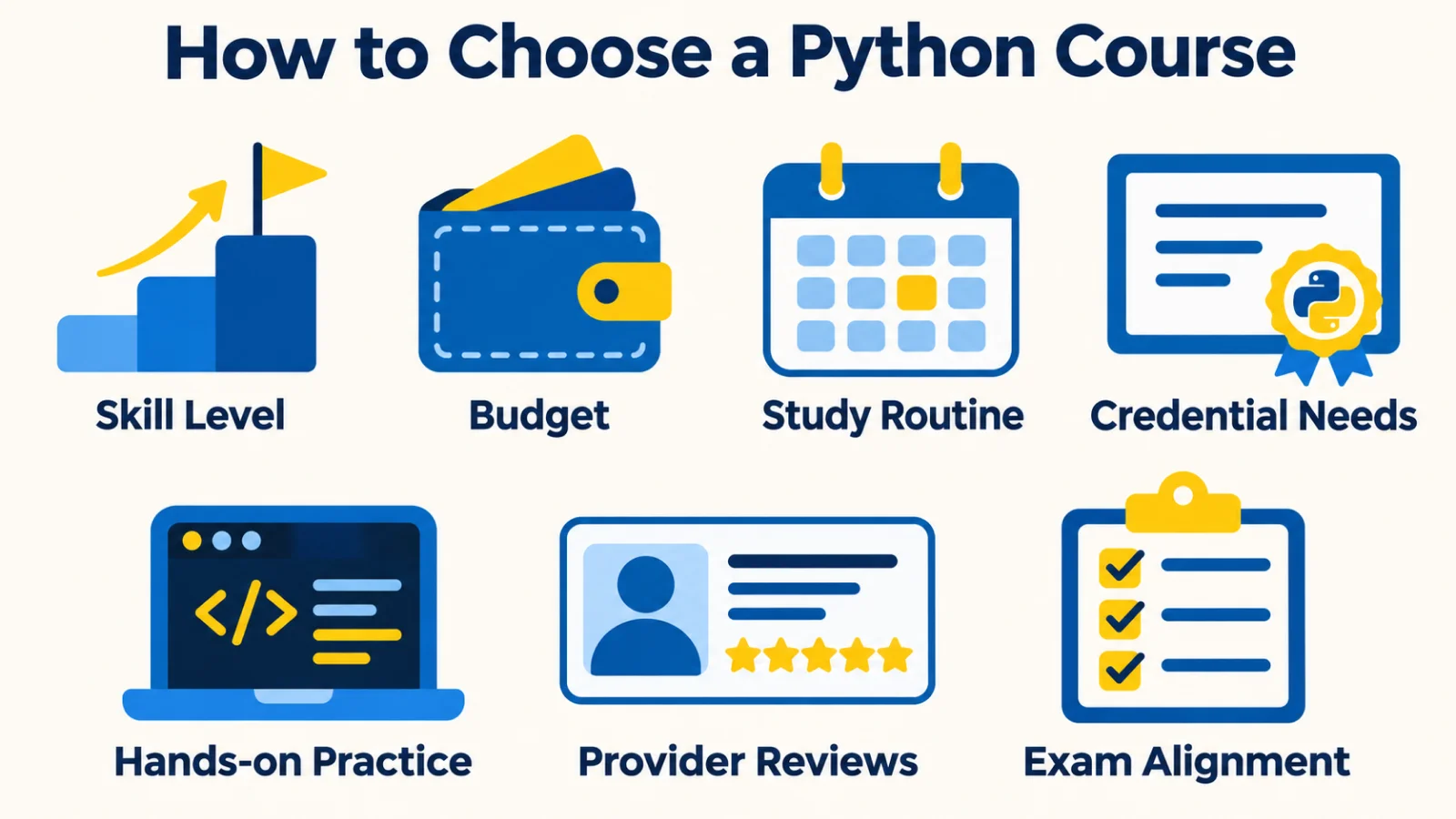
How To Choose the Right Python Online Course or Python Certification Course
Choose according to what you need to do after studying. A first program, a course completion award, and certification for Python programming are different goals, and the best Python courses make their purpose clear.
Compare the Python courses on your shortlist using these factors:
- Current experience: Choose an introduction to Python if variables and conditions are new.
- Budget and billing: Compare free access with subscription commitments.
- Study routine: Pick a Python online course whose format suits the time and attention you can give it.
- Credential needs: Ask what your employer or intended exam actually requires.
- Practice quality: Look for exercises that ask you to change a Python for loop, write a function, and handle unexpected input.
- Provider track record: Read course-specific feedback and keep instructor scores.
- Content relevance: Compare a Python certification course with the exam version it names.
Choose the course with the clearest next action. A shorter shortlist followed by consistent practice is more useful than collecting overlapping Python courses.
Are Python Courses Worth It?
Yes, Python courses are worth it when they provide a clear sequence and active practice. A suitable Python online course removes some of the planning work and gives you a sensible order for learning.
An introduction to Python becomes valuable when you can use the ideas away from the lesson. Write a small program, explain a Python for loop, and fix an error without immediately replaying the solution. Those tasks show what you have learned.
Judge the best Python courses by what you can build using your new knowledge. Finish a text-based game inventory, a file-organizing script, or a small data summary before deciding that another course is necessary.
Final Verdict
Choose exam-focused breadth if certification gives your study a clear purpose. The Complete Python Developer Certification Course is the strongest overall fit for that route, while Python for the Absolute Beginner is the better starting point when programming itself is new.
Google’s Python Class suits learners with some experience who want free official practice. Learn Python for Total Beginners is the budget Python course pick for video study. Choose the Coursera data science specialization instead if analysis and visualization are your goal.
The best Python courses match your starting point to useful practice. Begin with a Python course you can finish, then use a small project to decide what you need next.
FAQs
Python for the Absolute Beginner is the best Python course for beginners.
Yes, Python courses can add structure and practice to learning on your own.
Yes, Google’s Python Class, Scaler‘s beginner course, and Learn Python for Total Beginners on Udemy offer free routes.
Scaler lists under 10 hours of learning content for its beginner Python course, while Coursera lists 4 weeks for its beginner paths. These are course schedules. Building confidence takes additional coding, revision, and debugging.
A Python certification course targets an external exam, while a regular course teaches skills and may award a completion certificate. Compare the named exam and practical exercises when choosing the best Python courses.