



AAA Studios Face Economic Math That Doesn’t Work, According to Recent Report




- Global gaming revenue hit $219 billion in 2024, with 4% annual growth projected through 2028
- Platform-style games like Roblox and Fortnite dominate, capturing up to 60% of revenues on their platforms
- Indies thrive with faster growth rates and critical acclaim, leaving AAA squeezed in the middle
- User-generated content is now central, with Roblox creators earning nearly $1 billion in 2024
- AAA studios must reinvent economics and strategies to survive rising costs and shrinking margins
Jump to:
Industry Growth Masks Concentration of Power
The Bain & Company’s recent Gaming Report 2025 highlights that the global video game market grew by 5% last year, reaching $219 billion in revenue, excluding hardware, advertising, and esports.
The prominent global management consultancy firm is best known for its work on tracking customer sentiment in various fields. Its report forecasts 4% annual growth through 2028, a stable trend following the post-pandemic correction.
Yet growth is increasingly concentrated. Bain found that the top 10 games on each platform now account for 50% to 60% of all revenue. This ossification of the market represents a structural shift: the winners keep winning, while new entrants face monumental challenges.
“AAA studios are adapting, but they’re also getting squeezed by nimble indies capitalizing on evolving tastes and technology’s democratization of game development and distribution,” the report says in its opening remarks.
“Stoking players’ love is even more crucial as fans spend more time with favorite franchises through cross-media extensions.”
The report identifies “games as a platform,” such as Roblox, Fortnite, and Minecraft, as the defining force. Unlike traditional AAA releases, these platforms thrive on social play, user creativity, and persistent updates, drawing users deeper into their ecosystems over time.
Young Gamers Cement The Dominance of Platforms
Bain’s global survey across six countries shows younger gamers are the driving force behind top titles. Respondents under 18 devote a higher share of their media consumption to gaming than any other age group. The study notes: “The net effect is that young people’s favorite games are more heavily clustered around a few top titles than in other age groups.”
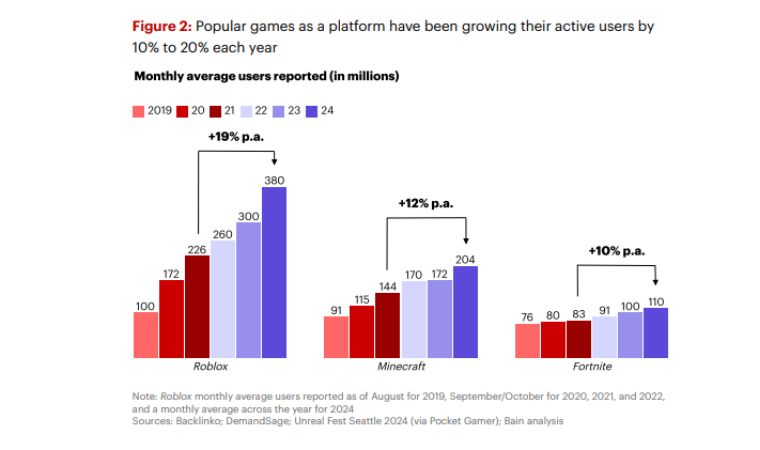
Roblox is emblematic. In 2021, around half of its users were under 13. By 2024, that share had declined to 40%, not because Roblox lost children but because many of those children aged into teens and stuck with the game. This durability signals that platform-style titles may hold generational loyalty in ways past AAA franchises struggled to sustain.
Currently, 56% of all Roblox users are no older than 17, and the platform is currently under legal scrutiny for not ensuring the safety of its majority users.
Gameplay And Socialization Now Beat Graphics
The Bain survey underlines a dramatic shift in what gamers value. While AAA franchises traditionally invested in cutting-edge visuals and incremental gameplay tweaks, players today are less swayed by fidelity.
Of players surveyed, 22% cited gameplay as their top priority while only 7% considered high-quality graphics or audio as the most important factor. This shows that the playing field has been leveled to the point where game studios of any size have a chance to launch a successful game as long as they get the gameplay right.
For AAA studios, the warning is clear: chasing photorealism while neglecting community-building leaves them spending hundreds of millions in areas consumers no longer prioritize.
User-Generated Content Becomes an Economic Engine
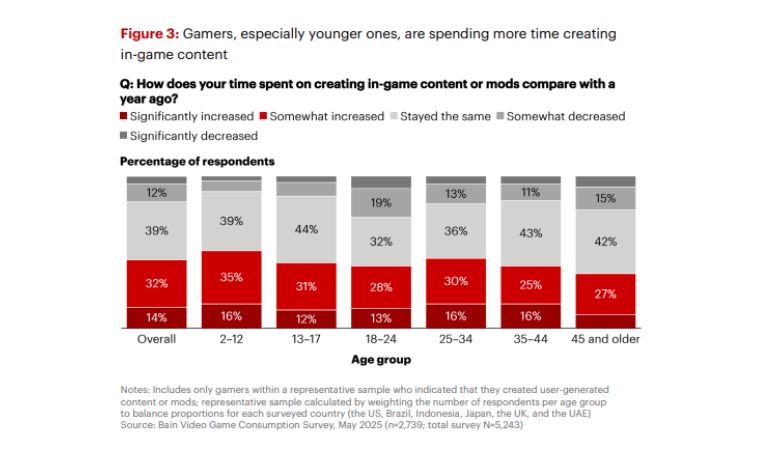
The report emphasizes the rise of user-generated content (UGC) as one of the most disruptive forces. In 2025, nearly half of creators reported spending more time making content than the previous year, especially younger gamers.
“About 80% of gamers in our 2024 survey said they had played a game featuring player-made levels, modes, or items,” the Bain report says.
At scale, community creation rivals or exceeds AAA budgets. Roblox paid its creators nearly $1 billion in 2024, while Fortnite paid out $350 million. Bain notes: “At scale, the collective creation efforts of the community can surpass the size of AAA game budgets”.
This makes UGC not a novelty but a pillar of modern gaming economics. Companies like Nintendo and Sony have dipped into this space with Super Mario Maker and Dreams, but the report warns UGC “cannot be an afterthought or a gimmick.”
Monetization Models Struggle to Keep Pace
Despite rising engagement, publishers still face the paradox of gamers “playing more but paying less.” Bain observes that marquee prices have been stagnant at $60 to $70 for two decades, which in inflation-adjusted terms is cheaper than cartridges in the 1990s.
Microtransactions remain a key lever, but leaning too heavily risks backlash. Subscriptions like Game Pass offer alternative models, but Bain notes “publishers exploring subscription revenue models have yet to prove that large titles can make that transition successfully.” Mobile has monetized through advertising, but outside mobile, ads remain experimental.
Interestingly, friction around ads is increasing, yet conversions are too. Bain reports that while 64% of players say ads interrupt gameplay, 46% admit they often make purchases triggered by ads – a 6% rise year-on-year. Roblox is already monetizing this contradiction with self-serve programmatic advertising via PubMatic and Google partnerships.
Indies Surge While AAA Falters
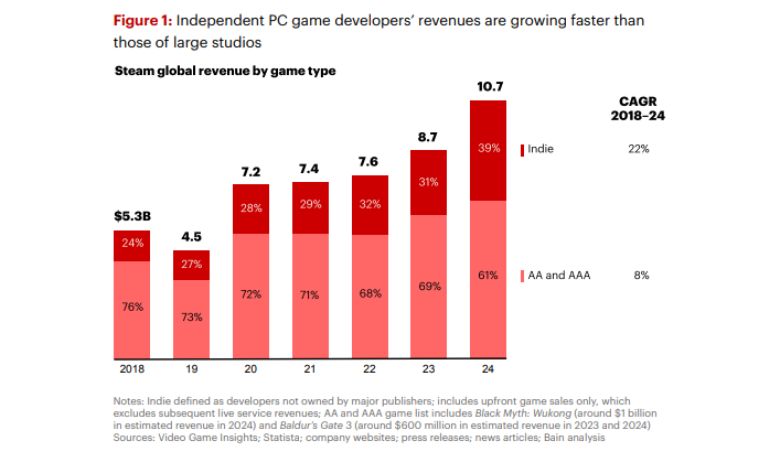
Perhaps the starkest revelation of the Bain report is how indies are thriving while AAA is squeezed. Between 2018 and 2024, PC revenue for indies grew at a 22% compound annual rate, compared with just 8% for AA and AAA combined.
Games like Palworld and Manor Lords illustrate how smaller studios are punching above their weight. The report highlights that recent indie launches such as Clair Obscur: Expedition 33 and Split Fiction each sold more than one million copies in three days – figures once associated exclusively with blockbusters.
By contrast, EA’s 2024 release Dragon Age: The Veilguard “engaged” only 1.5 million players, half its internal projections, forcing the company to revise financial forecasts downward and restructure the studio.
AAA Economics Break Down
For major publishers, the math no longer works. Budgets balloon, timelines lengthen, and the digital transition has not delivered expected margin relief.
“The bottom line for large studios: The math simply doesn’t work as easily as it once did,” the Bain report concludes.
Even platform distribution takes a toll. Fees from storefronts like Steam and console marketplaces now eat into what once went to retail. Meanwhile, the cost of operating live-service titles adds ongoing expenses, undermining the one-time recoup model that sustained the industry for decades.
With the number of new PC and console games growing about 30% annually over the last decade, AAA titles now compete in an overcrowded field. Steam alone saw 19,000 releases in 2024.
Lessons Learned or Not – Only Future Will Tell
The biggest flop in AAA history is without a doubt Concord. Its budget ran over $200 million dollars, excluding marketing, and it took the little known company Firewalk Studios eight years to make. Sony Interactive Entertainment was so enamored with the game that they bought the developing studio in April 2023 with the intention of becoming its publisher. Concord was also seen by Sony as a great addition to the PlayStation roster.
Concord had been a well-kept secret in the industry and probably for good reasons. When the game launched on Aug. 23, 2024 it was immediately met with an incredible tsunami of criticism. Rather than listening to the community, Sony doubled-down and blamed gamers for being out of touch with the current zeitgeist.
Much of the critique was levied against the characters of the game who were called preachy and pandering to the LGBTQ+ community. Several of the characters used they/them pronouns, were non-binary, or had openly queer relationships or backgrounds, making it difficult for a vast majority of gamers to identify with them.
The game was taken offline during Sept. 3-6 and Sony confirmed on Oct. 29 that the studio was sunsetting the game. During its incredibly short lifespan of only two weeks, Concord sold an estimated 25,000 copies which all ended up refunded by Steam and Sony with no questions asked.
Adaptation or Decline For Big Studios
Bain prescribes three strategies for AAA survival: doubling down on core fanbases, enforcing cost discipline, and pursuing smarter intellectual property expansion.
“Executives of these incumbent studios can no longer ignore a hard truth: They’ll have to reinvent how they operate if they want to stay relevant and secure their future”.
The report suggests learning from Riot Games and Nintendo, who orchestrate multi-channel IP strategies spanning TV, merchandise, and real-world events. Franchises like Fallout, revitalized by a successful television adaptation, illustrate how cross-media synergies can extend relevance.
Yet Bain underscores that none of this matters without a great game at the center. The consultancy concludes that the studios who will endure are those that “empower user creativity, build real communities, and evolve monetization to meet rising expectations.”
 or
or