


Best Accounting Courses in 2026: 6 Picks for Beginners

Eneba Hub contains affiliate links, which means we may earn a small commission if you make a purchase through them—at no extra cost to you. Learn more


QUICK LOOK
Start with the Financial Accounting specialization on Coursera for broad coverage of fundamentals, financial analysis, equity, and tax accounting.
The best accounting courses help beginners and career changers build practical skills without committing to a degree. Our picks include Financial Accounting: Master Core Concepts and Analysis Specialization for broader study and Introduction to Accounting and Core Concepts for beginners. If you’re exploring the subject on a budget, Introduction to Financial Accounting provides a free starting point.
These courses cover different levels of training, so the right choice depends on your goals and available study time. Some focus on accounting concepts, while others provide programs with formal credentials. Prices range from free options to WGU‘s $2,000 certificate program.
This guide compares course content and enrollment costs to help you choose a suitable starting point. You’ll also learn what the certificates mean and how accounting salary figures relate to career paths.
Jump to:
Best Accounting Courses at a Glance
These six accounting courses serve different goals, from a free introduction to a university certificate. Compare the time and credential alongside the cost. The best accounting courses for a working bookkeeper may differ from the best choice for someone testing the subject.
|
Course |
Provider |
Best for |
Price |
Time |
Certificate |
|---|---|---|---|---|---|
|
Financial Accounting: Master Core Concepts and Analysis Specialization |
 |
Best Overall |
$239 annual Coursera Plus offer |
4 weeks or 15–16 weeks at 3–4 hours/week |
Shareable certificate |
|
Introduction to Accounting and Core Concepts |
|
Best for Beginners |
$239 annual Coursera Plus offer |
7 hours |
Shareable certificate |
|
Introduction to Financial Accounting |
 |
Best Free Option |
Free |
55 minutes of lectures |
Not listed by the provider |
|
Basics of Accounting |
|
Budget Comparison Pick |
Not listed by the provider |
6 hours of video |
Certificate of completion |
|
Accounting Fundamentals Certificate |
 |
Best Certificate |
$2,000 |
6 months at 15–20 hours/week |
Accounting Fundamentals Certificate |
|
Mini Course on Accounting Skills for Business Owners |
|
Best for Business Owners |
Free |
Not listed by the provider |
Not listed by the provider |
The courses are arranged by their intended learning goals, so you can easily identify options that match your experience and interests. Treat the advertised Coursera Plus amount as an offer, and compare Basics of Accounting‘s enrollment price before choosing it on budget grounds.
Why Learn Accounting?
Accounting helps you record transactions and understand financial results. Its foundation is the accounting equation: Assets = Liabilities + Equity. Accounting courses help you understand how everyday financial transactions affect a business and appear in its financial reports.
A business owner uses those reports to distinguish profit from available cash. A bookkeeper needs to classify transactions consistently, while a student needs a foundation for more advanced study. A good accounting course should help you apply these concepts to real situations, such as understanding how equipment purchases affect a company’s finances.
For a small game studio, that could mean separating development equipment, outstanding bills, and money invested by the owner. The accounting equation keeps those relationships visible.
The best accounting courses teach financial statements, debits and credits, and transaction classification in context. Before focusing on accounting salary expectations, build a solid understanding of how financial records work and what they reveal about a business.
Syllabus and Provider Evidence Behind the Picks
These accounting courses were selected using provider-published syllabuses and enrollment details. Each course was chosen for its particular focus, with options that cover fundamental accounting concepts or more specialized areas of study.
Provider ratings appear with their review counts and are not ranked across platforms. Where a listing gives different duration measures, the entry explains them, including lecture totals versus rounded viewing time. Credential descriptions distinguish course completion from professional qualifications. This approach helps readers compare courses based on their educational content and published requirements, rather than relying on promotional claims.
The 6 Best Accounting Courses, Reviewed
The best accounting courses below move from broad foundations to shorter introductions and a business-owner specialty. Choose by learning depth first: a free accounting course can test your interest, while a larger program asks for a more sustained commitment.
1. Best Overall: Financial Accounting: Master Core Concepts and Analysis Specialization (Coursera)
This specialization stands out for its coverage beyond basic bookkeeping. It is the strongest overall accounting course here for learners who want to connect fundamentals with financial analysis, equity, and tax accounting.
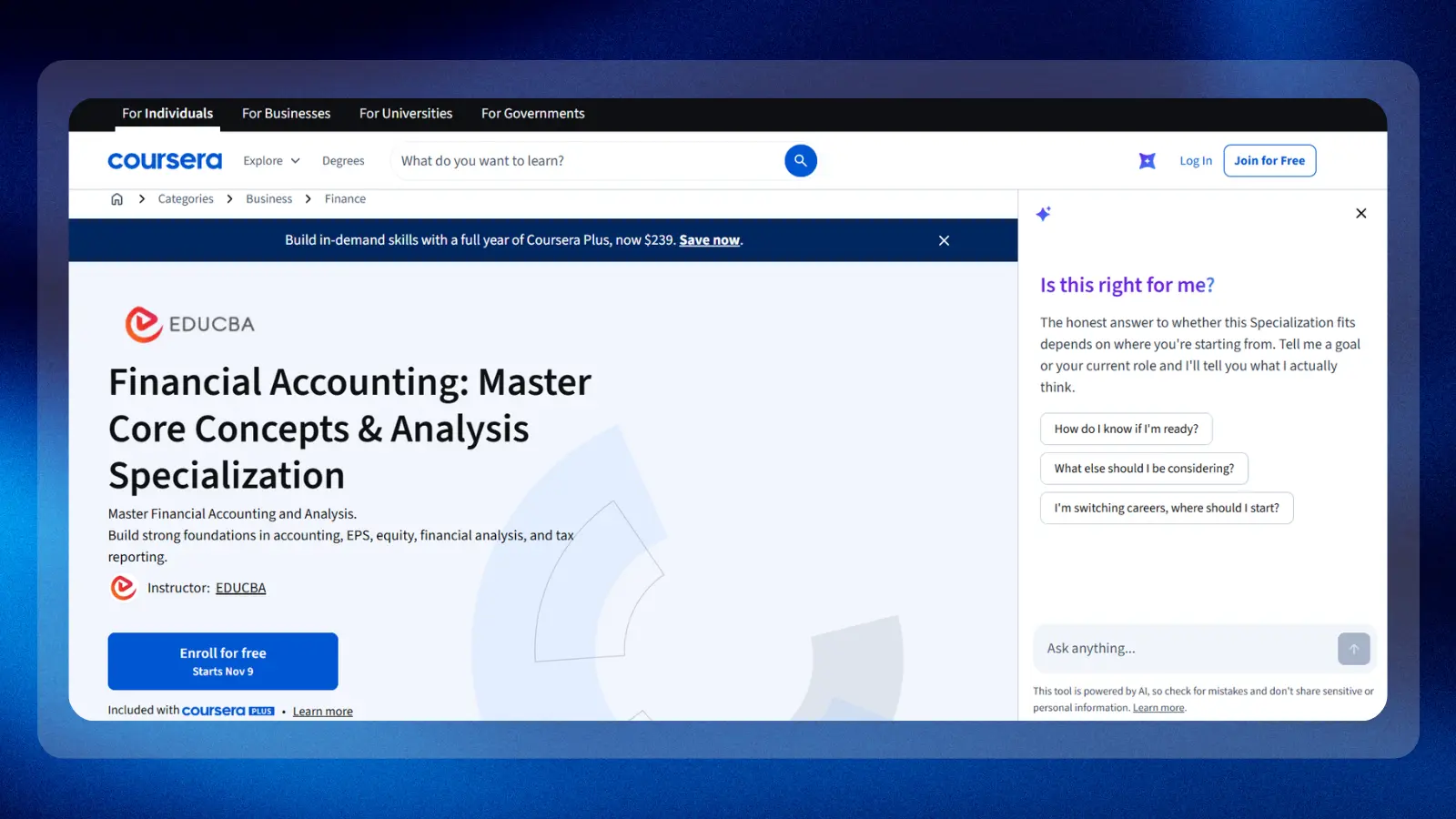
The Coursera syllabus covers accounting basics alongside financial analysis and advanced reporting topics. Projects include analyzing balance sheets, evaluating equity, and interpreting tax implications in financial statements.
That makes this accounting course a sensible progression after learning the accounting equation. Use the analysis tasks to explain why a financial result changed, then relate your explanation to the underlying transactions.
The page gives both a 4-week completion figure and a 15–16-week schedule at 3–4 hours per week. Plan your study time so you can revisit challenging exercises when needed. Broad training in accounting is more useful when you can explain the calculations afterward.
Here are the main course details:
| Provider | Coursera |
| Price | $239 annual Coursera Plus offer |
| Difficulty | Beginner |
| Time | 4 weeks or 15–16 weeks at 3–4 hours/week |
| Certificate | Shareable certificate |
| Rating | 4.7/5 from 68 reviews of courses in the program |
The shareable certificate confirms course completion but doesn’t grant a professional accounting license. The following trade-offs explain this accounting course’s overall position.
| Pros | Cons |
|---|---|
| ✅ Broad syllabus – Fundamentals, analysis, equity, and tax ✅ Applied tasks – Balance-sheet and financial-statement analysis ✅ Beginner level – An entry point into wider study ✅ Completion credential – Shareable certificate listed | ❌ Subscription basis – Access is presented through Coursera Plus ❌ Broader commitment – More material than a short introduction |
Choose this accounting course if you want practice connecting balance-sheet figures to equity and tax decisions.
2. Best for Beginners: Introduction to Accounting and Core Concepts (Coursera)
This accounting course is the clearest starting point for learners who need basic concepts explained before specialization. Its beginner focus suits someone unfamiliar with accounting terminology or business structures.
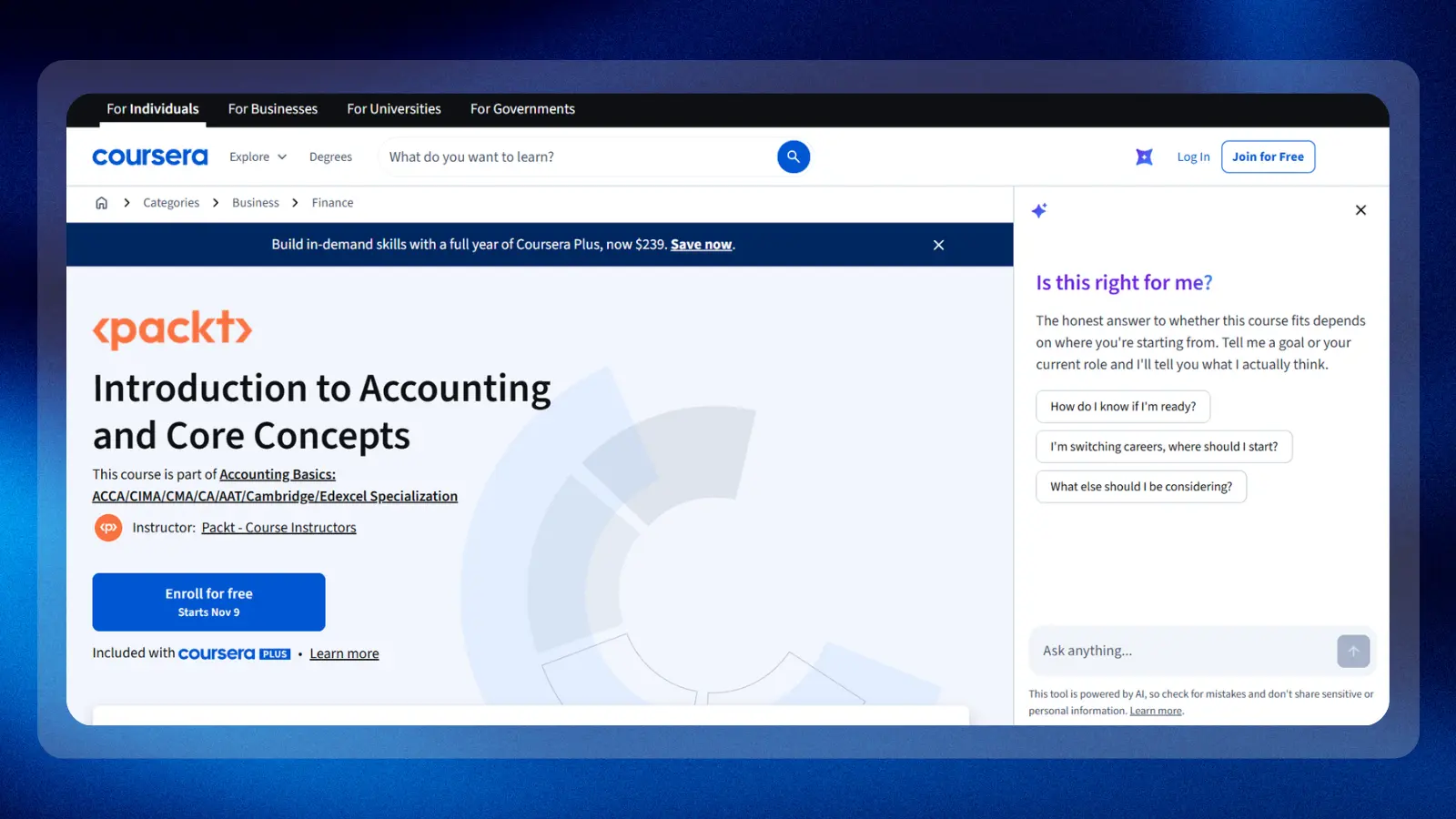
The course is taught by Packt – Course Instructors on Coursera. It covers core principles, financial and management accounting, and the differences between sole traders, partnerships, and limited liability companies.
This accounting course also includes Coursera Coach for interactive learning. Use those interactions to explain concepts in your own words before moving into a longer accounting course.
The listed 7 hours include 4 hours 30 minutes of video. Leave room for pauses and practice when organizing your training in accounting. Focus on understanding transaction categories before rushing through the remaining lessons.
Here are the course details:
| Provider | Coursera |
| Price | $239 annual Coursera Plus offer |
| Difficulty | Beginner |
| Time | 7 hours, including 4 hours 30 minutes of video |
| Certificate | Shareable certificate |
| Rating | Not listed by the provider |
This accounting course provides an accessible introduction with a shareable completion certificate. Its main strengths and limitations are:
| Pros | Cons |
|---|---|
| ✅ Beginner focus – No prior accounting knowledge required ✅ Business context – Explains different business structures ✅ Clear distinctions – Financial versus management accounting ✅ Interactive learning – Includes Coursera Coach | ❌ Subscription offer – Annual access can exceed a narrow learning need ❌ Limited rating detail – No provider rating listed |
This is a practical starting point among the best accounting courses for beginners. If your only requirement is to learn accounting for free, try a free introduction before paying for platform access.
3. Best Free Option: Introduction to Financial Accounting (Udemy)
This free accounting course provides a straightforward introduction to financial transactions. It gives a newcomer a useful way to try the subject before choosing longer training in accounting.
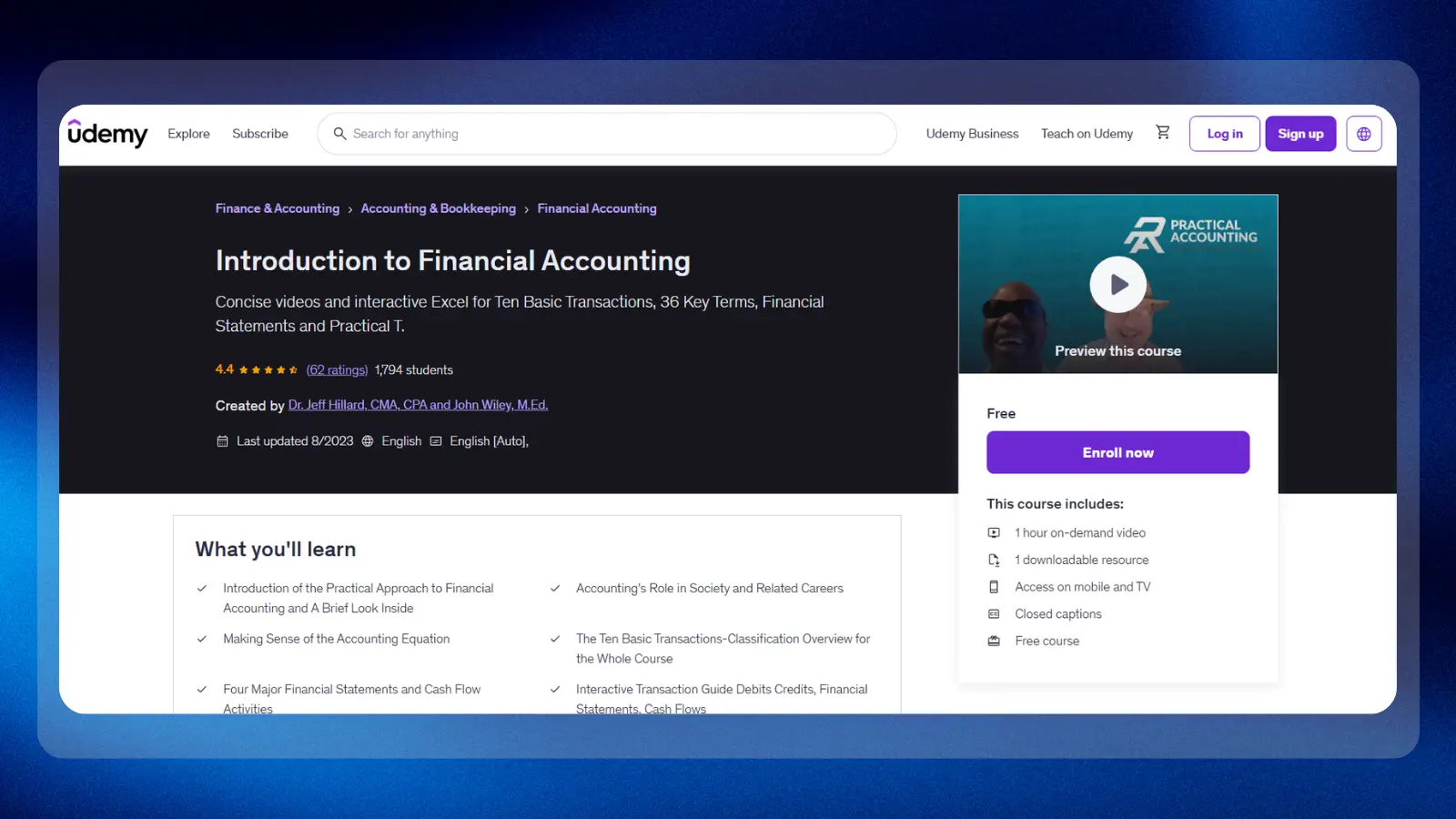
The Udemy course explains accounting’s role in society, the accounting equation, and basic transaction classification. Its practical approach gives learners something concrete to work with after the introductory definitions.
The lecture list totals 55 minutes, while the page also summarizes the video content as 1 hour. The table below uses the exact lecture total. Treat that as viewing time and pause to work through the transaction examples yourself.
For readers comparing the best accounting courses on cost, free access makes this a low-commitment first choice. Keep the learning goal specific: explain how a transaction changes the accounting equation before moving on to financial analysis.
Here are the listed course details:
| Provider | Udemy |
| Price | Free |
| Difficulty | Beginner |
| Time | 55 minutes of lectures |
| Certificate | Not listed by the provider |
| Rating | 4.4/5 from 62 ratings |
This accounting course is useful for learning, while readers seeking free accounting certifications should distinguish access to lessons from a listed credential.
| Pros | Cons |
|---|---|
| ✅ Free access – Try financial accounting without a course fee ✅ Core foundation – Introduces the accounting equation ✅ Transaction focus – Practices basic classification ✅ Accessible entry – No prior experience required | ❌ Introductory scope – Limited depth for advanced study ❌ Credential gap – No certificate listed |
Start here to learn accounting for free, then consider longer courses for additional practice or certification.
4. Budget Comparison Pick: Basics of Accounting (Udemy)
Basics of Accounting is worth considering for its coverage of reporting standards and assets. Compare its enrollment price with your alternatives before choosing it as a budget accounting course.
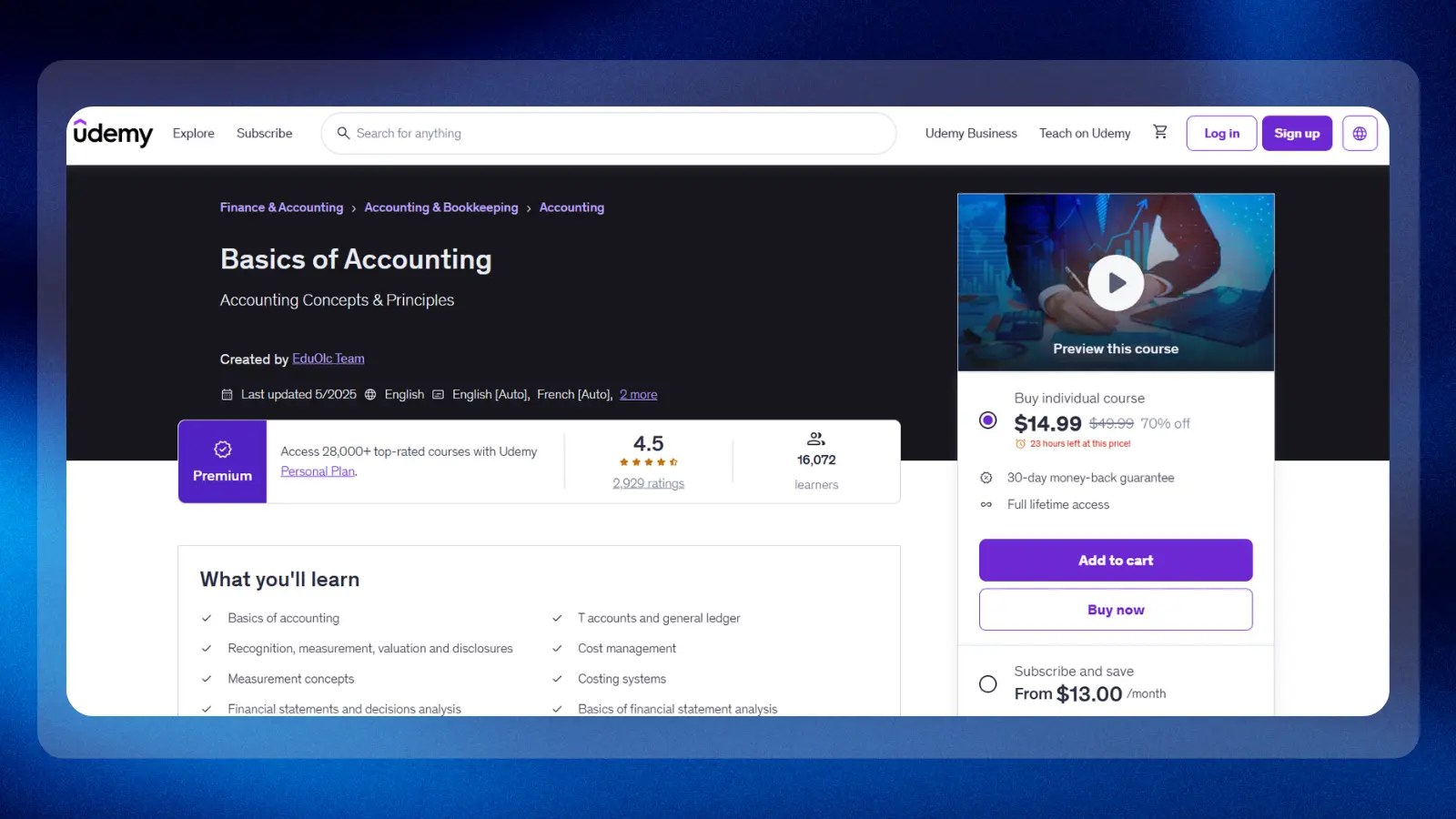
The Udemy syllabus covers accounting terminology, IFRS and GAAP, investment classification, and depreciation and amortization. IFRS and GAAP are financial-reporting frameworks. Depreciation and amortization spread the cost of certain assets across accounting periods.
This accounting course offers more room for those topics than the free introductions. For a small game studio, depreciation shows how equipment costs can be spread across accounting periods.
The course page lists 6 hours of on-demand video and a completion certificate. Choose this accounting course if its topics match your goals, and check the purchase price before enrolling.
Here are the published details:
| Provider | Udemy |
| Price | Not listed by the provider |
| Difficulty | Not listed by the provider |
| Time | 6 hours of on-demand video |
| Certificate | Certificate of completion |
| Rating | 4.5/5 from 2,919 ratings |
The course’s listed completion certificate may help document study. Readers seeking free accounting certifications should treat its pricing and credential as separate enrollment decisions.
| Pros | Cons |
|---|---|
| ✅ Reporting frameworks – Covers IFRS and GAAP ✅ Asset topics – Includes depreciation and amortization ✅ Investment coverage – Introduces classification ✅ Completion record – Certificate listed | ❌ Unlisted list price – Budget value depends on the enrollment offer ❌ Theory focus – Syllabus emphasizes concepts over software training |
Choose this accounting course for deeper study of asset costs and financial reporting frameworks.
5. Best Certificate: Accounting Fundamentals Certificate (WGU)
WGU suits learners who want a university-issued certificate and a structured study program. This accounting program asks for a much larger time and financial commitment than the short introductions.
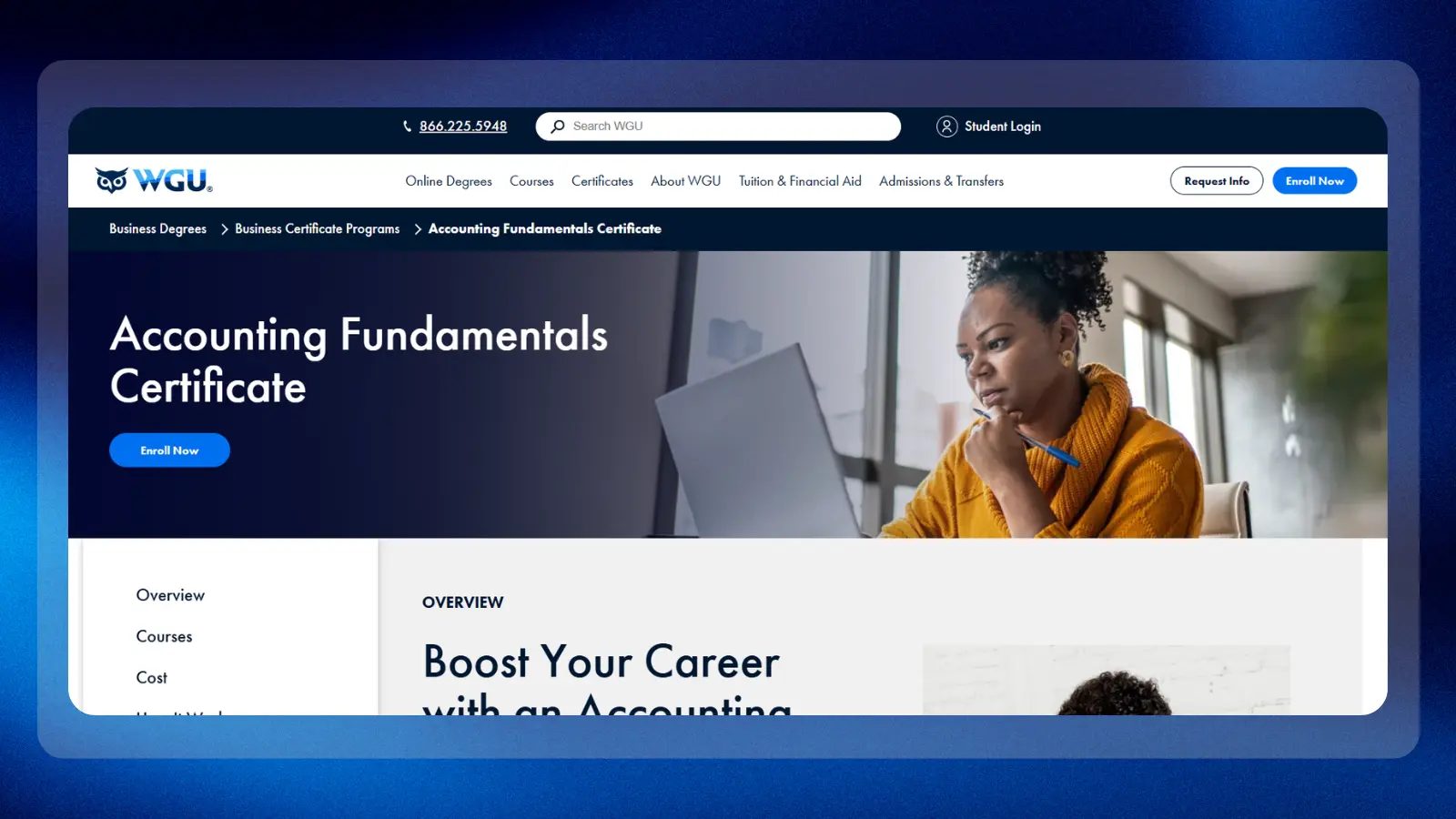
The program covers financial and managerial accounting, finance skills, and QuickBooks. This suits learners who want accounting fundamentals alongside practical business software skills.
WGU lists a $2,000 price and an installment option of 6 monthly payments of $333.33. The program takes about six months at 15–20 study hours per week.
Choose this accounting course when you can protect that weekly study time. A university certificate may suit learners who prefer a structured, longer-term program. Readers comparing free accounting certifications should first decide if they need an introductory record of participation or a larger academic program.
Here are the program details:
| Provider | WGU |
| Price | $2,000, or 6 monthly payments of $333.33 |
| Difficulty | Not listed by the provider |
| Time | 6 months at 15–20 hours/week |
| Certificate | Accounting Fundamentals Certificate |
| Rating | Not listed by the provider |
This accounting program provides a university certificate with a significant study commitment. The trade-offs are:
| Pros | Cons |
|---|---|
| ✅ University provider – Offered by WGU ✅ Named credential – Accounting Fundamentals Certificate ✅ Software study – Includes QuickBooks ✅ Payment option – Installment plan available | ❌ Larger cost – $2,000 program price ❌ Weekly workload – Recommends 15–20 hours |
Choose this accounting course if the combination of university study and QuickBooks matches your next step and you can sustain the weekly workload.
6. Best for Business Owners: Mini Course on Accounting Skills for Business Owners (Udemy)
This free accounting course stands out for its focus on business owners. It suits someone who wants to understand why accounting is useful before committing to broader training in accounting.
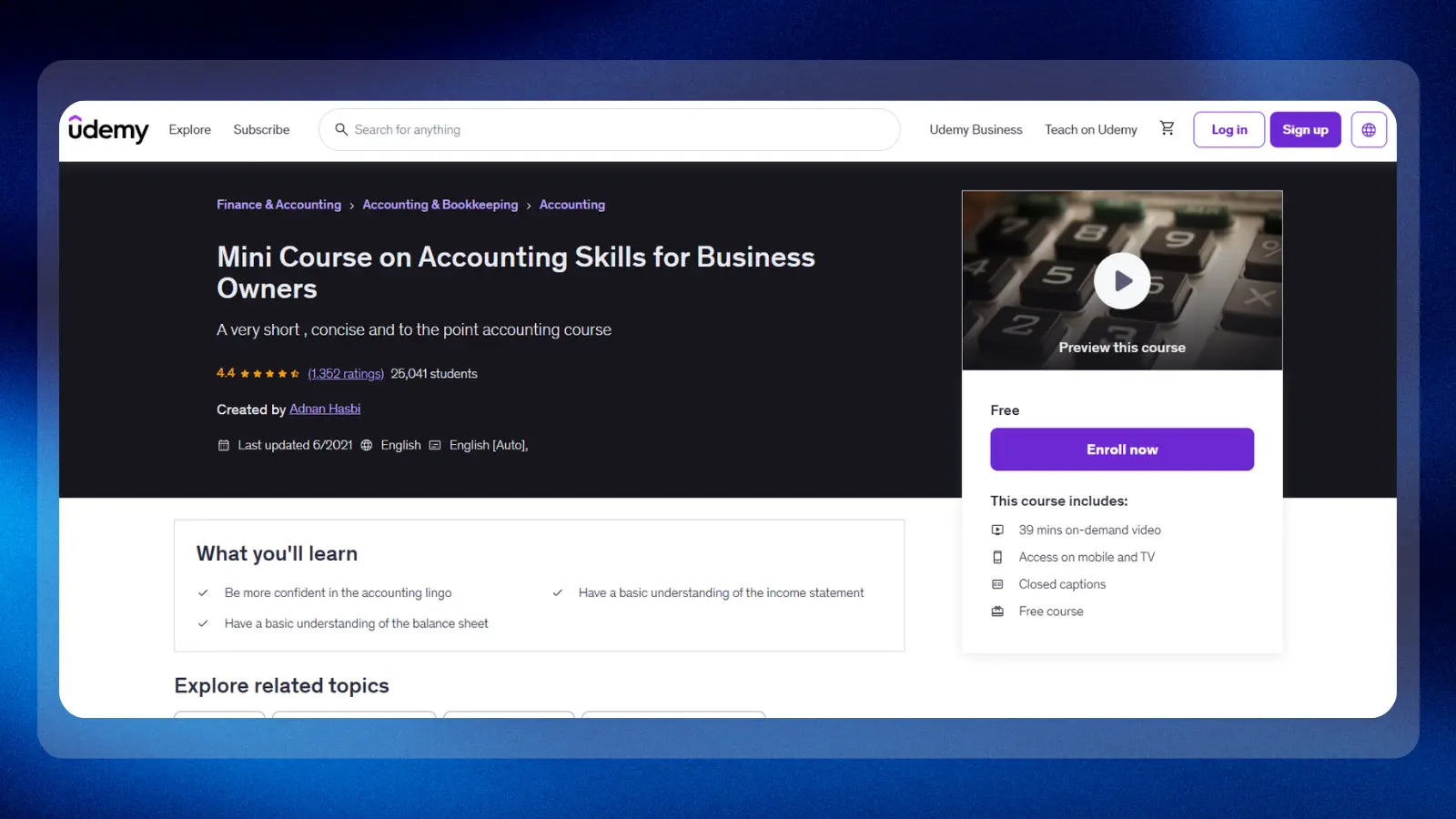
The Udemy course explains accounting’s purpose, the people who use accounting information, and the accounting equation. The instructor draws on an auditing and investment-analysis background.
Apply the course concepts to everyday financial questions about your own business. For example, distinguish money invested by an owner from sales revenue, then describe how each affects the books.
The course is free, which makes it another route to learn accounting for free before selecting a longer program. If you plan to manage financial records yourself, follow this course with more transaction practice.
Here are the published course details:
| Provider | Udemy |
| Price | Free |
| Difficulty | Beginner |
| Time | Not listed by the provider |
| Certificate | Not listed by the provider |
| Rating | 4.4/5 from 1,352 ratings |
This accounting course provides a basic introduction to the subject.. Its main strengths and limitations are:
| Pros | Cons |
|---|---|
| ✅ Free access – No course fee ✅ Relevant audience – Written for business owners ✅ Core relationship – Explains the accounting equation ✅ Business context – Introduces users of accounting information | ❌ Narrow scope – An introduction to the subject ❌ Credential gap – No certificate listed |
Among the best accounting courses for owners, relevance beats breadth at the starting point. Searches for free accounting certifications should come after deciding what you need to understand about your business.
Free Accounting Courses and Resources
Free accounting courses help you explore the subject and practice essential concepts before committing to paid training.
Start with these resources:
- Reference lessons: AccountingCoach offers free explanations, quick tests, and learning paths by Harold Averkamp, CPA, MBA. Its site lists 400,000+ subscribers.
- Structured open study: The Open University offers Introduction to Bookkeeping and Accounting. It covers the accounting equation and double-entry bookkeeping, with a free Statement of Participation on completion.
- Transaction introduction: Introduction to Financial Accounting on Udemy offers a focused route to learn accounting for free through basic transaction examples.
- Owner-focused introduction: Mini Course on Accounting Skills for Business Owners on Udemy explains accounting’s purpose in a business context.
Double-entry bookkeeping records the effects of transactions across accounts. Practice these examples until you understand how each transaction affects the accounts involved.
If you’re interested in free accounting certifications, check what type of credential each course provides. The Open University awards participation recognition, while the free Udemy picks have no listed certificate. Free accounting certifications and professional licensing belong to different decisions.
Paid accounting courses can still justify their cost through structure and depth. The Coursera specialization adds financial-analysis projects, while WGU combines a larger program with QuickBooks study. Consider these paid options when their additional lessons match the skills you want to develop.
Match Accounting Lessons to Your Tasks and Credential Needs
Choose an accounting course around your next practical task or credential requirement. The best accounting courses help you develop useful skills that support your current goals or future studies.
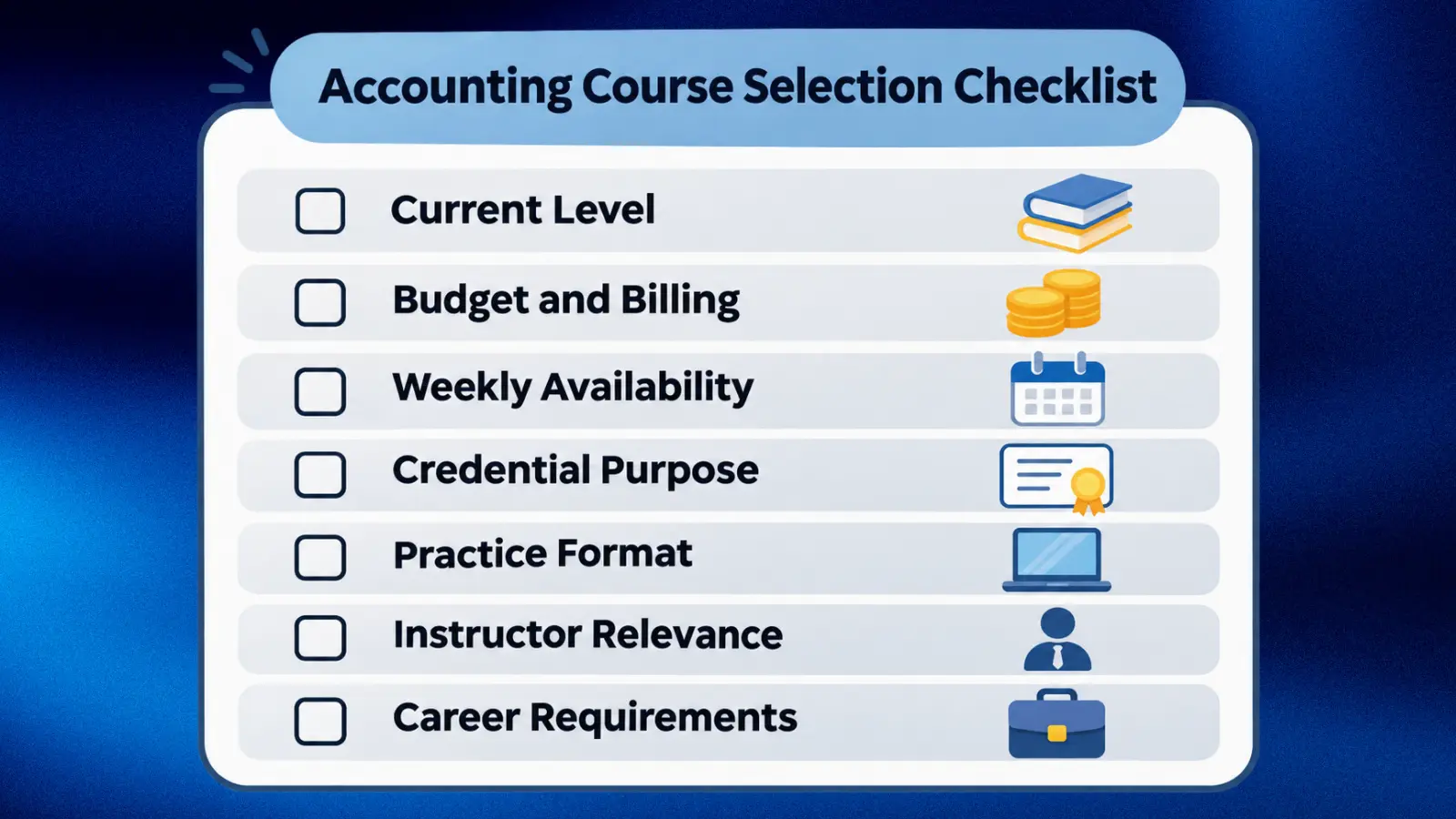
These factors help you compare study options, including free accounting certifications:
- Current level: Choose an introduction if the accounting equation is unfamiliar. Pick specialist material when you already understand transaction classification.
- Budget and billing: Decide if you want to learn accounting for free first. Compare an annual subscription offer with a university program’s full fee.
- Weekly availability: Match the workload to time you can protect. Training in accounting needs space for exercises as well as videos.
- Credential purpose: Read the exact award name. Searches for free accounting certifications can mix participation records, completion certificates, and professional qualifications.
- Practice format: Favor tasks that make you calculate, classify, or explain. A worked example becomes more useful when you repeat it without the answer.
- Instructor relevance: Look for subject experience and a syllabus that matches your intended use.
- Career requirements: Compare your target role’s education requirements separately from an accounting salary headline. Professional eligibility and likely accounting salary are difficult to judge from a course title alone.
The best accounting courses fit a specific gap. Business owners may need practical financial knowledge, while aspiring accountants might benefit from more structured academic training.
If free accounting certifications are your priority, first find out who needs to recognize the credential. This can help you avoid spending money on a credential that doesn’t meet your needs.
Choose training in accounting that lets you show a practical result, like correctly classifying transactions or explaining a balance sheet.
Are Accounting Courses Worth It?
Yes, accounting courses are worth it for structured learning and targeted practice when the syllabus matches your goal. They can strengthen your understanding of financial records and prepare you for more advanced accounting studies.
Use a clear task to assess learning progress separately from an accounting salary goal. After a lesson, explain a transaction without copying the example. After an analysis exercise, describe the reason behind the result. This approach makes it easier to judge an accounting course’s usefulness.
An accounting salary figure needs separate context. UMass Lowell reports the U.S. Bureau of Labor Statistics’ May 2024 median annual wage of $81,680 for accountants and auditors. That occupational figure covers workers with different qualifications and experience, so use it as career context.
Specialization also changes the accounting salary comparison. Tulane University’s Freeman School of Business cites Payscale‘s August 2025 median annual salary of around $82,300 for CPAs. An introductory accounting course does not satisfy the wider requirements for that credential.
If you want to learn accounting for free, use the free route to test your study habits first. Free accounting certifications may document participation, while paid accounting courses can offer broader content or a different credential. Pay for a learning benefit you can name.
Final Verdict on the Best Accounting Courses
Choose Financial Accounting: Master Core Concepts and Analysis Specialization for broad foundations with analytical practice. Introduction to Accounting and Core Concepts is the cleaner starting point if you need basic terminology explained first. The specialization is a strong next step for learners ready to explore financial statements in greater detail.
Start with Introduction to Financial Accounting if you want to learn accounting for free. Compare Basics of Accounting‘s purchase price before treating it as the budget choice. Consider WGU for structured university training, but remember that professional accounting licenses have separate requirements.
The best accounting courses match your learning goals and help you develop skills for future accounting opportunities.
FAQs
Introduction to Accounting and Core Concepts on Coursera is the beginner pick among the best accounting courses. Coursera lists 7 hours to complete, with no prior accounting knowledge required.
Yes, accounting courses can provide structure and practice with transactions and financial statements. Choose training in accounting for a specific skill gap. Course completion alone does not guarantee a job or an accounting salary increase.
Yes, you can learn accounting for free through AccountingCoach, the Open University, and the free Udemy introductions. Compare free accounting certifications by the exact credential awarded.
The time depends on depth and practice. Udemy lists 55 minutes of lectures for its free introduction, while WGU lists 6 months for its certificate. Viewing an accounting course is only part of learning the material.
Yes, some accounting courses do. The listed Coursera courses offer shareable completion certificates, Basics of Accounting lists a completion certificate, and WGU awards its named certificate. Check the exact award before enrolling.
Financial Accounting: Master Core Concepts and Analysis Specialization is the overall pick for breadth. Choose the beginner introduction for core concepts or WGU for university-based study. The right accounting course depends on your goal.
An accounting salary depends on role, location, and credentials. Compare pay for your intended role and region alongside its education requirements. Build relevant skills with the best accounting courses.