

“It’s Hard to Make a First Hit” – An Interview With Mantis Games (Deck of Haunts)



Mantis Games is the Ghent, Belgium-based studio behind the recently released Deck of Haunts, a haunted house deckbuilder that tasks players with not only building the house itself but also spooking pesky human investigators to death or madness – or insanity then death for the unluckiest ones.
Eneba recently spoke to the team (Philippe Mesotten, Tim Neckebroeck, Willem Verheughe and San Nollet) about the studio’s history, Deck of Haunts’ inspirations, and the technical considerations of working on a game for multiple platforms. It has been edited for clarity.

I’d like to start by asking you about your respective backgrounds. I understand Mantis Games was founded in 2018, but how did you all meet? Were you all already working in the game dev community in Ghent?
That’s an interesting question actually. Mantis Games was started up to produce and release Journey for Elysium, a VR game that is still available on Steam. However, the game wasn’t a commercial success and the studio shifted completely in 2020 (like a lot of things did).
Since then, we’re a completely new team, the only thing still remaining from before is our name, Mantis Games. We started off this new journey with three people in 2020 and welcomed another very talented artist a bit later.
Mantis Games was initially linked to Cronos Interactive, an organization that also incorporated a PR firm. Does Mantis Games share any employees with related companies, that in turn reflect upon the way you develop and market games?
We do not share any employees with the Cronos Groep, which is a major IT group in Belgium (Cronos Interactive itself ceased activities shortly after Journey for Elysium), but we do get a lot of support towards the non-gamedev aspects: HR and accountancy. PR-wise we are completely independent.
I’ve seen that other aspects to Mantis Games include offering Unity/Unreal assets and various production services. If you’re allowed to, could you please give a little more insight into the kind of work you’ve done with/for other studios?
We loved working on past projects for other studios and would love to work on some more! Collectively we’ve worked on different ranges of project sizes, from the bigger ones like Ghostrunner, Horizon VR: Call of the Mountain and Outcast: A New Beginning, to smaller ones like Phantom Fury, Graven, Severed Steel and Hubris (VR).
It’s not exactly the same as working on our own projects, but it’s amazing to work alongside other talented teams and learn from them.
How has working with other studios affected the development of your own title, in terms of: did you learn to avoid any specific mistakes or even find better ways to do something whilst working on Deck of Haunts?
We’ve seen how different teams handle production and have cherry picked from them, what now also works best for us. With this I mean how we work together in sprints, retrospectives, design meetings, communication… so not the purely technical aspect.
One thing we’ve learned is if you have a new feature in mind, make a basic version of it and let it be tested by gamers outside of your team/near environment to get some very honest feedback. Don’t fully create and produce it shielded from the rest of the world, only to find out it’s something that nobody wanted in the first place, after spending all that time and resources on it.
I’ve seen plenty of references and comparisons made from critics and players as to how to describe Deck of Haunts, but outside of video games, what other media inspired the game?
Definitely the board game Betrayal at House on the Hill, movies such as The Haunting of Bly Manor, Shirley Jackson’s Haunting of Hill House book, and the real-life Winchester Mystery House.
In light of Deck of Haunts already receiving some decent reviews, how do you, personally and as a team, measure success, and what does success mean to you?
First and foremost, commercial success is when the game earns enough money to cover its production. Ultimate commercial success for us is when it also earns enough money to cover the next game we’d want to produce!
Of course there is critical success as well: do people come back to play the game, what are the reviews, do influencers like it or are they “getting” what we meant for the game to be.
I’d like to ask about the technical side of game development. I recently chatted to Stephen Kick, from Nightdive, and we spoke about how a lot of studios these days don’t put as much emphasis on optimization as they used to, so that older systems tend to get neglected. How does Mantis Games approach optimization?
As we also aim on releasing on consoles, we do tend to also take care of optimizations. Be they in code, shaders, textures, polygons…we often bring up the Unreal Engine Shader Complexity view mode to spot things we have missed and try to make them more performant.
That said, we of course do not want to limit ourselves by old spec systems, rather, we want to make the game we want to make, and try to make it as optimized as we can make it. We did take into account what the most used system was on the Steam Hardware Survey, and are always optimizing for that.
How important is it that a game works as well as possible for rigs with an older spec? And how do you balance this with both incorporating modern graphical features and porting over to a modern console? Is anything ever sacrificed on either side of the development?
A game will always (well, usually) run better on a beefy PC. But since Deck of Haunts is not a fast paced FPS multiplayer game but a turn-based top-down game we do have a bit more leeway than perhaps other games.
I do not think we’d need to sacrifice much, but as we are still in the process of making the ports, that’s a question I can probably better answer at a later date. (Deck of Haunts recently released a demo on Xbox)
If it’s fair to refer to Mantis Games as an indie studio, what would you say are the main advantages, and disadvantages, of working as one?
This is definitely not something that goes for all indie studios, but I think is for most: it’s hard to make a first hit with your studio. Something that you can use to not only fund a next production but where you can also tap into the player base of, that you did not have before that first hit.
It’s always that internal struggle of do we work on someone else’s game, or another random IT project that maybe pays better but sucks the soul right out of you, or can we work on our own game…an obvious advantage is of course that, with a small team, you can be agile and shift focus fast.
How do you see the current state of industry from your place within it?
It’s of course sad to see companies big and small have to tighten their belts or even go bankrupt. It’s an industry that is full of passion and creativity which is great, but that same passion is sometimes used by not so nice people to their advantage, with all the bad happenings that ensue.
The world is not at the best spot at the moment, and as everything is connected, that also strains the industry. Although I’m hopeful for the future, as with everything, things ebb and flow. We’ll all find a path forward!
With Deck of Haunts receiving regular updates, are you able to give any hints as to what else is in store for the game in the future?
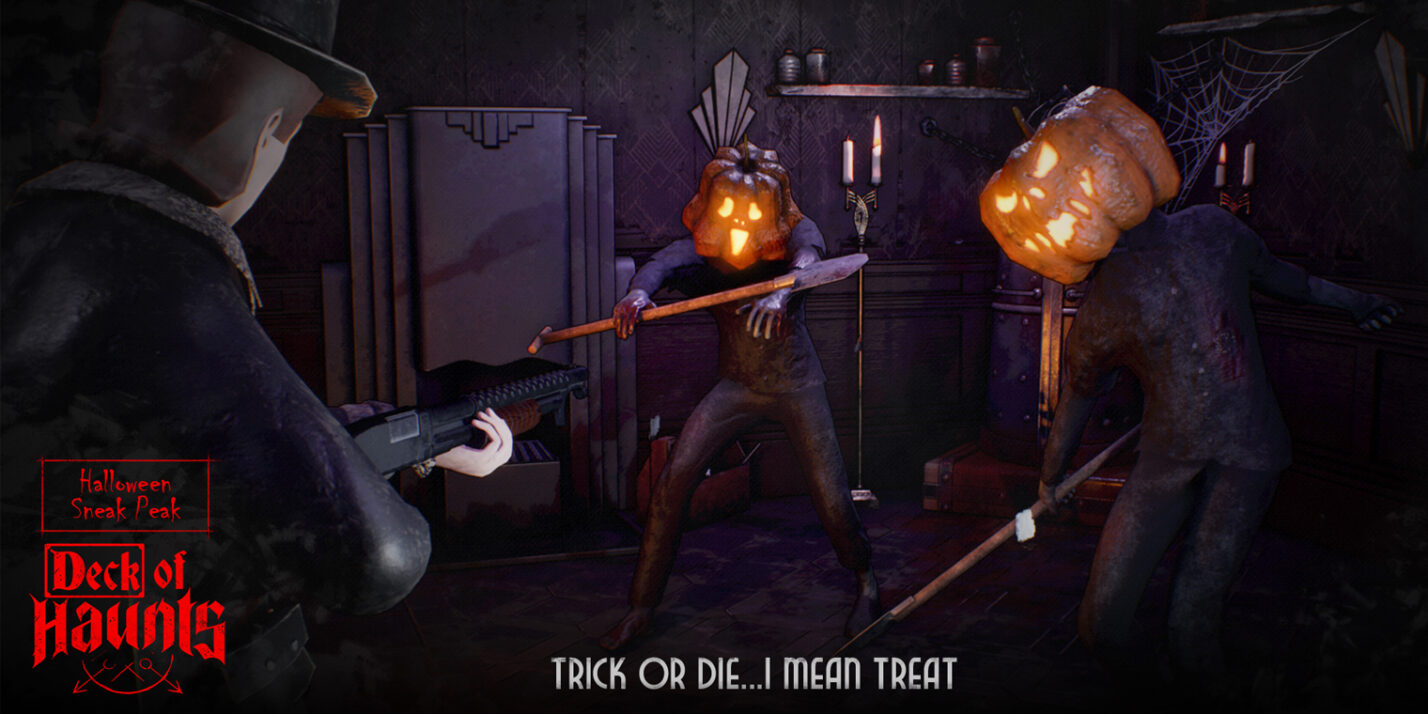
We’re actually working on a nice Halloween sauce that will be poured over the game sooner rather than later! And chipping away at a pre-alpha version of a scenario builder with Steam Workshop integration. So players could make their dream (or nightmare) run and share them with other players.
Lastly, when I interviewed Disc 2 Games they gave a few shout-outs to other studios, so I’d quite like to offer others the same chance. Deck of Haunts shares links with Blood Bar Tycoon (Clever Trickster Studio) and The Horror at Highrook (Nullpointer Games); do you personally know the studios involved in either game? Are there any other studios out there you’d like to give a shout-out to?
Besides being an awesome management game, the developers behind Blood Bar Tycoon are fellow Belgians, so what’s not to like, hah! The Horror at Highrook is another amazing game, and we just needed to make a haunted house game bundle together. Other studios that definitely deserve your attention are LuGus Studios, Pajama Llama Games, and the awesome one man army PR-Agency Pirate PR!
Deck of Haunts is out now on PC, with ports for Xbox and PS5 still in development.