



“This is Something That I’ve Never Revealed to a Journalist…” – Stephen Kick/Nightdive Interview Part 2



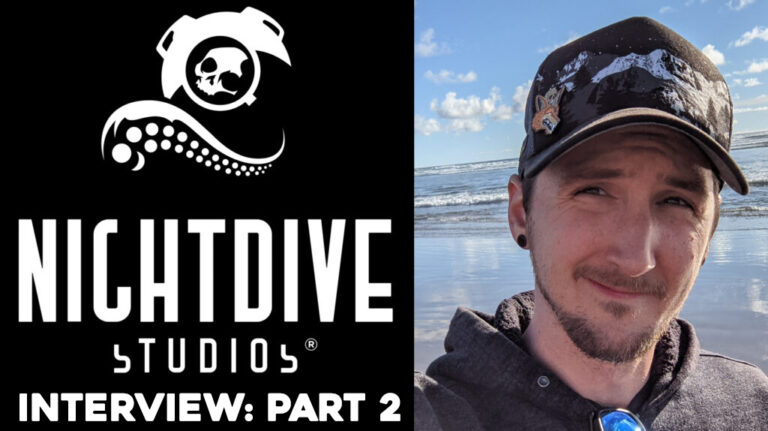
In part one of our chat with Stephen Kick, the CEO of Nightdive, we talked about horror comics, the impetus for starting Nightdive, and also how important it is to regard video games as art. In the second half of the interview, the conversation turned to game preservation, how projects are picked at the studio, and what it’s like working under Atari, among other topics.
I’d like to chat to you for a bit, if I can, about the whole Atari aspect of Nightdive.
Sure.
I understand you’ve got quite a few projects lined up and you’ve got the link with Digital Eclipse. I read that you share resources and that kind of thing, but does that also extend to ideas for games you’d like to work on? Do they ever come to you and go, ‘Hey, do you want to do this game?’ Or vice versa?
Yeah, actually that happens quite a bit now. It’s so awesome that Digital Eclipse is part of Atari, because Mike Mika (Digital Eclipse’ Studio Head) and I, we’ve been friends for a lot longer than the companies have been going.
It was always one of my dreams that we would have almost like a sister company, because there’s been times, and even more recently, where we’ll talk to a publisher about a specific game or an IP and the whole range of games that use that IP will get offered to us. And we’ll go, ‘Oh yeah, well we can do the shooter and then Digital Eclipse can do the side scroller, or the other games in the series because that’s their focus.’ They do more of that kind of stuff, like the collections.
And it’s made things a lot easier because we’re part of the same family now. We can share resources. On the development side of things, they might hire an animator for a project, and then when that project wraps up, they’re like, ‘We don’t have any use for them for the time being until we get something going on. Could you use them?’
We go ‘Yeah, bring ’em on over. We have a project right now where we need to do some animation and we could really use ’em.’
Hopefully it doesn’t, but I think it might surprise people to know how linked you guys are and that you have an actual friendship, so it’s not just business. But in terms of other people you’ve worked with, like other companies, I know that you have a link with GOG and of course, with their Preservation Program.
Are you linked with them at all in any way, in terms of the game preservation? Are you linked with any other game preservation companies or would you like to be?
We do have a little bit of crossover with the Video Game History Foundation, but probably not as much as we should. They do an amazing job, cataloging, collecting, acquiring all kinds of artifacts from gaming’s past. And there’s probably more that we can contribute to them because we get access to a lot of that stuff we use for our Vaults inside the games themselves. I’m sure that they would love to have raw copies of whatever we have, just making sure that there’s more backups of these things.
In terms of GOG, a lot of the reason that Nightdive exists is because of them. They were willing to trust me back in 2012 when I told them that I had the rights to System Shock 2, and to help me figure out the best way to go about releasing that game. Ever since then they’ve been a fantastic partner of ours. They’ve provided opportunities for us sometimes and they’ve actually helped out with development on a couple of things.
One of the examples of that is, we got the rights to distribute the Unreal engine-powered Wheel of Time game, and we just didn’t have the bandwidth to really work on it, to get it to run on modern systems at all. So they offered, ‘Hey, we have some developers that we work with. We’ll do it and then we will offer it for sale on our platform.’
And there’s been a number of other examples too, where things have come up where they ask us questions sometimes, like, what’s the best way to do this? Or, what do you guys think about this project? Like, should we do this? Would you be able to help us? It’s a really great relationship we have.
Speaking of people you admire, I understand that you’ve now met quite a few big names in the business. Is there anyone you haven’t met yet that you are absolutely dying to chat to?
Good question. We’ve had a lot of communication with John Romero. We did a podcast with him just recently, but that was my head of biz dev that conducted that interview. So I don’t think I’ve ever spoken to John Romero personally, but we’ve become friends with Warren Spector, Ken Levine – we did a podcast with him just recently. That was a fantastic opportunity. Also Paul Neurath, who is the head of Looking Glass, and a partner of Warren Spector.
I’ve had the briefest interactions with Gabe Newell, both in person and through email. I would love to sit down and talk with him mostly because of his love of diving, which I just recently found out about due to those interviews he’s been doing. I mean, he’s in Australia on a yacht and he’s diving.
I’m like, that’s one of my favorite things to do. I’ve been diving in the Great Barrier Reef. You know, he’s a huge fan of the System Shock franchise?
No! Really?
One little known thing is when System Shock 2 came out on GOG, the Steam Greenlight Program was going. And so indie developers had to go through Greenlight and basically get their game voted on by the users on whether or not it should be on steam.
I didn’t think that Greenlight was the appropriate place to put System Shock 2. I just thought it’s one of the best games ever, it should just be on Steam. And so I emailed Gabe directly and was like, ‘Hey, I have the rights to this. Can we just put this on Steam?’ And he wrote back and was like, ‘Yeah, it’s like my favorite game.’ And then he CC’d a Steam rep who’s with us still to this day. They got us set up and we put the game on steam.
Then they used System Shock as an example of how versatile the Steam controller could be. As you know, System Shock 2, you almost have to have a mouse and keyboard to play it ’cause there’s so many controls. But the Steam controller, at least at the time, was designed to mimic both of those things.
So Gabe reached out and was like, ‘Can we use System Shock 2 in all of our press events as an example of how good this thing is?’ I was like, ‘Yeah, of course. Go for it.’ So, Gabe would be awesome. I’d love to talk to him.
I just delight every time I go to GDC or Gamescom and I get to meet some of these people that crafted the experiences that ultimately inspired me to be here. I recently had a chance to sit down and talk to Denis Dyack (Silicon Knights’ founder) and our entire conversation pretty much revolved around HP Lovecraft. It was amazing. I’ve been having a real blast meeting these people and trying not to fanboy out too much.
When I was younger and I used to go to gigs, if I got talking to the people in the bands, I’d try not to freak out – I dunno if you’re familiar with Devin Townsend, he had a band called Strapping Young Lad, and when they were up and coming they did a gig in England. My best mate and I went and there was, I don’t know, 50 people watching him. And me and my mate were talking to him and I was like, oh my God, he’s played with Steve Vai, he’s done all this famous stuff with all these famous people and he was super nice.
This is something that I’ve never revealed to a journalist, but when I was in high school, Groton-Dunstable Regional High School, it was a tiny school in Massachusetts, and for some reason there was a music publisher – I can’t remember who they were – but they would send press kits to the school. Like samples of CDs and press releases and, sometimes, there’d be tickets to go see shows in our area, mostly Boston.
I remember signing up to write for our school newspaper to do music reviews, because they would give me the press kits; I would get the CDs and the eight by tens of the bands and all this stuff, and the tickets to the shows. What I would have to do is go to the show, and they would often give me backstage passes to go interview the bands. And as a 15, 16-year-old, I was like, this is the coolest thing ever.
I just got my license. I could drive to Boston and show up at these shows and all from writing from my school newspaper. So it was very much like that movie, Almost Famous, where the guy writes for Rolling Stone, but he is like 14 or whatever.
Me and a friend, we would go to these shows ’cause we’d get two tickets and one of the shows was for this band called the All American Rejects.
I remember them!
Yeah, and it was one of their first shows, like their first tour or whatever. We had the tickets and we went right up to the backstage and people are offering us beer. So we’re drinking and then the band would come out and we would sit there with this tiny little recorder, you know, with the little tape. We didn’t have smartphones or anything, and we would just bullshit with them for like an hour and not ask them any relevant questions at all.
It was amazing. We’d go home and I would write up this two-page-long interview for our school with 300 kids. And I don’t think anyone actually read it, but it was a blast. Those were some great memories.
I take it you’re still into music as I read that you’re a fan of Deftones.
Yeah, I just recently met them on tour a couple months ago.
Oh, nice. And how are they? Were they easy to talk to?
Yeah, actually they were. Back to the art thing, one of the things I like to do is if I get tickets, like VIP tickets to go see a show and I know that I’m gonna meet the band, I’ll make some art for them as a token of, ‘Hey, I love your stuff, this is just a gift from me to you if you like it.’ And that’s pretty much as far as I’ll take it.
I did a mock tour poster for the Deftones and Mars Volta, and when I got to meet them, I gave it to ’em and they were just like, ‘Oh my God, no one’s ever done this kind of thing for us before. This is incredible.’ And I got contact information and have been in touch to some degree. I do have an ulterior motive and it would be to officially do some art for one of the bands I love one day.
So would you like to do the gig posters or the album covers, or everything?
Whatever they wanted. If one of them thought my particular art style was the right look and feel for whatever they were doing, or if they were looking for something different, I’d be open to it.
Good luck with that, ’cause that would be really cool. If I could move onto the technical side of Nightdive, how do you decide between remaking and remastering a title?
In the case of System Shock, which is the only title that we’ve remade up to this point, it came down to almost a revelation that we had when we were remastering the enhanced edition of System Shock. That would’ve been around 2016, I think. We had brought on one of the modders who had been creating updates for the game; he was working on the mouse look mod, which was a huge game changer.
If you had ever played the game before, it was very difficult to control and get into if you had been used to modern control schemes. So when that was implemented and we were playing it for the first time, it was like, this is almost like a different game now that people need to play. Because System Shock is a foundational experience, it’s one of the best I think you can have on the computer or one of the best you can have playing a video game just in general. But really the outdated control scheme is such a major barrier for most people that we knew that, no matter what we did, we couldn’t convince people to jump in and try it out.
So that’s really where the discussion started, of: What if we remade this game with updated graphics and modern controls? And people could just experience System Shock that way. And it just really started to snowball, like the first thing that I did was I found an artist that I thought could create or translate the original look and feel, but in a modern way.
Then that led to: I know a guy from college who’s a programmer that I could probably just have help out part-time. And then that led to, we have like a prototype of like the first 10 minutes. Like what would happen if we put this on Kickstarter?
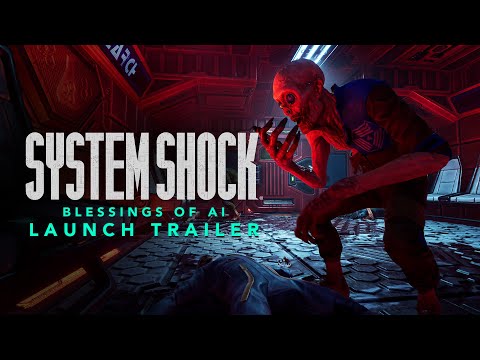
It got completely outta control and eight years later we ended up releasing a full Unreal Engine 4 remake that cost $6 million, $7 million to make and went way over budget and nearly killed the company.
How important is the technical aspect of remastering something so that you have the best version of the game you can do, versus something that is still accessible to, for example, someone that is an avid gamer but maybe has a real potato for a laptop?
That’s a good question. I feel like we’ve done a really good job of not adding so much to a game or really tinkering with what makes it great, that would kind of push it outside the range of low end machines or, you know, the bare minimum of what people have these days, though you’ll be surprised.
There’s been a couple of instances, I think with Turok 2 or maybe even the first Turok, where it’s a port of the original game in our engine and it runs on really low hardware specs. A lot of that is due to our lead engineer, Sam, just being an absolute genius when it comes to optimization, because one of the platforms that we support is the Nintendo Switch and obviously it’s a lot less powerful than a PlayStation 4, even at that time.
I think one of the things that people really appreciate the most about our games is the low install size too. And that’s such a nice thing these days because oftentimes I’ll buy a new game and it’ll be like a 60, 70 gigabyte download. It’s maybe 20 minutes, maybe a little bit shorter, but even that amount of time that passes for me, that’s super valuable. I might just go and get totally distracted by something else in that amount of time and then just forget about it. And the desktop icon will be on there for years.
I get exactly where you’re coming from. To be honest, that’s the main thing that’s managed to stop me from spending so much money on video games. I was getting fed up with how much space they took up and how long they took before I could actually play ’em.
I feel like I’m wasting so much time, and now with a PlayStation 5, I try to find stuff my kids can play and even if it’s like a Ben 10 or Paw Patrol game, they can take an hour to download and it boggles my mind that the optimization for modern games, it doesn’t seem to be as important as it used to be.
Oh, definitely not. I think the install size for the System Shock remake is only a gig or two. It’s incredibly small. I don’t know how our guys managed to do that, ’cause it’s a massive game and there’s tons and tons of art and visual stuff in there.
But that’s another thing that we get praised for a lot is, they can just play that game when they want to, as soon as it’s done downloading, which is a fraction of the time it would take for Call of Duty for instance, which is a 120 gig download size.
I also don’t want to fill up your hard drive. I remember what that was like when Half-Life came out. I was begging my parents for that game for years, because it got announced well before it came out.
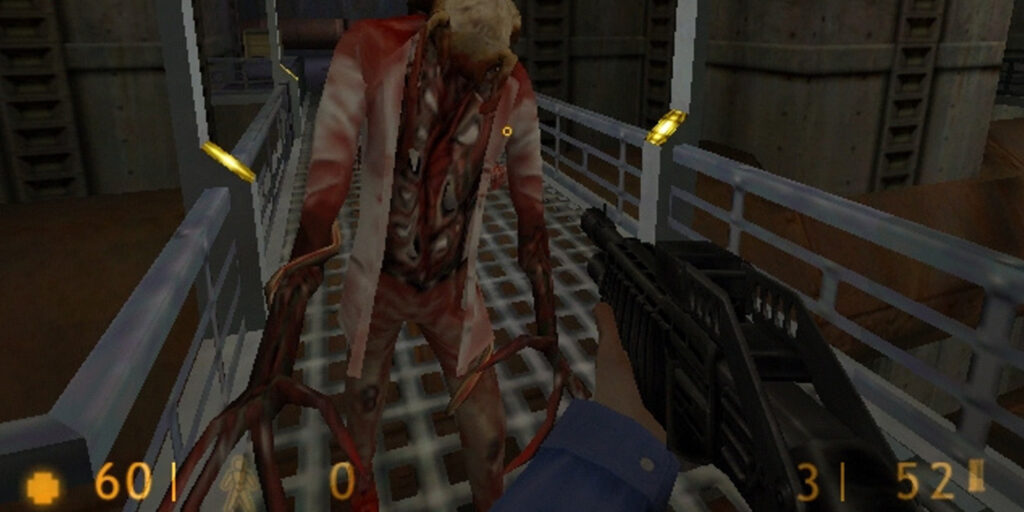
I printed out pictures from the internet of screenshots when they got released. I made collages of games that I was really into to hype me up while I waited. I finally got the game for Christmas and I’m showing it to my dad, and he looks at the system requirements and it said 400 megabytes of hard drive space.
He’s like, we can’t install this. We have a 1.2 gigabyte hard drive. That’s like a third of the hard drive. I eventually convinced him to delete all of his games and most of his stuff that he liked so that we could install Half-Life. And he ended up beating it before me. I remember him watching it, watching me play, and he was like, ‘Oh my God, this looks incredible.’
I would go to bed and then he would get on and then he’d have his own save game. I think it’s his favorite game. He says he’s played it like a dozen times.
Something I’m looking into at the moment is how, with AAA companies, they’re putting a focus on graphics over optimization, but as for Nightdive, do you consider yourselves a AAA studio or do you even give yourselves a level?
We’ve never really discussed that. But I think that if you were to do that, it would probably be based on our team size. I would say that we’re probably at like AA level just in terms of how many people we employ, between probably 60 and 70 people now.
But the type of work we do, I feel like it goes outside that definition, ‘cause there’s only a couple studios now that focus on remasters. Whereas I think a traditional AA studio, they’re working on original IP or licensed stuff that’s built from the ground up.
How much would you guys like to make your own game?
Oh, it’s been a dream of mine since I was probably eight years old. I originally went to school to become a game designer. That was my real ambition. Right outta high school I wanted to write, I wanted to come up with the scenarios. I wanted to design the mechanics. I wanted to create that game development document that would basically dictate the game that was being made.
But after writing a dozen of those things for school, I was like, oh my God, it’s a lot of work. Writing is hard. I think it’s a lot harder than people give it credit for. And as part of my program, they exposed us to all the various disciplines of game development. While I focused on game design and writing, we also did level design and we learned the earlier versions of the Unreal Engine.
I did animation, I did rigging, and I even took some programming classes, and scripting classes. I just don’t have the capacity to do engineering. I have a lot of respect for those who do and can live in that world, but that is not me. I am purely a left brain art visual person.
When we got into learning 3D modeling, which was Studio Max and Maya at the time, it was like a light bulb went off in my head. Like, oh my God, I’m 3D modeling. They’re teaching me how to UV, unwrap and texture and I can go on Photoshop – my dad sent me his old Wacom tablet that he had from the nineties, so I was hand-painting textures, back in 2000, 2004, 2005 or whatever.
And that’s what I really started gravitating towards, was making the characters. When I graduated, my entire portfolio was character art. So I had gone from wanting to be a writer to doing art for video games and I got a job right away after I graduated.
Would you say it’s harder for that kind of situation to happen these days for people that want to be involved in an aspect of game development? To be able to find a job straight away?
I think it comes down to the individual and how much work they wanna put into achieving their goals. I mean, you could really say that about anything. But specifically, the game development industry is extremely competitive and I would like to think that, if I were to do it all over again, but had access to YouTube or any of the online training programs or anything like that, I wouldn’t have had to have gone to school. I could have completely self-taught and done it on my own.
I’ve had family members, cousins and young kids in my family, who wanna get a job in the industry and they’re like, ‘What school do I go to? How do I get into this?’ And I’m like, you don’t have to do that anymore. One, it’s way too expensive. I think my degree, even in 2007, it was over $100,000, which is insane. You can just go on YouTube and if you’re motivated enough, you don’t need the structure of a classroom to get you to where you wanna be because there’s forums, there’s Discord channels now, there’s ArtStation, which can host your portfolio for you.
When you’re getting into the industry or you wanna get into the industry, you can really focus on one particular aspect of a discipline. There will be a need for you. For instance, if you wanted to work at Nightdive, look at one of your favorite classic games and then make art in that style and send us a portfolio and we’ll have a job for you.
If you wanted to work at Epic on Fortnite and you just wanted to make the effects, the Unreal Engine is right there. It’s free to use, free to download. There’s tons of tutorials on how to do that one specific thing. And let me tell you, effects artists are one of the most highly sought after positions, because there’s just nobody that does that.
Same with UI and user experience. If you get really good at designing the graphics and being able to implement those into the engine…I mean, I wish that I had done that, ’cause those guys get paid way more than anyone else because nobody else does that.
It is incredible, isn’t it? Just how many resources there are for that kind of stuff. Given your position in the industry, what’s your take on the state of it? I mean, is it in good health or how do you see it?
That’s a really good question. I feel like it fluctuates quite a bit between, like scary, with people getting laid off en masse from a lot of studios. Studios are getting shut down all the time. Then you see success stories like Team Cherry and Silksong coming out and breaking records, and only charging 20 bucks for a game that’s gonna provide countless hours of entertainment, from a relatively small indie team.
So you kind of have to break it down: how’s AAA doing versus indie, and everything else in between. And then, this leads to a much larger topic, which I think is very relevant: the advent of AI and game development.
There’s a lot of people that are very adamant about not letting any of that in and not utilizing those tools because ultimately it’s going to lead to less people being involved, which is counter to creating artwork. Art is a human thing. It’s not a machine thing. The computer’s not creating art. It’s just taking from other artists and regurgitating what’s already been done.
It can replicate rather than create.
Yeah. And so I think that we’re right on the cusp of a sea change where I believe that AI can be used for game development. But I don’t believe that there’s been a really good way to utilize it yet, that is really going to take advantage of what it can really do. But it won’t be long. I would say probably within the next year or two we’re gonna see games that are probably heavily influenced by AI in one way or the other. And some are gonna be good and some are gonna be bad, and we’re gonna have everything in between.
But it’s an inescapable thing. Even Nightdive, we’re probably gonna have to adapt to it in some way. One of the videos that just came out from Microsoft was, what if we had an AI basically recreate a game that already exists, from scratch, and we just ask it to do it and have no input whatsoever. It’s getting really close to being able to do that now.
So where does that put a company like Nightdive that spends a year and a half to three years, essentially remastering a classic game to look and feel and run exactly the way you remember when an AI could potentially do it in a matter of hours?
I’d like to go back to the game preservation angle of Nightdive, because that is something different you can offer to counteract AI game development. How do you explain the idea of game preservation to someone who doesn’t really understand its importance? What can they do to help?
Many movies, books, and music have been remastered, restored, or re-released in some form and video games should be treated no differently – they’re cultural works of art that tell us about the time, technology, and people who made them. If we don’t preserve them, we lose not only a piece of history, but the potential of that game to teach us, inspire or influence us in any number of ways that lead to more forms of expression.
Imagine if all of Beethoven’s compositions had left to molder away or what if all copies of Ray Harryhausen’s movies turned to dust on the reel? Would the absence of those advancements in style, or technology, have a profound impact on current art? Absolutely – we’re all richer as a result of being exposed to that art.
You can help game preservation by supporting re-releases and remasters. Purchasing legitimate reissues signals demand. You can also support organizations like the Video Game History Foundation, the Strong Museum of Play, or local archives.
If a specific title you love hasn’t received an official preservation effort, seek out a community of fans and donate your skills or abilities to help keep the game alive. Scan in old magazine advertisements, back up your personal copy of the game on the cloud – sometimes just digitizing an old piece of media is a great way to preserve history.
And just to top all this off, what are your thoughts on the Stop Killing Games initiative?
The Stop Killing Games initiative shines a light on a problem we’ve been fighting against since Nightdive’s founding – the idea that games can just be shut off, lost forever once a publisher decides they’re done.
At Nightdive, we believe games are art, not disposable products. Our mission has always been to rescue and restore them so that players today, and generations from now, can still experience their magic. Stop Killing Games raises awareness, and we provide the proof: games don’t have to die. They can be preserved, respected, and celebrated.

Nightdive Studios’ latest release is System Shock 2: 25th Anniversary Remaster, and it’s currently available on all major platforms. The studio also recently collaborated with id Software on the Heretic and Hexen remasters, which are also available on all major platforms.