


“What I’m Doing is Completely New” – a Chat With GamerCard Inventor Grant Sinclair



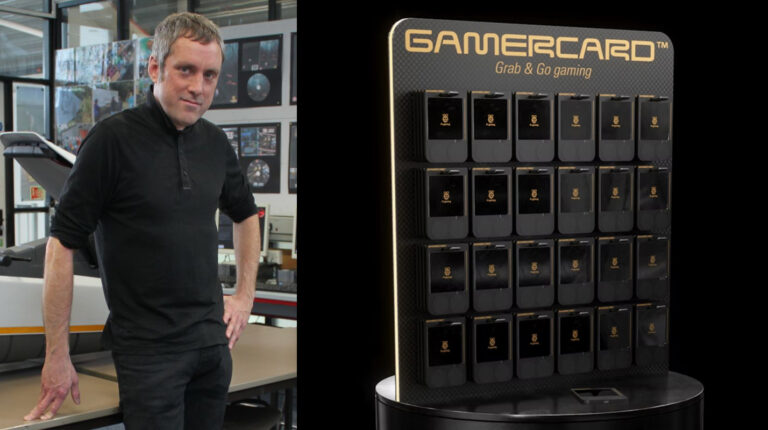
Grant Sinclair is the nephew of Clive Sinclair, the inventor of the ZX Spectrum (and many other things). However, Grant is an inventor in his own right, with the IRIS eTrike and a DIY pocket computer, POCO, already under his belt. His latest invention is also related to pocket gaming: the GamerCard.
At only 6.5mm thick, it’s a supremely thin and lightweight handheld powered by Raspberry Pi. Eneba spoke to Grant about this, his upbringing in a family of designers, and what the future might hold for technological innovation. The interview has been edited for clarity.
Let’s start with the GamerCard. It’s currently available online, but I know you said before about having it by the kiosk when you go to buy stuff, so is that still something you’re hoping to do?
You just grab it and go so it’ll be on a hook, and I’ve got a massive global distributor who wants to put it out. So we made it launch first online, and then do that stage too.
And how many games does it come with?
It’s got about six games on it straight out of the box, or off the peg as it were. But the whole point is that it gives you enough for a flight or a train, but I wanted to make it so it’s more than just a gaming device.
Say you’re a parent with their children or teenagers on a long haul flight, they can do more with it than just game. They can explore the whole Raspberry Pi ecosystem and if they want to download emulators or download chess games or whatever they like…because it’s based on Raspberry Pi it gives you access to a huge amount more.
Including access to PICO-8 games.
PICO-8 I find really exciting because when I was growing up I was never that interested in learning, I was always a bit bored at school. But I think the whole PICO-8 thing, it makes learning really fun, especially as you can get groups of people, like one person working on the soundtrack, or a team working on the soundtrack, another team working on sprite design. It’s a really interesting way to collaborate. And you can turn out a game really fast.
That’s dynamite really as far as I’m concerned because learning has always been something I want to make more fun, and since we’ve been marketing this we’ve been messaged by people all over the world wanting to use it for PICO-8. Strangely enough, not just gamers but also artists.
Could you see it becoming, for want of a better term, a gateway to PICO-8? To showcase what that engine is capable of as well as your device.
Well one of the key things about it is, with PICO-8 they make it available for free to schools, the base version. But then if you buy the proper version online you’ve suddenly got access to thousands of games.
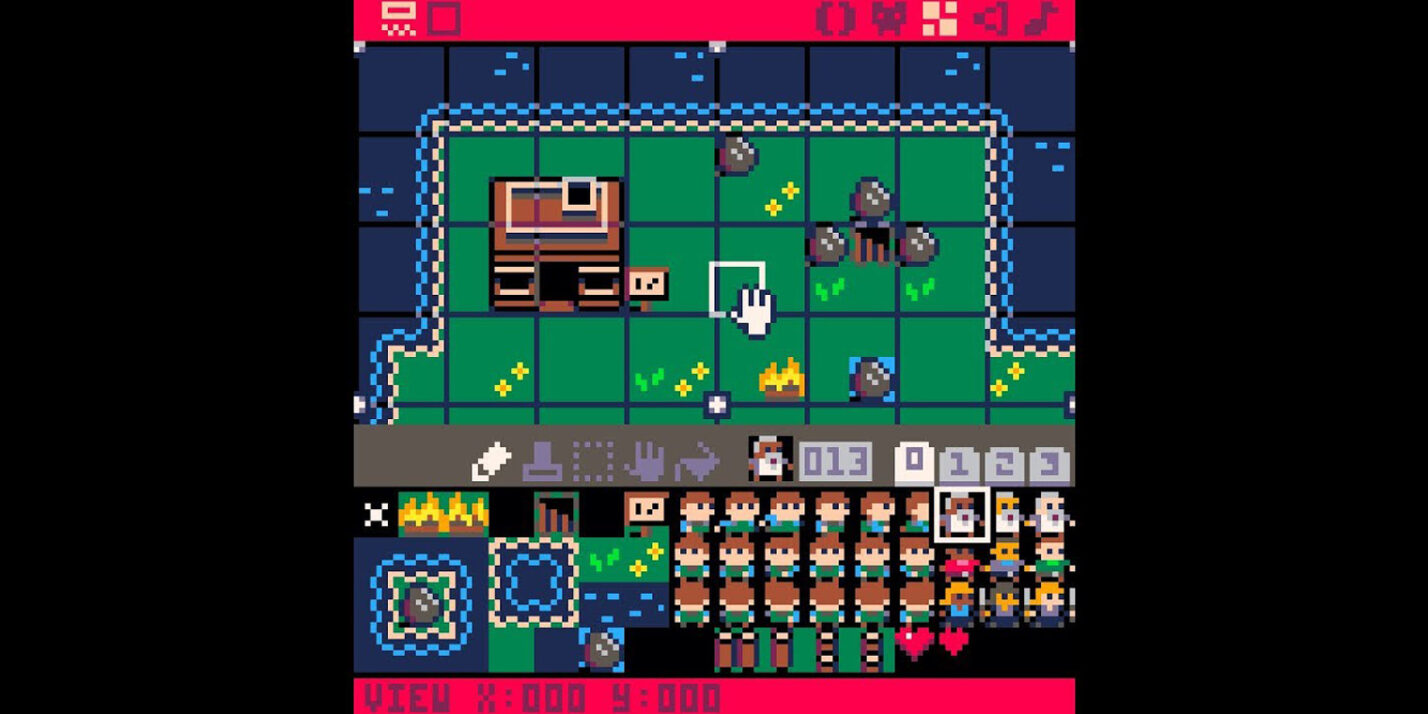
One of the questions we get asked is, how do you install it? It’s often a bit of a hassle installing stuff from Raspberry Pi; you have to type in lines of code. So I have a way of getting the PICO-8 app: it’s a script that installs it and optimises it for GamerCard.
PICO-8 games also have a specific square aspect ratio, too.
And I think something about the timing of the square screen thing…a lot of kids, especially teenagers, are buying and collecting vinyl, and they’re looking at art again, which you didn’t really get with online music. Also I noticed in hospitals they have square screens because it’s a really efficient way of looking at lots of data at once.
And I think some people see it (GamerCard) as a sort of…some people call it retro-futuristic, which is never how I intended it to be. I always intended to design a product to look as futuristic as possible. But with this product I had to use what was available commercially, so I had to find a low cost but very high resolution screen.
The screen I found was the same pixel density as a MacBook Pro. So when people turn this on, the first thing they say is “Wow, that’s got an amazing screen.” Because I was on a budget, I had to use other stuff that was available, like Raspberry Pi. But I found a clever way of packaging it all up, because I came up with this construction of making it out of just PCBs without a body casing. I managed to get the whole thing so much thinner.
Yeah, it’s really thin.
Nobody else has ever done it, because it is basically a full-on PC. You can plug a keyboard in, you can plug a big screen in. It’s got a heatsink inside, which mates to the CPU. And then basically the whole of the chassis is like one big heatsink. You can overclock it so you can actually make it run much faster if you want.
Until you just told me now, I didn’t understand how powerful it could be. And I think that might be true for, let’s say the general gaming public. I think the whole retro futuristic thing is – that’s also just how the culture is for gaming at the moment.
If we can talk about the retro aspect, when I interview people I always want to know about their gaming memories because none of us would be in this industry if we didn’t have some kind of tie to it. Before this interview you mentioned having a Game & Watch…
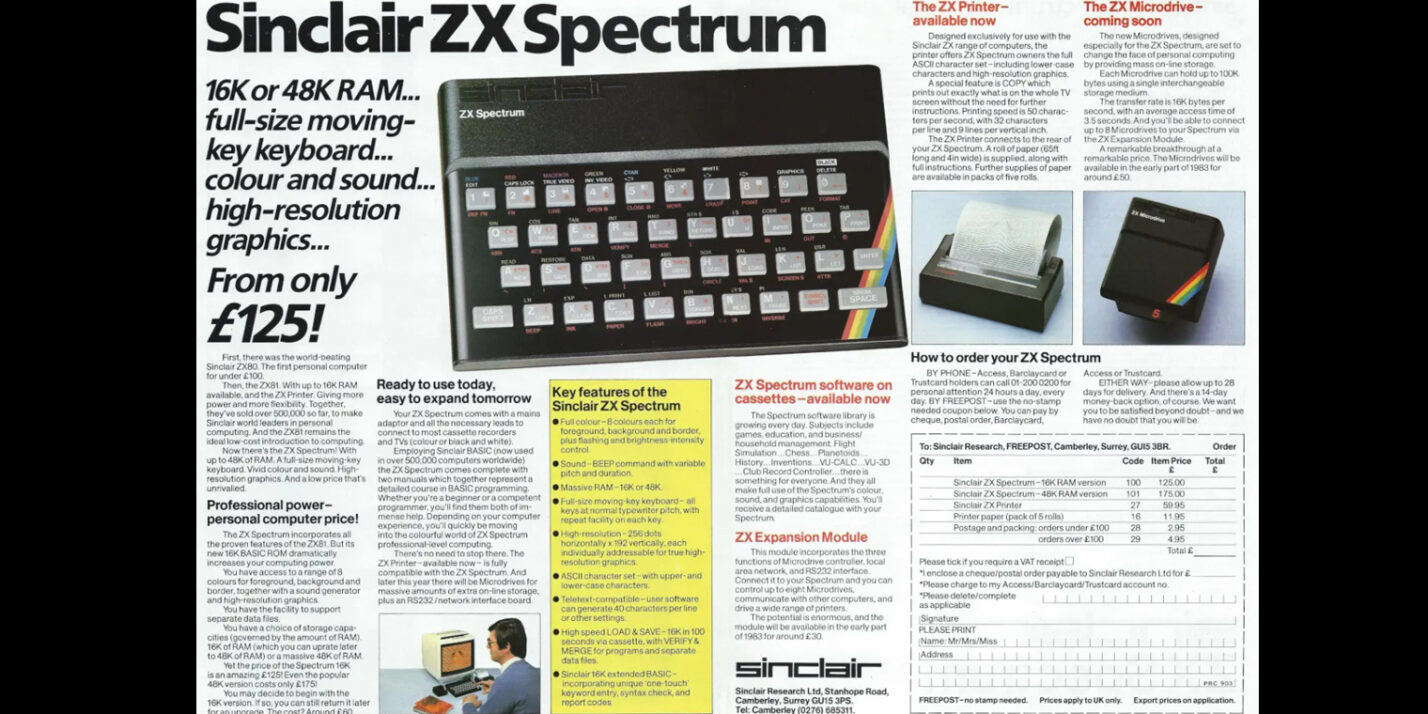
The really early ones weren’t even branded as Nintendo because Nintendo didn’t want to risk damaging their brand. So I got those I think in 1980, 1981, and my sister and I were playing them. They were quite addictive and amazing and I remember taking them to school – but then there was the whole Sinclair computer thing where everybody had one and I used to get hassled quite a lot about what’s going to be the next thing.
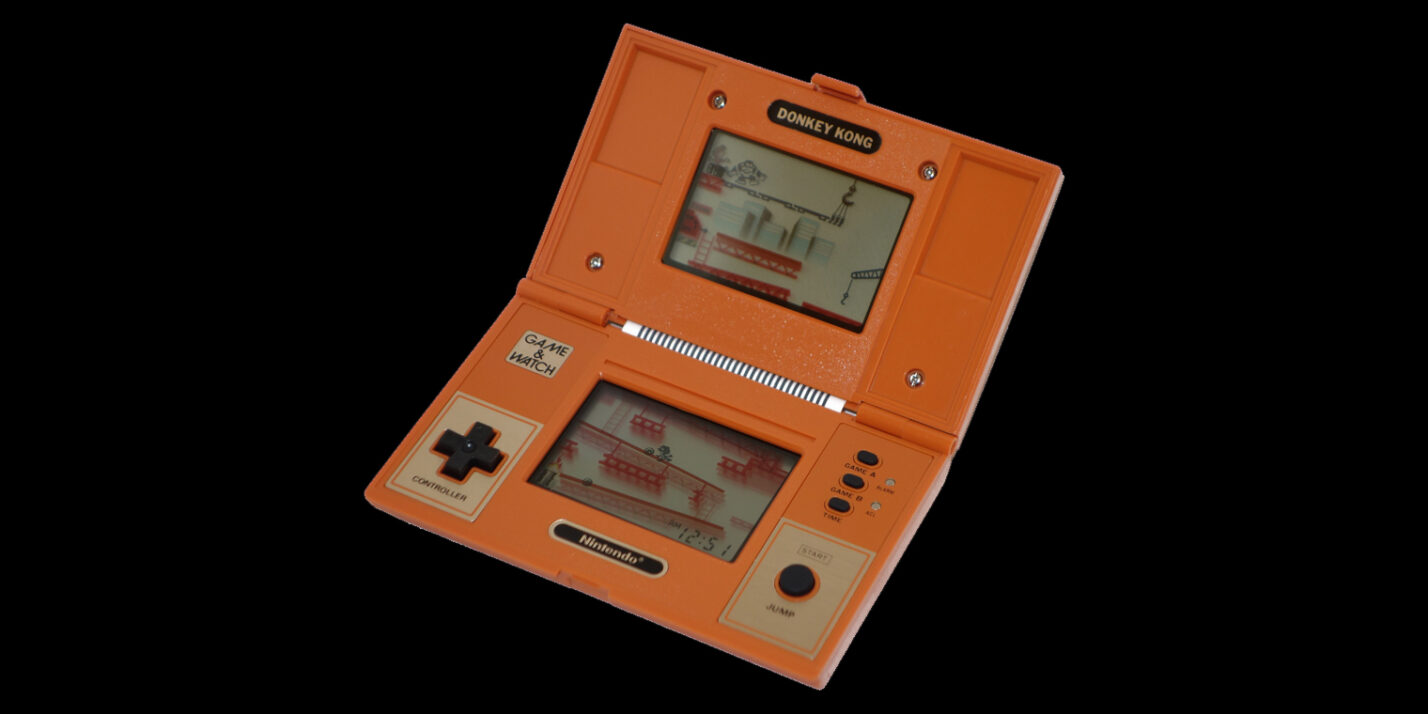
One day I went to school and some kid had the branded Donkey Kong Game & Watch and I remember being really jealous of that product. It was a step up from the Spectrum, like on another level. And the way people were crowding around it and addicted to it, and you could just put it in your pocket. I was like, Jesus. It was almost like professional jealousy, because of my family that was my brand.
That was just an amazing product. Just the whole color of it – orange, and the feel and the tactility of it – it can just snap it back shut. It was really incredible, and it only inspired my memory of that because you mentioned it. I never actually told anyone that story before.
And that was thanks to your dad bringing things home for work, right?
My dad was an industrial designer. So my dad styled products. He’d styled a lot of Clive’s early stuff. Given Clive his sort of very slick design, futuristic kind of minimal design. Clive did all the engineering and hardware and my dad did the styling.
Companies like Nintendo, Sony, Casio, all used to test market. Like if they wanted to try out new products and not necessarily try out their own market, or they would try out their own market but didn’t want to launch in the US or Europe, they’d test market it in Hong Kong. So you get products like Sony products that never came out anywhere else in the world.
My dad would come back with these products. He would have all these amazing things that we would look through that wasn’t necessarily electronics, could have been anything, it could have been a beautifully designed telephone or anything like that. And that was incredible to see all that stuff.
I remember he came back in 1980 with a cordless phone I’d never seen before and we took it apart. Normally I wasn’t allowed as a kid to take things apart but I remember that was the first time. I think Clive used to encourage it with his kids. His house would be full of stuff to take apart like microwave ovens, big old mechanical calculators, anything you might imagine.
So how much did this older tech influence the design of GamerCard?
With this product I didn’t set out to do a retro design at all. I’m interested in the fact that it ended up looking a bit retro, people do associate it as retro really by chance I think.
Do you foresee that ultimately helping with selling it, if people consider it like a retro-styled thing?
Well I think people do see GamerCard as a completely new look and all the comments are all, that looks cool. So I think they see it as a retro-futuristic, as a futuristic take on a classic concept.
I’d like to ask you about, if it’s okay – following this thread of retro making a comeback, that kind of thing – we’re seeing Peri Fractic taking over Commodore, and of course other people are doing a version of the Spectrum.
Are you involved with those people or would you like to be involved with them, or is there anyone else like that that you’d be interested in partnering with?
What I’m doing is completely new. There’s obviously a crossover there because people see Sinclair on a product. It’s got my name, you know, I use Grant Sinclair as my brand and people see the association so I obviously get lots of traction from the Sinclair, whatever you want to call it, dynasty or whatever.
But I’m not interested in doing a Spectrum clone. I could have a whole business doing endless products like that. It just doesn’t interest me because I’m trying to do my own thing.
I’m interested in the future. GamerCard is inspired by not just Clive’s computers, his calculators, his radios, his hi-fi, his TV, but also my father’s designs, some of the stuff he’s done for intelligent game computers.
So in terms of building out this ecosystem, can or do you see yourself branching out into other gaming related stuff, or will you try other things like you’ve done with the eTrike?
I have lots of other hardware in development. And one of them, which is particularly radical and everyone I showed it to was blown away by, I put it on hold because we had all the component shortages that came out of lockdown and it was very hardware intensive, the products that I’ve got in my catalog.
So with the GamerCard, it was really back to the drawing board. I was stuck in lockdown. I wanted to put together a really neat product using stuff that I could get out quickly and that was more readily available. So I tried to keep the component count as low as possible.
Also I wanted to keep the cost as low as possible. It’s still a fairly high price point product, because I’d seen really low cost sort of £20, £30 products sold in places like Argos, and I thought, if you’re going to do a grab and go product, it’s got to be significantly better than the cheap Chinese game consoles that have a thousand games on.
It didn’t interest me to design something which is just disposable. I wanted something that you can not only game on, but you can also install new stuff; it’s got a quick connector on the side so you can mod it. You can solder on a board and plug it in.
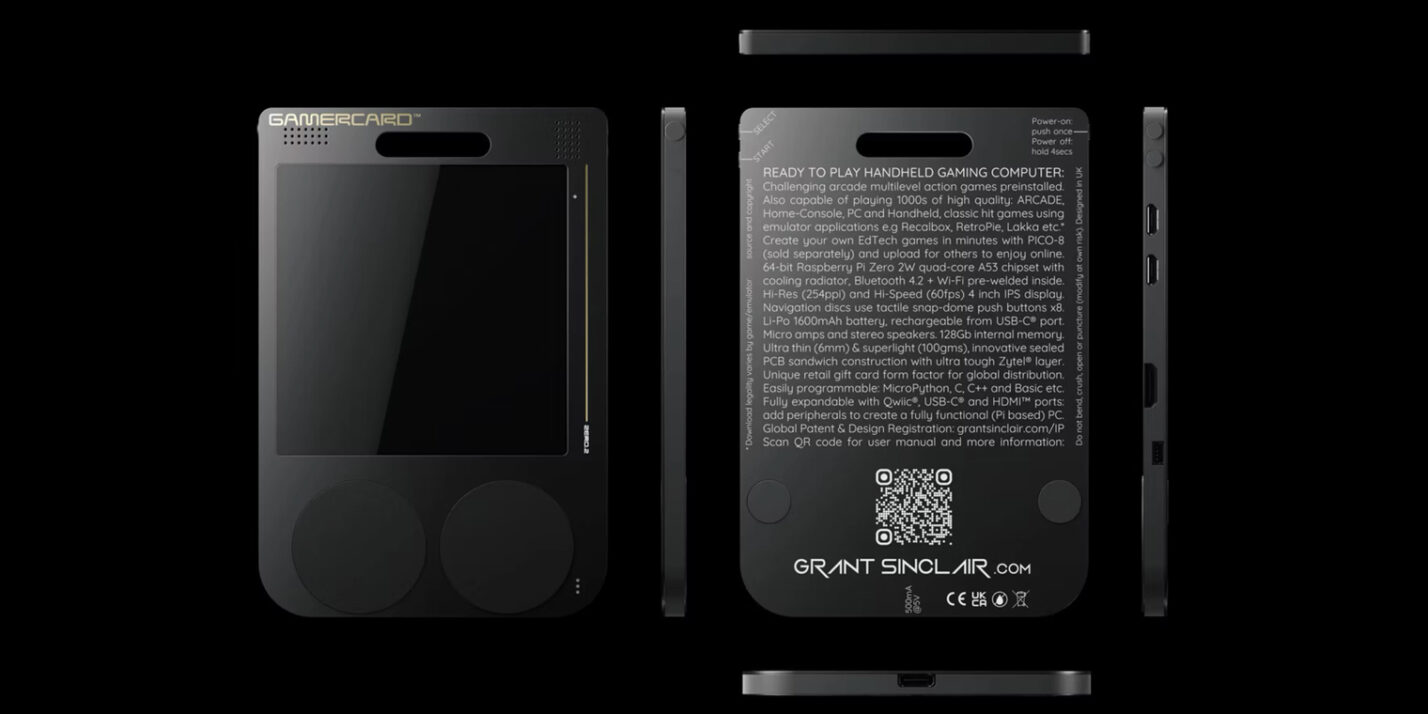
I noticed some schools have quite good budgets for buying kit. They buy Arduinos and Raspberry Pis and stuff, but they get used for one project then stuck in a box and never used again. I wanted to make it so you could break out GamerCard, do your customizing, turn it to a bird cam, or whatever you want to do. And when that’s finished, you can unplug it and start a new project.
And also, part of the pull for me was using Raspberry Pi, suddenly you hook into an ecosystem, a Raspberry Pi ecosystem, which has over 70 million users. So there’s an evolution of lots of stuff, but yeah, partly inspired by my family stuff, but also equally inspired by Nintendo and Game & Watch and all sorts of other products.
Aside from Game & Watch, I actually had a few friends with Spectrums, but a lot of my friends had C64s. So I’d go around to various friends’ and basically, most of us ended up having something a little different to each other. So when we were in each other’s houses, we got to play with other technology.
Yeah, that was quite funny. The most exciting childhood memory was because of Spectrum, people used to take them apart a lot. I especially used to take them apart and look inside. You could quite easily damage your ribbon cables, which I did.
Eventually I told my mother that I damaged the cable, so we went into the Sinclair lab and it was tiny. It was like four people working in it. There weren’t any commercial games available for Spectrum at this time, but one of the lab guys had got an Atari joystick rigged up to the Spectrum and they were moving around a little sprite.
Me and my friend had a go on this Atari joystick and it was the most exciting thing I’ve ever known. And that guy who demoed us the stuff is now – I looked him up fairly recently – he’s at NVIDIA and he’s like the director of AI at the moment.
That’s amazing. Clive and your dad had a lot of really good ideas that were definitely ahead of their time, certainly very innovative. And of course, some stuff stalls because people for some reason are not ready for it, or they don’t seem to realise there’s a need for it, or they’ve never used it so they don’t think they would use it even though it then, in 10 years maybe, becomes a super common thing.
I know it’s an extremely broad question, but where do you see technology heading?
What Clive was always trying to do is get everything on one chip. And that’s the way it’s all going now anyway, because hardware has become very very bloated. I’m amazed the engineers get away with it really. I read that Microsoft invested $100 million in designing the Xbox One controller, which looks hugely complicated.
I mean, I’ve spent my whole life taking things apart. When I designed the GamerCard, I tried to go back to basics, keep it as simple as possible. And that’s what the future will be. So that’s my prediction. There’s nothing new there. Clive was doing it 40 years ago. That’s the way it’s all going.
Grant Sinclair’s GamerCard is currently available from his site.